Thanks, John.
18.02.2026 13:32
👍 0
🔁 0
💬 0
📌 0

@inneskeighren
Professor of Historical Geography at Royal Holloway, University of London. Co-convenor of the London Group of Historical Geographers. Writing a book on the global lives of William Macintosh (1737–1813). www.inneskeighren.com
Thanks, John.

Portrait of Jacques-Pierre Brissot (c. 1790), by François Bonneville. Musée Carnavalet, Histoire de Paris (P2608).
New blog post: "Jacque-Pierre Brissot in the Sponging House" inneskeighren.com/williammacin... #C18
Terrific. Thank you!
![Cutting from The St. James's Chronicle; or, The British Evening-Post, no. 137 (11–14 June 1768), [3].](https://cdn.bsky.app/img/feed_thumbnail/plain/did:plc:wcu4e3v45agqytvhfjk2od4d/bafkreialefmtrrkgtp5y6vskwp6chhppha2a36i5yyoz5jpakdg6bwhmzy@jpeg)
Cutting from The St. James's Chronicle; or, The British Evening-Post, no. 137 (11–14 June 1768), [3].
Are any historians of #C18 London familiar with Thomas Phillips' lock-up house on Gray's Inn Lane? Although Phillips died in 1770, I believe this is where Jacques-Pierre Brissot was briefly imprisoned in 1784. I would love to know more about it. Thank you kindly!

Portrait of Johann Wolfgang von Goethe, by Joseph Karl Stieler (1828). © Bayerische Staatsgemäldesammlungen – Neue Pinakothek, WAF 1048.
New blog post: "Macintosh, Washington, and Goethe's birthday present" inneskeighren.com/williammacin...
Thanks for the assistance; they are "tous" and "frais" respectively.
Thanks. Having checked another source, it looks like it's frais after all.
After struggling with this all morning, it turns out that a transcription already exists in Claude Perroud's edition of Brissot's correspondence (1912). You and Perroud are in agreement: "tous" and "frais".
![J'y ai quelque titre 1°. par tous les ouvrages que j'ai publiés, [????] écrits dans la vue d’être utile 2°. par le tableau que j'ai publié de la situation des anglois dans Les Indes Orientales, ouvrage qui a exigé des rechercher prodigieus et entrainé beaucoup de [frais?].](https://cdn.bsky.app/img/feed_thumbnail/plain/did:plc:wcu4e3v45agqytvhfjk2od4d/bafkreiebhfiqjcjiud5n2sy4zvwmounkfqylgifyabslljgzpde23lbl4y@jpeg)
J'y ai quelque titre 1°. par tous les ouvrages que j'ai publiés, [????] écrits dans la vue d’être utile 2°. par le tableau que j'ai publié de la situation des anglois dans Les Indes Orientales, ouvrage qui a exigé des rechercher prodigieus et entrainé beaucoup de [frais?].
I am, once again, asking for your palaeographical support (especially from #C18 Francophone friends). Any thoughts on the two words underlined in yellow? Merci!
When Aaron Burr met Macintosh in Eisenach in 1810, they discussed this letter. Burr recorded it in his journal as being "now in the museum at Weimar." The "museum" was, I suspect, Goethe's home on Frauenplan. I believe Macintosh came to know Goethe via the Strieber family. As ever, more to uncover!
If you search for "talis" plus the name of the book, it should be possible to see if it appears on reading lists (at least for institutions that use Talis). Similarly searching for "syllabus" plus the book name can reveal its presence in North American teaching.
The word "museum" was probably an overstatement on Burr's part, but it captures the fact that a good portion of Goethe's home was given over to the storage and display of his collections. A sort of Wunderkammer-cum-salon.
I think I've resolved this to my satisfaction (sometimes asking the question is enough). The letter from George Washington was gifted to Goethe by my subject (William Macintosh) and added to his collection of autographs. Burr, who visited Goethe's home in January 1810, likely saw it there.
A renewed plea to scholars of Goethe / the #C18: would "the museum at Weimar" have been understood in 1810 to be Goethe's home? Danke schön!

A sketch portrait of Luise von Göchhausen (c. 1780) by Johann Wolfgang von Goethe.
New blog post: "Where were the women?" inneskeighren.com/williammacin...

Extract from "Dictionnaire Historique des Rues de Marseille" (2001).

Plan routier de la ville et faubourg de Marseille (1808). https://gallica.bnf.fr/ark:/12148/btv1b53029736h
It turns out that there were two Places des Carmes! One still exists; the other disappeared after the Revolution. Given the proximity of the former one to the "Salle de Spectacle", I suspect this is where the hotel was located (or in one of the adjoining streets).

Plan routier de la ville et faubourg de Marseille (1808). https://gallica.bnf.fr/ark:/12148/btv1b53029736h

Google Maps aerial view of Place des Grands Carmes.
Thanks for the suggestion. The streetscape in this part of the city has clearly changed quite a lot since the 1780s, especially with the construction of the Rue de la République, but I think the Place has survived (albeit as a car park).
Merci ! Les archives municipales possèdent une liste d'annuaires que j'ai consultée (archives.marseille.fr/n/indicateur...), mais sans succès jusqu'à présent. Je garde espoir !
Thanks for the tip, Aurélie. I'll check it out next week.

Fragment of an 1780s advertisement for a hotel in Marseille. The text reads: HÔTEL DE- AND GREAT B- PLACE DES CARMES AT MARSEIL- Keeped by the Widow B- THAT Hôtel establis h'd since ma- the centre of the town, its posi- agreable, and near the new Play Office, and Walkings places. The Ge- find there all the commodities possible, h'd and the best Wines, and Tea of
For those (especially scholars of 18th-century France) who might enjoy a productive distraction, any thoughts on the identity of this hotel (which has so far escaped my sleuthing)? It was located, I presume, on the Place des Carmes in Marseille in the mid 1780s. Merci! #18C
Yes, I think that's right. The spelling elsewhere is a bit wobbly too.
!["...a preliminary condition requisite for admission, viz: of my being initiated in the Roman Catholic religion your word which you pledged to Mr. Plovits that your perfect consent should go hand in hand with my wishes in that point procured me a temporary [???] prudence will not allow zeal to go father; an unlimited admission is a [???] reserved for a line or two from you, authorising superiors to second my earnest wishes. I am sure..." Letter from Brussels, 12 July 1783.](https://cdn.bsky.app/img/feed_thumbnail/plain/did:plc:wcu4e3v45agqytvhfjk2od4d/bafkreigzznzpfrjykhikjygqeb635i6atad62fdjs7w5qqklmvevrxacw4@jpeg)
"...a preliminary condition requisite for admission, viz: of my being initiated in the Roman Catholic religion your word which you pledged to Mr. Plovits that your perfect consent should go hand in hand with my wishes in that point procured me a temporary [???] prudence will not allow zeal to go father; an unlimited admission is a [???] reserved for a line or two from you, authorising superiors to second my earnest wishes. I am sure..." Letter from Brussels, 12 July 1783.
For those who could use a palaeographical distraction: any thoughts on the words underlined in yellow? My initial transcription is in the image description. Thank you kindly! #C18
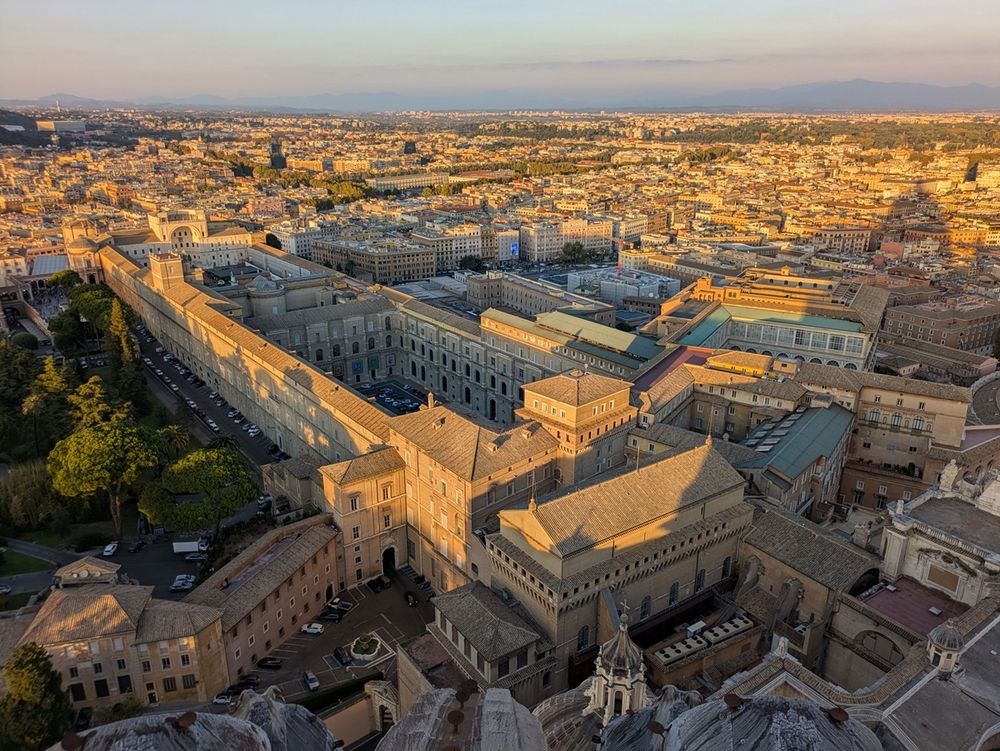
A view from above of part of Vatican City and Rome at sunset, showing in particular a large building, the Cortile del Belvedere.
New blog post: "Macintosh in the Eternal City" (or some hints on using archives in Vatican City and Rome). inneskeighren.com/williammacin... #C18

A cup of coffee on a slatted wooden table in a room whose stone walls are the ruins of a fountain.
A modest proposal: the price of coffee in all archives and libraries to be pegged to that of Bar B.A.V. (shared between the Archivo Apostolico and the Bibliotheca Apostolica in Vatican City). €1.30 for a cappuccino.

Merci! It looks like we have a possible match:

Three anglophone renditions of the name of the unknown sender.
The anglophone recipient of the letters, wrote the sender's name like this (which seems to be Molnat or Mollnat") but also doesn't seem to match the signature very closely.

@inneskeighren.bsky.social reviews ‘Sector 2: Nicosia,’ at the Leventis Municipal Museum of Nicosia: doi.org/10.1016/j.jhg.2025.04.005
(Vol. 89)
29/42

Two signatures at the bottom of handwritten letters in French.
Dear Francophone palaeographic hive mind, any thoughts on the signature here? Possibly a Parisian banker or lawyer in 1781. Merci beaucoup!

A hand-coloured, nineteenth-century lithograph of an engraving by Johann Peter Hasenclever entitled "Weinverkoster in einem Keller".
Registration for our hybrid autumn seminar programme—"Bad Habits"—is now live! Full details and registration links here: eepurl.com/jnswZs
The mystery deepens...