
People are angry that the performance of these systems that are being shoved down our throats are suboptimal, despite what the execs say. People don’t like to be lied to.
25.05.2025 15:17
👍 0
🔁 0
💬 0
📌 0
People are angry that the performance of these systems that are being shoved down our throats are suboptimal, despite what the execs say. People don’t like to be lied to.
Working on a grant and this factoid in my significance section is blowing my mind:
Forty four percent of all Americans receive at least some health insurance via a government supported individual choice health insurance market.
#HealthPolicy

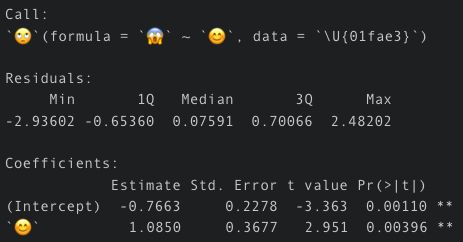
I'm just saying this is syntatically correct #rstats code
officeverse by David Gohel
#RStats
https://bigbookofr.com/chapters/packages.html#officeverse

⭐Tomorrow, Vanessa Didelez will present "Statistical Methods for Causal Inference with Time-to-Event Data in Epidemiology" at @bemcolloquium.bsky.social!
🗓️ Wed. Jan. 8
🕔 16:00 Berlin time (CET)
📍 Zoom webinar
Abstract + webinar sign up link: bemcolloquium.com/meetings-cal...
#EpiSky #CausalSky


When awesome packages come together 💥
#rstats
Because 2025 = 45² and 45 is a triangle number, we get these lovely sums:
2025 = (1 + 2 + 3 + 4 + 5 + 6 + 7 + 8 + 9)²
2025 = 1³ + 2³ + 3³ + 4³ + 5³ + 6³ + 7³ + 8³ + 9³
Pleasingly the next triangle number 55 is 10 more, so get ready for a repeat of this fact in the year 3025.
This is an interesting take and I’ve had similar thoughts. I don’t think our human brains organize data into spreadsheets with neat columns and rows. Perhaps we should emulate that. Our so-called unstructured databases actually have a lot of structure.
I was surprised how much more I knew about health policy compared to FACULTY when I was a professor in a department of surgery.
All I want for Christmas is uuuuuniversally unique identifiers instead of incrementing integers!
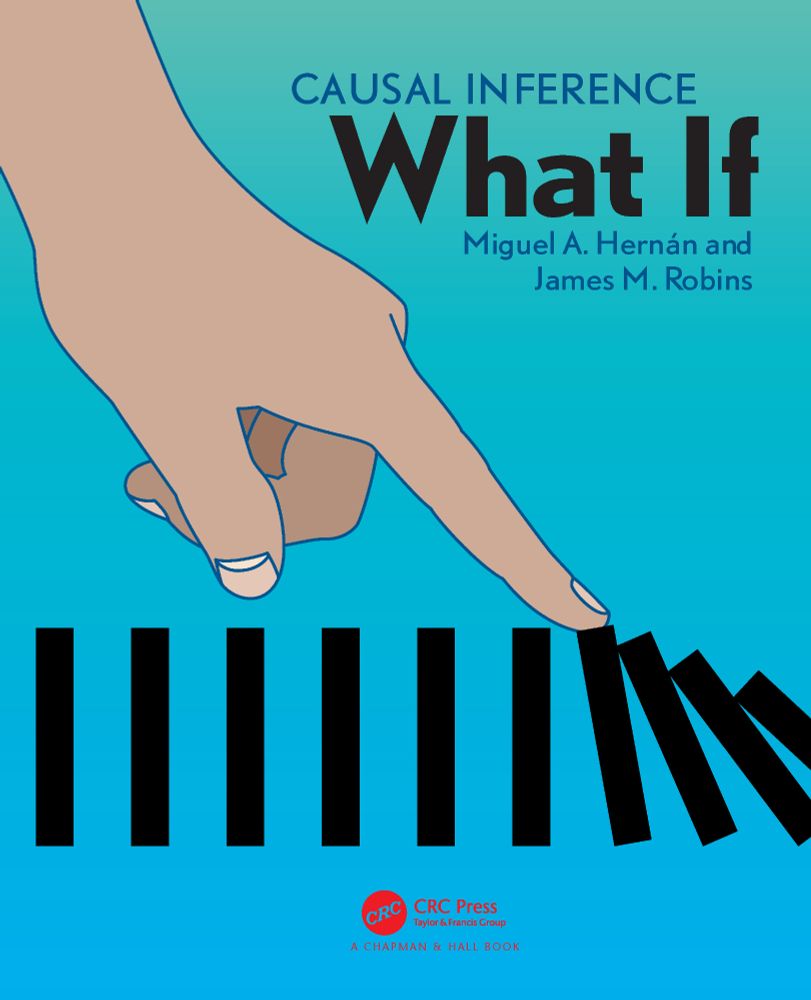
Upgrade your #causalinference arsenal.
A revision of our book "Causal Inference: What If" is available at miguelhernan.org/whatifbook
Thanks to everyone who suggested improvements, reported typos, and proposed new citations and material.
Enjoy the #WhatIfBook plus code and data. Also, it's free.

Excellent post about the recent OpenAI o3 results on ARC (& other benchmarks). I don't know how @natolambert.bsky.social manages to write these so quickly! I highly recommend his newsletter.
www.interconnects.ai/p/openais-o3...
I am (more slowly) writing my own take on all this, coming soon.

I was today years old when I found this gem of a web app to explore 2500+ color palettes for R:
r-graph-gallery.com/color-palett...
The future ain’t what it used to be
Yes can be built into the design and often related to a flawed research question or ambiguous estimand. I guess a better term is over/under *conditioning* on variables
Yea they’re distinct concepts in my my book, but perhaps related under the umbrella of issues with over or under adjusting for variables.
Very often especially in clinical epi settings.
Anything related to COVID policies*. The causal effect of COVID itself is apparent and doesn’t need data analysis.
R #statsky are we using the magrittr pipe (%>%) or the base pipe (|>) in most cases these days? I've been away from R for a while, and I'm curious where things have trended.
Never heard of that terminology. I do not endorse it


Estimating conditional means when y ≥ 0:
(1) Poisson regression
(2) OLS using log(y + 1)
(3) negative binomial regression
(4) Bayesian zero-inflated negative binomial regression
When you say “flexible model” do you mean Poisson?
Those who used to follow me on Twitter know that I tediously made the distinction between a model and an estimation method. In one thread, I considered regressions in a treatment effect context:
Y on 1, D, X
Y on 1, D, X, D*(X - Xbar)
It is common to refer to the first as "OLS."
So what is their biggest challenge?
Nay unless you convince me otherwise.

I am a VERY compulsive saver! I can't help it!


Just pushed a Christmas update to {ggblanket}. I decided to support colour blending. It uses {ggblend} under the hood (thanks @mjskay.com), which uses graphics features developed by Paul Murrell. Give {ggblanket} and {ggblend} a star, if you find them useful. Oh, and have a merry Christmas #rstats

Image for the 2025 IBS Distinguished Lecture Series "Ethical AI is More than Loss Functions" on January 30, 2025 at 2pm Eastern. Includes headshot and titles for Sherri Rose, Professor of Health Policy and Director of Health Policy Data Science Lab at Stanford University.
Join me virtually next month for the International Biometric Society Distinguished Lecture on January 30!
“Ethical AI is More than Loss Functions"
www.biometricsociety.org/education/dls
Sorry that’s what I meant. The most impactful and innovative academic and scientific ventures often requires novel data collection. Think about laboratory data. Can AI collect that data?
Doesn’t work for fields in which you actually need to use a real dataset