As we discuss in the piece, workers are trying to work more hours; employers aren't giving them the hours they seek.
05.01.2026 18:38
👍 2
🔁 0
💬 1
📌 0
Very helpful framing, thank you!!
05.01.2026 16:16
👍 2
🔁 0
💬 0
📌 0
New with @agpines.bsky.social: on Can We Still Govern, we show how OBBBA's new work requirements will deny benefits to families due to volatile hours and employment in the service industry--which is caused by bosses, not workers
05.01.2026 16:13
👍 28
🔁 13
💬 0
📌 0
Going to die on the hill (sorry, @bcdreyer.social) that we should call this BS red tape a “Job Loss Penalty,” as @matthewcort.land suggests.
05.01.2026 14:30
👍 64
🔁 36
💬 3
📌 2
This is also why states will struggle to reduce their SNAP error rates (no, washington post, it's not fraud). Eligibility and benefit determination is already *really* complicated. States will lose ~$160 billion in SNAP funding b/c of the complexity--not because of fraud.
05.01.2026 14:41
👍 88
🔁 30
💬 2
📌 2
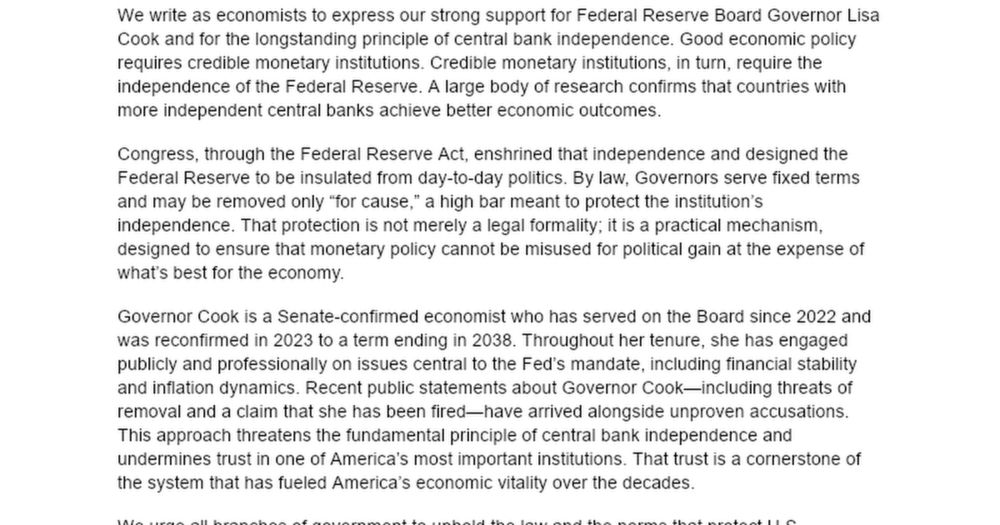
Open letter
Click here to add your signature. An Open Letter from Economists in Support of Governor Lisa Cook and Federal Reserve Independence To the President, Members of Congress, and the American public: We wr...
Update: we are at 379 signatures in support of Lisa Cook and Fed independence!
The letter be open for signatures through Sun. (Link to sign at the top).
If you are on X or listservs, please spread the word there!
docs.google.com/document/d/1...
29.08.2025 13:22
👍 45
🔁 24
💬 1
📌 3
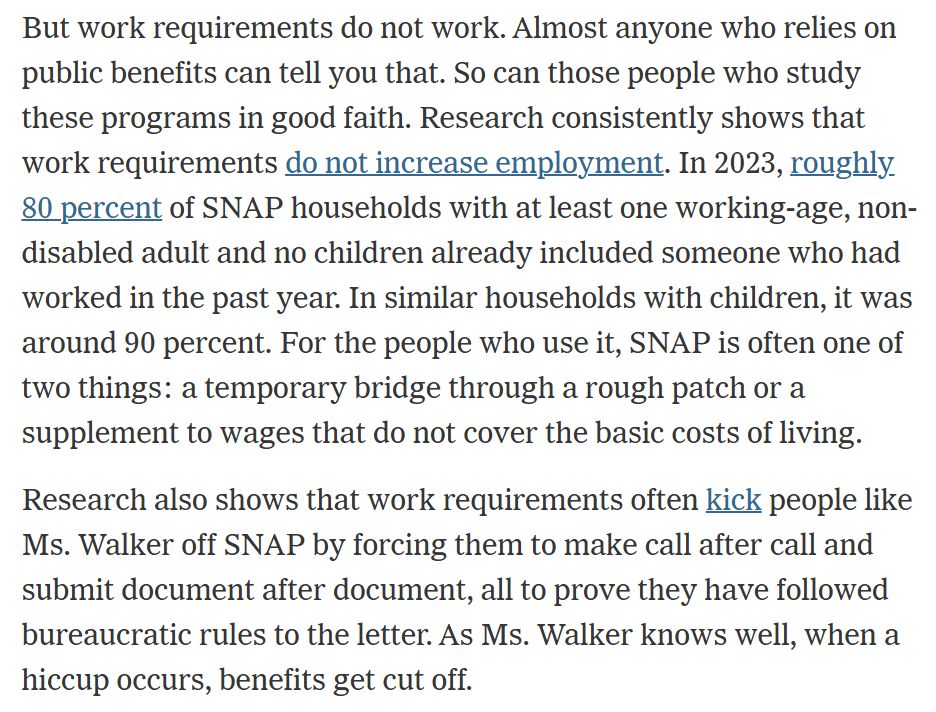
@tmmcmillan.bsky.social has a new must-read piece on SNAP and work requirements. While her characterization of the evidence is both accurate and awesome, her story and the stories of other participants matter more. Let's all act in good faith.
Gift article:
www.nytimes.com/2025/06/10/o...
10.06.2025 15:23
👍 11
🔁 7
💬 0
📌 0
Watch me scramble in real time as I try to find the economic angle on the Musk-Trump tiff.
(I think I found one, and the issues it highlights are terrifyingly important.)
05.06.2025 19:36
👍 869
🔁 232
💬 28
📌 20
Seems like if we want to increase a culture of work etc etc, this might be more promising than taking food benefits away from 60 year olds or parents of 9 year olds. Of course funding things like this wouldn’t open up budgetary space for tax cuts for rich people.
03.06.2025 18:27
👍 47
🔁 13
💬 1
📌 0
SNAP work requirements have biggest effect on those least able to work
Most people pushed out of SNAP in Connecticut didn’t find their way back in, even when work requirements were later reversed.
Ok folks, we know work requirements reduce benefits without increasing work (cc: @chloeneast.bsky.social)
But who loses benefits and what happens if work requirements are reversed?
New evidence from linked SNAP-Medicaid data and a natural experiment in CT tell a concerning story...
Thread below 👇
02.06.2025 14:07
👍 175
🔁 105
💬 4
📌 8
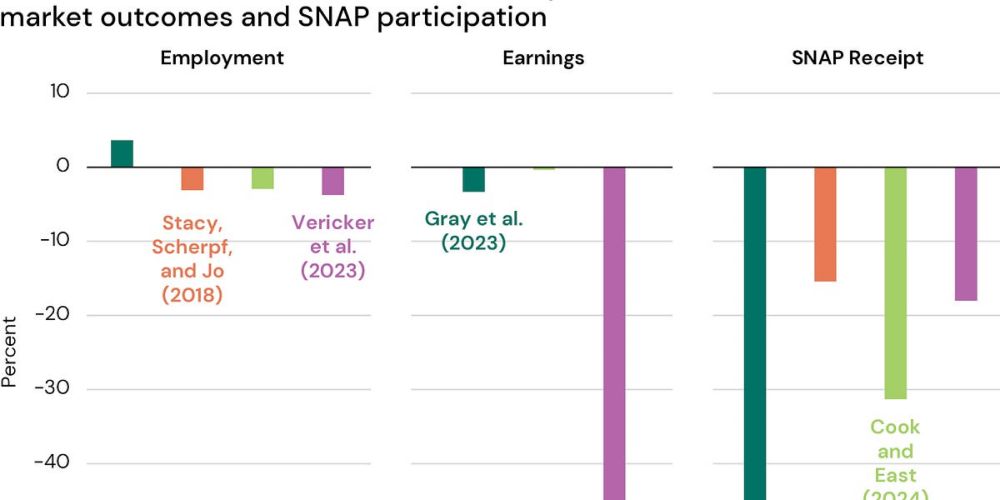
What AEI Gets Wrong about SNAP Work Requirements
They cited my research, so let me respond!
New from @chloeneast.bsky.social at Can We Still Govern:
AEI cited her work to make the case for SNAP work requirements. Chloe explains that her and other research show that work requirements reduce SNAP access while doing nothing for employment outcomes.
donmoynihan.substack.com/p/what-aei-g...
30.05.2025 12:33
👍 360
🔁 128
💬 11
📌 13
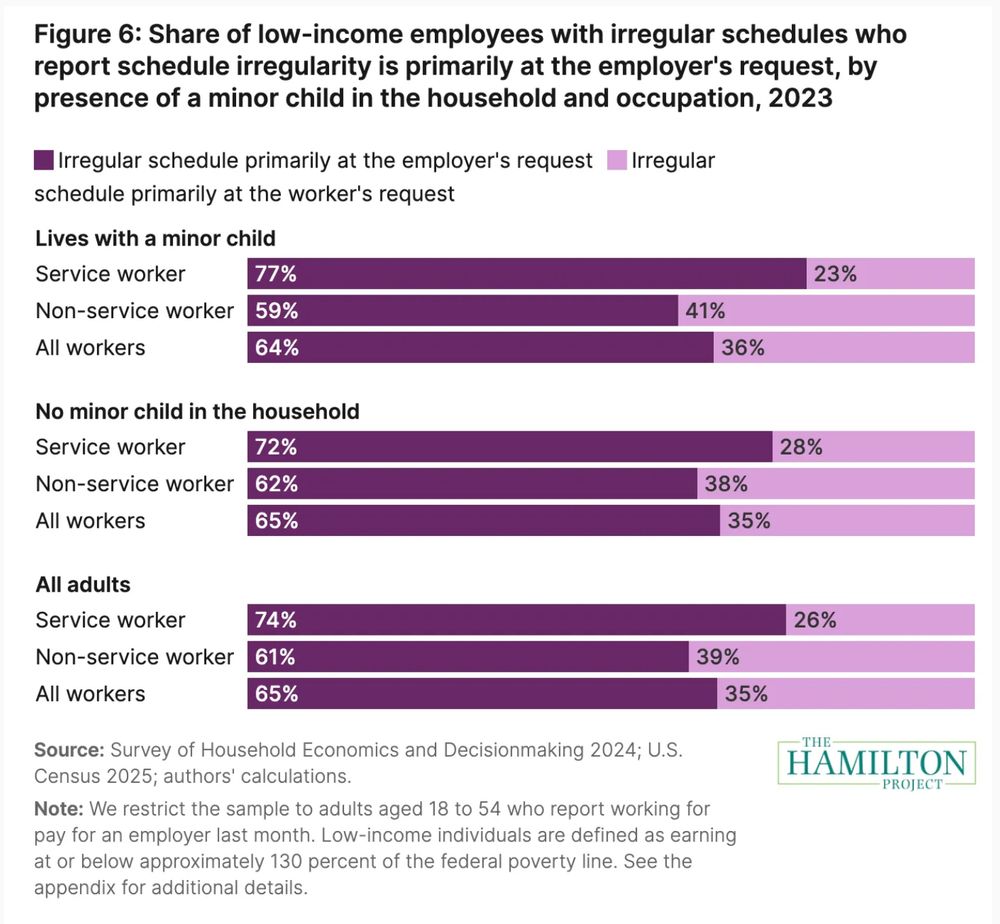
chart showing that service workers have more irregular hours inconsistent with work reporting requirements
The recurring theme of work requirements is that they hurt people who are working or looking for work.
Worse, the requirements make it impossible for some workers, such as those in the service sector with irregular hours. From @lizananat.bsky.social www.hamiltonproject.org/publication/...
30.05.2025 15:11
👍 51
🔁 15
💬 1
📌 1
I respond to AEI’s mischaracterization of three of my papers
AND
discuss the clear evidence that work requirements don’t increase work, but do reduce food assistance for households that need it.
30.05.2025 15:01
👍 149
🔁 56
💬 5
📌 2


Who do work requirements penalize? @lizananat.bsky.social, @agpines.bsky.social, and Olivia Howard offer findings on low-income service sector workers whose unpredictable work hours are largely driven by their employers and not by choice. www.brookings.edu/articles/wor...
28.05.2025 14:15
👍 7
🔁 5
💬 0
📌 0
As @lizananat.bsky.social shows here, work requirements are unrelated to the jobs poor families depend on to survive. The result: one third of eligible service workers would get kicked off of programs with work requirements because of high volatility in the number of hours worked in service jobs.
27.05.2025 17:11
👍 9
🔁 4
💬 0
📌 0
Critical point: The legislation is designed to kick people off Medicaid because it ignores the reality that low-wage jobs have highly variable hours--and they can't control that.
27.05.2025 14:38
👍 178
🔁 82
💬 6
📌 4
Work requirements will trip some people up because they struggle with paperwork, but will by design hurt other people who work a lot but have unstable hours (thread)
27.05.2025 15:16
👍 205
🔁 73
💬 7
📌 3

Combined, these sources of volatility mean that nearly 1 in 3 service workers in households with children *who meet or exceed 80 work hours/month* over the course of the year would fall short of the work requirement in at least one month–and get kicked off basic needs programs: 8/8
27.05.2025 14:06
👍 49
🔁 18
💬 4
📌 2

Turnover is also high in the service sector–and the bill does not allow work search by those between jobs to count as work effort: 7/n
27.05.2025 14:05
👍 47
🔁 7
💬 1
📌 0

This volatility means that even someone who works on average throughout the year at well above the 80 hours/month required by the law is highly likely to have a “short” month and get kicked off basic needs programs: 6/n
27.05.2025 14:04
👍 52
🔁 13
💬 2
📌 0

That’s despite how hard it is to raise a family on this type of work. Hours fluctuate enormously in these jobs–driven overwhelmingly by employers’ focus on meeting fluctuating customer demand with the lowest possible labor costs, not by workers’ preferences: 5/n
27.05.2025 14:03
👍 38
🔁 9
💬 1
📌 0

And those aren’t just casual jobs held by young men who spend the rest of their time “playing video games”--in fact, service work has become more common for low-income families with school-age children than for any other group. 4/n
27.05.2025 14:01
👍 49
🔁 9
💬 1
📌 0
That’s bc Congress fails to understand low-wage work today: The bill is designed as if low-wage workers are still pulling fixed shifts at a factory &should just sign up for more shifts–but in reality, low-wage workers are increasingly in jobs in the service sector (retail, food service, health) 3/n
27.05.2025 13:55
👍 49
🔁 8
💬 1
📌 0
New research from me&@agpines.bsky.social
Congress is pushing work requirements for Medicaid&SNAP. You’ve heard these kick eligible folks off (@pamherd.bsky.social @donmoyn.bsky.social), don't increase work&cause hunger (@laurenhlb.bsky.social @chloeneast.bsky.social). But wait there's more! 1/n
27.05.2025 13:51
👍 65
🔁 31
💬 5
📌 8
#priorities
It really is just that simple.
23.05.2025 13:42
👍 45
🔁 9
💬 1
📌 0


