Tip for students contacting potential advisors about graduate school in paleontology - probably not a great idea to tell me that you'd rather do dinosaurs but my "boring" plant fossils are ok I guess and that you probably wouldn't get bored or uninterested in your first email to me.
09.01.2026 21:49
👍 3
🔁 1
💬 1
📌 0

My student, Evan Cerna presenting at #2025SVP on a new Cretaceous dinosaur trackway in the Glen Rose Formation in central Texas!
12.11.2025 23:38
👍 11
🔁 2
💬 0
📌 0

Were Dinos On Their Way Out Before The Asteroid Hit? Maybe Not
Two new studies suggest that, contrary to longstanding beliefs, dinosaurs were not on the decline before the Chicxulub asteroid impact.
What do we know about the last surviving dinosaurs, living right before the asteroid? And is Nanotyrannus a tiny tyrannosaur species or juvenile T. rex?
Lindsay Zanno & I talk through the big questions with Ira Flatow on today's @scifri.bsky.social !
www.sciencefriday.com/segments/din...
07.11.2025 17:38
👍 52
🔁 15
💬 0
📌 0
Had the pleasure of working on the press release image for this groundbreaking research!
23.10.2025 19:38
👍 1010
🔁 245
💬 15
📌 6

New evidence reveals dinosaurs were thriving right up to the moment the asteroid hit
Newly dated fossils from New Mexico challenge the idea that dinosaurs were in decline—and suggest instead they had formed flourishing communities.
New dates on fossils from New Mexico reveal a community of dinosaurs that were thriving right before the asteroid strike, including 80-foot-long, 30-ton giants like Alamosaurus. I’ll tell you more in my latest for NatGeo. 🧪
23.10.2025 18:14
👍 197
🔁 48
💬 7
📌 3
Not even here is safe from Leafs jokes...
23.10.2025 18:59
👍 3
🔁 0
💬 2
📌 0

This work not have been possible without the generous support of NSF-EAR, @acs.org PRF, Bureau of Land Management, and @baylor.bsky.social
23.10.2025 18:09
👍 5
🔁 0
💬 0
📌 0

This has been truly collaborative study. I am grateful to @stevebrusatte.bsky.social, @danpeppe.bsky.social, Matt Heizler for co-leading this study, to all my co-authors for their hard work, and @nataliajagielska.bsky.social for her awesome artwork.
23.10.2025 18:09
👍 7
🔁 0
💬 1
📌 0

Lastly, this N-S bioprovincialism persists after the mass extinction and is seen in early Paleocene mammalian communities suggesting that the biogeographic structure was not destroyed by the mass extinction event.
23.10.2025 18:09
👍 2
🔁 1
💬 1
📌 0

We then used ecological modeling to show dinosaur communities were partitioned into two different bioprovinces during the terminal Cretaceous across western North America, driven by differences in climate. This suggests dinosaurs in North America diverse & thriving leading up to the K/Pg boundary.
23.10.2025 18:09
👍 2
🔁 1
💬 1
📌 0

This Naashoibito dinosaur community was dominated by the giant sauropod Alamosaurus and crested Lambeosaurine hadrosaurs, which is a marked difference than the coeval Hell Creek Formation.
23.10.2025 18:09
👍 2
🔁 1
💬 1
📌 0

Four panel figure. Panel A shows map of western north ameria indicating major Laramide basins and hightlight the study area in the San Juan Basin of NW New Mexico. Panel B shows geologic map of the San Juan
Using magnetostratigraphy and Ar/Ar geochronology, we were able to constrain the age of Naashoibito Member deposition, and the major vertebrate fossil localities, to no older than 66.38 Mya.
23.10.2025 18:09
👍 2
🔁 1
💬 1
📌 0
We provide new age constraints on the Naashoibito Member in the San Juan Basin of NW New Mexico showing these rocks, and their unique dinosaurs, are among the last non-avian dinosaurs from the last 340 Kyr of the Cretaceous, contemporaneous with the famous Hell Creek fauna. doi.org/10.1126/scie...
23.10.2025 18:09
👍 2
🔁 1
💬 1
📌 0
Our new paper is out in @science.org #ScienceResearch
Our understanding of the dinosaurs at the very end of the Cretaceous is limited by few localities. What dinosaur biogeographic patterns were present leading up the K/Pg boundary? What can these tell us about end Cretaceous dinosaur communities
23.10.2025 18:09
👍 27
🔁 6
💬 2
📌 0

Something explosive is coming tomorrow...
(Science by Andrew Flynn and team; art by @nataliajagielska.bsky.social )
22.10.2025 16:13
👍 34
🔁 6
💬 0
📌 0

Landscape picture of rocks in the San Juan Basin of northern New Mexico. Lower, drab colored rocks overlain by gold and tan sandstones plus fossilized trees.
Looking for a graduate program in paleobotany, paleoclimatology, and/or terrestiral sedimentology? Attending #GSA2025 next week? Please reach out so we can chat!
Recruiting MS students for Fall 2026 for projects focused on the late Cretaceous - early Paleogene of western North America.
17.10.2025 16:26
👍 12
🔁 6
💬 1
📌 0

Meet the Scientist Digitizing Millions of Fossilized Pollen Grains to Reveal Earth’s Climate History
Smithsonian researcher Ingrid Romero studies fossil pollen to reconstruct ancient climates and predict future changes
Thanks to @smithsonianmag.bsky.social for highlighting the
Fossil Pollen collection at NMNH and the research we are developing with this collection
Meet the Scientist Digitizing Millions of Fossilized Pollen Grains to Reveal Earth’s Climate History - smithsonianmag.com/blogs/nation...
26.09.2025 19:26
👍 2
🔁 1
💬 0
📌 0
Andrew G. Flynn
I am recruiting MS students to join my research group at New Mexico State University starting Fall of 2026! Any students interested in late Cretaceous-early Paleogene fossil plants, terrestrial paleoclimate, Earth surface processes, or magnetostratigraphy, please reach out!
www.andrewgflynn.com
16.09.2025 22:33
👍 6
🔁 5
💬 0
📌 0

Violin plots depicting estimated assimilation rates ranges for nine fossil plant taxa.
Estimating carbon assimilation rates from #fossil #leaves & application to the mid-Miocene Clarkia #forest
New #AJB research by Melanie Cham, Alexander Lowe, Dana Royer, Sophia Ronan, William Rember & Caroline Strömberg
doi.org/10.1002/ajb2...
#botany #plantscience #paleobotany #photosynthesis
11.08.2025 16:32
👍 14
🔁 6
💬 0
📌 1

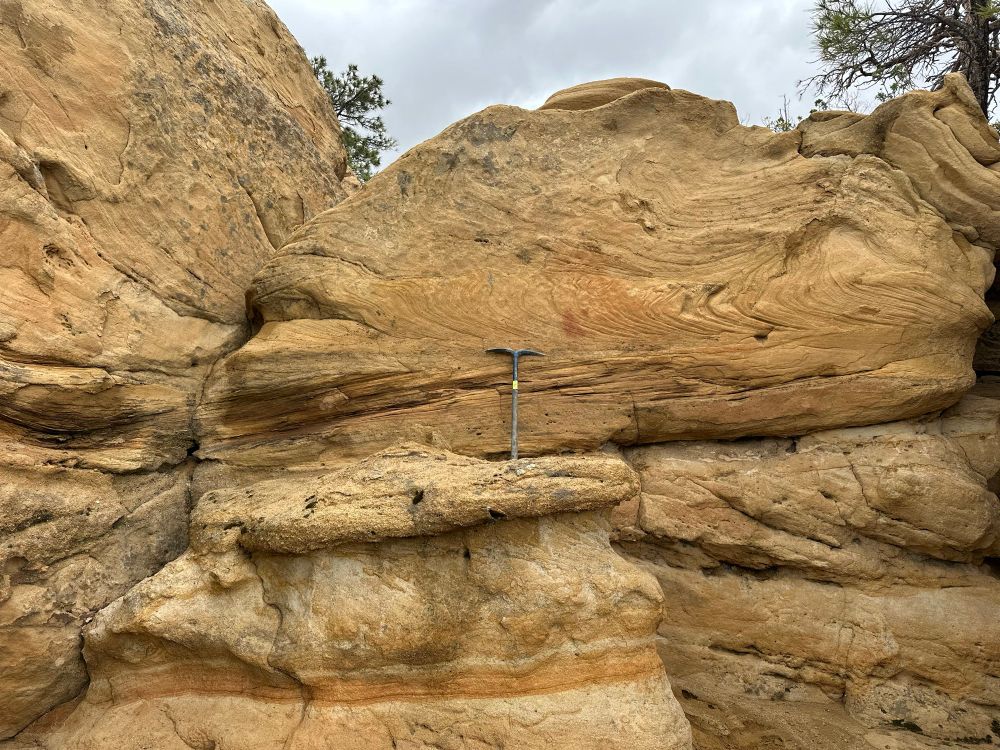
Rainy but productive day collecting Paleocene - Eocene fossil leaves out of the lower San Jose Formation in the San Juan Basin, New Mexico. Also found some super cool soft sediment deformation and sedimentary structures!
02.06.2025 23:30
👍 2
🔁 0
💬 0
📌 0


Day two of collecting earliest Eocene plants from the lower San Jose Formation in the San Juan Basin. Found lots of legumes including some attached!
30.05.2025 23:19
👍 9
🔁 2
💬 0
📌 0