thank you!
06.03.2026 16:03
👍 0
🔁 0
💬 0
📌 0

@hotgpod
A History of the Germans from the Middle Ages to Reunification in weekly 25-35 min #podcast episodes. Famed for its "moderate but not severe biases of the typical contemporary liberal variety" https://historyofthegermans.com/
thank you!

Just in case you had enough of the chaos out there and want to hear how almost a 1000 years ago a boy with a difficult childhood and an elevated sense of self importance found himslef caught in a major societal shift that destroyed his empire and him too..
open.spotify.com/playlist/03z...
I never thought the 15th century would hold us back for so long. And that makes me very worried about the 16th…🤣🤣

Why are the Swiss called the Swiss – and how did the first encounter between the two famous Renaissance forces, the Landsknechte and the Swiss Reisläufer turn out?
New episode just out - wherever you get your podcasts
historyofthegermans.com/2026/03/land...

So sorry - but…
That is my kind of marketing!
Yesterday I finished the latest episode of @patrickwyman.bsky.social Past Lives, and finally there is an new episode from @hotgpod.bsky.social So a good week for the commute to work

Europe's political landscape is shifting - it is all about the balance of power now, and this balance is firmly out of whack.
Maximilian has a Grand Plan that could have nipped centuries of death and destruction in the bud. But…

A "Big Shoutout" to @hotgpod.bsky.social
for this informative, interesting interview with Prof. Hardy!
👌🙏
podcasts.apple.com/de/podcast/h...
I am sorry - the website is currently being worked on and a number of functionalities have been interrupted. It should be back on shortly.

I’m required by podcast law to recommend History of the Germans here; he did a whole season on the Hussite Revolt @hotgpod.bsky.social
@hotgpod.bsky.social three question on Charles IV on University Challenge in the latest episode! Knew all the answers, of course, thanks to HOTGPOD 🔥

The Reichstag, the assembly of the electors, princes and cities of the Holy Roman Empire was weirder but more effective than usually believed..
Find out more in the latest episode of the History of the Germans Podcast available on Apple Podcasts, Spotify, YouTube or wherever you listen to podcasts.
Great to hear you enjoyed it!
Very nicely put!
I thought I was doing well for my @hotgpod.bsky.social Places to See in Germany list but even in the west there are gaps that yawned as the pod went on.
(And the east is a disaster but I am not in a position to go off piste this year.
Pining for Naumburg: my tourist woe.)

The new episode of the History of the Germans Pdcast is available on Apple Podcasts, Spotify, YouTube and as on my website.
historyofthegermans.com/2026/01/tyrol/

After 13 years of fighting in the Low Countries, Maximilian, now king of the Roman, returns home to a rammed full inbox. His cousin, the dissolute count Sigismund of Tyrol who is selling out the family fortune. The king of Hungary is still occupying Vienna – and a new heiress come on the market
As the legendary Lübeck Bürgermeister Hinrich Castrop and leader of the Hanseatic League put it in the late 15th century: „it is always easier to hoist the banner of war but a lot more costly taking it down in honour”……
In Germany, every year on New Year's Eve they publish the results of the year-long survey of which city in Germany is the happiest. It is a long-standing tradition and without fail the city of Neuss always wins. That is why it is common to great the new year screaming "Frohes Neuss!"
Frohes Neuss.

Lovely summary of selected places to must visit in 🇩🇪
Perfect description of Hamburg btw, no complaints here! 😉
🙏 @hotgpod.bsky.social
podcasts.apple.com/de/podcast/h...
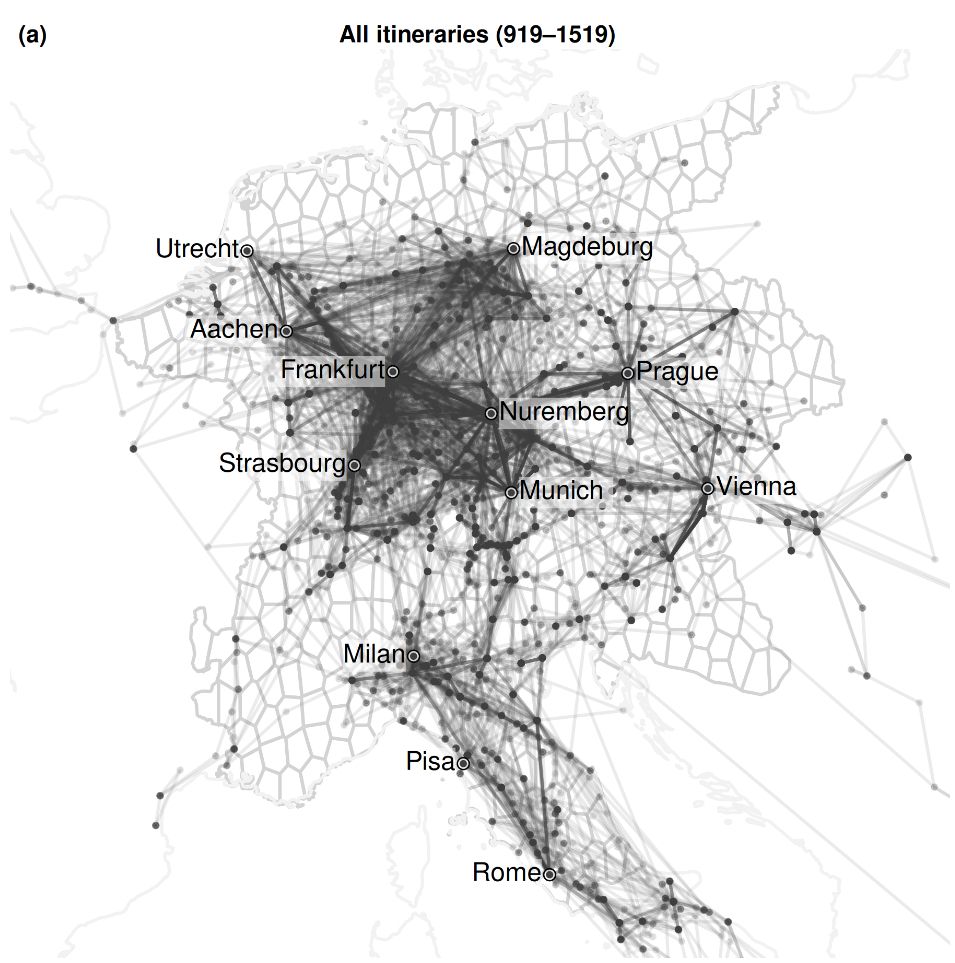
Itineraries of 25 Emperors of the Holy Roman Empire, 919 to 1519
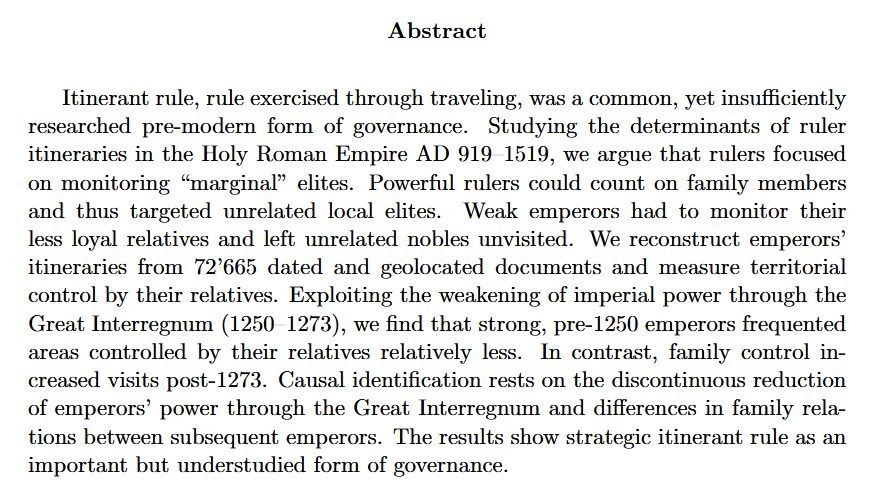
Itinerant rule, rule exercised through traveling, was a common, yet insufficiently researched pre-modern form of governance. Studying the determinants of ruler itineraries in the Holy Roman Empire AD 919-1519, we argue that rulers focused on monitoring `marginal' elites. Powerful rulers could count on family members and thus targeted unrelated local elites. Weak emperors had to monitor their less loyal relatives and left unrelated nobles unvisited. We reconstruct emperors' itineraries from 72'665 dated and geolocated documents and measure territorial control by their relatives. Exploiting the weakening of imperial power through the Great Interregnum (1250-1273), we find that strong, pre-1250 emperors frequented areas controlled by their relatives relatively less. In contrast, family control increased visits post-1273. Causal identification rests on the discontinuous reduction of emperors' power through the Great Interregnum and differences in family relations between subsequent emperors. The results show strategic itinerant rule as an important but understudied form of governance.
🚨 Very excited that our paper on *Rulers on the Road* has been cond. accepted at the AJPS @ajpseditor.bsky.social. We analyze emperors' strategies of itinerant rule in the Holy Roman Empire 919-1519. Fun working with @claranw.bsky.social, @andrejkokkonen.bsky.social & Jørgen Møller shorturl.at/Spm7z
Thanks - that looks amazing
😄😄😄
New Episode - the War that Made the Habsburgs
I watched a few clips on YouTube - not sure I will buy the whole series. Did you watch it?

“Let others wage war; you, happy Austria, marry”, that is what we are told. The reality was very different – invasion, rebellion, execution…
New episode out today
Simon and Jess have done a brilliant job making us all sound clever - so well worth listening to


