


Potatoes 🥔 in a forest stream: the ultimate tracer of overland flow from upstream agricultural fields. Took us a while to figure this out.
06.02.2026 21:40
👍 7
🔁 0
💬 0
📌 0
Potatoes 🥔 in a forest stream: the ultimate tracer of overland flow from upstream agricultural fields. Took us a while to figure this out.
“This one bird nest that we found turned out to be like a history book" 🪶
Thanks @eos.org for including my research in this article! 🐦🧪


Finally a meteorologic+soil sensor station on the UNIL campus. Real-time data visualizations will be made publicly available in 2026. This is a first step towards making our campus an environmental observatory for teaching, research and scientific outreach.

Our ability to figure out how old stream water is relies almost entirely on environmental tracers. But stable water isotopes rarely tell us anything about water parcels older than 1–2 years, and even tritium often doesn’t push that limit much further dx.doi.org/10.1029/2025....
Too late, but: Alzette next to Neumünster Abbey. There was an AGU Chapman conference there back in 2014.

Thank you Benjamin! I agree that 3D visualizations are very helpful. QGIS also has a simple plugin to convert DEMs into STL and I used it for printing the Wigger catchment after burning the river network deep into the DEM for better visualization.
I am looking for simple teaching material on watershed delineation in English. On the web there is a lot of material but I find it rather software-oriented. I'm looking for material that illustrates general concepts in a software-agnostic way. Does anyone have suggestions?

This looks powerful, but students can't look into the model if they want, right? I had a very good experience with @jpgannon.bsky.social's cuahsi.shinyapps.io/HBV-model/ for a class of ~100 bachelor students with mixed backgrounds. I definitely recommend it. We need more of these educational apps!
Well in the end I am getting a stage + EC sensor with real-time data transmission and a water autosampler with remote control. This way samples can be efficiently collected for targeted hydrochemical conditions.
If you were a hydrologist interested in stream water quality, and you had some residual 10'000 $ that you can use for buying a cool instrument (e.g. another sensor, autosampler, or accessories), what would you get?

Coquet river near Longframlington, Northumberland, UK. Sometimes I wish I could have a research proposal featuring all the nice rivers I come across.
Doerthe these places are beautiful. Are you there for work or holiday or both?
The first urban runoff after a few dry weeks can be very dirty, and it ususally goes straight into the river. The one in the movie is not an isolated spill: all the roads I crossed were the same color.
Scientists at UNIL have created a unique 3D visualization model showing the evolution of glacier cover in Switzerland since the last great ice age, and into the near future. The installation be on display at the Osaka World Expo in Japan!infos here: www.unil.ch/news/1750355...
This is a great event, and I would have loved to come. Maybe next time let the info circulate earlier.

The new Ecotron system manufactured by UGT and funded by the UNIL Faculty of Geoscience and the Environment @fgse-unil.bsky.social is operational! It's a rather big machine with a very big potential for ecohydrological experimentation.

Five years ago, an experiment began at ETH Hönggerberg: researchers set up an outdoor laboratory in the forest. They used sensors positioned in trees, the soil and in a stream to study water dynamics. ETH News accompanied the head of the experiment, Marius Floriancic. ethz.ch/en/news-and-...

Here indeed Gianluca Botter introducing his impressive project
Congratulations to Xavier Dupla, Ph.D. candidate in our institute, for successfully defending his thesis and coming up with the sentence "Soil fertility is like love: everyone knows what it means but no one can define what it is"
The negotiations between Wiley and the Swissuniversities consortium are discontinued (shorturl.at/u6RZq). Swiss researchers are recommended to not submit to and review for Wiley journals, which include all AGU journals, Ecohydrology, Hydrological Processes and WIREs Water among others.

MS Student Alessio Nembrini showing Ilja van Meerveld his ongoing work: a continuous-tracer injection device to estimate streamflow and stage-discharge rates. The initially evident fluorescein is hardly visible after ~50 m as it mixes with the stream water. The fluorometer is 200 m downstream.

Youri Rothfuss (Federal Research Center in Julich, Germany) presenting us their lab on wheels: the IsoMobile. What a wonderful mobile infrastructure to measure water stable isotopes in-situ!
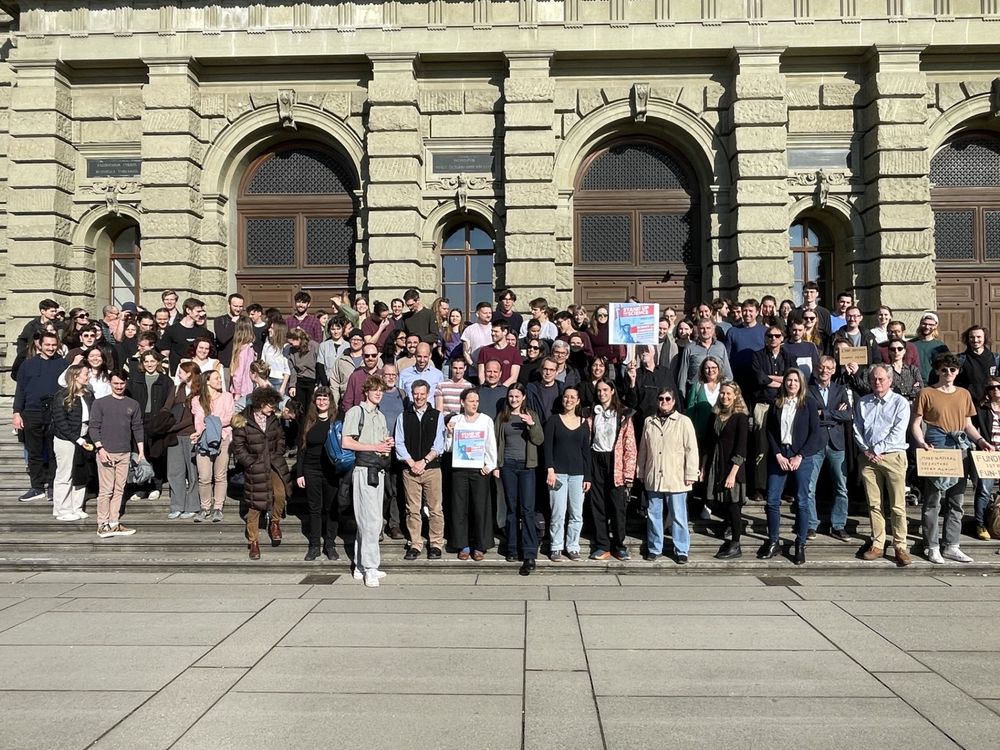
With @ethzurich.bsky.social colleagues & friends, we decided to #StandUpForScience this afternoon to express our support for our US colleagues. Science is a common good. Thanks to all those who joined so spontaneously!
@usyseth.bsky.social @eth-eaps.bsky.social @standupforscience.bsky.social
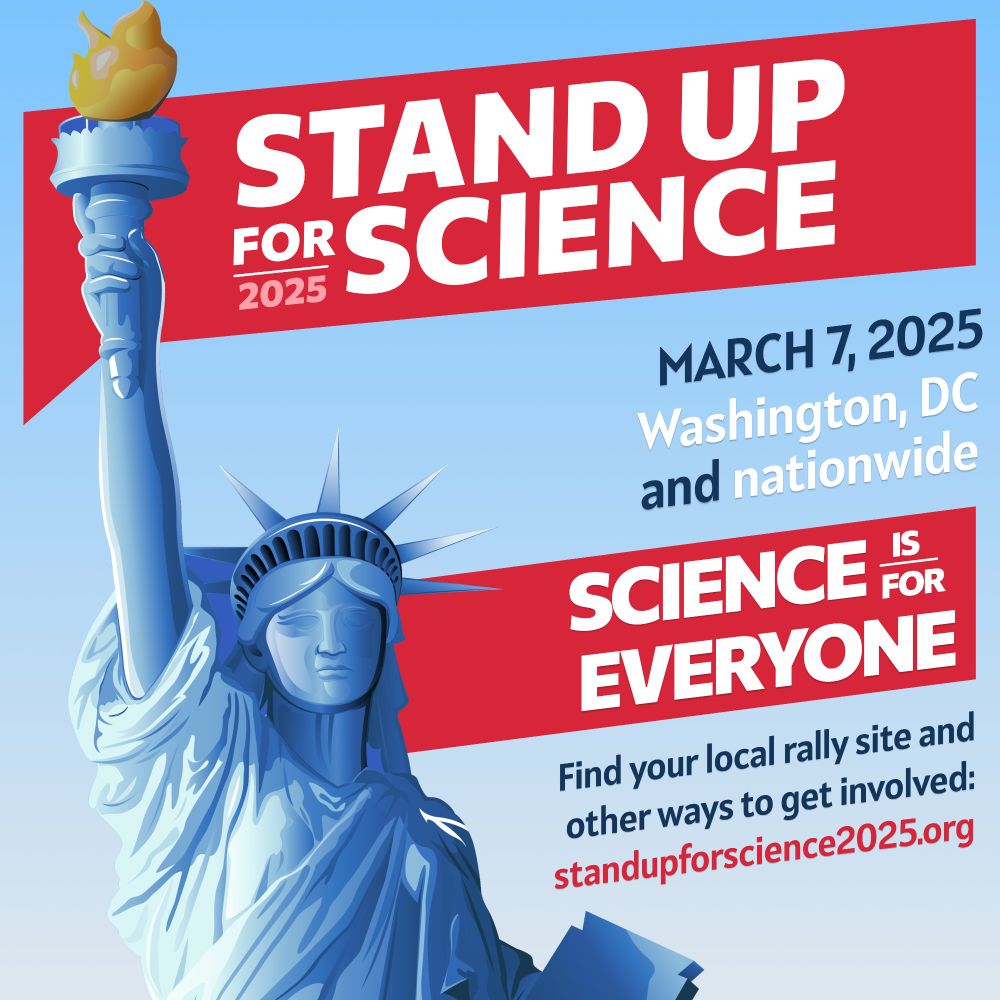
Welcome to the Bluesky account for Stand Up for Science 2025!
Keep an eye on this space for updates, event information, and ways to get involved. We can't wait to see everyone #standupforscience2025 on March 7th, both in DC and locations nationwide!
#scienceforall #sciencenotsilence

Excited about our #AI based runoff reconstruction for #switzerland ranging back to 1962. Lead by @bask0.bsky.social, co-authored by @hydrologywsl.bsky.social , @soniaseneviratne.bsky.social , William Aeberhard, Michael Schirmer. hess.copernicus.org/articles/29/...
It also means humbly yet firmly resist those who shout their views, whatever side they come from.
The word "resistance" bears significant historical values. To me, honoring those values today means being moderate and struggle to remain so. Both in life and science.
I am helping convene one session on the "Influence of ecosystem water and nutrient demands on riverine solute exports". The deadline for abstract submission is January 17.
For folks interested in all aspects of the earth's Critical Zone: this June in Finland there will be the first eLTER conference. There are a lot of interesting sessions in the program (elter-ri.eu/science-conf...) plus field excursions to some of the best examples of eLTER instrumented sites.

