

Looks like it's a combination of UK conditions and similar conditions across EU meaning inter-connector prices are also high.. www.linkedin.com/posts/fintan...
08.01.2026 13:41
👍 3
🔁 0
💬 1
📌 0
Looks like it's a combination of UK conditions and similar conditions across EU meaning inter-connector prices are also high.. www.linkedin.com/posts/fintan...
Most of the systems on HeatpumpMonitor run at lower flow temperatures than this and some with only minor radiator upgrades. Heat loss calculations have over-estimated heat loss in pre-2000 buildings in particular in the UK and this has over-inflated expectations of the flow temperatures required.
On your question on required flow temperatures. That's an interesting one. It seems that there are a very large number of properties in the UK with sufficient existing radiators to run at flow temperatures of between 45-50C without radiator upgrades. This is what enables HeatGeek's ZeroDisrupt model

On HeatpumpMonitor.org we have high performing heat pumps across a wide range of makes and models from budget to premium brands. Some makes and models make it easier to achieve higher performance due to better controls - but even those with poor controls can work well with the right settings.
2/2 This improvement is almost entirely down to better installation, commissioning and operation of these systems. It highlights what the best installers can achieve. The Electrification of Heat trial published last year used the same generation of heat pump technology but only achieved SPF 2.8.
Key finding of the paper is not all recent heat pump installations are delivering these efficiencies but that the specific set of heat pump installations that we are monitoring on HeatpumpMonitor.org are achieving much better performance than previous trials. 1/2
Must be something else as well, it's been way colder over the last week than today?
👀

Well-installed heat pumps installed in the UK today achieve on average a 64% higher efficiency than those during the early trials 15 years ago.
It is testament to the brilliant installers and to the technology getting better. More in our recent paper:
www.sciencedirect.com/science/arti...
Amazing well done @zapaman.bsky.social !

I have been notified that the video link to my Helsinki talk does not work for some people. Here's an alternative link for those who prefer a YouTube version: youtu.be/D2abyXGvELI

Let’s see what we can learn from temperature change in the next two years – mailchi.mp/caa/global-t...
Also available on Substack: jimehansen.substack.com/.../global-t....
Based on the 11-year running mean (and on Earth's Energy Imbalance), the near-term rate of warming could turn out much higher than the linear 2010-2025 extrapolation.
The next El Niño peak will be very informative for the rate of global warming, as @drjamesehansen.bsky.social points out:
Thanks @janrosenow.bsky.social it's been great to work with you on this! Thank you for making the paper possible!

Massive thanks to @trystanlea.bsky.social and @glynhudson.bsky.social for setting up HeatPumpMonitor.org, the excellent installers and to the people willing to share their data! Without you none of this would have been possible.
It's been great to be part of this project with @janrosenow.bsky.social @trystanlea.bsky.social to share the results from HeatpumpMonitor.org @openenergymon.bsky.social in a peer-reviewed paper 🥳
The overall highlighted HP performance is testament to the work of excellent installers 👏 🎉

NEW RESEARCH: UK heat pumps can perform far better than many think.
Our analysis of HeatPumpMonitor.org data shows well-designed systems achieve ~40% higher efficiency than past trials (SCoP 3.86 vs 2.81), cutting bills (~£224/yr) and emissions.
Open access: www.sciencedirect.com/science/arti...
Maybe less dramatic but there is a risk to undersize on newer build properties, especially where max output during defrost conditions doesn't match datasheet and if build quality is lower than design..

I just wrote some more thoughts here on the new MCS heat loss calculator and the ventilation calculation, you may find interesting community.openenergymonitor.org/t/new-mcs-he...
Makes sense in building physics terms but if this just adds to over-inflated heat loss in pre-2000 properties then it's not helping. Key is to have good agreement between calculated and measured heat loss.
Big thanks to TBarton Electrical for doing an excellent job installing the solar and battery system, they've been great to work with tbartonelectrical.co.uk
We will do a detailed comparison
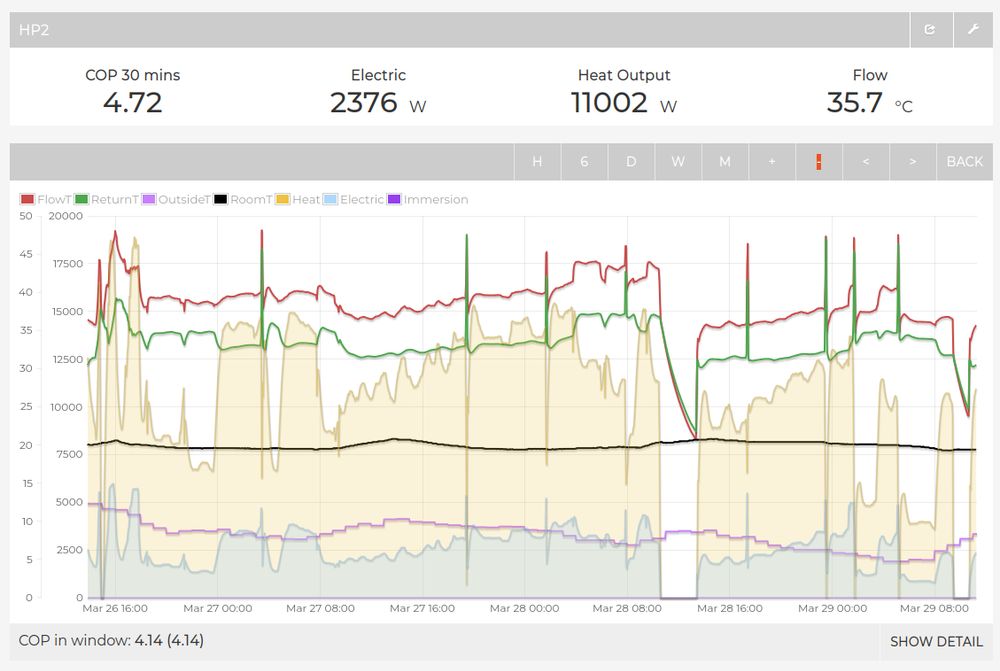
Performance on space heating has been great so far, COP 4. While a buffer was installed as per viessman spec, we also have the option to bypass the buffer and we've been running it with the buffer bypassed all on the primary circulation pumps just fine over recent days 👍
It's been great to be part of this project. While most of the work is credit to Chris from Griffith's heating, Glyn and I did the heatloss calc and are involved in commissioning, optimisation and monitoring of course
That's a great way of approaching it, always good to come at it from both angles, that should be part of standard heat loss calc methodology rather than relying on calculation alone
Thanks Keith, all about a useful amount but not too much , thanks for picking these points up!
When I was getting our heat pump here, because of the twitter heatpump discourse, I was worried that our model was oversized, but found in practice that it actually performs very well! (It's well within @openenergymon.bsky.social's range of useful oversizing).
Heat pumps are running! Still lots of tweaking and tidying to do but building is heating up 😁
30kW SolarEdge PV and 65kWh of GivEnergy Commercial battey system is now up and running, with @openenergymon.bsky.social monitoring 😀
Yes that's correct, weather comp for boilers has not been widely adopted or mandated as is the case elsewhere.

