A huge congratulations to Dr Madeline Howell and Dr Thomas Maunder on their PhD graduations! 💫 Maddy has gone onto a postdoc job in the US and Tom is doing data science in industry. We couldn’t be prouder!!
16.09.2025 23:30
👍 4
🔁 0
💬 0
📌 0

Front page news! 📰 Monash PhD researcher Christian Adamcwicz leads new LVK results revealing the mysterious 40 M☉ gap in black hole populations. Exciting clues about how the universe’s heaviest stars live and die! #BlackHoles #LVK #Astrophysics www.theaustralian.com.au/science/grav...
29.08.2025 03:16
👍 11
🔁 4
💬 0
📌 0

Monash researchers have simulated one of the lightest neutron stars ever—just 1.192 solar masses—bringing us closer to solving a key astrophysics puzzle. A leap forward for supernova science. 🌟🧠 #NeutronStars #Astrophysics #Supernova #MonashScience
16.04.2025 01:36
👍 1
🔁 0
💬 0
📌 0

Monash University takes all three prizes at the OzGrav bingo ice breaker activity at the 2024 retreat! @ozgrav.bsky.social
11.12.2024 01:05
👍 5
🔁 1
💬 0
📌 0

Exciting news! Monash University’s, Rowina Nathan, has authored a groundbreaking study using the powerful MeerKAT telescope to create the most detailed map of the gravitational wave background to date: shorturl.at/KRXKj
Check out an article on Rowina’s work: shorturl.at/oS3G1
03.12.2024 21:52
👍 6
🔁 1
💬 0
📌 0
Optimist: The cup is half full
Pessimist: The cup is half empty
Astronomer: There are Type I cups and Type II cups but clearly this is a rare transitional Type 1.5 cup.
24.11.2024 21:34
👍 4
🔁 2
💬 0
📌 0

An infographic explaining different black hole mergers. The left side shows two smaller black holes spiralling inwards. The right shows two larger black holes orbiting each other. The text on the left reads: "BINARY BLACK HOLE
MERGER
Observed by: ground-based detectors.
Detector lenth: kilometers
Solar masses: tens to hundreds
Found in: everywhere?
Merger time: seconds
GW period: milliseconds
"Sounds like':) chirp, bang, crash"
The text on the right reads: "SUPERMASSIVE
BINARY BLACK HOLE
Observed by: putsar timing arrays
Detector length: kiloparsecs
Solar masses: millions to billions
Found in? center of large galaxies
Merger time: millions of years*
GW period: years
'Sounds like': rumble, hum"
What is the difference between gravitational-wave signals measured by LIGO and pulsar timing arrays? Well lots of things, but mainly the mass of the black holes. This infographic summarises the differences. 👀🕳️💫
25.11.2024 00:43
👍 41
🔁 17
💬 5
📌 0

Cartoon infographic showing two orbiting black holes rippling spacetime. A pink pulsar gives off a beam of light being rippled by the gravitational waves before reaching Earth. The text reads "Orbiting black holes generate gravitational waves. Gravitational waves stretch and squeeze spacetime. Curving spacetime changes the path of light."
How can pulsars be used to detect gravitational waves? Ripples in spacetime affect the path of light!
I'll be posting some fun infographics in the lead up to my paper release on December 3! Follow along so you're ready for the release 🌟 @ozgrav.bsky.social
21.11.2024 23:57
👍 35
🔁 8
💬 1
📌 1

Figure 1 from https://arxiv.org/abs/2411.07035
Schematic explaining the possible fates of an NSBH merger, depending on the binary parameters. We are interested
in answering the question: what threshold remnant baryonic mass is required to launch a GRB jet? We consider the remnant
mass and orientation of the system as the two requirements to measure a GRB from an NSBH merger.
~Infer gamma-ray burst jet physics with this one weird trick!~
A population of neutron star-black hole mergers might let us discover new physics about GRB jets. 🔭 🧪
Check out my brand new paper with @plasky.bsky.social and Eric Thrane to find out more.
arxiv.org/abs/2411.07035
12.11.2024 05:34
👍 33
🔁 6
💬 0
📌 0

Huge congratulations to Tom who submitted his PhD thesis “Multi-Dimensional Radiative Transfer Calculations for Asymmetric Stripped-Envelope Supernovae” today ✨🎉💥
11.11.2024 01:25
👍 11
🔁 2
💬 0
📌 0

Old black and white image of the Parkes radio telescope in an open field. Taken during the early days of telescope operations.

Old black and white photo of the Parkes radio telescope under construction with a crane nearby hoisting material onto the top of the skeletal dish structure

The Parkes radio telescope, in the distance. Old black and white photo with sheep grazing in the foreground.

Old black and white photo of men working at building the base of the Parkes radio telescope, with a large ring that has been dug into the ground.
Almost forgot!
Oct 31 is the anniversary of Murriyang starting operations in 1961!
63 years of operation, and it’s still giving us solid science/discoveries.
Iconic Aussie astronomy infrastructure.
Wrote some words on this a few years back: www.spaceaustralia.com/index.php/fe...
📸 CSIRO 🔭📡
31.10.2024 22:37
👍 54
🔁 6
💬 1
📌 0

Congratulations to Monash Astrophysicist Dr Fan Liu who was awarded the Monash Faculty of Science Publication Award for their paper At Least One in a Dozen Stars Shows Evidence of Planetary Ingestion, Nature (2024).
24.10.2024 05:29
👍 10
🔁 1
💬 0
📌 0

Today we had our beyond third year event, to encourage undergraduate students to consider further study in physics and astronomy. 🪐 🧲 Students mingled with potential supervisors and we are looking forward to welcoming them next year! ✨
15.10.2024 02:15
👍 2
🔁 0
💬 0
📌 0

Almost a million stars mapped by Anglo-Australian Telescope
Follow the latest news headlines from Australia's most trusted source. Read in-depth expert analysis and watch live coverage on ABC News.
Fingerprints of 1M stars reveal Milky Way's history! The Aussie-led GALAH project releases data from the AAT’s 50th birthday. Monash astrophysicist Madeline Howell contributed key spectroscopic data on M4, an ancient globular cluster that holds clues to our Galaxy's formation. shorturl.at/HwXng
08.10.2024 05:07
👍 1
🔁 0
💬 0
📌 0

Huge gamma-ray burst collection ‘rivals 250-year-old Messier catalogue’
Hundreds of gamma-ray bursts (GRBs) have been recorded as part of an enormous global effort so extensive it "rivals the catalogue of deep-sky objects created
by Mess...
GRB optical catalog with contributions from S. Belkin
@monashastro.bsky.social "rivals Messier catalog"; sure, but Messier objects just sit there waiting for you to observe them at your leisure, not like GRB optical counterparts which disappear in <~ 1 day! ras.ac.uk/news-and-pre...
16.09.2024 10:25
👍 7
🔁 2
💬 0
📌 0

🎉 Huge congratulations to our talented Honours student, Amber Tilly, for being the Regional Winner of the 2024 Global Undergraduate Awards for her report on modelling disk kinematics in protoplanetary disk AS209! 🏆✨
18.09.2024 02:23
👍 2
🔁 0
💬 0
📌 0

On Friday Maddy and Giulia submitted their PhD theses and went on the famous walk to the graduate research office to collect their pens. We’re proud of their hard work and excited for the bright futures ahead. Congratulations Maddy and Giulia!
03.09.2024 08:16
👍 4
🔁 0
💬 0
📌 0


From 8-12 of July the ACES: Advances in Cool Evolved Stars conference ran at Monash in hybrid format. The conference was organised by Taïssa Danilovich with assistance from Amanda Karakas, Zara Osborn, Maddy Howell, Alex Wallace, Yoshi Mori, Fan Liu and Carolyn Doherty.
29.08.2024 22:59
👍 0
🔁 0
💬 0
📌 0

New research from Monash University explains the mysterious bumps in superluminous supernovae. A "magnetar-star binary engine" could be the key, where a magnetar evaporates its companion star, causing the unique light curves. More details: shorturl.at/RwguZ
29.08.2024 05:56
👍 0
🔁 0
💬 0
📌 0


Monash Physics and Astrophysics students go beyond theory—they code in various languages, simulate galaxies, and analyse data to bring the universe into the classroom. Professor Daniel Price energised a second-year coding session, making physics come alive! 🚀
27.08.2024 08:22
👍 1
🔁 0
💬 0
📌 0
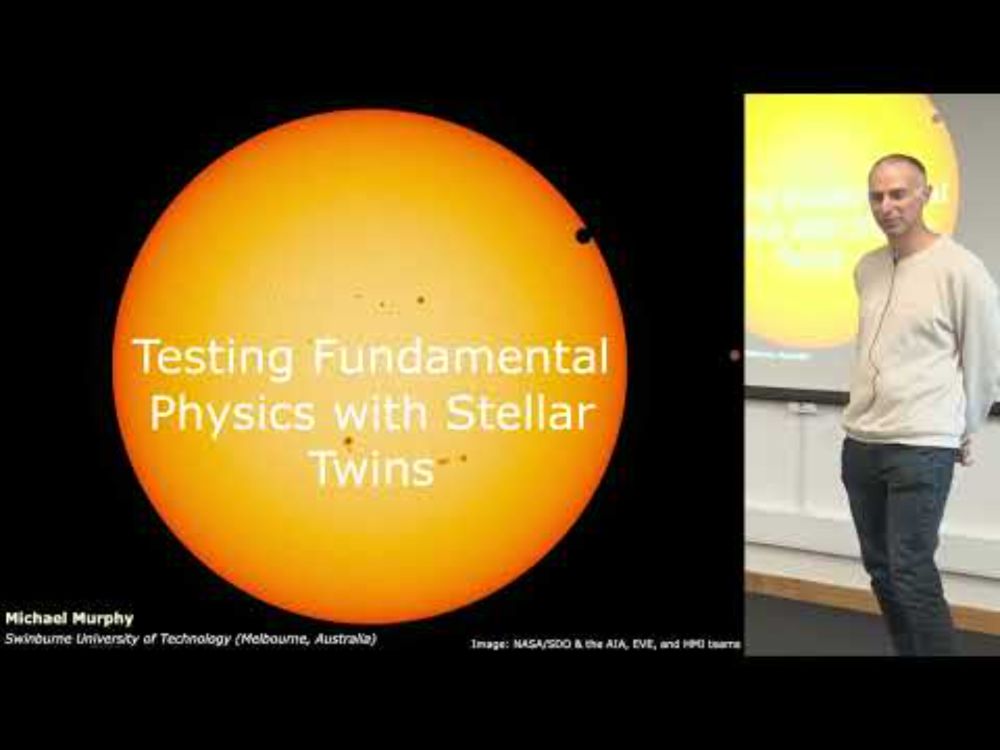
Is there an underlying connection between dark matter and electromagnetism - Testing stellar twins?
YouTube video by MonashPhysicsAndAstronomy
I spoke at Monash Uni about my team's project to map electromagnetism’s strength across our Galaxy.
We're testing fundamental physics where dark matter is most concentrated, near our Milky Way's centre.
Thanks @monashastro.bsky.social for hosting & recording!
🧪🔭
youtu.be/LMsvwRilpyk
22.08.2024 00:50
👍 15
🔁 6
💬 0
📌 0

A new paper by Lewis Picker explores the role of convection as a dominant form of energy transport in massive stars. It highlights how the convective mass of stars changes throughout their evolution and the impact this can have on binary star systems.https://shorturl.at/PSI6y
26.08.2024 04:43
👍 1
🔁 0
💬 0
📌 1