Extreme ‘Day Zero’ water shortages may affect nearly 74% of drought‑prone regions by 2100, says research in @natcomms.nature.com. Study maps future water‑scarcity hotspots linked to climate change: spklr.io/633218YgiZ
#WaterScience #ClimateChange
16.01.2026 14:26
👍 2
🔁 2
💬 0
📌 0
The high-resolution simulations show a substantial increase in regional information relative to the TCo319 experiment, especially over topographically complex terrain. Examples of enhanced regional information include changes in temperature, rainfall, winds, extreme events, tropical cyclones. 🧪
18.07.2025 10:48
👍 1
🔁 1
💬 1
📌 0
We used the coupled earth system model OpenIFS–FESOM2 with a 9 km atmospheric resolution and a 4–25 km ocean resolution. We conducted a control simulation and 4 coupled transient simulations for the 2000s, 2030s, 2060s, and 2090s. 🧪
18.07.2025 10:48
👍 0
🔁 0
💬 1
📌 0
We present a wind reconstruction based on marine diatoms preserved in an Antarctic Peninsula ice core, to reconstruct westerly winds across the Pacific sector of the Southern Ocean. The poleward shift and acceleration of the westerly winds is unprecedented.
🧪
08.07.2025 10:31
👍 3
🔁 2
💬 0
📌 0

Our simulations also show clear evidence that extremes of vector density and EIR increase in the future by almost 100%, suggesting that major malaria epidemic outbreaks will become much more likely.
🧪
20.06.2025 07:53
👍 2
🔁 0
💬 0
📌 0

We compute the Time Of Emergence of vector density and the infectious biting rate using 50 members of Community Earth System Model version 2 Large Ensemble simulations. This reveals that vector densit and EIR will rise significantly and permanently above the pre-industrial background variability.
🧪
20.06.2025 07:53
👍 4
🔁 0
💬 1
📌 0

Rules all PIs should follow
For anyone who manages other researchers, I strongly suggest to read this list of rules that young reseachers think PIs should follow. If you think you don't need such improvements, well you are likely the one who needs to read this the most.
🧪 #science #research
www.science.org/doi/10.1126/...
09.06.2025 07:26
👍 6
🔁 5
💬 0
📌 0
We examined the spatial propagation of terrestrial heatwaves using a complex network algorithm, and find four preferred propagation pathways of terrestrial heatwaves. Along each preferred pathway, heatwaves evolve in two ways: propagating along the pathway or being stationary
31.05.2025 09:43
👍 0
🔁 0
💬 1
📌 0
Second day at #egu25 🧪
So far attended sessions on wildfires and also health impacts today
I am positively surprised how many health sessions are at EGU
29.04.2025 09:54
👍 3
🔁 0
💬 0
📌 0
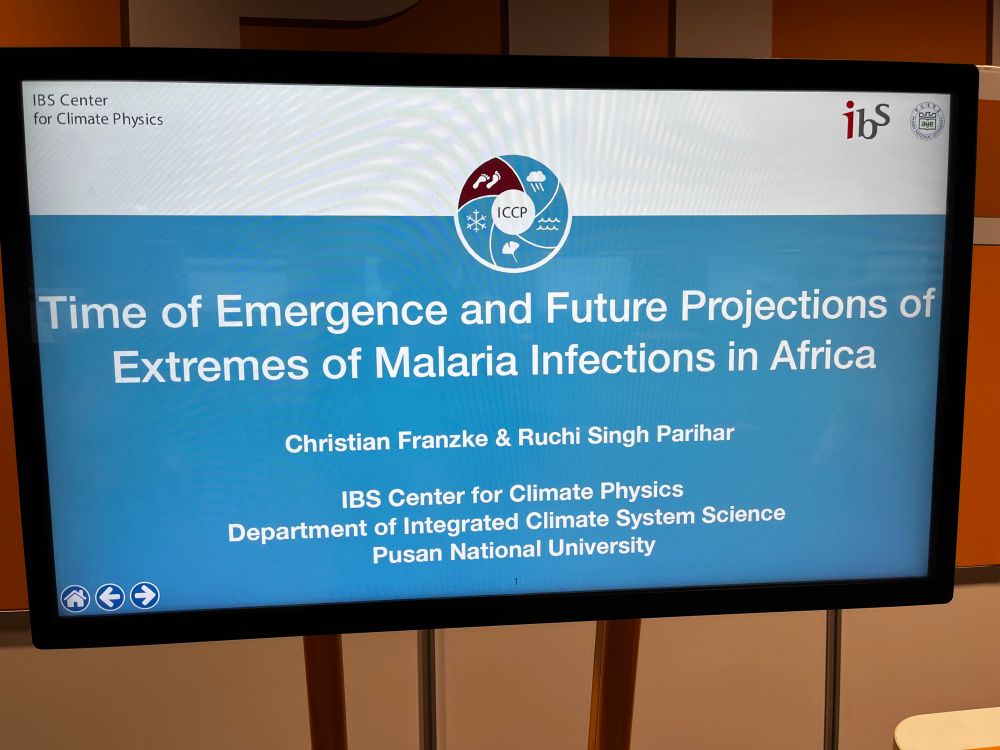
Title slide of my presentation
Gave my presentation on malaria and climate focusing on time of emergence and extremes
First time that I gave a PICO presentation @egu.eu #egu25 🧪
28.04.2025 13:55
👍 12
🔁 0
💬 0
📌 0
🧪
28.04.2025 06:26
👍 3
🔁 0
💬 0
📌 0
First day at @egu.eu 2025
I start with a session on climate and health ITS2.4 PICO spot 2
28.04.2025 06:25
👍 1
🔁 0
💬 0
📌 1

Wondering about what brilliant science we have published during February with the #EGUjournals? Check out the latest GeoRoundup, with all the #OpenAccess highlights on the #EGUblogs!
👉 Discover more here: egu.eu/5GIESL/
05.03.2025 10:00
👍 12
🔁 3
💬 0
📌 0
Models show intensifying wildfires in a warming world due to changes in vegetation and humidity; only a minor role for lightning – IBS Center for Climate Physics
Our results show that with every degree global warming the global mean area burned by fires each year will increase by 14%. This can have substantial effects on ecosystems, infrastructure and human health and livelihoods.
🧪
Read the full press release here:
ibsclimate.org/news/models-...
13.02.2025 00:42
👍 3
🔁 2
💬 1
📌 0
Models show intensifying wildfires in a warming world due to changes in vegetation and humidity; only a minor role for lightning – IBS Center for Climate Physics
Our new study on interactive climate-lightning-wildfire was just published in Science Advances
We show that the strongest anthropogenic trends in biomass burning are in southern and central equatorial Africa, Madagascar, Australia, parts of the Mediterranean and western North-America.
🧪
13.02.2025 00:42
👍 0
🔁 1
💬 1
📌 0
Postdoctoral Fellow – Kilometer-Scale Global Modeling and Extremes – IBS Center for Climate Physics
I have a postdoc position available in my group on kilometer-scale global #climate modeling and #extremes
There are also opportunities to get involved in other ongoing projects at ICCP
Please contact me if you are interested
ibsclimate.org/jobs/postdoc...
07.01.2025 23:51
👍 0
🔁 0
💬 0
📌 0

Happy new year!
First sunrise of the new year from Yunsan mountain
01.01.2025 00:41
👍 1
🔁 0
💬 0
📌 0

A schematic showing three connected pillars (climate science, decision making, and impact science). From Sillmann et al., 2024, CC-BY-4.0.
In a new concept paper following the @wcrpclimate.bsky.social Open Science Conference, we examine links between climate science and decision making regarding extremes and risks. Enhancing these links requires better integration of climate sciences and impact sciences for actionable climate info. 1/3
20.12.2024 01:33
👍 21
🔁 8
💬 2
📌 2

End of semester grading session
19.12.2024 23:20
👍 3
🔁 0
💬 0
📌 0


