
Today, on World Wetlands Day, YEW is proud to release its COP15 Report following the 15th Conference of the Parties of the Convention on Wetlands, held in Zimbabwe.
Report available here: bit.ly/4bsAjnf
📢 We invite you join us in strengthening youth engagement in wetland governance worldwide.
02.02.2026 18:18
👍 0
🔁 0
💬 0
📌 0

I would like to thank my supervisors and co-authors,
@jocelyn-tdv.bsky.social Thomas Blanchon @tamarlok.bsky.social and @joseaalves.bsky.social for the advice! Also, technicians and field volunteers at @tourduvalat.bsky.social eco_flyway @globalflyway.bsky.social CESAM, and @uaveiro.bsky.social
22.06.2025 17:31
👍 5
🔁 2
💬 0
📌 0

To concluded (7/8)
22.06.2025 17:31
👍 3
🔁 0
💬 1
📌 0

The story continues!
We examined chick migratory behaviour based on crossing major barriers:
🟡 No barriers
🟢 Sahara Desert
🔵 Mediterranean Sea
Intriguingly, as the season progresses, the chance of spoonbills crossing major ecological barriers decreases. (6/8)
22.06.2025 17:31
👍 3
🔁 0
💬 1
📌 0

Later-born chicks were seen to have lower body condition than early born chicks.
Thus, by breeding earlier, older spoonbills have higher likelihood of having chicks with higher body condition. (5/8)
22.06.2025 17:31
👍 3
🔁 0
💬 1
📌 0

Using camera traps & expert observations, we identified when breeders were seen breeding for the first time in the season.
Our finding: Older spoonbills tend to breed earlier in the season than younger ones.
But how can this impact their offspring? (4/8)
22.06.2025 17:31
👍 2
🔁 0
💬 1
📌 0

To identify individual spoonbills, since 2008, the @tourduvalat.bsky.social team has ringed more than 5000 thousand chicks with PVC rings.
Thanks, to these individual markings we were able to determine the age of 451 breeders and the migratory behaviour of 105 juveniles. (3/8)
22.06.2025 17:31
👍 2
🔁 0
💬 1
📌 0

As animals age, past experience can improve their performance of basic behaviours such as foraging and movement.
However, due to the difficulty to follow animals it is often difficult to assess how their performance impacts their offspring. (2/8)
22.06.2025 17:31
👍 6
🔁 1
💬 1
📌 0

Tracking - what are we learning about waders?
LOTS!
wadertales.wordpress.com/2025/05/06/m...
One Whimbrel made all of these journeys.
The 'Global Wader' project is encouraging scientists to archive this sort of information, so that it is available for future analyses.
#ornithology
07.05.2025 05:10
👍 30
🔁 8
💬 1
📌 1
GWTDP
Happy to join the Wader community! 😁
🌍 If you're involved in wader tracking, research, or conservation, check out our project: Global Wader.
🐣 More than happy to connect and help you to find out more! #Waders #Conservation #BirdTracking
www.globalwader.org
02.04.2025 13:48
👍 5
🔁 0
💬 0
📌 0
Thank you! @tamarlok.bsky.social @jocelyn-tdv.bsky.social José Alves, @tourduvalat.bsky.social @uaveiro.bsky.social Ecoflyway CESAM
18.03.2025 16:08
👍 0
🔁 0
💬 0
📌 0


Now that I’ve finally rested, I want to thank all the observers, technicians, volunteers, colleagues, supervisors, friends, and family, who made this thesis possible. The best part of the defense was feeling all the love and support. Obrigado, see you in the next challenge! :D
18.03.2025 16:08
👍 3
🔁 0
💬 1
📌 0
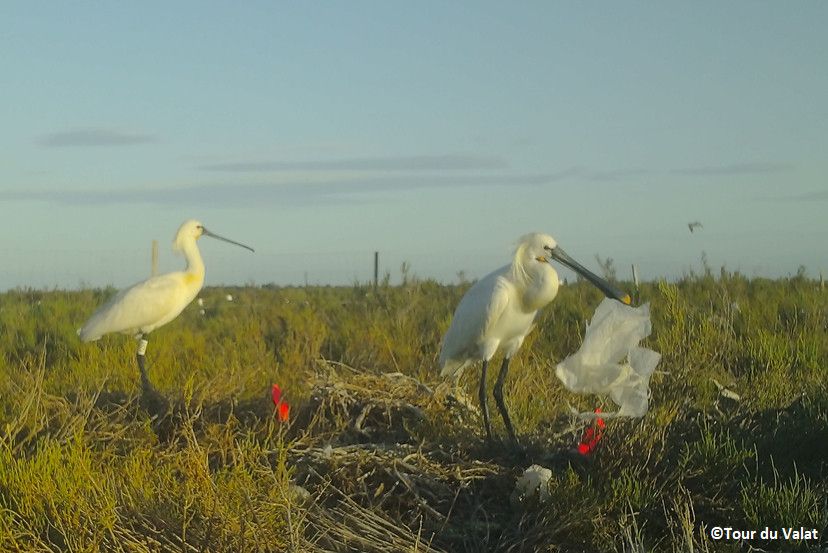
39% des nids de spatules blanches contiennent du plastique, selon une étude scientifique récente doi.org/10.1016/j.sc... @ferreirahrs.bsky.social
25.02.2025 12:37
👍 2
🔁 1
💬 0
📌 0

I would like to thank my supervisors and co-authors
Carolina Hadden, @jocelyn-tdv.bsky.social , Tamar Lok, Marion Vittecoq, and José A. Alves for the advice and tremendous help!
Also, Sandra Hodic (fieldwork), the @tourduvalat.bsky.social, eco_flyway, CESAM, and @uaveiro.bsky.social ).
.
24.01.2025 14:35
👍 5
🔁 2
💬 0
📌 0

Understanding where spoonbills gather ANM and whether they actively seek it is a priority for further research.
Studies such as necropsy or detailed nest temperature analysis could help unravel the benefits and potential adverse effects of ANM on waterbird breeding success. 9/10
24.01.2025 14:35
👍 3
🔁 0
💬 1
📌 0

Our results suggest other species may be better pollution sentinels in wetland nesting sites than spoonbills.
However, spoonbills could act as #biovectors, potentially transporting materials like sheet plastics from agricultural fields to natural nesting areas. (8/10)
24.01.2025 14:35
👍 2
🔁 0
💬 1
📌 1

No link was found between ANM proportion and breeder age or hatching success. But it is noteworthy that, despite the high incidence of ANM, there are no documented cases of mortality due to entanglement or suffocation of chicks or adults by nest material in #Camargue. (7/10)
24.01.2025 14:35
👍 2
🔁 0
💬 1
📌 0

Although it is not clear whether they are used to replace or complement natural materials, an increase in the use of ANM throughout the season coincided with a decrease in the proportion of Halimione in the nest lining. (6/10)
24.01.2025 14:35
👍 1
🔁 0
💬 1
📌 0

Nest lining mainly contained natural fragmented materials like #Halimioneportulacoides, ANM, and feathers.
Raw data suggests Halimione decreases ~21 days post estimated egg laying, while ANM remains constant. (5/10)
24.01.2025 14:35
👍 0
🔁 0
💬 1
📌 0

We used photos as a balanced precision/disturbance method to assess ANM in nest lining.
Nests were photographed during each visit (2.3).
Marked breeders were identified and linked to nests (2.5), and hatching success was recorded (2.6). (4/10)
24.01.2025 14:35
👍 1
🔁 0
💬 1
📌 0

Out of 439 nests observed at the field, 39 % contained at least one ANM (Survey 2.2), usually plastic of sheet-like shape and white-transparent colours (Survey 2.4).
ANM were mainly located in the nest lining and on average represented 1.4 ± 0.87% of the nest total mass. (3/10)
24.01.2025 14:35
👍 0
🔁 0
💬 1
📌 0

Although commonly found in #Eurasianspoonbill nests, anthropogenic nesting materials (ANM) have never been quantified.
We monitored ANM occurrence in nests in the #Camargue wetland, Southern France, over two breeding seasons. (2/10)
24.01.2025 14:35
👍 0
🔁 0
💬 1
📌 0

There is no two without three!
Third chapter of my thesis out in #stoten @elsevierconnect.bsky.social
"Presence and potential impact of anthropogenic nesting materials on a colonial breeding waterbird"
www.sciencedirect.com/science/arti... (1/10)
24.01.2025 14:35
👍 7
🔁 4
💬 1
📌 1
I would like to thank my supervisors and co-authors Tamar Lok, Thomas Blanchon, Jocelyn Champagnon, Olivier Duriez, Frédéric Jiguet, and José Alves, for the advice and tremendous help!
Also, the Tour du Valat, eco_flyway, Global Flyway, CESAM, and @uaveiro.bsky.social.
23.12.2024 15:41
👍 1
🔁 0
💬 0
📌 0

Understanding how specific management actions may affect waterbird presence and habitat use is essential not only to improve the effectiveness of conservation efforts, but also to promote wetland connectivity and species resilience, particularly in fragmented landscapes. (8/8)
23.12.2024 15:41
👍 1
🔁 0
💬 1
📌 0

In Marais Vigueirat, a strongly protected area (6), is actively managed to provide optimal conditions for waterbirds, considering climatic conditions, the annual cycle, and the biology of the target species.
This reserve was identified as one of the most important areas. (7/8)
23.12.2024 15:41
👍 0
🔁 0
💬 1
📌 0

Surprisingly, spoonbills did not increase their use of strongly protected areas during the waterfowl hunting season (late disp. & wintering periods). This could be explained by the variety of hunting practices in Camargue and by the large size of the hunting estates used. (6/8)
23.12.2024 15:41
👍 0
🔁 0
💬 1
📌 0

Our study shows that privately managed wetland areas play a complementary role to strongly protected areas: they may provide spoonbills (and other waterbirds) with suitable foraging habitat at certain periods of the year when these are less available in strongly protected areas.
23.12.2024 15:41
👍 0
🔁 0
💬 1
📌 0


