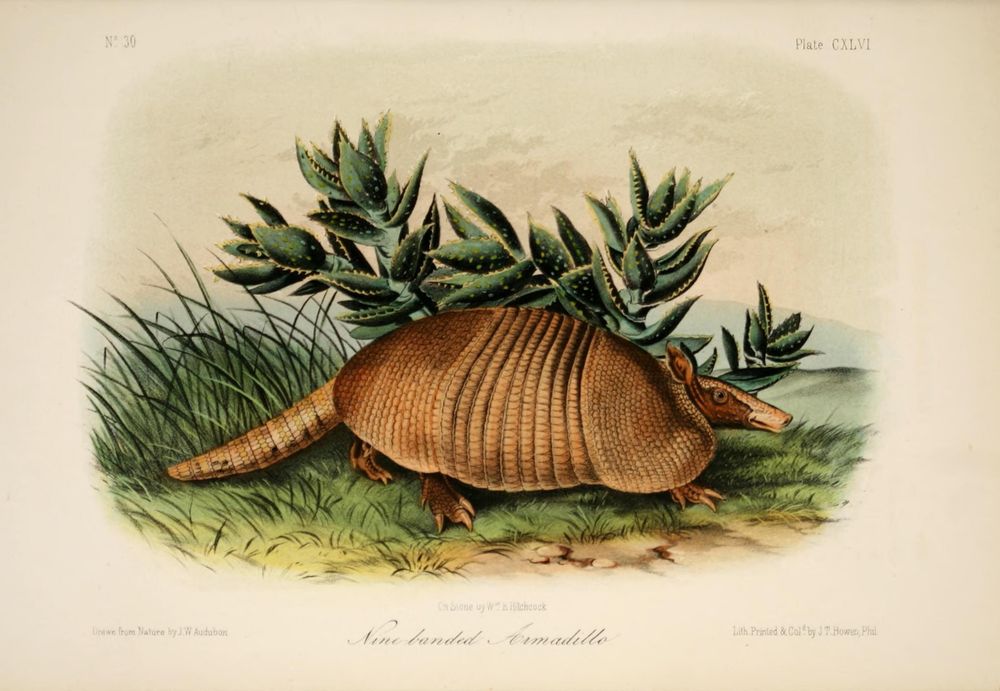
Illustration of a nine-banded armadillo standing on grass with green leafy plants behind it. The armadillo is shown in side profile, with its segmented, armored shell covering its body, a long banded tail, and a pointed snout. The image highlights the detailed texture of the armadillo's scales and shell. The style is a 19th-century hand-colored lithograph from John James Audubon's "The Quadrupeds of North America" series, dated 1851-54. The artwork emphasizes the armadillo’s unique protective armor and distinct anatomy in a natural habitat setting.
🛡 The quadrupeds of North America, .
New York, V.G. Audubon, 1851-54.. The #Aztec called #armadillos azotochtli, meaning "turtle-rabbit." See them in #bhlib & @eol eol.org/pages/7630/overview
[Source]
07.03.2026 01:23
👍 10
🔁 2
💬 0
📌 0

A detailed black-and-white scientific illustration of a fish labeled "Hexagrammos Octogrammus," drawn by Chloe Lesley Starks. The fish is shown in profile with pronounced scales, large eye, spiny dorsal fins, and delicate pectoral fins. Below the main drawing is a close-up sketch of the fish's fin structure. The image is from a historical 1898-99 publication on fur seals and related marine life of the North Pacific, despite the focus on a fish rather than seals. The plate is titled "PLATE L." and notes the location "Unalaska."
🦭 The fur seals and fur-seal islands of the North Pacific Ocean. v.3.
Washington, Govt. Print. Off., 1898-99.
[Source]
06.03.2026 23:23
👍 12
🔁 1
💬 0
📌 0

Illustration of various detailed botanical structures of Frichostylium affine Corda, a green moss-like plant. The image shows multiple views and cross-sections of the plant’s leaves, capsules, and spores, highlighting cellular textures with hexagonal patterns and fine root-like hairs. The detailed drawings feature shades of green and brown, with labels numbering each segment. The overall style is scientific and precise, reflecting 18th-19th century botanical art focused on plant morphology for study and classification. The page is titled in script with the plant’s scientific name and numbered "XXXIV" at the top right.
🌸 Deutschlands flora in abbildungen nach der natur
Nurnberg: Gedruckt auf kosten des verfassers, 1798-[1862]
[Source]
06.03.2026 21:23
👍 15
🔁 3
💬 0
📌 1

A historical illustration from 1808 shows two labeled birds: on top, a large dark brown eagle with sharp talons gripping a small hare, set against a coastal landscape with cliffs and sea under a muted sky. Below, a vulture with a bare, reddish head and neck, brown and white feathers, and large black talons, stands on rocky terrain near the water’s edge, with a cliff in the background. Both images have detailed shading and coloring typical of early natural history prints.
🦅 Natural history of birds, fish, insects, and reptiles, .
London, Printed for the Proprietor and sold by H. D. Symonds, 1808..
[Source]
06.03.2026 19:24
👍 12
🔁 2
💬 0
📌 0

Black and white illustration of a complete skeleton of an early saber-tooth tiger, Hoplophoneus primaevus, displayed in profile on a rectangular wooden base. The skeleton is shown in a crouching pose with extended forelegs, visible sharp claws, elongated spine, and a long tail curving downward. The skull features prominent jaws but no visible saber teeth. Text on the image identifies it as a specimen from the Oligocene period, held by the American Museum of Natural History and reprinted by permission from the South Dakota School of Mines. The background is solid black, emphasizing the bone structure.
🐯 The White River Badlands
Rapid City, S.D., 1920.
[Source]
06.03.2026 15:23
👍 9
🔁 1
💬 0
📌 0

Historical illustration from "Recueil de divers oiseaux étrangers et peu communs" (1768-1776) depicting two birds perched on a bare, gnarled tree branch. On the left is a yellow-bodied bird with a red crown and speckled chest. On the right is a hummingbird with an iridescent green, pink, and brown body, a long curved beak, and a distinctly white-tipped tail. The setting includes small plants and a mossy ground beneath the tree. Fine, delicate etching and hand-coloring detail the plumage and naturalistic posture of the birds, capturing their exotic and uncommon nature in 18th-century ornithological art.
🐦 Recueil de divers oiseaux étrangers et peu communs
A Nuremberg: Chez les Héritiers de Seligmann, 1768-1776.
[Source]
06.03.2026 13:23
👍 10
🔁 2
💬 0
📌 0

Illustration from an 1891 catalogue featuring botanical drawings and descriptions of various hardy herbaceous plants. The main subject related to "foxglove" shows tall, slender spikes of tubular flowers arranged vertically, typical of Digitalis purpurea. The flowers are depicted densely packed along the stems, capturing their characteristic shape and growth habit. Accompanying the foxglove are other detailed black-and-white sketches of flowering plants including gaillardia, geranium, hollyhock, and larkspur, each with distinct floral structures and foliage, presented alongside historic typographic plant descriptions.
🌼 Lovett's illustrated catalogue of fruit and ornamental trees and plants for the autumn of 1891..
Little Silver, N.J.: J.T. Lovett, [1891].
[Source]
06.03.2026 11:23
👍 12
🔁 2
💬 0
📌 0

Illustration of various fossilized gastropod shells from the Gosau formation in the northeastern Alps, dated 1852. The drawing features 19 detailed shell specimens of different shapes and sizes, including conical, spiral, and rounded forms. Some shells are shown in profile, while one central shell is depicted in a cross-sectional view revealing internal chambers. Each specimen is meticulously shaded to highlight texture and curvature. Labels and numbers accompany the shells, identifying species such as Actaeonella Renauzana, Actaeonella Voluta, and Actaeonella glandiformis, emphasizing their scientific and geological significance.
🐌 Die Gasteropoden der Gosaugebilde in den nordöstlichen Alpen /.
Wien: K.K. Hof- und Staatsdruckerei, 1852..
[Source]
06.03.2026 09:23
👍 5
🔁 1
💬 0
📌 0

Illustration of Melampyrum silvaticum (Wood's Cow Wheat), an alpine plant with slender green stems, elongated lance-shaped leaves, and small pale yellow flowers. The plant's root system is visible at the base. The detailed botanical drawing emphasizes the plant's delicate structure, characteristic of forested, cool alpine environments in the Alps. The image is from the 1899 Atlas de la flora alpine, showing its natural habitat noted as wooded, fresh areas during June to August. The background is plain, highlighting the plant as the main subject against a neutral beige tone.
🖼️ Atlas de la flora alpine 4.
Genève, Georg & Co., 1899.
[Source]
06.03.2026 07:23
👍 12
🔁 1
💬 0
📌 0

Illustration of five banded mongooses gathered around the entrance of a burrow in rocky terrain. The mongooses have dark gray fur with distinctive horizontal black bands across their backs and tails. They exhibit small, rounded ears, pointed snouts, and bright eyes, appearing alert and curious. The surrounding environment shows textured rocks and scattered feathers on the ground, suggesting a natural habitat. The artwork is detailed with soft shading and naturalistic colors, typical of early 20th-century wildlife illustrations. The scene highlights the social behavior of banded mongooses as they gather near their den.
🙊 Wild life of the world: .
London ;F. Warne and co., 1916..
[Source]
06.03.2026 03:23
👍 18
🔁 2
💬 0
📌 0

Illustration of a three-toed sloth clinging to a tree branch, depicted in detailed black ink lines. The sloth’s rounded head, small facial features, and dense, shaggy fur are clearly shown, with distinctive markings on its back. Its curved claws grasp the textured branch firmly. The image includes fine cross-hatching to emphasize the sloth's fur and the bark of the tree. Text beside the sloth identifies it as "The Three-Toed Sloth" with the scientific name Bradypus tridactylus and notes its length as two feet. The drawing is from an 1827 London publication titled "The class Mammalia."
🦥 The class Mammalia /.
London: Printed for Geo. B. Whittaker, 1827..
[Source]
06.03.2026 01:23
👍 13
🔁 2
💬 0
📌 0

Historical illustration of a large, detailed owl with striking yellow eyes perched on a branch, gripping a small koala by the scruff of its neck in its sharp talons. The owl's feathers display intricate patterns of brown, white, and black. Below the branch, the koala appears limp, showing its rounded ears and gray fur. Sparse foliage in muted green tones surrounds the scene. The image captures a predator-prey interaction, emphasizing the owl's power and the koala's vulnerability.
🐨 The birds of Australia..
London, Printed by R. and J. E. Taylor; pub. by the author, [1840]-48..
[Source]
05.03.2026 23:23
👍 24
🔁 6
💬 1
📌 1

Illustration features six detailed fossilized reptilian teeth and jaw fragments from the Cretaceous period. Items 1 and 2 show isolated conical teeth with vertical striations; 3 is a rounded fossil fragment. Items 4, 5, and 6 display teeth embedded in sediment blocks, highlighting fine grooves and structural details. The work is a scientific lithograph from an 1851-64 monograph on fossil Reptilia, emphasizing morphology and preservation for paleontological study.
🦖 A monograph on the fossil Reptilia of the Cretaceous formations..
London, Printed for the Palæontographical society, 1851-64..
[Source]
05.03.2026 21:23
👍 10
🔁 2
💬 0
📌 0

Black and white historical illustration titled "Digitalis, or Foxglove," showing a dense cluster of tall, spike-like foxglove plants with numerous bell-shaped flowers along each stem. The foxgloves are depicted in a garden bed with detailed leaves and clustered flower spikes. The image is part of a 1902 seed catalog page from Peter Henderson & Co., featuring various flower species including dahlia, dianthus, and delphinium around the central foxglove illustration. The overall style is finely detailed line engraving typical of early 20th-century botanical catalogues, emphasizing the plant's height, floral abundance, and garden suitability.
🌼 Everything for the garden: .
New York: Peter Henderson & Co., 1902..
[Source]
05.03.2026 19:23
👍 5
🔁 1
💬 0
📌 0

Illustration of the Yellow Globe Tulip (Calochortus amabilis) from a 1915 field book. The image shows a slender stem with narrow, elongated leaves and three tulip-like flowers in varying stages of bloom. The flowers have rounded petals with detailed veining and fringed edges, capturing the distinct, delicate form of this western wildflower. The botanical name and common name are neatly labeled below the drawing. The style is simple, line-based, and scientific, typical of early 20th-century botanical illustrations.
🌷 Field book of western wild flowers /.
New York: Putnam, 1915..
[Source]
05.03.2026 17:23
👍 12
🔁 2
💬 0
📌 0

Illustration of a brown platypus walking on land near water and grass. The animal is shown in side profile with a broad, flat duck-like bill, webbed front feet with visible claws held curled under in a "knuckle-walk" posture to protect the webbing between its toes, and a flattened tail. The background features a small mound of earth, grass, and water. The detailed drawing highlights the platypus’s unique anatomical features and natural habitat. Text below identifies the creature as Ornithorhynchus Paradoxus.
😸 Compléments de Buffon. t.1.
Paris: P. Pourrat Frères, 1838. #platypus "knuckle-walk" on land 2 protect webbing b/t toes. See 1838 illustration of this curious creature in #bhlib
[Source]
05.03.2026 15:23
👍 18
🔁 3
💬 0
📌 0

Illustration of a bird labeled "Coot-Footed Tringa," standing on a green moss-covered rock surrounded by water and leafy plants. The bird has a long, slender beak split at the tip, a white and brown-speckled neck, and brown wings with black and white markings. Its legs are long and thin with distinctive large, lobed feet adapted for walking on soft surfaces. The detailed hand-colored print is from an early 19th-century naturalist publication, showcasing the bird as a natural curiosity. The background is plain, emphasizing the bird and its unique feet.
🔎 The Naturalist's Pocket Magazine or compleat cabinet of the curiosities and beauties of nature.
London.
[Source]
05.03.2026 13:23
👍 15
🔁 3
💬 0
📌 0

Historical illustration titled "The Birds of North America" from 1895, showing ten different small songbirds perched on branches and near a tree stump. The birds vary in coloration, including brown, yellow, and red hues, each labeled with a small number. The background features a calm landscape with water and distant trees. The branches and foliage include detailed leaves, while the tree stump is textured and prominent. The keyword "thistle" suggests these birds are associated with thistle plants, known for their seeds favored by many small birds. The image captures diverse bird species in natural, detailed settings.
🌾 The birds of North America
New York, U.S.A.: Published under the auspices of the Natural Science Association of America, 1895, c1888.
[Source]
05.03.2026 11:23
👍 27
🔁 8
💬 0
📌 0

Historical illustration titled "The birds of North America," published 1903, showing five woodpeckers perched on tree trunks. The largest woodpecker has striking black and white plumage with a vivid red crest. Four smaller woodpeckers also display black, white, and red coloration with distinct patterns on their wings and heads. The background depicts a forest scene with leafy foliage and tree bark details. This detailed naturalistic artwork emphasizes the woodpeckers' distinctive markings and environment, providing a clear representation of these North American bird species.
🐦 The birds of North America
New York: Published under the auspices of the Natural Science Association of America, 1903.
[Source]
05.03.2026 09:23
👍 22
🔁 4
💬 0
📌 0

Illustration plate depicting detailed microscopic views of the germination, development, and fructification stages of Pteridophyta (ferns and related plants). The page shows 42 numbered diagrams of various cellular and tissue structures, including developing sporangia, spores, and gametophyte elements. Each figure highlights different shapes and cell patterns, such as elongated cells, clusters of spores, cellular divisions, and appendix-like projections, illustrating the complex reproductive cycle of higher cryptogamic plants. The drawings emphasize cellular anatomy and developmental changes during fern reproduction, presented in a scientific, line-art style typical of 19th-century botanical illustrations.
🌴 On the germination, development, and fructification of the higher Cryptogamia
London: Published for the Ray Society, by Robert Hardwicke ..., 1862.
[Source]
05.03.2026 07:23
👍 7
🔁 1
💬 0
📌 0

Historical illustration of a ring-tailed opossum (Phalangista cooki) clinging to a fruit-laden tree branch. The possum has dense, soft fur, a rounded face with closed eyes, and small rounded ears. Its distinctive long, bushy tail curls upward in a ring-like shape. The opossum is depicted nibbling on fruit, with detailed clusters of round berries and elongated leaves surrounding it. The tree and background are lightly sketched, providing a natural habitat setting. The black-and-white engraving style emphasizes texture and shading, reflecting 19th-century scientific illustration methods. The image is from "The mammals of Australia," printed in Sydney, 1871.
🦘 The mammals of Australia: .
Sydney: Thomas Richards, government printer, 1871..
[Source]
05.03.2026 05:23
👍 19
🔁 4
💬 0
📌 0

Illustration of three giraffes in a natural setting, with one standing upright and two bending down to drink water from a small pool. The giraffes feature detailed brown patches on their bodies, capturing the texture of their fur. The background shows lush foliage with shades of green and purple, suggesting a dense forest or woodland environment. The image is rendered in a soft, colored pencil style, emphasizing the gentle nature of the animals. The artwork is signed by Louis A. Sargent and dated circa 1909, from a historical collection titled "The wild beasts of the world."
👾 The wild beasts of the world /.
London: T. C. & E. C. Jack, [1909?].
[Source]
05.03.2026 03:23
👍 11
🔁 1
💬 0
📌 0

Illustration from "The Royal Natural History" (1893-1896) depicting five macaques in a forest setting. The image shows various macaques with different fur colors and facial features, including one with distinctive white mane-like fur around its face sitting on a tree branch. Other macaques vary from brown to reddish-brown fur, some perched on branches and one standing on the ground. The background features leafy trees and foliage, highlighting their natural habitat. The detailed, vintage-style illustration captures the diversity and social nature of macaques.
🐒 The royal natural history
London: F. Warne, 1893-1896.
[Source]
05.03.2026 01:23
👍 8
🔁 1
💬 0
📌 0

Historical scientific illustration from "Paléontologie française" (1840-1894) showing detailed black and white depictions of fossilized sea urchin spines and their cross-sections. The image features multiple branch-like segments with oval and hexagonal patterns representing the urchin's spine structures, labeled with numbers 1 through 17. The cross-sectional views highlight varying arrangements of dark, petal-shaped internal cavities. The illustration includes scientific names such as Bifulstra Argus, Bifulstra aequalis, B. variabilis, B. fragilis, and Bifulstra Royana, emphasizing detailed morphology for paleontological study. The background is beige, with fine stippling and shading for texture and depth.
🌊 Paléontologie française: .
Paris: Chez l'auteur, 1840-1894..
[Source]
04.03.2026 23:23
👍 8
🔁 2
💬 0
📌 0

Illustration of the "elephant ear" plant (genus Alocasia), featuring large, broad, dark green leaves with prominent white veins and deep burgundy undersides. Two tall flower stalks with pale yellow-green spathes and spadices emerge from the stems. A central detailed stem is shown with a bamboo-like texture. Inset diagrams in the upper left corner depict close-up views of the plant’s reproductive parts, highlighting botanical structures. The image combines detailed botanical accuracy and artistic style typical of historical botanical magazines.
🐘 Curtis's botanical magazine..
London ;New York [etc.]: Academic Press [etc.].
[Source]
04.03.2026 21:23
👍 21
🔁 7
💬 0
📌 0

Historical illustration of Physalia pelagica, a Portuguese man o' war jellyfish, featuring a translucent, inflated, bladder-like float at the top with a pinkish hue and faint striping. Numerous long, dark blue and purple, coiled trailing tentacles hang beneath the float against a dark, muted background, emphasizing the jellyfish's delicate and venomous structures. The image is detailed with careful shading and texture to highlight the organism’s unique anatomy. The text on the page includes the title "Physalia Pelagica," the artist's signature "M.J. Vésine," and printing details from Paris, 1922.
🎣 Animaux venimeux et venins: la fonction venimeuse chez tous les animaux
Paris, Masson & co., 1922.
[Source]
04.03.2026 19:23
👍 39
🔁 11
💬 0
📌 1

Historical scientific illustration displaying cross-sections of various mammal femurs, including the right femur of a tapir (Tapirus) prominently centered. Other labeled specimens shown include the left femur of a black bear, right femur of a Mexican burro, African elephant, two-toed sloth, eland, wild ass of Asia, musk ox, kinkajou, and otter. Each bone cross-section reveals detailed internal structure and texture characteristic to the species. The illustration is from Smithsonian Contributions to Knowledge, 1848–1916, serving as a comparative anatomical reference of mammalian femurs.
🐘 Smithsonian contributions to knowledge
Washington: Smithsonian Institution, 1848-1916.
[Source]
04.03.2026 17:23
👍 8
🔁 2
💬 0
📌 0

Illustration of the marsh marigold (Caltha palustris) from an 1894 botanical atlas. The plant features two bright yellow flowers with multiple rounded petals and prominent central stamens. Several large, rounded green leaves with visible veins emerge from thick stems. The roots are fibrous and spread out beneath. The text notes that this plant grows by water edges and marshes and blooms in April and May. The botanical classification "Renonculacées" is also included.
🌺 Atlas de poche des plantes des champs, des prairies et des bois
Paris: P. Klincksieck, [1894]
[Source]
04.03.2026 15:23
👍 13
🔁 2
💬 0
📌 0

Illustration of a Mealy Redpoll bird (Arctic race, Linota hornemanni) perched on dry thistle and fallen oak leaves. The bird is shown in profile with detailed brown, white, and black plumage, and a distinctive red patch on its forehead. It is pecking at a spiky thistle seed head. The background is a soft blend of muted earth tones, emphasizing the bird and plant details. The image is a historical colored figure from "Coloured figures of the birds of the British Islands" (1885-1897), highlighting the species associated with the keyword "horn."
📯 Coloured figures of the birds of the British Islands / issued by Lord Lilford..
London: R. H. Porter, 1885-1897..
[Source]
04.03.2026 13:23
👍 21
🔁 4
💬 0
📌 0

Illustration of a male bird of paradise perched on a bare, textured branch. The bird has a glossy green head and upper body with iridescent feathers, dark wings, and a long, slender tail with green and gray tones. Its underparts are white, and it has a strong, curved beak and red eyes. The branch shows detailed bark and smaller offshoots, emphasizing the naturalistic style typical of early 19th-century ornithological artwork. The background is plain, focusing attention on the bird.
🦜 Histoire naturelle des promerops, et des guêpiers: .
Paris: [publisher not identified], 1807..
[Source]
04.03.2026 11:23
👍 23
🔁 4
💬 0
📌 0