
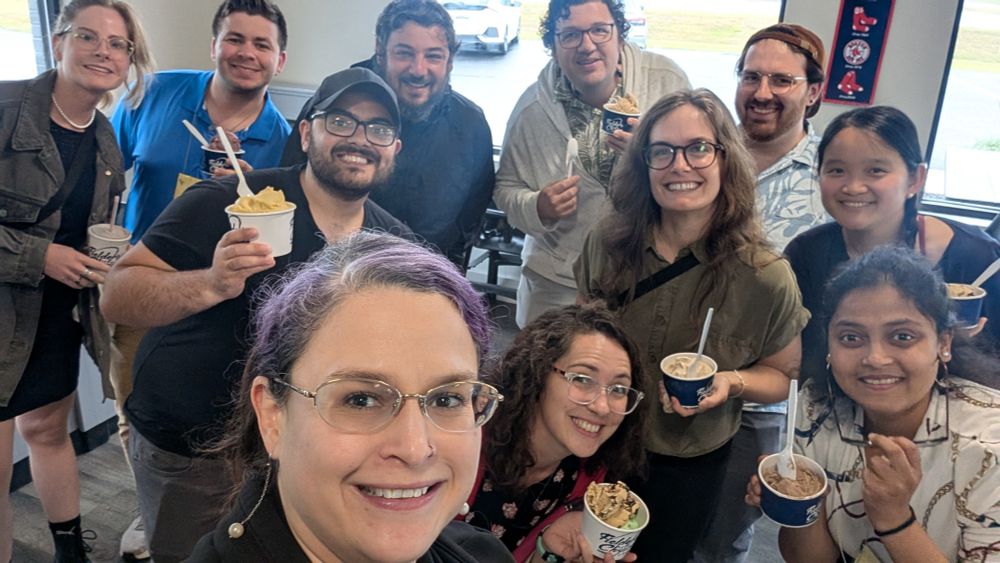
Photochemistry and ice cream, summer is complete! #grcphotochemistry @johnswierk.bsky.social @dr-dani-ar.bsky.social
31.07.2025 20:13
👍 11
🔁 1
💬 0
📌 1
Photochemistry and ice cream, summer is complete! #grcphotochemistry @johnswierk.bsky.social @dr-dani-ar.bsky.social

Feeling proud of @binghamtonu.bsky.social for ensuring that graduate admissions are unaffected and that we deliver on our commitments to admitted students!
Come get me, I’m ready!
Thanks Justin!
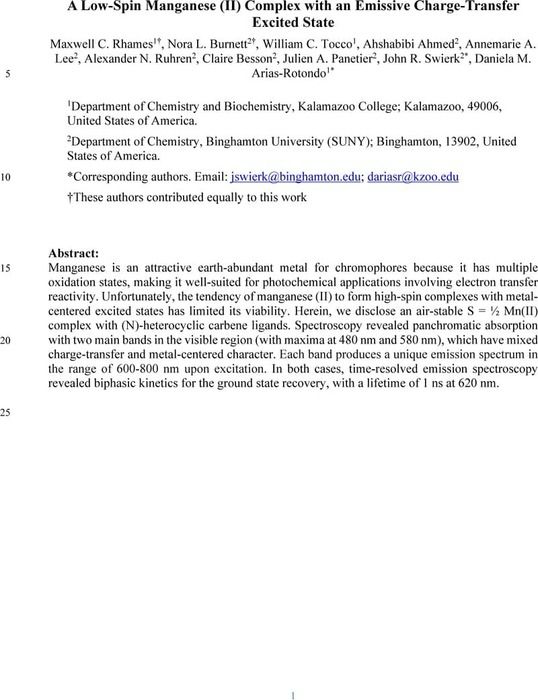
I’m so excited to share my group’s first pre-print! This is a collaboration with @johnswierk.bsky.social and @japanetier.bsky.social.
Here’s your reminder that great science comes from PUIs, too 😊
doi.org/10.26434/che...

Grad students on this project get a pretty broad exposure to different techniques (TAS, qNMR, echem) and will work in a really supportive group environment. Previous students have done well w/ publications (both number and impact)
www.binghamton.edu/apps/academi...
Just putting this out there but next fall my group will be taking on a new grad student for our mechanistic photochemistry work so if you have undergrads that are interested in studying mechanisms and kinetics, encourage them to apply to our PhD program (link below👇)
*whispers*
The University of Pennsylvania and Pennsylvania State University are two different schools very far away from each other :)
Overall, we think this is the first step in understanding how to rationally design photoredox chain reactions. Huge congrats to Annemarie for her first 1st author paper and on bringing this cool study to completion! 7/7
This could mean that some reaction run under intense light conditions could show chain reactivity under less intense conditions. Also, the modeling shows that QY for a chain reaction changes with light intensity - unlike non-chain reactions. 6/n
Kinetic modeling using the rate constants from TAS reproduces the experimental QY and allows us to explore how changing other variables impacts the reaction. One interesting result, chain reactivity is most efficient at low light intensity. 5/n
Transient absorption spectroscopy shows that propagation is slow, while reduction by the photocatalyst is fast. When O2 is added, O2 acts as a secondary electron acceptor and slows the reduction of [4+2]•+ by an order of magnitude. This enables high chain reactivity. 4/n
In this report, we show that the key step in the [4+2] cycloaddition of isoprene and anethole is formation of the [4+2] product radical cation. This species can oxidize another anethole to propagate the chain or get reduced by the photocatalyst. 3/n
We had previously shown that chain reactions, those where one photon leads to multiple product molecules, are important for producing useful amounts of material at scale. But how do you intentionally design for chain reactivity? 2/n

Proud to share our latest in JACS We report an in-depth kinetic and mechanistic investigation of a [4+2] chain photoredox rxn. 1/n
pubs.acs.org/doi/abs/10.1...

Text comment on end of semester evaluation that says “I did not like the class because I actually had to learn material rather than memorize answers for exam questions”
I got this comment on an end of semester evaluation. It’s not tongue in cheek but I will take it as a unintended compliment?
I think more focused symposia with better attendance. It’s pretty grim to go give a talk to 10 people. Some of the divisions seem to succeed in that better than others (e.g., POLY). There are probably too many symposia overall. Sometimes the venues are too big, you spend too much time traveling
I just don’t think ACS offers the value for that kind of rate, especially when factoring hotels, food, travel, etc
$850 for an ACS meeting early registration. Are you kidding me…?
Awesome talk from @jkisunzu.bsky.social today about aryne chemistry! Totally engrossing the whole time. Very cool stuff!
I am convinced that academic dishonesty procedures exist mostly to discourage faculty from submitting complaints.
With the semester ending, the point is to recognize that grades are just a snapshot of a moment in time influenced by a myriad of things, only some of which relate to the classroom and the content. Remember that the next time you talk to a student or analyze an application. 12/12
Personally, I was a mediocre Gen Chem and orgo student through no fault of the people teaching the class. It wasn’t until I got to inorganic that something clicked and I pursued chemistry. Now I love teaching Gen Chem and do physical organic research. 11/
A large number of Nobel Laureates were mediocre students. The right set of conditions later in life made things “click.” 10/
Much like the reactions that never improve, those students are frustrating but I would still argue for positivity and supportiveness. There is still a chance down the road that something changes and you don’t want to stifle that chance before it ever happens. 9/
How about grades in aggregate? Do they tell you something? Maybe. Just like a sluggish reaction, maybe there no set of conditions that you can use to unlock a student’s potential. Maybe they have a significant trauma or just aren’t interested enough to put in the effort. 8/
Chemists are good at optimizing reaction conditions, which most often means overcoming kinetic issues. If students aren’t doing well, think of it instead as an unoptimized reaction, with some room for improvement. What can YOU do to optimize the class and remove barriers? 7/
So we do we do with this information? One, we can recognize that a student who does poorly in our classes may still have lots of potential at a different time and place and thus avoid saying, “you’re not good at XXX.” 6/
I think we would all agree that it’s unlikely that student would still get a C-. If that C- was an absolute measure of ability, it wouldn’t change. The fact that we know it would change means we recognize that grades are context dependent. 5/