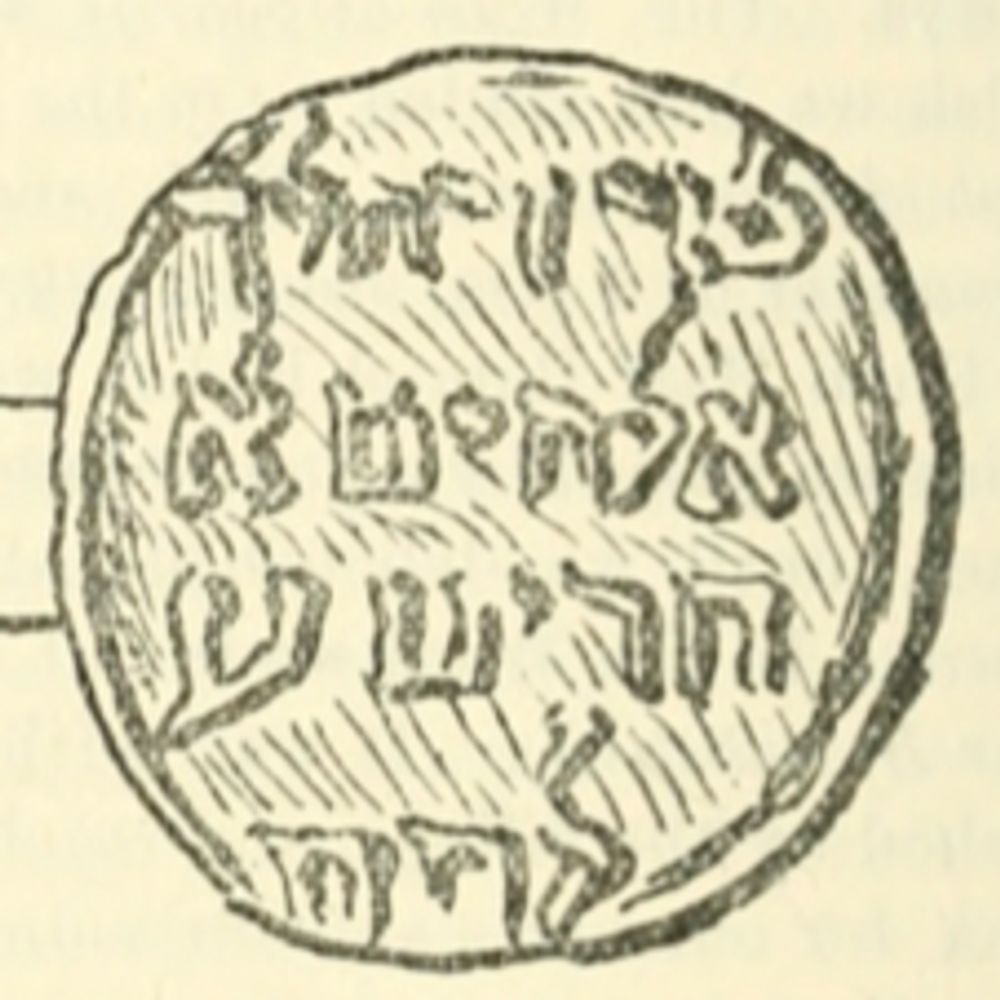
How fitting that Commentary chose to illustrate this nasty, fraudulent piece of work with a notorious fake, the Jehoash Inscription.
What a way to show you care about Jewish history.
03.09.2025 00:21
👍 0
🔁 0
💬 0
📌 0

Instead of this fairytale that Mandel ends with, we might note that Israel, like every other actor in this story, uses the idea of "preserving world history" for political ends -- and this includes Mandel and Commentary.
02.09.2025 23:22
👍 1
🔁 0
💬 1
📌 0

So, Mandel and Commentary care so much about Jewish history that they recycled a stock image of a fake inscription to illustrate this nasty piece of crap.
02.09.2025 23:22
👍 2
🔁 0
💬 1
📌 0

As far as I can tell, this illustration first appeared in a 2005 Nature article on this and other forgeries causing a scandal in Israel in beyond.
Apparently it has since become a stock image available from Getty Images & used in different articles.
www.nature.com/articles/434...
02.09.2025 23:21
👍 2
🔁 0
💬 1
📌 0
There is a silver lining to this nasty piece of work, though: the choice of illustration.
What we have here is something that has nothing to do with the article itself -- it's a detail of the so-called "Jehoash Inscription," a notorious forgery.
02.09.2025 23:20
👍 1
🔁 0
💬 1
📌 0


Mandel then dismisses the idea that the bill is opposed because it is a way of officially annexing (he uses the common euphemism "sovereignty expansion") the West Bank -- even though, in the very TOI article he starts with, the MK who introduced the bill admits this openly.
02.09.2025 23:20
👍 1
🔁 0
💬 1
📌 0
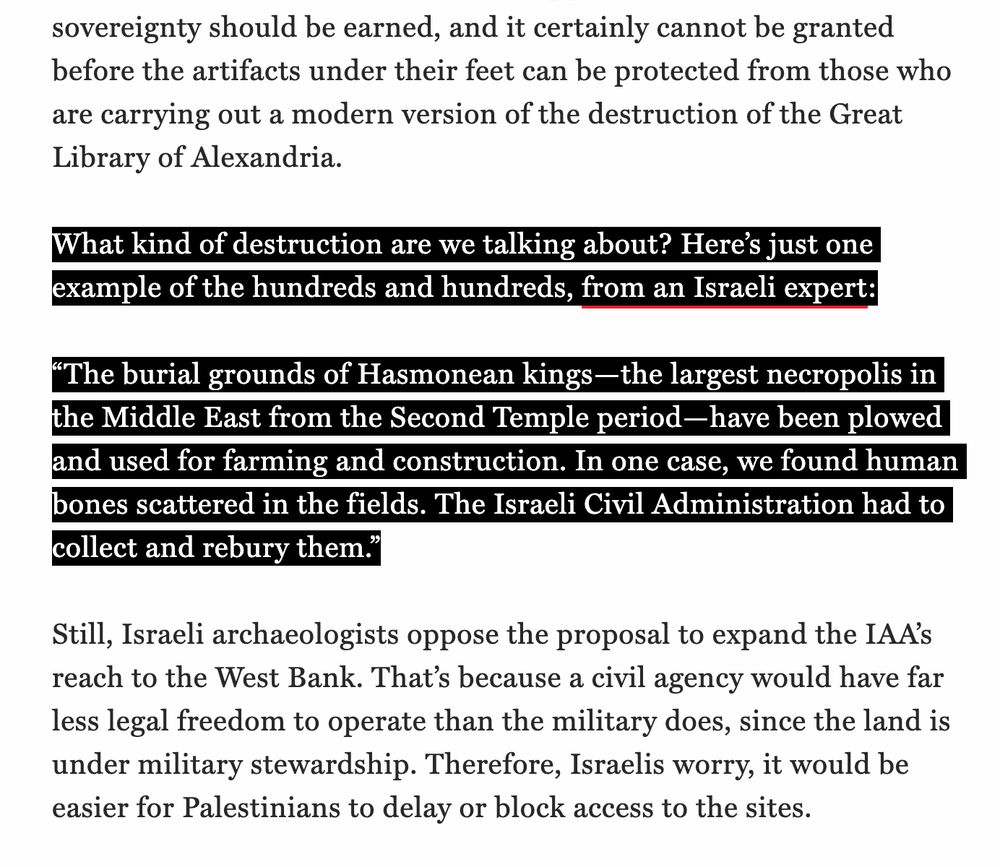
It's probably very telling that Mandel uses the word "expert" here and not "archaeologist", so that this is not a literal lie, just highly misleading.
02.09.2025 23:19
👍 1
🔁 0
💬 1
📌 0

Mandel continues by quoting an "Israeli expert" on the nature and scale of the destruction.
The reader will naturally infer that the expert is an archaeologist -- but when you follow the link you see the "expert" is actually a senior figure at a settler organization.
02.09.2025 23:17
👍 1
🔁 0
💬 1
📌 0
And, if we were actually trying to understand looting, we would note (as experts in the study of the antiquities trade regularly do) that trafficking is driven by the demand side.
In this case, a significant percentage of the collectors and dealers driving the trade are Israelis
02.09.2025 23:17
👍 1
🔁 0
💬 1
📌 0

He also conveniently omits any mention of Israeli culpability -- even though, just below the passage Mandel quotes, a settler organization admits to the fact that Israelis, too, are looting sites.
02.09.2025 23:16
👍 1
🔁 0
💬 1
📌 0

In the process, of course, he continues the longstanding, absurd Israeli obsession (from long before 2023) of comparing Palestinians -- and not just Hamas, but Palestinians in general -- to ISIS
02.09.2025 23:15
👍 1
🔁 0
💬 1
📌 0

He dismisses any discussion of *why* the looting might be happening -- something vital to understand if you want to actually counteract it -- to keep laser-focused on blaming Palestinians.
02.09.2025 23:15
👍 1
🔁 0
💬 1
📌 0

Mandel ignores all of this, to focus on the issue apparently of greatest concern to him: blaming Palestinians for the problem.
02.09.2025 23:14
👍 1
🔁 0
💬 1
📌 0
While there are some problems with this article, you can at least learn something about what is going on, the viewpoints of the different actors involved, and how international law relates.
bsky.app/profile/mich...
02.09.2025 23:13
👍 1
🔁 0
💬 1
📌 0
Of all the hysterical warnings over the last few years that "they're destroying our history", this -- from the senior editor of Commentary -- might be both the nastiest and the most dishonest 🧵
02.09.2025 23:11
👍 2
🔁 0
💬 1
📌 2

All the scrolls & fragments in rotation at Museum of the Bible (& I believe those displayed at the Reagan Library) were found in caves around Khirbet Qumran in the West Bank when it was under Jordanian occupation, & have since been moved illegally by Israel to West Jerusalem
02.09.2025 19:48
👍 0
🔁 0
💬 0
📌 0
Special Exhibit: Dead Sea Scrolls
Special Exhibit: Dead Sea Scrolls. NOVEMBER 22, 2024 - SEPTEMBER 2, 2025*
Dead Sea Scrolls: The Exhibition opened last year (and is closing today) at the Ronald Reagan Presidential Library -- another institution that apparently sees no problem partnering with the IAA.
www.reaganlibrary.gov/exhibits/spe...
02.09.2025 19:48
👍 1
🔁 0
💬 1
📌 0


Nearly two years into Israel's annihilation of Gaza and Museum of the Bible's partnership with the Israel Antiquities Authority (IAA) is still going strong.
02.09.2025 19:47
👍 1
🔁 0
💬 1
📌 0

In Revue Biblique, I have an article on the provenance of the "Nazareth Inscription", an Early Roman-period text that has been often linked over the last century with the earliest Christians. What can we actually say about it? 🧵
27.08.2025 20:46
👍 10
🔁 5
💬 1
📌 0
PEETERS ONLINE JOURNALS
Thus, we are left with a blank -- as usually happens with the antiquities trade, the act of looting destroys any real knowledge we could ever have about where this object actually comes from.
poj.peeters-leuven.be/content.php?...
27.08.2025 20:54
👍 3
🔁 0
💬 0
📌 0
So, what can we conclude about the inscription?
When Froehner wrote that the inscription was sent from Nazareth, it very likely was sent by the Koubourssys -- but they could have collected it almost anywhere in the southern Levant.
27.08.2025 20:54
👍 2
🔁 0
💬 1
📌 0
In fact, the only dealers in Palestine that I'm aware of who sent items to French collectors in the 19th century were these 2 dealers from Nazareth
27.08.2025 20:54
👍 0
🔁 0
💬 1
📌 0

And (as has been known for decades but has been ignored by most scholars) among the French collectors who interacted with the Koubourssys was Wilhelm Froehner himself--the man who acquired the Nazareth Inscription!
(Froehner, Mélanges d’épigraphie et d’archéologie XI-XXV, 1875)
27.08.2025 20:53
👍 0
🔁 0
💬 1
📌 0
The Koubourssys were the source of several antiquities now in the Louvre, but their names are nowhere to be found in the Louvre's collection database; only the collectors like de Saulcy who acquired the items from the Koubourssys & then donated them to the Louvre are named.
27.08.2025 20:53
👍 0
🔁 0
💬 1
📌 0
Source: Félicien de Saulcy, Numismatique de la Terre Sainte (1874)
27.08.2025 20:52
👍 0
🔁 0
💬 1
📌 0


In particular, I was able to highlight the activities of 2 members of the Koubourssy family of Nazareth, who acquired antiquities for French collectors between the 1860s and 1890s, and whose activities ranged from S Syria to Kerak in Transjordan to Akka to Asqalan.
27.08.2025 20:52
👍 0
🔁 0
💬 1
📌 0

As for the claim abut Nazareth as an antiquities hub: my research on the 19c antiquities trade has shown that in fact Nazareth *was* a regional hub for the trade:
Objects were collected east of the Jordan, and were sold not just to tourists but to merchants from Lebanon.
27.08.2025 20:52
👍 0
🔁 0
💬 1
📌 0

I argue, however, that both these conclusions are wrong.
First, the only evidence for tying the inscription to Kos is a provenience study of the marble -- but this would demonstrate only where the marble was quarried. It tells us nothing about where it was set up.
27.08.2025 20:51
👍 1
🔁 0
💬 1
📌 0