

Open access article, with Michael Hameleers and @emmavandergoot.bsky.social: academic.oup.com/ct/advance-a...
13.12.2025 05:58
👍 3
🔁 2
💬 0
📌 0
Open access article, with Michael Hameleers and @emmavandergoot.bsky.social: academic.oup.com/ct/advance-a...
💡 We propose a conceptual framework for identifying illegitimate experts. This can help spot them while acknowledging that this is a complex task
📌 Our case study on climate change and Covid-19 shows that expertise in misinformation is shaped more by content and how it is communicated than by credentials alone. Misinformation uses strategies like selective quoting and speaking outside one’s area of expertise to create credibility
🔹 In misinformation, fake experts can be real people, for example someone is quoted outside one's expertise, but they can also be a rhetorical tool, like listing large numbers of supposed experts who may not exist
🧐 The fake expert label lacks significance, unless explicitly linked to misinformation. Expertise is highly context-dependent, so someone can be a true expert in their field but become a “fake expert” if they, for example, speak outside their expertise
Fake expert and pseudo-scientist labels are increasingly used in science and public debates to delegitimize actors or claims, often in the context of misinformation 📰 In our newest publication in Communication Theory we explore what such terms actually mean. 👇
How did a high-stakes meeting between Trump, Vance& Zelenskyy turn from diplomacy to open confrontation?
Lotte van Burgsteden, @christelvaneck.bsky.social &I unpack conversational polarisation as it unfolded live in the Oval Office. @polcommjournal.bsky.social contains link to transcript #openaccess
🌿 PhD Opportunity in Environmental Psychology: We would like to invite students to apply for the student-led 2026 WGSSS PhD Studentship Competition at Cardiff University. (1/3)
🗓️ Deadline: 11 Dec 2025
🔗 wgsss.ac.uk/student-led-general-competition

Title, authors’ names, abstract, and keywords from a paper about the effect of communication strategies by climate scientists on their credibility
Scientists are changing their normal #communication practice of only giving facts, esp. re climate change. @christelvaneck.bsky.social & @tonivdmeer.bsky.social tested whether stories & affective expression affect scientists’ credibility & found context & consistency matter doi.org/10.1177/0963...
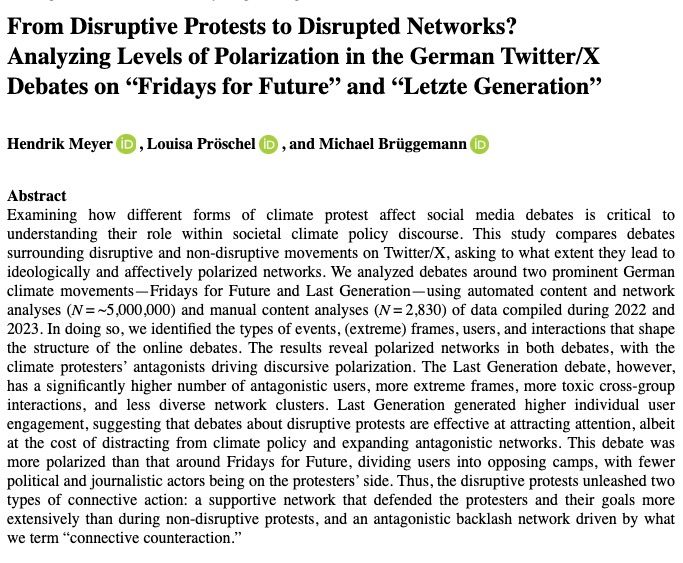
New in Social Media + Society:
How do (non-)disruptive #climate #protests shape social media debates?
We analyzed ~5M Twitter/X posts on #FFF & #LetzteGeneration: Disruptive protests generate more engagement—but also more polarization, driven by right-wing/conservative users: doi.org/10.1177/2056...

A screen capture of the science article on the CBC homepage today, which features a picture of me and a title reading “prominent climate scientist argues it’s time to ditch the myth of neutrality in science.”
Was not expecting to open the main CBC page this morning and see this!
In today’s climate, I feel our message is even more relevant than even just a few months ago when the interview was recorded.
www.cbc.ca
@christelvaneck.bsky.social @lydiamessling.bsky.social
Thanks so much for the warm welcome! 🙏
Thanks for this summary Aaron! Sad that I couldn’t join. @anne-urai.bsky.social were you there? This is relevant input to our Academic Green Deal 🙏

4️⃣🤩 Together with @tonivdmeer.bsky.social. Read our study, open access, in Public Understanding of Science: journals.sagepub.com/doi/10.1177/...
3️⃣
✅ When sharing facts, a neutral tone is most effective.
✅ When sharing personal stories, expressing emotion—whether optimistic or pessimistic—resonates best.
2️⃣ Our results suggest when climate scientists incorporate emotion or personal anecdotes into their messaging, their credibility remains largely intact. But message consistency is key...
1️⃣ More and more, we see scientists openly expressing emotions—moving away from the traditional norm of "rational", "neutral" communication. But what are the consequences of this shift? Does showing emotion compromise a scientist’s credibility? In our latest publication, we explored this question 🧵👇
Gefeliciteerd!! 🤩🤩🤩
Thanks so much, Lydia—you know this is genuinely mutual! I think it's about time we meet up! 😊🎉
8️⃣Let’s keep the conversation going—what are your thoughts on the role of scientists in advocacy? 🌍
7️⃣👏 Also, a big thanks to @yuyaolu.bsky.social, whose work on analyzing the results made this research (and her first published article!) a great achievement.
6️⃣🤩 Huge shoutout to Dr. Lydia Messling for inviting me into this project—it’s been an amazing experience. Our discussions were invaluable, as she challenged my thinking & brought clarity to this complex debate.
5️⃣I invite you to read the article 📖, published open access in Public Understanding of Science, and explore all the fascinating quotes! 👉 lnkd.in/gZhMuQDW
4️⃣In essence, protecting the integrity of science is used as an argument both for and against advocacy. But there’s a caveat! Scientists often hold multiple, sometimes conflicting views—so this framework should not be seen as a binary tool.
3️⃣At the same time, preserving scientific integrity was also an argument in favor of advocacy. Many scientists saw it as their responsibility to defend science from misinterpretation (F1) 🛡️ and to ‘sound the alarm’ as experts & citizens (F2) 📢.

2️⃣Our framework reveals key reasoning. Advocacy was seen as a threat to scientific integrity, either by creating (or raising suspicion of) biased science (A1) 🤔—where political values shape research—or by scientists overstepping their expertise & misusing authority (A2) 🤐.

1️⃣ There’s much debate about the role of scientists in climate advocacy, but we often overlook the core concerns behind their arguments.
In our latest publication 🔍, we map these concerns based on interviews with 47 climate scientists! journals.sagepub.com/doi/10.1177/...

📣NEW PAPER: ‘Advocacy - defending science or destroying it?’ Our interviews with 47 climate scientists provide detailed explanations on all the good things about policy advocacy and the legitimate concerns with threats to the integrity and credibility of science. journals.sagepub.com/doi/10.1177/...
I used to think science was completely objective, free from human values and biases.
Obviously, that is bollocks. We are humans who make value informed decisions every day!
So I ❤️ this from @christelvaneck.bsky.social @katharinehayhoe.com @lydiamessling.bsky.social www.nature.com/articles/s44...