
How does acidity affect #ImmuneCells?
The @xuzhoulab.bsky.social at @bostonchildrens.bsky.social found that a drop in pH can suppress immune responses by disrupting a protein called #BRD4.
🥼 Abstract in @cellpress.bsky.social: https://bit.ly/3IZDAhP
✏️ Press release: https://on.bchil.org/48rhZtf
13.10.2025 16:09
👍 1
🔁 1
💬 0
📌 0

Super excited to see our recent @cellcellpress.bsky.social paper featured in a Life Metabolism preview! Huge thanks to Christoopher Glass @ucsdmedschool.bsky.social for the thoughtful highlight. 🔗 academic.oup.com/lifemeta/adv...
#inflammation #macrophage #chromatin #pH #biomolecularcondensates
19.09.2025 15:31
👍 2
🔁 1
💬 0
📌 0
congratulations to @virusesimmunity.bsky.social @brangwynnelab.bsky.social!
19.09.2025 15:27
👍 2
🔁 0
💬 0
📌 0
Thanks Kevin!
22.07.2025 21:16
👍 1
🔁 0
💬 0
📌 0
Thank you so much Igor! It was a fun journey :)
22.07.2025 21:16
👍 0
🔁 0
💬 0
📌 0
Thank you Sunny!
22.07.2025 18:50
👍 1
🔁 0
💬 0
📌 0
Thanks Junjie~
22.07.2025 15:21
👍 0
🔁 0
💬 0
📌 0
Thank you Meghan!
22.07.2025 15:21
👍 0
🔁 0
💬 0
📌 0
This long journey started ~10yr ago when I was postdoc with @rmedzhitov.bsky.social. twists and turns along the way&many hypotheses proven wrong. This journey is impossible without generous support from my former mentor and labmates, talented people in my own group and collaborators&colleagues.
22.07.2025 14:21
👍 0
🔁 0
💬 0
📌 0

last but not least, BRD4 are broadly expressed in different cell types. We found consistent pH-dependent regulation across immune, stromal, epithelial and tumor cells, including both mouse and human. More examples are accumulating in-house. feel free to dm / email me if anybody is interested.
22.07.2025 14:15
👍 0
🔁 0
💬 1
📌 0

we hypothesize that BRD4 condensates could function as an internal pH meter to gauge cellular state linked to inflammatory activation and metabolism, by controlling the expression of key metabolic genes. 22/n
22.07.2025 14:12
👍 0
🔁 0
💬 1
📌 0

and a similar response happens in vivo! 21/n
22.07.2025 14:09
👍 0
🔁 0
💬 1
📌 0

As immune activation tends to increase intracellular and extracellular acidification, we turned to look at what happens just with LPS stimulation. And it is sufficient to reduce BRD4 condensates in vitro 20/n
22.07.2025 14:07
👍 0
🔁 0
💬 1
📌 0

for anybody who is curious what make a gene dependent or not on BRD4 condensates: we don't have the answer yet, but we found that pH-sensitive genes seem to have the most recruitment of BRD4 to their enhancers. In another words, BRD4 recruitment might be a predictor of pH-sensitive expression.19/n
22.07.2025 14:06
👍 0
🔁 0
💬 1
📌 0

disruption of BRD4 condensates leads to disruption of MED1 condensates, which likely explains the suppressed the inflammatory activation in macrophages (more to come about these mechanisms!) 18/n
22.07.2025 14:05
👍 1
🔁 0
💬 1
📌 0

surprisingly, we found that only histidine residues in selective regions of BRD4-IDR are required for pH sensitivity, and that consecutive histidine can give rise to pH-sensitivity in biomolecular condensates at physiological pH range.
17/n
22.07.2025 14:01
👍 0
🔁 0
💬 1
📌 0

Swapping histidines (ph sensitive around 6-7) to alanine can reverse the pH-dependent regulation on transcriptional condensates. 16/n
22.07.2025 14:01
👍 0
🔁 0
💬 1
📌 0

This response is regulated by enriched and conserved histidines on BRD4-IDR 15/n
22.07.2025 14:00
👍 0
🔁 0
💬 1
📌 0

with suggestions from reviewers, we brought up our game to super-resolution microscopy to characterize the changes of native BRD4 condensates with STED scope & thanks to help from Krishnan Raghunathan and Thiagarajah lab👍
22.07.2025 13:59
👍 1
🔁 0
💬 1
📌 0

@bsabari.bsky.social @richardyonck.com @whiteheadinstitute.bsky.social Arup Chakraborty @mitpress.bsky.social among other pioneers in biomolecular #condensates showed that BRD4 forms transcriptional condensates. We found that these condensates native to macrophages are disrupted by acidic pH. 13/n
22.07.2025 13:57
👍 1
🔁 0
💬 1
📌 0
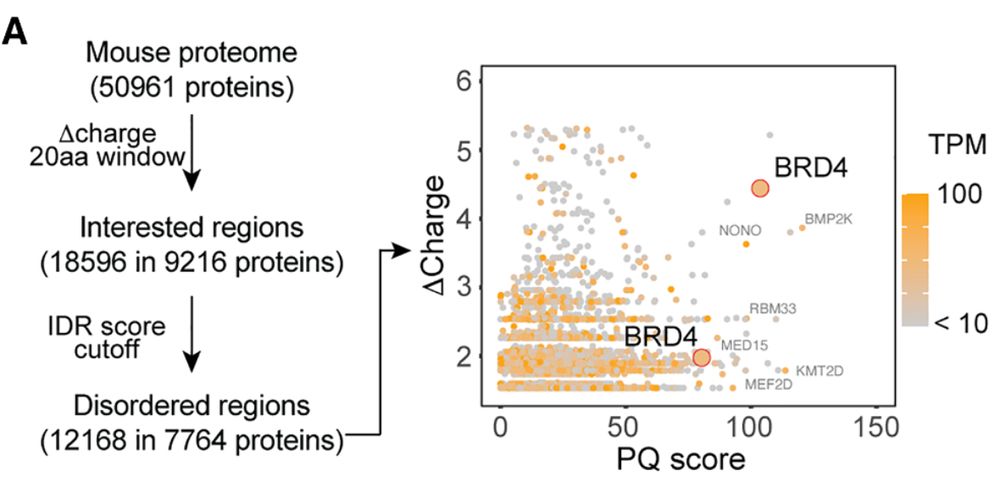
Based on features of the disordered loop in yeast SNF5. Diana Leung in my lab did an in silico screening and found mammalian BRD4 as putative pH sensor. Happy to chat about the bioinformatic work if anyone is interested. 12/n
22.07.2025 13:51
👍 0
🔁 0
💬 1
📌 0

But how does it happen? We tested differential signaling, protein translation, global epigenetic modification etc. all proven wrong. a few good years of negative data 10/n
22.07.2025 13:49
👍 0
🔁 0
💬 1
📌 0

this analysis suggested that inflammatory genes partition into functions for immediate microbial defense and propagations of inflammatory cascade in a pH-dependent manner 9/n
22.07.2025 13:48
👍 0
🔁 0
💬 1
📌 0

And even more surprise, pH-dependent response is independent of well-known pH sensors in macrophages. To understand better how it happens, we developed a #deconvolution model to quantify how pH and immune signals interact to activate each gene.
Alert 🔥 A computational pipeline will be online soon.
22.07.2025 13:47
👍 0
🔁 0
💬 1
📌 0

Thanks so much for constructive suggestions from anonymous reviewers. We confirmed the protein level expression for many inflammatory effectors. The pH-dependent regulation was confirmed at protein level, such as for interferon-b and IL-6. 7/n
22.07.2025 13:44
👍 0
🔁 0
💬 1
📌 0

to our surprise, acidic ph regulates a switch-like gene-specific inflammatory response in macrophages. with many interesting genes repressed or more induced at low pH #cytokine #IFN 6/n
22.07.2025 13:42
👍 0
🔁 0
💬 1
📌 0
We tested ph. because 1. Ph is sensed & regulated throughout our body. 2. Ph is perturbed in inflammation, cancer and other disease. 3. Cells express dedicated pH sensor. 4. Acidic ph is largely though to repress immune activity.
22.07.2025 13:40
👍 0
🔁 0
💬 1
📌 0

These ideas are also derived from our earlier discussion
annualreviews.org/content/jour...
and our recent review focusing on pH with
Stephanie Hajjar
22.07.2025 13:40
👍 2
🔁 0
💬 1
📌 0


