I do think it's becoming a tool our students will encounter in the workforce, and there's value in them learning how to use it critically—knowing when it's useful, when it's not, and how to verify what it produces. Same way we teach them to use any other tool with appropriate skepticism.
16.12.2025 21:25
👍 0
🔁 0
💬 0
📌 0
I don't think AI is a panacea. It hallucinates, it gets things wrong, it raises real questions about reproducibility and intellectual labor, but...
16.12.2025 21:24
👍 0
🔁 0
💬 1
📌 0

Claude Code Learning Hub - Master AI-Powered Development
Learn Claude Code, VS Code, Git/GitHub, Python, and R with hands-on tutorials. Build real-world projects with AI assistance.
Been using Claude Code for a year. My R scripts no longer make me want to walk into the sea (which, as a marine biologist, is occupationally inconvenient).
Made codewithclaude.net for researchers who've ben meaning to learn AI coding. open source, assumes you have a experience. open to feedback!
16.12.2025 20:34
👍 2
🔁 0
💬 1
📌 0
![On official UC letterhead:
UNIVERSITY
OF
CALIFORNIA
James B. Milliken President
Office of the President
1111 Franklin Street Oakland, CA 94607
universityofcalifornia.edu
CAMPUSES Berkeley
Davis
Irvine
UCLA
Merced
Riverside San Diego San Francisco
Santa Barbara Santa Cruz
MEDICAL CENTERS
Davis
Irvine
UCLA
San Diego
San Francisco
NATIONAL LABORATORIES Lawrence Berkeley Lawrence Livermore Los Alamos
DIVISION OF AGRICULTURE AND NATURAL RESOURCES
November 18, 2025
Dear Chancellors:
I'm writing with regard to the President's Postdoctoral Fellowship Program (PPFP) and the program's associated faculty hiring incentive.
As you know, for more than 40 years, PPFP has provided postdoctoral research fellowships, professional development, and faculty mentoring to scholars in all fields whose research, teaching, and service advance the academic and research missions of the University of California.
Since 2003, UC campuses that hire current and former PPFP fellows into ladder-rank positions have been eligible for a hiring incentive funded by the University that provides support for newly hired fellows for five years. Since the creation of the incentive, more than $162 million has been invested by the University to support PPFP faculty hires. This commitment has enabled our campuses to successfully recruit and retain outstanding faculty across a range of disciplines.
Given the myriad challenges currently facing UC - including disruptions to billions of dollars in annual federal support, as well as uncertainty around the state budget- reasonable questions were raised in recent months about whether the University could maintain the commitment to current levels of incentive funding. After considering a recommendation to sunset the incentive program due to these significant fiscal constraints, I consulted with all of you as well as faculty and campus academic administrators and systemwide Academic Senate leadership.
[continued on next image]](https://cdn.bsky.app/img/feed_thumbnail/plain/did:plc:rzn6yramffebefeitqifiqqz/bafkreigiwq5ongzwpj4wqmgjam3yfvhyjnv5e3dbq6cnrrbwblqvs624gq@jpeg)
On official UC letterhead:
UNIVERSITY
OF
CALIFORNIA
James B. Milliken President
Office of the President
1111 Franklin Street Oakland, CA 94607
universityofcalifornia.edu
CAMPUSES Berkeley
Davis
Irvine
UCLA
Merced
Riverside San Diego San Francisco
Santa Barbara Santa Cruz
MEDICAL CENTERS
Davis
Irvine
UCLA
San Diego
San Francisco
NATIONAL LABORATORIES Lawrence Berkeley Lawrence Livermore Los Alamos
DIVISION OF AGRICULTURE AND NATURAL RESOURCES
November 18, 2025
Dear Chancellors:
I'm writing with regard to the President's Postdoctoral Fellowship Program (PPFP) and the program's associated faculty hiring incentive.
As you know, for more than 40 years, PPFP has provided postdoctoral research fellowships, professional development, and faculty mentoring to scholars in all fields whose research, teaching, and service advance the academic and research missions of the University of California.
Since 2003, UC campuses that hire current and former PPFP fellows into ladder-rank positions have been eligible for a hiring incentive funded by the University that provides support for newly hired fellows for five years. Since the creation of the incentive, more than $162 million has been invested by the University to support PPFP faculty hires. This commitment has enabled our campuses to successfully recruit and retain outstanding faculty across a range of disciplines.
Given the myriad challenges currently facing UC - including disruptions to billions of dollars in annual federal support, as well as uncertainty around the state budget- reasonable questions were raised in recent months about whether the University could maintain the commitment to current levels of incentive funding. After considering a recommendation to sunset the incentive program due to these significant fiscal constraints, I consulted with all of you as well as faculty and campus academic administrators and systemwide Academic Senate leadership.
[continued on next image]

After learning more about the history and success of the program and weighing the thoughtful perspectives that have been shared, I have concluded that barring extraordinary financial setbacks, the PPFP faculty hiring incentive program will continue while the University continues to assess the program's structure as well as its long-term financial sustainability. As a result of our continuing consultation and review, there may be consideration of some changes to elements of the program including the total number of incentives supported, a number that has fluctuated significantly over the years, and how the awards are distributed among campuses. In the meantime, the University will continue to fund the PPFP faculty hiring incentive program and campuses may continue to take advantage of these incentives. We will have an opportunity to discuss any potential changes prior to adoption.
As we look to the future, I will continue to engage with faculty leaders, program stakeholders, and UC community members about this important program. I especially appreciate the thoughtful perspectives shared in recent weeks by Academic Council Chair Palazoglu and Vice Chair Scott, the Council of Graduate Deans, UC faculty members, and you as our campus leaders.
Sincerely,
James B. Milliken
President
WE JUST KEEP WINNING. (UC President's Postdoctoral Fellowship Program RESTORED!!!!)
18.11.2025 22:34
👍 921
🔁 212
💬 9
📌 16
Widespread Heterogeneity in Density‐Dependent Mortality of Nearshore Fishes
You have to enable JavaScript in your browser's settings in order to use the eReader.
ottom line: Population regulation isn't a fixed property—it's contingent on ecological context.
Want to dive deeper? 📖 Paper: onlinelibrary.wiley.com/doi/10.1111/...
Big thanks to my coauthor @CraigOsenberg and everyone who shared their data! 🙏 (8/8)
18.11.2025 20:38
👍 2
🔁 0
💬 0
📌 0
Why does this matter?
Understanding density-dependence is crucial for:
🔹 Managing fisheries
🔹 Conserving endangered species
🔹 Predicting how populations respond to disturbance (hello, climate change)
But we can't predict what we don't understand. (7/8)
18.11.2025 20:38
👍 2
🔁 0
💬 1
📌 0
Here's the kicker: Most studies don't report the environmental details we need to understand WHY results vary so much.
It's like trying to predict weather without knowing temperature, pressure, or humidity. We need better reporting! 📊 (6/8)
18.11.2025 20:38
👍 2
🔁 0
💬 1
📌 0
Species that naturally occur at LOW densities showed STRONGER density-dependence. This makes sense—if you're not adapted to crowding, adding neighbors hits harder.
Think: introvert at a packed party 😅 (5/8)
18.11.2025 20:38
👍 2
🔁 0
💬 1
📌 0
The same species showed wildly different responses depending on:
Predator density
Shelter availability
Habitat complexity
Even the SIZE of fish when the study started
Location, location, location! (4/8)
18.11.2025 20:38
👍 4
🔁 0
💬 1
📌 0
When predators were present, density-dependent mortality was ~15× stronger than without them. Why? At high densities, fish compete for hiding spots—and those left exposed become snacks. (3/8)
18.11.2025 20:38
👍 1
🔁 0
💬 2
📌 0
For decades, ecologists have known that when fish populations get crowded, mortality often increases—a key mechanism regulating populations.
But here's what surprised us: the STRENGTH of this effect varied by 1000-fold, even within the same species! 🤯 (2/8)
18.11.2025 20:38
👍 2
🔁 0
💬 1
📌 0
New paper alert! We just published a massive meta-analysis in @EcologyLetters asking: How does crowding affect survival in reef fish populations?
The answer? It's way more complicated than we thought.
🧵 Thread on what 147 studies taught us (1/8) onlinelibrary.wiley.com/doi/10.1111/...
18.11.2025 20:38
👍 30
🔁 8
💬 1
📌 1
This plays out in real West Coast fisheries—Pacific hake, petrale sole, sablefish—where assessments update every 1-4 years. Climate-ready doesn't mean win-win. It means being transparent with communities about whether we're prioritizing conservation or catch.
06.10.2025 23:09
👍 1
🔁 0
💬 0
📌 0
We modeled fish populations under climate change and found consistent trade-offs. When productivity declined, adaptive management kept populations 42% larger but reduced harvest. When it increased, adaptive rules boosted harvest >100% but populations ran 40% smaller.
06.10.2025 23:09
👍 2
🔁 0
💬 1
📌 0

Our new study by Jameal Samhouri in @PLOSClimate reveals an uncomfortable truth about climate-ready fisheries: adaptive management strategies can boost population biomass OR harvest—but rarely both. The 'right' choice depends on what we value as a society.
journals.plos.org/climate/arti...
06.10.2025 22:48
👍 5
🔁 1
💬 1
📌 0
Cryptic predation on coral spawn: Hidden trophic links in the dead of night
YouTube video by Tom Shlesinger
www.youtube.com/watch?v=1HTj...
26.09.2025 11:56
👍 2
🔁 1
💬 0
📌 0

Coral spawning = nature’s biggest party 🎉🌊
But while corals release their eggs + sperm into the night, a hidden guest list shows up hungry… 🦀⭐🐚🦪
@TomShlesinger reveals crabs, barnacles, brittle stars & more secretly feasting on coral spawn. doi.org/10.1002/ecy....
26.09.2025 11:52
👍 15
🔁 4
💬 1
📌 0
Take-home: Indonesia’s reefs may be showing more resilience than expected, but cover alone doesn’t capture species shifts, functional change, or hidden vulnerability.
03.09.2025 16:31
👍 3
🔁 0
💬 1
📌 0
3/ The “shifted baseline” point is key: most data begin after the 1998 global bleaching event. What looks “stable” may already reflect reefs that declined before monitoring began.
03.09.2025 16:31
👍 2
🔁 0
💬 1
📌 0
2/ This stability is surprising given repeated mass bleaching and local disturbances.
So what’s going on? The authors suggest 4 possibilities:
• shifted baselines (post-1998 data dominate)
• averaging masks local losses & gains
• sampling biases
• true resilience of Indonesian reefs
03.09.2025 16:31
👍 3
🔁 0
💬 1
📌 0
Had so much fun visiting @ucdavis.bsky.social Bodega Marine Lab today and learning about all of the amazing work going on here. Thank you @dranyabrown.bsky.social , @rachaelabay.bsky.social , @tessahill.bsky.social and Jay for such a nice visit! 🐳
28.08.2025 04:56
👍 4
🔁 0
💬 0
📌 0
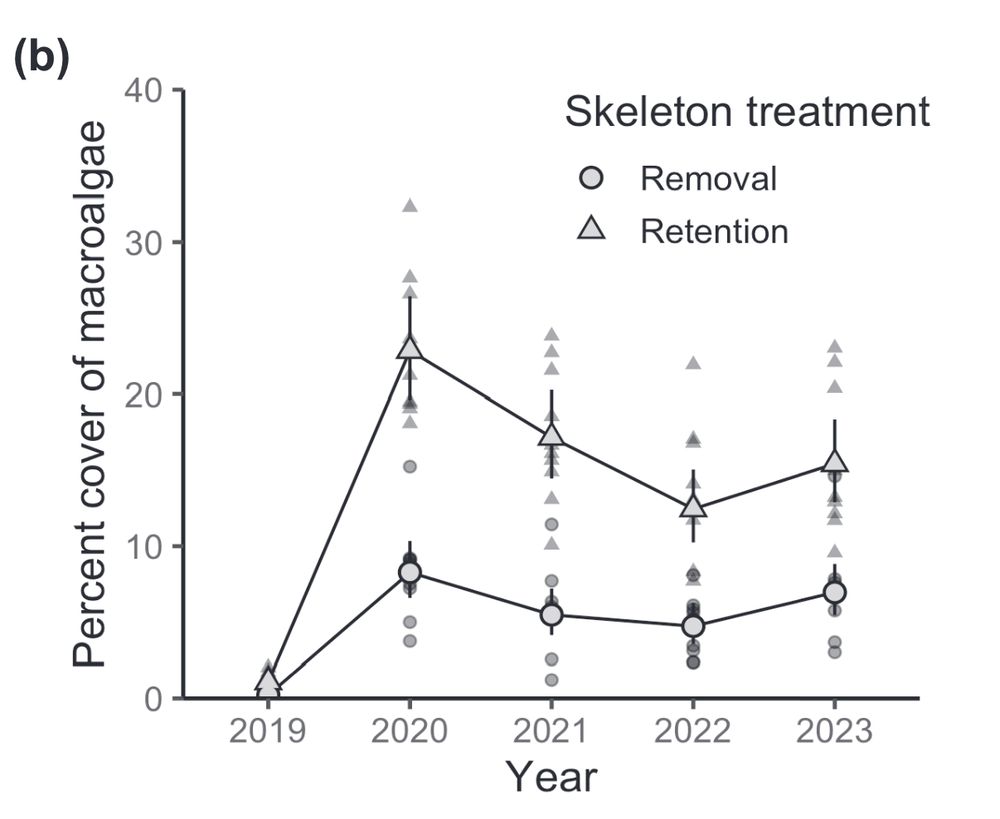
After marine heatwaves, removing dead coral skeletons cuts macroalgae in half and boosts coral recruitment 5-fold.
A novel, field-tested strategy to promote reef resilience.
Bravo, Kai Kopecky!
🧠📸🪸
Open access @ESA_org doi.org/10.1002/eap....
29.07.2025 16:52
👍 13
🔁 3
💬 0
📌 1

Securing a sustainable future for US seafood in the wake of a global crisis
The United States seafood industry is undergoing rapid change, as a result of the current trade war with China, ongoing global COVID-19 pandemic, and …
Just wrote and submitted a paper with another co-author in less than a week as a follow up to our Froehlich et al. 2021 pub (below), focused on comparing the U.S. Seafood Executive Order from 2020 to the one that was just released in 2025. Preprint coming soon 👀
www.sciencedirect.com/science/arti...
25.04.2025 22:19
👍 6
🔁 3
💬 0
📌 1
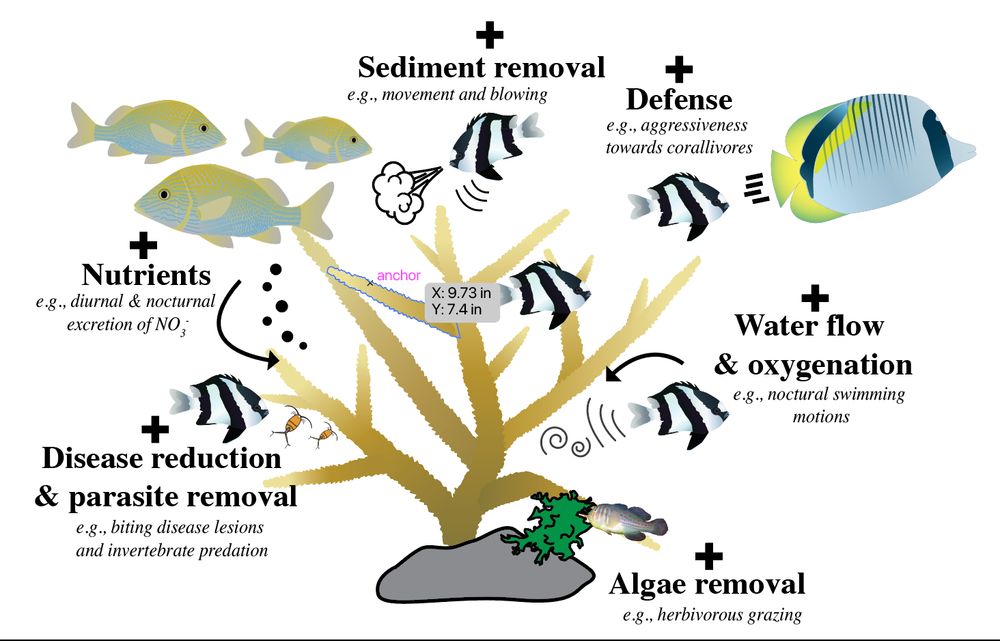
New in Coral Reefs ! 🐟🪸 Our review of how coral-associated fishes boost coral health by enhancing oxygenation, nutrients, and defense—key allies for coral resilience. With Craig Osenberg and Tory Chase!
drive.google.com/open?id=1s57...
#coralreef #marineecology
02.04.2025 20:31
👍 5
🔁 0
💬 0
📌 1
To all my colleagues in government who work tirelessly to try to make our world a better place, I'm so sorry you're going through this and am so grateful for your service, thank you ❤️
21.02.2025 16:36
👍 1
🔁 0
💬 0
📌 0
wondering about a log scale to make the smaller values more visible, is it zero bounded?
06.02.2025 19:30
👍 1
🔁 0
💬 1
📌 0