A blue-green tinted sketch of Anthracobune wardi eating some weeds

A sketch of Indohyus indirae in a green pencil.
Yesterday and today for #marchofthemammals2026 #paleoart #sciart - portraits this week for efficiency.
06.03.2026 19:52
👍 46
🔁 13
💬 0
📌 0

Vector illustration of Anthracobune wardii, a large bodied stem-perissodactyl from middle Eocene South Asia. The large, stocky, tapir like animal is sitting on its haunches looking up. It is dark brown with a dark underside, with dark stripes on its long tail and white patches on its legs and face
#marchofthemammals2026 day 5: Anthracobune wardii, a big chunky stem-perissodactyl
#sciart #paleoart #fossilfriday
06.03.2026 19:23
👍 32
🔁 9
💬 2
📌 0

A large mammal with a long tail leads another, smaller one across a lush creek.

A closer view of the larger animal.

March of the mammals prompt list
#marchofthemammals2026 Day 6: Anthracobune wardi
Anthracobune leads her calf across the creek.
06.03.2026 20:34
👍 9
🔁 5
💬 0
📌 0

Done in sketch, colored pencils and crayons.
Day 5: Indohyus indirae
An extinct hoofed mammal known as raoellid artiodactyl from Kuldana Formation during Eocene Asia.
#marchofthemammals2026 #paleoart #sketchbook
05.03.2026 23:10
👍 8
🔁 2
💬 0
📌 0
My cat (supposedly obligate carnivore) whenever we bring home a new plant:
05.03.2026 18:19
👍 3
🔁 1
💬 0
📌 0

Vector illustration of Indohyus indirae, a raccoon sized artiodactyl closely related to whales. This small unassuming ungulate has long legs, a long snout, a thick tail and small hooved feet. It is dark brown with an olivey yellow rump. The animal is seen walking with a lotus leaf in its mouth
#marchofthemammals2026 day 4: Moving on from the Mesozoic to the Early Eocene mangroves of Pakistan with a cheeky Indohyus indirae
05.03.2026 18:01
👍 64
🔁 20
💬 3
📌 1

A small rat/deer-like mammal walks by a riverbank, brushing against a cattail that is significantly larger than it.

Full view of the Kuldana formation diorama featuring an open woodland around a creek.
March of the mammals prompt list
#marchofthemammals2026 Day 5: Indohyus indirae
Indohyus sniffs around the creek bank for a snack. A not-quite whale to start us off in the formation famous for its early whales!
05.03.2026 17:27
👍 10
🔁 4
💬 0
📌 0
I love the rats of various forms (Mesozoic mammal diversity)
04.03.2026 23:53
👍 1
🔁 0
💬 1
📌 0

Drawings of multiple small ancient mammals lightly coloured in browns and pinks , marked with their Latin names (Megacornis mammalifornis, MAiopatagium furculiferum and Ruguodon eurasiaticus) and a #marchofthemammals graphic as part of an annual art challenge
Week one posting together for #marchofthemammals2025 #paleoart 🐡 #sciart
04.03.2026 23:35
👍 133
🔁 34
💬 3
📌 0


Kunpengopterus flies in on the first rest day of #marchofthemammals2026 , helping to wrap up the Tisojishan Formation! Maybe those mammals could learn a thing or two about his opposable thumbs... Join us tomorrow when we enter the realm of the early whales!
04.03.2026 18:43
👍 26
🔁 8
💬 1
📌 0

Day 3: Rugosodon eurasiatius
A extinct genus of rodent-like multituberculate mammal from eastern China that lived 160 million years ago during the Late Jurassic period.
#marchofthemammals2026 #paleoart #sketchbook
03.03.2026 22:31
👍 7
🔁 2
💬 0
📌 0

Vector illustration of Jurassic multituberculate Rugosodon eurasiaticus, climbing on the curved branch of Wielandiella, a bennittitale. The rat like allotherian mammal is brown-grey in color with a light underbelly and light spots on its brow. Wielandiella has long curving branches lined with leaf scars, topped with a crown of long, draping leaves. There is a large orange fruiting body in between the branches, dotted with a rough texture
#marchofthemammals2026 day 3: Rugosodon eurasiaticus! Ft. Wieilandiella
03.03.2026 20:59
👍 34
🔁 12
💬 1
📌 0

A small plain mammal rests on a mossy log with pink babies on her back.

A further view, including a gray flying squirrel like mammal and a larger brown mammal on the ground.
March of the mammals prompt list
#marchofthemammals2026 Day 3: Rugosodon eurasiaticus
Rugosodon clambers over a mossy log with her babies holding on.
03.03.2026 18:52
👍 10
🔁 7
💬 0
📌 0

Day 2: Maiopatagium furculiferum.
An extinct genus of gliding euharamiyids which existed in Asia during the Middle-Late Jurassic period.
#marchofthemammals2026 #paleoart #sketchbook
02.03.2026 20:49
👍 8
🔁 2
💬 0
📌 0


#marchofthemammals2026 Day 2. Got out a desk lamp to help take the photos. Much better quality photo of yesterday’s entir.
02.03.2026 19:04
👍 9
🔁 3
💬 0
📌 0

Vector illustration of Miaopatagium furculiferum, a gliding haramiyid from the Jurassic of China. The small mammaliaform is hanging from a branch, climbing along with its long limbs. Its long fluffy tail is curled up above the branch. The animal is dark gray with a reddish face and a light underside. Its long fingers, nose and rounded ears are bare and pink
#marchofthemammals2026 Day 2: Miaopatagium furculiferum. A top 10 Mesozoic mammal
02.03.2026 17:44
👍 39
🔁 19
💬 2
📌 0

A gray flying squirrel like mammal clings to a large tree trunk.

A further view.

March of the mammals prompt list
#marchofthemammals2026 Day 2: Maiopatagium furculiferum
Maiopatagium climbs up a tree to start a daring glide all over again.
02.03.2026 17:36
👍 15
🔁 6
💬 0
📌 0

#marchofthemammals2026 I’m going to attempt to do this years and last years at the same time. sorry for the image quality will try and get better photos tomorro.
01.03.2026 22:55
👍 9
🔁 1
💬 0
📌 0

Back to the drawing paleo-mammals for #marchofthemammmals2026 starting with day 1: Megaconus mammaliaformis.
A extinct genus of allotherian mammal from the Middle Jurassic Tiaojishan Formation of Inner Mongolia, China.
#paleoart #Jurassic #mammals
01.03.2026 20:25
👍 9
🔁 2
💬 0
📌 0

Vector illustration of Megaconus mammaliaformis, an ambiguous Jurassic mammaliaform from China. The rat sized animal is stanced across from the viewer, showing the large spurs on its feet. It is dark grey in color, with a light belly
Get ready for #marchofthemammals2026! Starting off strong in the forests of Jurassic China with Megaconus mammaliaformis
#paleoart #vectorart #sciart
01.03.2026 19:18
👍 45
🔁 15
💬 2
📌 0

A dark brown mammal with no external ears on the floor of a lush forest.

A further view
March of the mammals prompt list
#marchofthemammals2026 Day 1: Megaconus mammaliaformis
Megaconus uses its dark coloration to hide on the forest floor. While the phylogenetic position of Megaconus changes between true mammal and close relative, this comparatively giant Jurassic mammaliaform starts us off strong in the Tisojishan!
01.03.2026 16:42
👍 11
🔁 4
💬 0
📌 0
Welcome back edaphosaurus
17.02.2026 01:56
👍 2
🔁 0
💬 0
📌 0
A colorful March Calendar listing extinct fauna.
Wednesdays are listed as rest days.
1: Megaconus, 2: Maiopatagium, 3: Rugosodon, 5:Indohyus, 6: Anthracobune, 7:Birbalomys, 8:Palaeosyops, 9:Paratritemnodon, 10: Pakicetus, 12: Ptolemaia, 13: Antilohyrax, 14: Bothriogenys, 15:Apidium, 16: Masrasector, 17: Moeritherium, 19: Proscelidodon, 20:Agryolagus, 21: Lagostomus, 22: Macroeuphractus, 23: Huayqueriana, 24: Thylacosmilus, 26: Teleoceras, 27: Eocoileus, 28: Arctomeles, 29: Mylohyus, 30: Pristinailurus

How to participate and rules. Any art form is welcome, and will accrue raffle tickets for one of the models I make. Winners of the raffle will get their choice of the models I make for this month.
Welcome back to another year of #marchofthemammals2026 ! We'll be going from formation to formation again, going from gliding mammaliaformes to rotund early elephants to Appalachian red pandas, and everything in between. I hope to see y'all participate!
16.02.2026 20:45
👍 18
🔁 6
💬 0
📌 7

A large gray sloth moves through a rocky diorama with a notable pine tree on the side. Many gray and black birds are perched around it.

Another angle on the sloth.

Another angle on the sloth.
Megalonyx wanders through a flock of Clark's Nutcracker as they're caching pine nuts for the long winter.
#prehistpricplaneticeage had me thinking about Megalonyx in the rockies, and I tried to extrapolate what a summer coat may look like for them. #sciart #paleoart
26.12.2025 23:35
👍 26
🔁 11
💬 1
📌 0

A very blurry brown and white bird with a dark face and light neck.
There was this little passerine(?) hopping around the Gigantopithecus at the river. I went through every bird in Thailand (I believe where this would have been filmed) and couldn't find a match, and since it reacts to the giganto I'm thinking it may be CG.
27.11.2025 17:02
👍 7
🔁 0
💬 0
📌 0
I did my own bout of PhP birding and came to the same conclusions on everyone that you shared. I believe this is a flock of primarily Madagascar Cuckooshrike, there may be a couple Vanga in there as well but it's too blurry and quick to tell for sure.
27.11.2025 16:56
👍 2
🔁 0
💬 1
📌 0

A green Tyrannosaurus rex stands over a freshly killed carcass. Two smaller gray Nanotyrannus stand in the foreground with still bloodied faces.

Another view of the Tyrannosaurus rex, with its eyes locked on the camera.

A picture of the resting Nanotyrannus with a waterfall in the background.
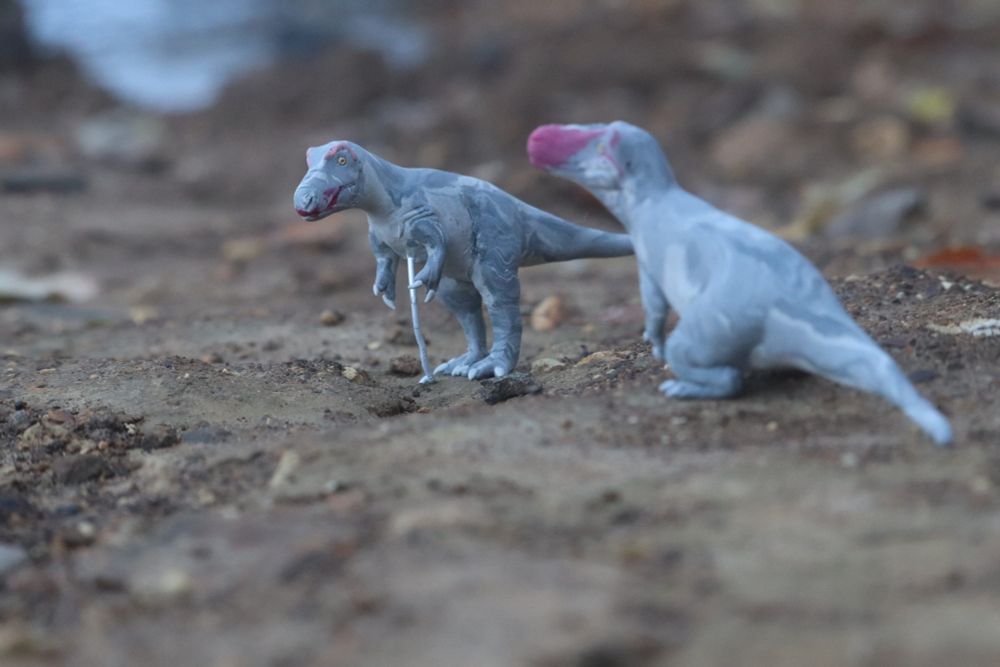
Another picture of the Nanotyrannus pair with the second one in focus.
Tyrannosaurus rex helps herself to the carcass of a subadult Edmontosaurus - the well fought meal of the Nanotyrannus lancensis pair that she bullied off. A new mesopredator in the Hell Creek does mean plenty of food to steal, even if you aren't an obligate scavenger. #sciart #paleoart
05.11.2025 21:05
👍 15
🔁 3
💬 0
📌 0

A large sloth rests in the sunshine while three brown and cream colored birds roost on its side.

Another angle of the sloth with dimmer lighting.

Bird's eye view of the resting sloth and caracaras.

Photo of the ground sloth resting with claws on display in a lightbox with a white floor and black background.
The giant ground sloth Glossotherium rests as a flock of Yellow-headed Caracara keep him tick free.
09.10.2025 18:48
👍 5
🔁 2
💬 0
📌 0

A small brown crocodile with a flat head wanders on upright legs on a dark forest floor. A flashlight illuminates the head and front arms. Thikarisuchus xenodentes (Elton) is looking with beady yellow eyes for their next meal.

The Thikarisuchus model inside with a neutral black background. The detail is more noticeable, showing an armored tail lacking the ridges of aquatic crocs we know today.

A closes view of Thikarisuchus, showing off it's variable dentition. The front of the mouth has conical spikes, while the back has more compressed lanceolate teeth and then shearing rectangular teeth. The back teeth occlude with a ridge on the dentary.
The diminutive Thikarisuchus xenodentes (1/2 scale) wanders the forest floor at night. I'm glad the Blackleaf has another taxa and I'm so grateful to have helped in the process. There's more research from yours truly on this guy down the pipeline, so stay tuned! #sciart #crocodile #paleoart #clayart
23.09.2025 13:47
👍 15
🔁 7
💬 0
📌 0