Haymarket Books Fall 2025 Catalog!
Check out Haymarket’s Fall/Winter 2025 Catalog, featuring books by authors including: Brian Jones, Rebecca Solnit, Vicky Osterweil, Hamid Dabashi, Alfred W. McCoy, Madeline Lane-McKinley, Keeanga-Yama...
Our Fall 2025 catalog is here!
Featuring new books from @brianjoneseducator.bsky.social, @rebeccasolnit.bsky.social, @vickyacab.bsky.social, Hamid Dabashi, @lalouverouge.bsky.social, @keeanga.bsky.social, @mikaelaloach.bsky.social and many more!
12.06.2025 15:19
👍 48
🔁 12
💬 1
📌 2

Announcement: I'm going on US book tour in a couple weeks! The wonderful @haymarketbooks.org are publishing It's Not That Radical in the US in July (you can preorder it from them now at 20% off!)
Chicago, New York City, Philly - I'll be seeing you soon! Ticket links on my website!
13.06.2025 10:59
👍 36
🔁 9
💬 1
📌 0
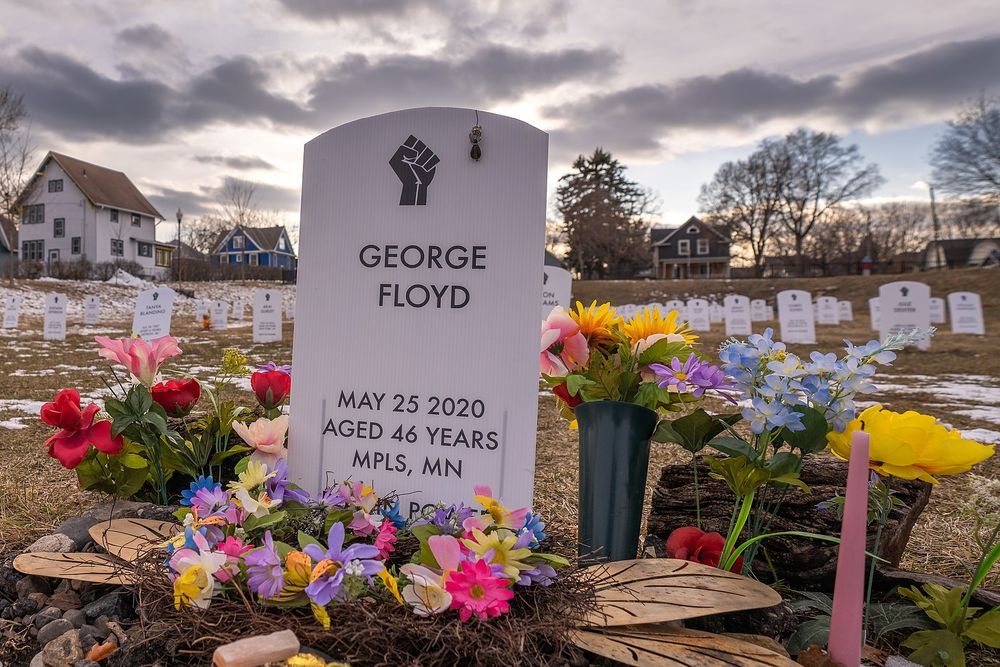
Memorial for George Floyd at the Say Their Names cemetery
George Floyd was murdered by police five years ago today.
The Say Their Names cemetery in Minneapolis features memorials for Floyd, Breonna Taylor, Amadou Diallo, Oscar Grant, Korryn Gaines, Freddie Gray and far too many more Black people who died at the hands of police.
25.05.2025 17:09
👍 19910
🔁 4669
💬 330
📌 117

Learning Together, Rising Together with Jeremy Corbyn, Mikaela Loach & More
Join Left Book Club for the launch of our exciting campaign to establish 100 reading groups nationwide.
📚LEFT BOOK CLUB EVENT📚
@leftbookclub.bsky.social
Learning Together, Rising Together with
@jeremycorbyn.bsky.social
@mikaelaloach.bsky.social & more
🗓️Sat, May 24
⏰2:30 pm
📍Halkevi - Community Cafe & Centre
10.05.2025 07:01
👍 10
🔁 4
💬 0
📌 0

Cross-Chapter Box 10 | Policy Attribution – Methodologies for Estimating the Macro-level
Impact of Mitigation Policies on Indices of Greenhouse Gas Mitigation
Authors: Mustafa Babiker (Sudan/Saudi Arabia), Paolo Bertoldi (Italy), Christopher Bataille (Canada), Felix Creutzig (Germany),
Navroz K. Dubash (India), Michael Grubb (United Kingdom), Erik Haites (Canada), Ben Hinder (United Kingdom), Janna Hoppe
(Switzerland), Yong-Gun Kim (Republic of Korea), Gregory F. Nemet (the United States of America/Canada), Anthony Patt (Switzerland),
Yamina Saheb (France), Raphael Slade (United Kingdom)
This report notes both a growing prevalence of mitigation policies over the past quarter century (Chapter 13), and ‘signs of progress’
including various quantified indices of GHG mitigation (Table 2.4). Even though policies implemented and planned to date are clearly
insufficient for meeting the Paris long-term temperature goals, a natural question is to what extent the observed macro-level changes
(global, national, sectoral, technological) can be attributed to policy developments. This Assessment Report is the first to address that
question. This box describes the methods for conducting such ‘attribution analysis’ as well as its key results, focusing on the extent to
which polices have affected three main types of ‘outcome indices’:
• GHG emissions: emissions volumes and trends at various levels of governance including sub- and supra-national levels, and
within and across sectors.
• Proximate emission drivers: trends in the factors that drive emissions, distinguished through decomposition analyses, notably:
energy/GDP intensity and carbon/energy intensity (for energy-related emissions); indices of land use such as deforestation rates (for
LULUCF/AFOLU); and more sector-specific component drivers such as the floor area per capita, or passenger kilometres per capita.
• Technologies: developments in key low-carbon technologies that are likely to have a strong influence on future em…

Cross-Chapter Box 10 (continued)
from micro-level data evaluation, and inference from combining multiple lines of analysis, including expert opinion. Additionally, the
literature contains reviews, many of them systematic in nature, that assess and aggregate multiple empirical studies.
With these considerations in mind, multiple lines of evidence, based upon the literature, support a set of high-level findings, as
illustrated in Figure 1 in this Cross-Chapter Box, as follows.
1. GHG Emissions. There is robust evidence with a high level of agreement that mitigation policies have had a discernible impact on
emissions. Several lines of evidence indicate that mitigation policies have led to avoided global emissions to date of several billion
tonnes CO2-eq annually. The figure in this box shows a selection of results giving rise to this estimate.
As a starting point, one methodologically sophisticated econometric study links global mitigation policies (defined as climate laws
and executive orders) to emission outcomes; it estimates emission savings of 5.9 GtCO2 yr–1 in 2016 compared to a no-policy world
(Eskander and Fankhauser 2020) (Section 13.6.2).
A second line of evidence derives from analyses of the Kyoto Protocol. Countries which took on Kyoto Protocol targets accounted
for about 24% of global emissions during the first commitment period (2008–12). The most recent robust econometric assessment
(Maamoun 2019) estimates that these countries cut GHG emissions by about 7% on average over 2005–2012, rising over the period to
around 12% (1.3 GtCO2-eq yr–1) relative to a no-Kyoto scenario. This isconsistent with estimates of Grunewald and Martinez (2016) of
about 800 MtCO2-eq yr–1 averaged to 2009. Developing countries’ emissions reduction projects through the CDM (defined in Article 12
of the Kyoto Protocol) were certified as growing to over 240 MtCO2-eq yr–1 by 2012 (UNFCC 2021c). With debates about the full
Policies
Increase in number of mitigation policies implemente…

Cross-Chapter Box 10 (continued)
extent of ‘additionality’, academic assessments of savings from the CDM have been slightly lower, with particular concerns around
some non-energy projects (Section 14.3.3.1).
A third line of evidence derives from studies that identify policy-related, absolute reductions from historical levels in particular
countries and sectors through decomposition analyses (Le Quéré et al. 2019; Lamb et al. 2021), or evaluate the impact of particular
policies, such as carbon pricing systems. From a wide range of estimates in the literature (Sections 2.8.2.2 and 13.6), many evaluations
of the EU ETS suggest that it has reduced emissions by around 3% to 9% relative to unregulated firms and/or sectors (Schäfer 2019;
Colmer et al. 2020), while other factors, both policy (energy efficiency and renewable support) and exogenous trends, played a larger
role in the overall reductions seen (Haites 2018).
These findings derived from the peer-reviewed literature are also consistent with two additional sets of analysis. The first set concerns
trends in emissions, drawing directly from Chapters 2, 6 and 11, showing that global annual emission growth has slowed, as evidenced
by annual emission increments of 0.55 GtCO2-eq yr–1 between 2011 and 2019 compared to 1.014 GtCO2-eq yr–1 in 2000 and 2008.
This suggests avoided emissions of 4–5 GtCO2-eq yr–1 (see also Figure 1.1d). The second set concerns emissions reductions projected
by Annex I governments for 2020 in their fourth biennial reports to the UNFCCC. It is important to note that these are mostly projected
annual savings from implemented policies (not ex-post evaluations), and there are considerable differences in countries’ estimation
methodologies. Nevertheless, combining estimates from 38% of the total of 2,811 reported policies and measures yields an overall
estimate of 3.81 GtCO2-eq yr–1 emission savings (UNFCCC 2020d).
2. Proximate emission drivers. With less overt focus on emissions, studies of trends i…
listen up, climate policies have resulted in the avoidance of greenhouse gases and global emissions would be way higher had we done nothing
here is a wall of text from the IPCC report with evidence
www.ipcc.ch/report/ar6/w...
IPCC AR6 WG3 Chapter 14 Cross Chapter box 10 (14-43, line 39)
24.04.2025 21:37
👍 305
🔁 117
💬 6
📌 6

Today we handed in an incredible ONE MILLION signatures calling on the UK Government to stop new oil and gas.
A huge thank you to everyone who added their name, and to @carladenyer.bsky.social and @elliechowns.bsky.social for coming out to show your support 👏
23.04.2025 16:02
👍 77
🔁 29
💬 2
📌 1

Wondering "What Can We Do??" about all the issues in our world?
I've started a free newsletter series of interviews with organisers from the most impacted communities of today's biggest crises. The first one is about Ukraine 🇺🇦, with Ukrainian climate activist Viktoriya Ball: shorturl.at/1ocpY
24.04.2025 10:05
👍 8
🔁 4
💬 1
📌 0

You Can't Change the World Without Your Feelings — The Safina Center
By Safina Center Community Organizing Fellow Mikaela Loach
"Making anything better is worth it. Saving anyone is worth it. Feeling the grief and channeling it into action is always worth it."
Safina Center Fellow @mikaelaloach.bsky.social reminds us that it's never too late to fight for a just and sustainable world.
#activism #climate #conservation 🌍
21.04.2025 17:02
👍 5
🔁 2
💬 1
📌 0
Is anyone here involved with the new Climate Justice degree at Sussex uni? I'd love to chat with the course organisers!
08.04.2025 09:20
👍 5
🔁 6
💬 0
📌 0
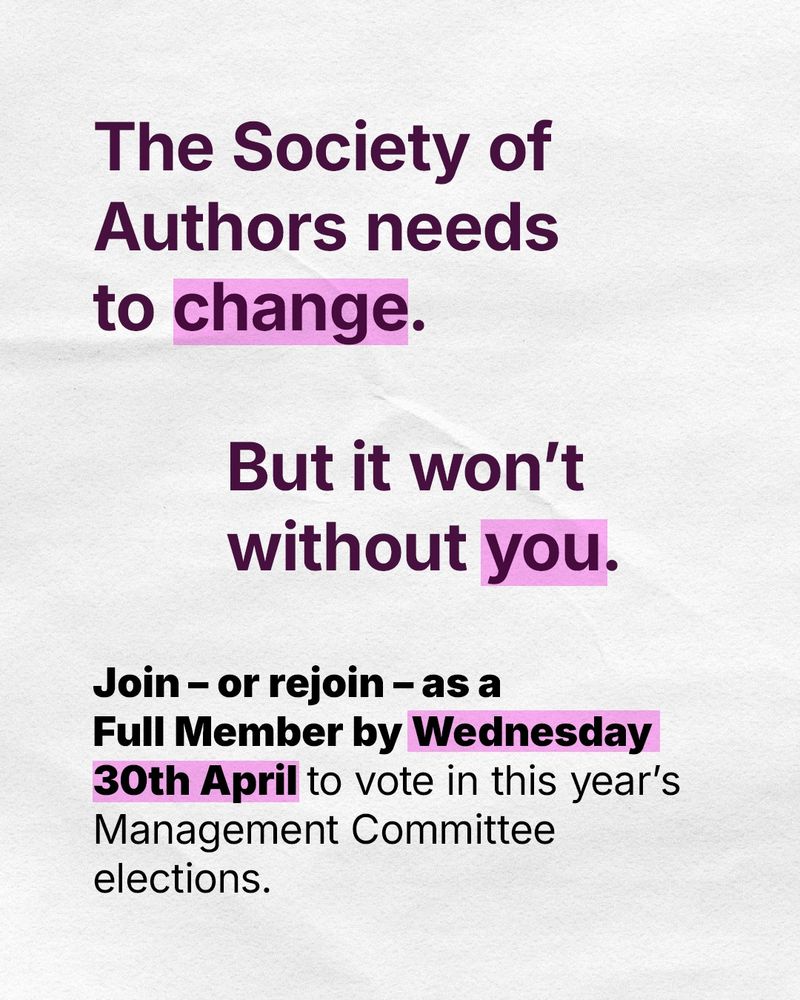
The Society of Authors needs to change. But it won’t without you.
Join – or rejoin – as a Full Member by Wednesday 30th April to vote in this year’s Management Committee elections.
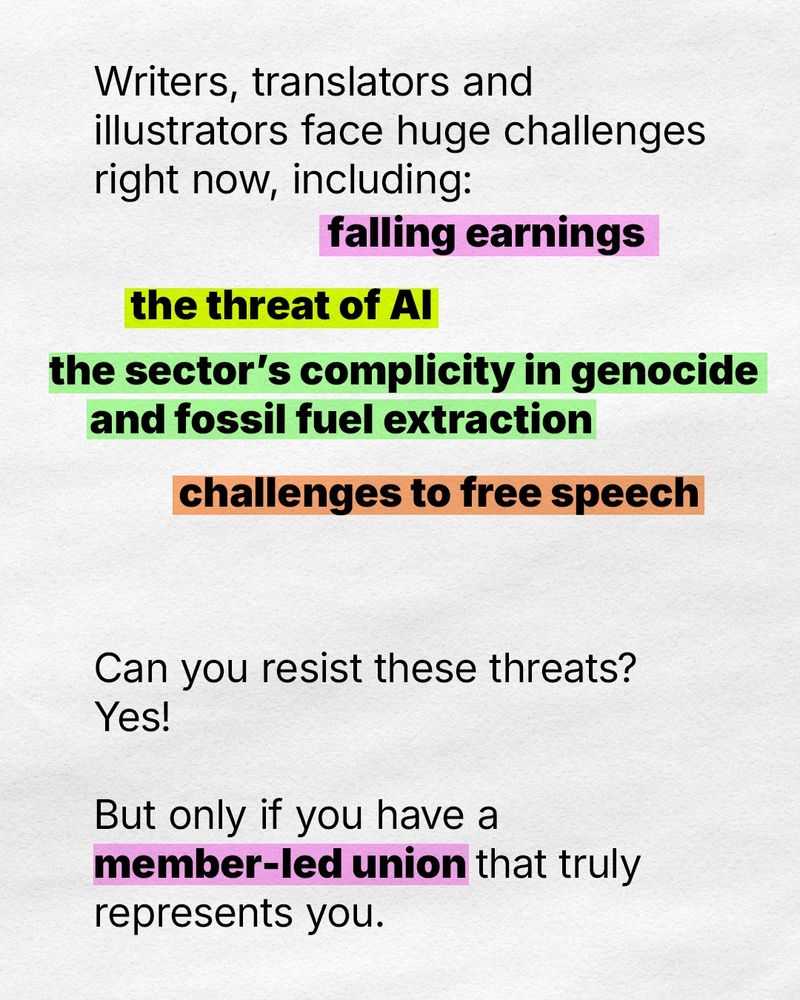
Writers, translators and illustrators face huge challenges right now including: falling earnings, the threat of AI, the sector’s complicity in genocide and fossil fuel extraction, challenges to free speech.
Can you resist these threats? Yes! But only if you have a member-led union that truly represents you.
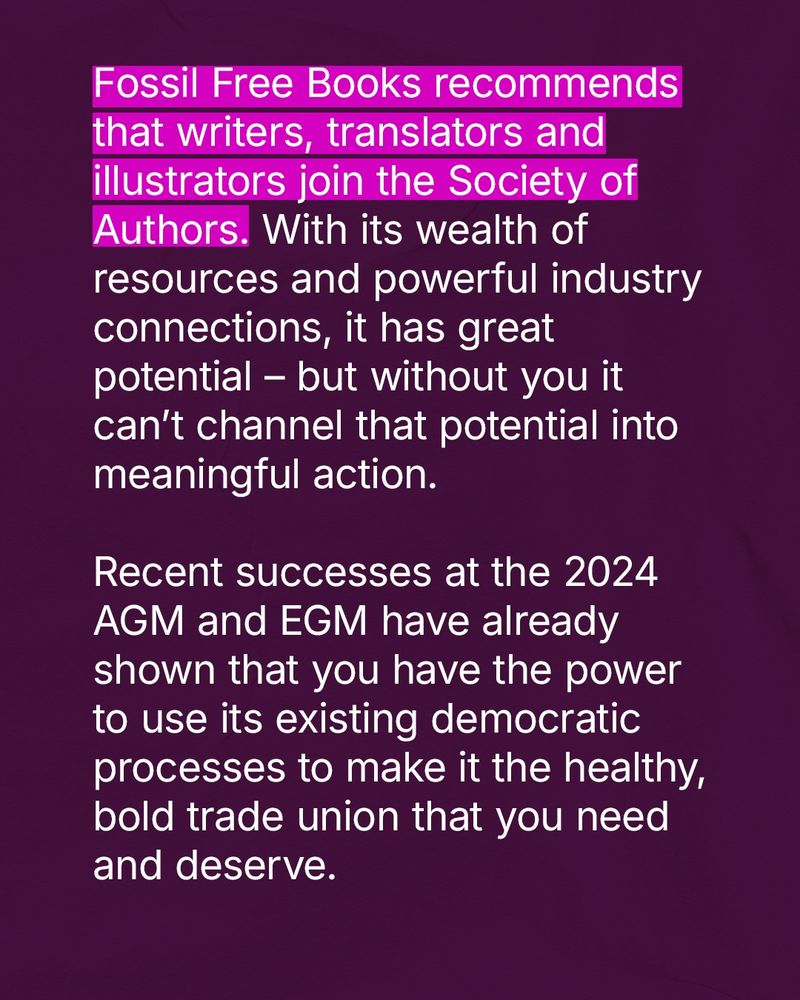
Fossil Free Books recommends that writers, translators and illustrators join the Society of Authors. With its wealth of resources and powerful industry connections, it has great potential – but without you it can’t channel that potential into meaningful action.
Recent successes at the 2024 AGM and EGM have already shown that you have the power to use its existing democratic processes to make it the healthy, bold trade union that you need and deserve.
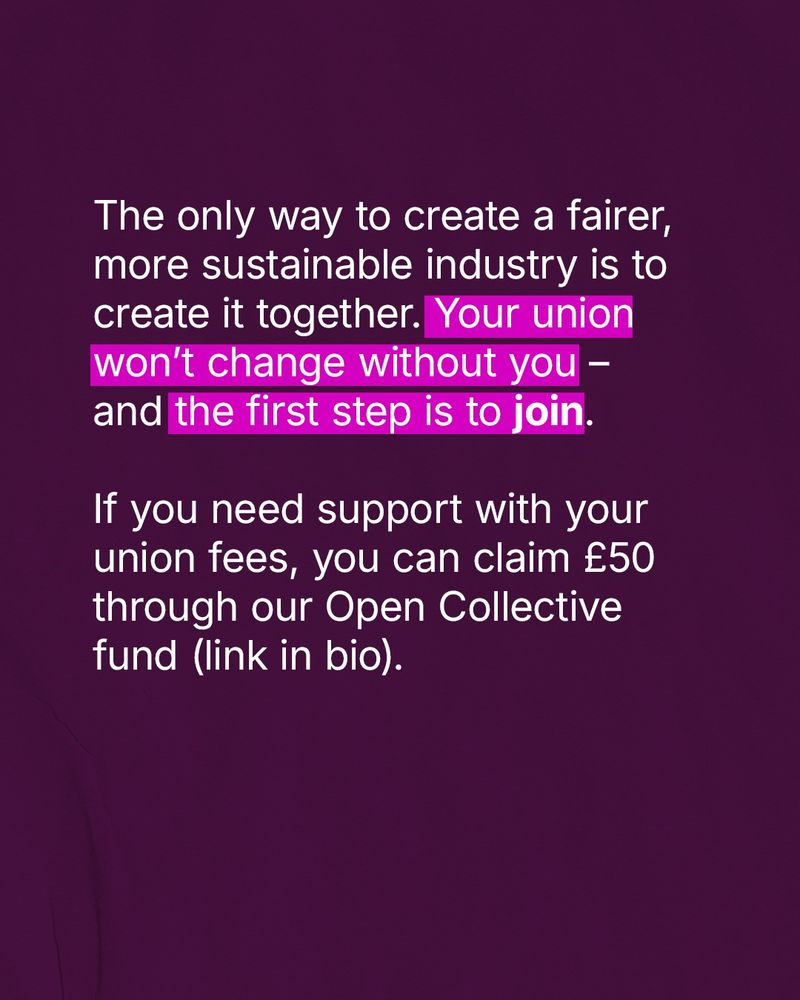
The only way to create a fairer, more sustainable industry is to create it together. Your union won’t change without you – and the first step is to join.
If you need support with your union fees, you can claim £50 through our Open Collective fund (link in post).
The Society of Authors needs to change. But it won’t without you.
Join – or rejoin – as a Full Member by Wednesday 30th April to vote in this year’s Management Committee elections.
Writers, translators & illustrators face huge challenges right now… (1/5)
04.04.2025 11:52
👍 30
🔁 15
💬 1
📌 7
For younger readers, @mikaelaloach.bsky.social has authored CLIMATE IS JUST THE START 🤩📖♥️
#loveisclimateaction #shopsmall #writingcommunity #booklove #books #tbr #climate #climatecrisis #climatejustice #booklovers #writing #climatestories #climatestorytelling #hearourvioces #diversebooks #ownvoice
28.03.2025 15:17
👍 3
🔁 1
💬 0
📌 0
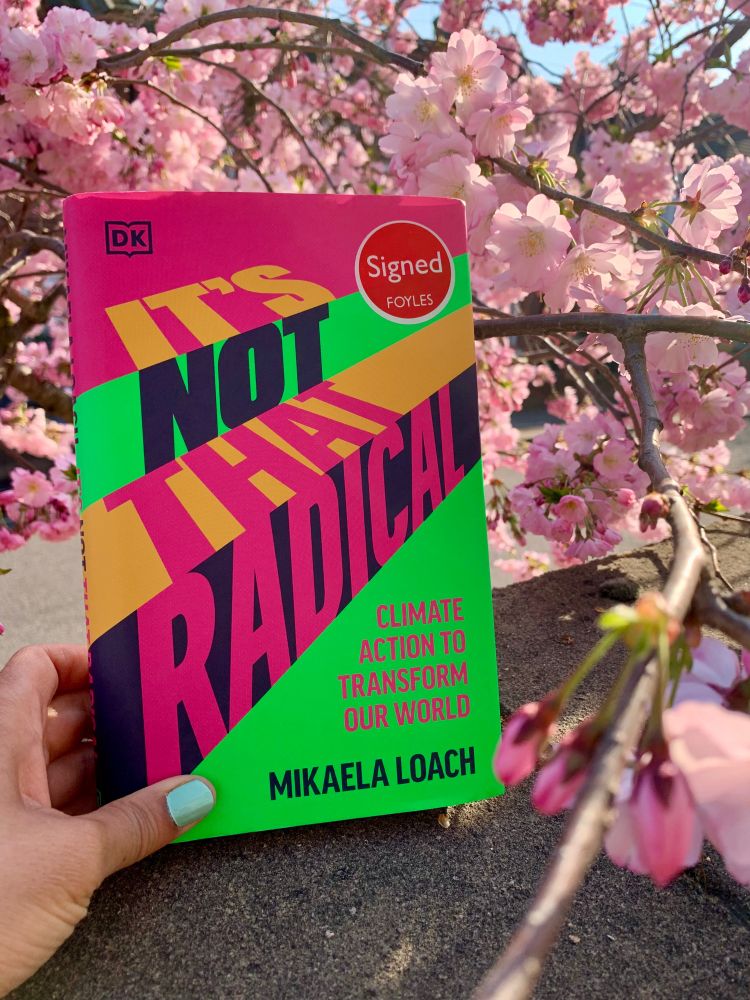
Big snaps for Mikaela Loach author of IT’S NOT THAT RADICAL🫰🏾📖❤️
Each month of 2025, I’m picking a climate book and gabbing about it. We desperately need good climate stories. And I’m happy to spread the word about ones that speak to me!
Thanks @mikaelaloach.bsky.social for your take on:
28.03.2025 15:17
👍 6
🔁 3
💬 1
📌 0

‘Klimaatactivisme heeft betere marketing nodig’ – MO*
‘Bang zijn van iets krijgt mensen niet in beweging. Je moet voor iets positiefs vechten’, bezweert Mikaela Loach.
MO* sprak met auteur, influencer en klimaatactiviste Mikaela Loach: ‘In de klimaatbeweging moeten we mensen niet bang maken voor de toekomst, maar hun tonen dat we een betere wereld kunnen bereiken als we ons inzetten.’
23.11.2024 09:40
👍 9
🔁 2
💬 1
📌 0

An image with the numeral 1, titled "Not That Radical" by Mikaela Loach with a photo of the author holding her book (photo credit to Holy Moly UK). The text above reads:
It's Not That Radical: Climate Action to Transform Our World by Mikaela Loach. This book is an accessible and down to earth toolkit to inspire people from all walks of life on how they can take action to drastically change the world as we know it for the benefit of us all.

The numeral 2 with the title Social Justice for the Sensitive Soul: How to Change the World in Quiet Ways by Dorcas Cheng-Tozun, with a selfie of the author holding her book. The text above reads:
This book features 6 possible pathways for sensitive people into activism and includes inspiring, real-life examples of highly sensitive world-changers to get you inspired to make change.

The numeral 3 with the title Mutual Aid: Building Solidarity During This Crisis (and the Next) by Dean Spade, with a selfie of the author holding his book. The text above reads:
In dark times, the answers lie with us, the people. This is a handbook for how to organize to meet immediate needs in your community and work toward lasting change. It also has concrete tools for organizing.

The numeral 4 with the title Becoming Abolitionists: Police, Protest, and the Pursuit of Freedom by Derecka Purnell, with a photo of the author with her book (photo credit: Willow Delp). The text above reads:
This a powerful and personal argument for rethinking a fair, equal society where there is no place for state violence and racial repression. It’s a revolutionary book about the hope for freedom, safety, equality, and real justice for all.
Well, it’s January 127th and we’re doing the best we can… thankfully, we have help.
Here are 4 books the 350.org team loves that inspire hope and action for a better future:
31.01.2025 17:29
👍 16
🔁 10
💬 1
📌 1

We're feeling extra energised after seeing Mikaela Loach and Domi Palmer last night at The Bristol Cable event.
They chatted climate justice that liberates everyone & creates an equitable energy transition.
A great reminder to bring joy into climate action (especially dancing!)
12.06.2024 11:13
👍 1
🔁 1
💬 0
📌 0

“Your days of profiting off our lives are numbered” - climate activist Mikaela Loach at Shell’s AGM - NADJA
Climate activist Mikaela Loach was removed from Shell's AGM this week for criticising the oil giant’s activities in the Niger Delta.
"Your days of profiting off our lives are numbered." In May Mikaela Loach confronted Shell's board and shareholders at the company's AGM, describing how its activities in the Niger Delta had polluted the water, leading to several deaths. She was escorted out of the venue by security.
bit.ly/3QY1Stl
06.12.2024 13:15
👍 1
🔁 1
💬 0
📌 0

Search LibGen, the Pirated-Books Database That Meta Used to Train AI
Millions of books and scientific papers are captured in the collection’s current iteration.
There's a search tool on The Atlantic's article about this which showed that It's Not That Radical was amongst the stolen works used to train Meta's new generative AI. You can find out others here: www.theatlantic.com/technology/a...
27.03.2025 13:55
👍 1
🔁 0
💬 1
📌 0
I just found out (via The Atlantic) that Meta stole my book to train their AI. No permissions asked or granted, no compensation. They stole my words on climate justice, liberation, anti-capitalism, resisting white supremacy and my heartbreak over my enslaved ancestors to train their fucking AI. Wow.
25.03.2025 12:34
👍 9
🔁 3
💬 2
📌 1
@mikaelaloach.bsky.social :
"You can’t change the world without your feelings.
If you are not moved by the world, you will not act to move the world. It’s that simple.
So hold on to your soft heart. It’s the most important thing you can do!"
25.03.2025 07:24
👍 12
🔁 4
💬 0
📌 0

The AWETHU School of Organising logo, with a bold graphic underneath depicting four hands gripping the wrist of the next arm to form a closed loop. In the middle are 2 crossed pencils, all beneath the words "It's ours". Bold black graphics on white background.
The AWETHU School of Organising is an educational initiative in London dedicated to empowering individuals & communities through political education & tools for grassroots organising.
Launched by Mikaela Loach & others.
Support their amazing work on Open Collective: opencollective.com/awethu
09.09.2024 15:02
👍 2
🔁 3
💬 0
📌 0

Cover of book 'It's Not That Radical: Climate Action To Transform Our World' by Mikaela Loach. The title is written on steps in bold letters and colours.
Picked up 'It's Not That Radical' by Mikaela Loach for a reading challenge and I just want to recommend it to everyone. It's the first time I've really felt seen - as a working class queer person - in a climate discussion, and that together we actually CAN and actually WILL make a difference <3
17.03.2024 10:24
👍 7
🔁 3
💬 1
📌 0
I just read about this in It’s Not That Radical by Mikaela Loach. Highly recommend her book! Everyone has a place in the revolution, we don’t need to wait for heroes. 💖
01.12.2024 08:36
👍 5
🔁 1
💬 0
📌 0
2024-43. It's not that radical, by Mikaela Loach - 5/5
Amazing, motivating and educational! Despite thinking I know climate issues well, I learnt a lot, especially about expanding the future we imagine: the connection between climate and socio-economic problems. Totally recommend!
💙📚
25.08.2024 13:35
👍 3
🔁 1
💬 1
📌 0
Israel just committed *the largest child massacre in its history*, according to Haaretz. Two hundred Palestinian children murdered in a single day, with direct support from the US and UK, and zero outrage from Western media. What stage of barbarism is this...
23.03.2025 09:57
👍 5605
🔁 2891
💬 61
📌 115
I just finished reading Sunrise On The Reaping and I fear I will never be over it 😭
23.03.2025 14:25
👍 5
🔁 0
💬 0
📌 0
It's Not That Radical by Mikaela Loach is one of the most empowering and hopeful climate books I've read.
03.04.2024 06:55
👍 4
🔁 2
💬 0
📌 0