

EV technology in China is truly amazing. Charging in 5 minutes rivals a gas station and seems like a game changer.
youtu.be/TE1ny9h_SEg?...
06.03.2026 03:41
👍 13
🔁 2
💬 1
📌 1
EV technology in China is truly amazing. Charging in 5 minutes rivals a gas station and seems like a game changer.
youtu.be/TE1ny9h_SEg?...
not fired though.
😂
Congratulations!!

For researchers working with the IPEDS dataset (nces.ed.gov/ipeds/), which can be kind of a bear to work with, especially over time, I've constructed some code to harmonize the data into a single DuckDB database
github.com/paulgp/ipeds...

🚨New research looks at early impacts of MA’s free community college policies. Early evidence suggests expanded access & a reshaping of who shows up on campus.
Full brief ➡️ bit.ly/wepcmassreco...
@joshua-goodman.com, @doughesm.bsky.social, Morgan Fleming, Yunee H. Yoon
@buwheelock.bsky.social


Great new paper in The Review of Economic Studies using randomized incentives to detect non-response bias, using administrative data to provide ground truth for comparison. While incentives increased participation, they didn't reliably reduce NR bias
academic.oup.com/restud/advan...

One of my favorite recent papers also investigates this relationship (using a policy experiment). By Edward Okeke. www.aeaweb.org/articles?id=...


The Nazis stopped Jewish doctors from practising, so thousands of them left the country (my great grandfather was one of them). So many left that this was a good natural experiment for estimating the causal effect of losing doctors on infant mortality (& thousands died)
Interesting. Is this a monopsony story?
Tariffs are not a "political topic", they are economic policy. For goodness sake!!!
I saw this picture and wondered if there was a cat in there.
😂
it's not shrinkflation.... more like skimpflation.

Article: The political effects of X’s feed algorithm Abstract: Feed algorithms are widely suspected to influence political attitudes. However, previous evidence from switching off the algorithm on Meta platforms found no political effects1. Here we present results from a 2023 field experiment on Elon Musk’s platform X shedding light on this puzzle. We assigned active US-based users randomly to either an algorithmic or a chronological feed for 7 weeks, measuring political attitudes and online behaviour. Switching from a chronological to an algorithmic feed increased engagement and shifted political opinion towards more conservative positions, particularly regarding policy priorities, perceptions of criminal investigations into Donald Trump and views on the war in Ukraine. In contrast, switching from the algorithmic to the chronological feed had no comparable effects. Neither switching the algorithm on nor switching it off significantly affected affective polarization or self-reported partisanship. To investigate the mechanism, we analysed users’ feed content and behaviour. We found that the algorithm promotes conservative content and demotes posts by traditional media. Exposure to algorithmic content leads users to follow conservative political activist accounts, which they continue to follow even after switching off the algorithm, helping explain the asymmetry in effects. These results suggest that initial exposure to X’s algorithm has persistent effects on users’ current political attitudes and account-following behaviour, even in the absence of a detectable effect on partisanship.

Figure 2. ITT estimates of feed-setting changes on engagement and political attitudes. ITT effect estimates of switching the algorithm on and off (in s.d.). Left, effect of moving from the chronological to the algorithmic feed for users initially on the chronological feed. Right, effect of moving in the opposite direction for users initially on the algorithmic feed. For each outcome, the results of two specifications are reported. Blue, unconditional estimates with robust s.e., controlling only for the initial feed setting and, where applicable, pre-treatment outcome levels. Orange: conditional estimates, controlling for pre-treatment covariates using GRFs; 90% and 95% CIs are reported. Numerical effect sizes and P values correspond to the conditional estimates (all tests are two-sided). The unit of observation is respondent. From top to bottom, sample sizes are n = 4,965, n = 3,337, n = 4,965, n = 4,965, n = 4,596, n = 4,596 and n = 4,850. Tests are described in Methods. Supplementary Information Table 2.16 reports the exact numerical point estimates, s.e., CIs and sample sizes for every specification. All outcomes are standardized. Additional results are presented in Supplementary Information section 2. PCA, first principal component from principal component analysis.
X's algorithm is in fact doing what you think it's doing. www.nature.com/articles/s41...
He also said "prices are down" which I know he knows is not true.
😂

🚨Thrilled to share our new @nber.org WP.
Research and policy often assume teacher effectiveness is essentially fixed.
We revisit this question by studying what happens when high-performing teachers are incentivized to transfer to struggling schools.
🧵
nber.org/papers/w34845
I, indeed, did not see that coming.

A working paper by @kirabojackson.bsky.social and colleagues finds that Universal Pre-K can deliver substantial economic benefits. In nine states and cities, UPK programs increased employment—especially among women—and raised earnings. #WorkingPaperWednesday spr.ly/63325hPxlJ
😂
1000% reductions in price, 15% GDP growth - what comes first?
The man with the nuclear codes is less numerate than a high school sophomore.
The Enlightenment and modernity have, Brink Lindsey argues, led to mass society and mass affluence. But their overrun has also created a world where individuals are buffeted by strange alien and alienating systems—market, bureaucratic, ideological, algorithmic—that barely register them as... 1/
Days?? That's getting off easy!
Breaking Bad!
Pretty extraordinary to think about how much cardiovascular researchers figured out, and how that turned into public health campaigns, medicines, surgeries, and emergency care that changed millions of people's lives.
ourworldindata.org/cardiovascul...

Very interesting research paper that shows that using AI with programming can significantly reduce mastery over topics. Perhaps unsurprising, but the lack of significant speed gains in this exercise are remarkable
www.anthropic.com/research/AI-...
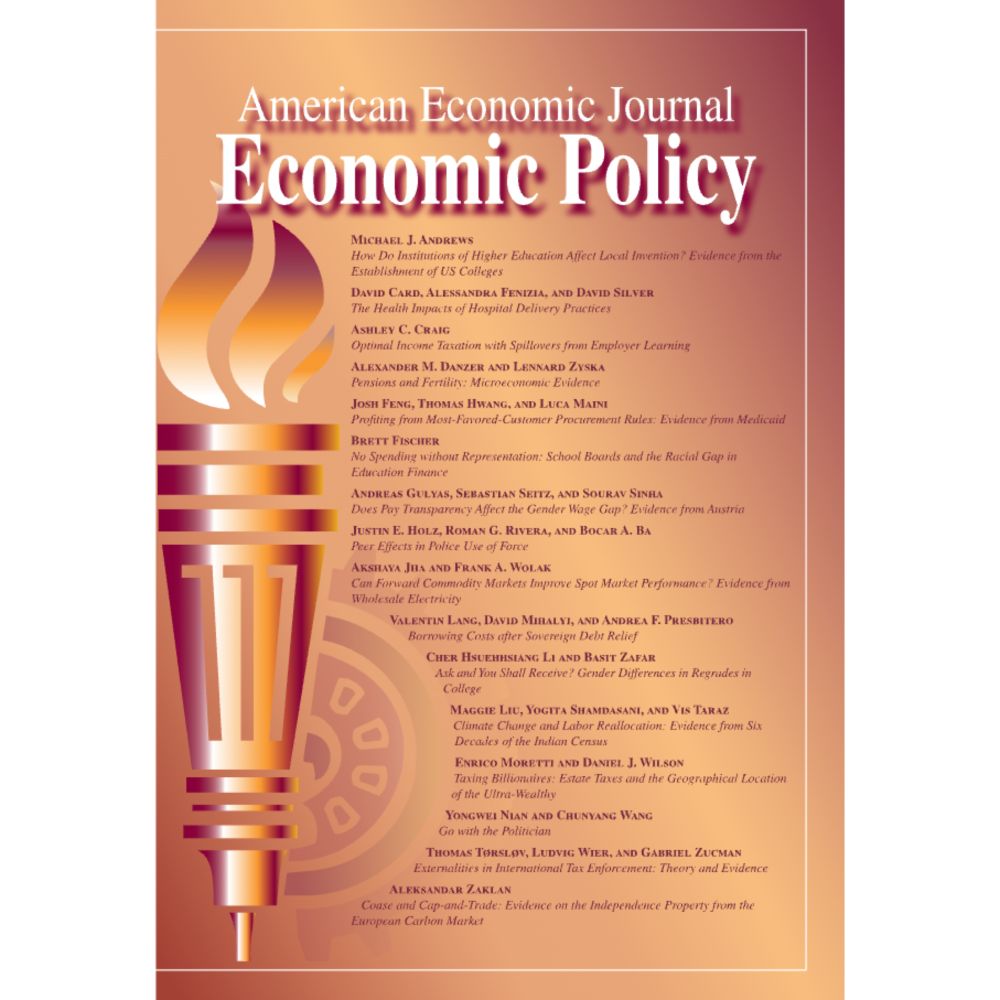
The February 2026 issue of AEJ: Economic Policy (18, 1) is now available online at aeaweb.org/issues/834.

Meanwhile the U.S. government just shed **10,000*** STEM PhDs from the federal workforce in a single year.
www.science.org/content/arti...
Anyone seeking to block the energy transition now has to reckon with the brute economics of the thing: renewable energy is cheaper than fossil fuels.
The only way to slow transition is by fighting the gravity of economics