anna brogan's Avatar

anna brogan

@apbrogan

PhD student into bacteria & coffee. Rudner lab @harvardmed. @penn_state alum.

194
Followers
123
Following
10
Posts
13.12.2023
Joined
Posts Following

Latest posts by anna brogan @apbrogan

Post image

The moment you’ve all been waiting for…

🦠 SAVE THE DATE! 🦠

BBM2026 will be held from June 22nd - 23rd at Boston University’s George Sherman Union. Our featured speaker this year is Dr. Eric Skaar from Vanderbilt University!

Registration opens soon!

More info at: bostonbacterial.org

#BBM2026

12.02.2026 11:37 👍 21 🔁 17 💬 1 📌 0
 Model for Clostridioides difficile germination. Top: Model of the C. difficile proteins required for germination during sporulation. From left to right: interdomain processing of the CspBA fusion protein by the protease YabG occurs in the spore coat layer; heterodimerization of CspC and CspA and homodimerization of CspB; and loading of key germination proteins into the cortex region of the mature spore. Bottom right: Model of a C. difficile spore undergoing germination. Sensing of germinant and co-germinant signals (either directly or indirectly) by the CspC:CspA heterodimer (1) leads to the heterodimer adopting an active conformation (2). Bottom left: CspC:CspA heterodimer space-filling model. Residues at the center of the CspC:CspA heterodimer binding interface (I.) play important roles in transducing germinant and co-germinant signals, while residues at the periphery of the binding interface (II.) help stabilize the complex. Signal transduction by the CspC:CspA heterodimer initiates the activation of CspB (either directly or indirectly) (3). Active CspB then proteolytically activates the cortex-lytic enzyme SleC (4), which will go on to degrade the spore cortex (5), allowing for rehydration of the spore core and resumption of metabolic activity.

Model for Clostridioides difficile germination. Top: Model of the C. difficile proteins required for germination during sporulation. From left to right: interdomain processing of the CspBA fusion protein by the protease YabG occurs in the spore coat layer; heterodimerization of CspC and CspA and homodimerization of CspB; and loading of key germination proteins into the cortex region of the mature spore. Bottom right: Model of a C. difficile spore undergoing germination. Sensing of germinant and co-germinant signals (either directly or indirectly) by the CspC:CspA heterodimer (1) leads to the heterodimer adopting an active conformation (2). Bottom left: CspC:CspA heterodimer space-filling model. Residues at the center of the CspC:CspA heterodimer binding interface (I.) play important roles in transducing germinant and co-germinant signals, while residues at the periphery of the binding interface (II.) help stabilize the complex. Signal transduction by the CspC:CspA heterodimer initiates the activation of CspB (either directly or indirectly) (3). Active CspB then proteolytically activates the cortex-lytic enzyme SleC (4), which will go on to degrade the spore cortex (5), allowing for rehydration of the spore core and resumption of metabolic activity.

Unlike other #bacteria, C. difficile must detect both germinant & co-germinant signals to trigger #spore #germination. This study finds that the CspC:CspA complex is a key signaling node that integrates environmental cues to regulate #Cdifficile spore germination @plosbiology.org 🧪 plos.io/4rtCKdZ

03.02.2026 09:20 👍 6 🔁 3 💬 1 📌 2

Great new story from Sophie Helaine and Molly Sargen!

www.helainelab.com

28.01.2026 23:01 👍 35 🔁 18 💬 0 📌 0
Preview
Identification of sporulation genes in Bacillus anthracis highlights similarities and significant differences with Bacillus subtilis How good is Bacillus subtilis as a model for the spore-forming pathogen Bacillus anthracis? Using high throughput genetics to identify B. anthracis sporulation genes and cytological analysis of the mu...

Fer’s tour de force in B. anthracis is out! Fer got Tn-seq running, built an ordered knockout library, defined all essential sporulation genes, and found a peptidoglycan deacetylase inhibitor critical for engulfment. Including our first one-by-all Alphafold screen! journals.plos.org/plosbiology/...

13.12.2025 16:53 👍 42 🔁 23 💬 0 📌 0
Preview
Identification of sporulation genes in Bacillus anthracis highlights similarities and significant differences with Bacillus subtilis How good is Bacillus subtilis as a model for the spore-forming pathogen Bacillus anthracis? Using high throughput genetics to identify B. anthracis sporulation genes and cytological analysis of the mu...

Identification of sporulation genes in Bacillus anthracis highlights similarities and significant differences with Bacillus subtilis

@plosbiology.org from David Rudner

journals.plos.org/plosbiology/...

13.12.2025 12:33 👍 21 🔁 6 💬 1 📌 1
Preview
Proteome-wide in silico screening for human protein-protein interactions Protein-protein interactions (PPIs) drive virtually all biological processes, yet most PPIs have not been identified and even more remain structurally unresolved. We developed a two-step computational...

Thrilled to share that the final piece of my PhD work is now on bioRxiv! biorxiv.org/content/10.1... With support from @nvidia and the @NSF, we used AlphaFold to screen 1.6M+ protein pairs, revealing thousands of potential novel PPIs. All data can be viewed at predictomes.org/hp

12.11.2025 21:26 👍 163 🔁 67 💬 5 📌 4
Preview
Comprehensive genetic interaction analysis of the Bacillus subtilis envelope using double-CRISPRi Koo et al. apply genome-scale double-CRISPRi to map cell envelope gene interactions in Bacillus subtilis, revealing >1,000 genetic interactions and uncovering gene networks in envelope biogenesis and ...

Identification of genetic interactions in Bacillus subtilis cell division. Congratulations, Byoung-Mo Koo, Carol Gross, and all involved!
@cp-cellsystems.bsky.social #subtiwiki

www.cell.com/cell-systems...

04.10.2025 10:16 👍 15 🔁 8 💬 0 📌 0
Preview
Dual transposon sequencing profiles the genetic interaction landscape in bacteria Gene redundancy complicates systematic characterization of gene function as single-gene deletions may not produce discernible phenotypes. We report dual transposon sequencing (dual Tn-seq), a platform...

Dual transposon sequencing profiles the genetic interaction landscape in bacteria | Science www.science.org/doi/10.1126/...

25.09.2025 23:19 👍 58 🔁 23 💬 0 📌 3
Preview
Peptidoglycan–outer membrane attachment generates periplasmic pressure to prevent lysis in Gram-negative bacteria - Nature Microbiology Outer membrane attachment to peptidoglycan enables periplasmic pressure to build up and counter cytoplasmic turgor pressure, preventing lysis during osmotic challenges in Escherichia coli.

#microsky
We challenge the long-standing view that peptidoglycan alone protects cells from bursting.

Our study shows that the periplasm — enclosed by OM–PG connections — acts as a pressure buffer essential for osmoprotection in Gram-negative bacteria.

📄 www.nature.com/articles/s41...

29.07.2025 13:23 👍 65 🔁 40 💬 2 📌 4
Post image

The #SubtiWiki Paper of the month for June 2025 has been selected.
Congratulations, @apbrogan.bsky.social @ @harvardmed.bsky.social
@natmicrobiol.nature.com

subtiwiki.uni-goettingen.de/wiki/index.p...

30.06.2025 12:50 👍 6 🔁 3 💬 0 📌 0

Thank you so much!

19.06.2025 03:09 👍 0 🔁 0 💬 0 📌 0
Preview
Cyclic-di-AMP modulates cellular turgor in response to defects in bacterial cell wall synthesis - Nature Microbiology Brogan et al. uncover a signalling pathway in which levels of the nucleotide second messenger c-di-AMP increase in response to defects in cell wall synthesis. This regulatory pathway decreases turgor ...

🚨Out now!

Cyclic-di-AMP modulates cellular turgor in response to defects in bacterial cell wall synthesis @harvardmicro.bsky.social

#MicroSky 🦠

www.nature.com/articles/s41...

18.06.2025 13:51 👍 17 🔁 4 💬 0 📌 0

Thanks Adrienne!

18.06.2025 00:58 👍 0 🔁 0 💬 0 📌 0

Thank you! and will do.

17.06.2025 14:34 👍 1 🔁 0 💬 0 📌 0

Thank you Jörg! I was so inspired by your work over the years.

17.06.2025 14:33 👍 1 🔁 0 💬 1 📌 0
Cyclic-di-AMP modulates cellular turgor
in response to defects in bacterial cell wall
synthesis

Cyclic-di-AMP modulates cellular turgor in response to defects in bacterial cell wall synthesis

Cyclic-di-AMP modulates cellular turgor
in response to defects in bacterial cell wall
synthesis

Cyclic-di-AMP modulates cellular turgor in response to defects in bacterial cell wall synthesis

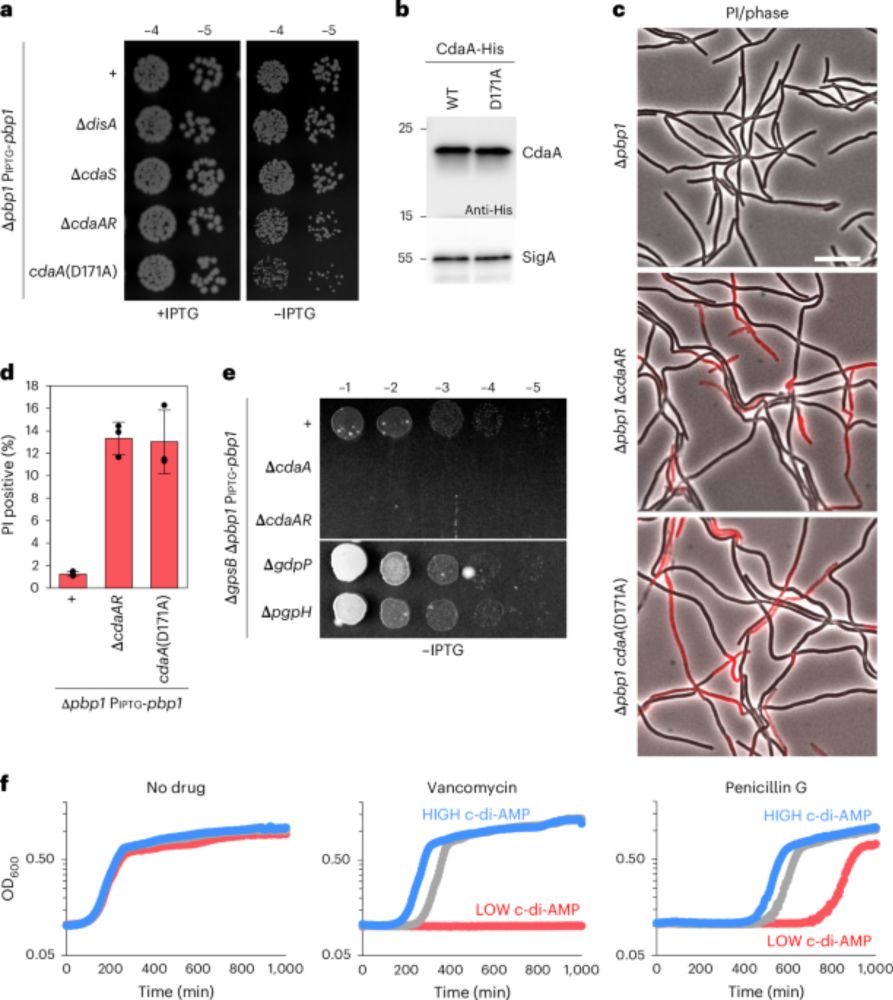
Brogan et al uncover a signaling pathway in which levels of the nucleotide second messenger c-di-AMP increase in response to defects in cell wall synthesis. This regulatory pathway decreases the cytoplasmic turgor pressure and protects the cell from lysis: www.nature.com/articles/s41...

17.06.2025 13:01 👍 14 🔁 4 💬 0 📌 0

This was a great collaboration with Dr. Paola Bardetti and Dr. Rico Rojas at NYU. With their help, we provide evidence that c-di-AMP functions to control the cytoplasmic turgor pressure. The c-di-AMP mediated reduction in turgor protects cells from lysis.

17.06.2025 12:20 👍 1 🔁 0 💬 0 📌 0

In short, there is: the c-di-AMP cyclase/regulator complex CdaAR upregulates cyclic-di-AMP in response to defects in cell wall synthesis. Similar to other envelope stress response systems in B. subtills, the cyclase regulator CdaR uses an intrinsically disordered region to sense cell wall defects.

17.06.2025 12:20 👍 2 🔁 0 💬 1 📌 0

c-di-AMP has long been implicated in resistance to cell wall targeting antibiotics. We hypothesized that there could be a regulatory connection between the cell envelope and c-di-AMP levels.

17.06.2025 12:20 👍 0 🔁 0 💬 1 📌 0
Preview
Cyclic-di-AMP modulates cellular turgor in response to defects in bacterial cell wall synthesis - Nature Microbiology Brogan et al. uncover a signalling pathway in which levels of the nucleotide second messenger c-di-AMP increase in response to defects in cell wall synthesis. This regulatory pathway decreases turgor ...

Very happy to share that a large part of my thesis work is out today: B. subtilis uses the second messenger c-di-AMP to modulate its turgor pressure in response to the state of its cell envelope. www.nature.com/articles/s41...

17.06.2025 12:20 👍 59 🔁 27 💬 4 📌 2
Preview
The interplay of membrane tension and FtsZ filament condensation on the initiation and progression of cell division in B. subtilis The first step of cell division is deforming the planar cell membrane inward towards the cytoplasm. As deforming membranes is energetically costly, biology has developed various protein systems to acc...

I’m excited that the work by Diego Ramirez and Lei Yin is out, where they gained several key insights into what provides the force underlying bacterial cell division doi.org/10.1101/2025....

To divide, cells must first bend the membrane inward, a process that’s energetically expensive

20.05.2025 17:17 👍 44 🔁 16 💬 2 📌 3

🚨👉 Please check our recent work on bacterial cell division. In situ Cryo-ET reveals the cellular function of the penicillin binding protein 1b supported by AFM, live-cell imaging, in silico AlphaFold proteome screen and TIRFM. Hope you enjoy the read! #teamtomo #cryo-ET ❄️🔬🐎 big thanks to the team!

03.04.2025 09:08 👍 56 🔁 23 💬 0 📌 4
Preview
Predictomes, a classifier-curated database of AlphaFold-modeled protein-protein interactions Schmid and Walter train a classifier that discerns functionally relevant structure predictions in proteome-wide protein-protein interaction (PPI) screens using AlphaFold-Multimer, and they use this co...

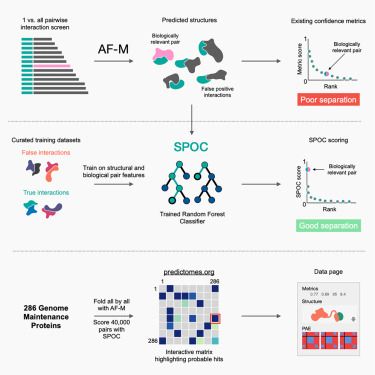
Very excited to share that my thesis work is out in Molecular Cell! We trained a Structure and Omics informed Classifier (SPOC) to score binary AlphaFold multimer (AF-M) predictions by structural quality and consistency with experimental omics datasets. www.cell.com/molecular-ce...

26.02.2025 18:14 👍 29 🔁 11 💬 3 📌 1
Post image

SAVE THE DATE ‼️ 📆 📢
BBM 2025 will be held on June 9-10th at the Harvard Science Center feat. the one and only Dr. Petra Levin as keynote! We can't wait to see you there.

Registration and scholarship applications open next week.

01.02.2025 15:05 👍 50 🔁 30 💬 1 📌 3
PNAS Proceedings of the National Academy of Sciences (PNAS), a peer reviewed journal of the National Academy of Sciences (NAS) - an authoritative source of high-impact, original research that broadly spans...

Angelika Gründling’s work from her sabbatical in the Bernhardt-Rudner labs is out. She came with the goal of finding the missing G+ phosphatidylglycerol phosphate phosphatase and found it with time to spare. I can also highly recommend her as a bay mate! www.pnas.org/doi/10.1073/...

28.01.2025 15:10 👍 9 🔁 3 💬 0 📌 0
Post image

HARIBO bacter for happy holidays

20.12.2024 15:38 👍 5 🔁 2 💬 0 📌 0