
Our new study on how large floods will change in Europe under climate change, led by @bfang.bsky.social, with @bevacquae.bsky.social
29.08.2025 18:37
👍 20
🔁 6
💬 1
📌 0
Our new study on how large floods will change in Europe under climate change, led by @bfang.bsky.social, with @bevacquae.bsky.social
Indeed, it was a pleasure to contribute to this course with content on extreme events, climate change, and attribution science. Now it’s time for the examination! :)

To what extent does human-induced climate change contribute to global extreme wildfires? In our latest study, we quantified the contribution of human-induced climate change to over 700 observed extreme wildfires globally. www.nature.com/articles/s41...
📊 Warming was the main driver, but precipitation, humidity, and wind changes either enhanced or counteracted warming effects in many regions.
📄 Paper in npj Climate and Atmospheric Science www.nature.com/articles/s41... or rdcu.be/eiYcp
@natureportfolio.nature.com @compoundnet.bsky.social

🔥🌍 In a new paper led by Sifang Feng, we find a growing human-induced climate change fingerprint in weekly regional fire extremes.
📈 On average, climate change was responsible for a fraction equal to 8 ± 4% of the predicted probability of more than 700 fire extremes worldwide between 2002 and 2015.

Hi - I'd like to share this story of what is happening at NOAA GFDL, where some of my colleagues and I worked until the mass firings at NOAA last week.
"...the birthplace of weather and climate forecasting"
Great job opportunity in Graz, check it out!
Hi Glen, adding to Carl, more text related to this is in paragraphs 2-3 of our brief communication. For those interested in expanding, see also Betts' discussion: www.nature.com/articles/d41.... The same windows are also used to document impacts/effects emerging at a given warming level.

2024 was the first year to see global average temperatures rise more than 1.5°C above pre-industrial levels. Has the Paris Agreement goal already bitten the dust? www.newscientist.com/article/2467...
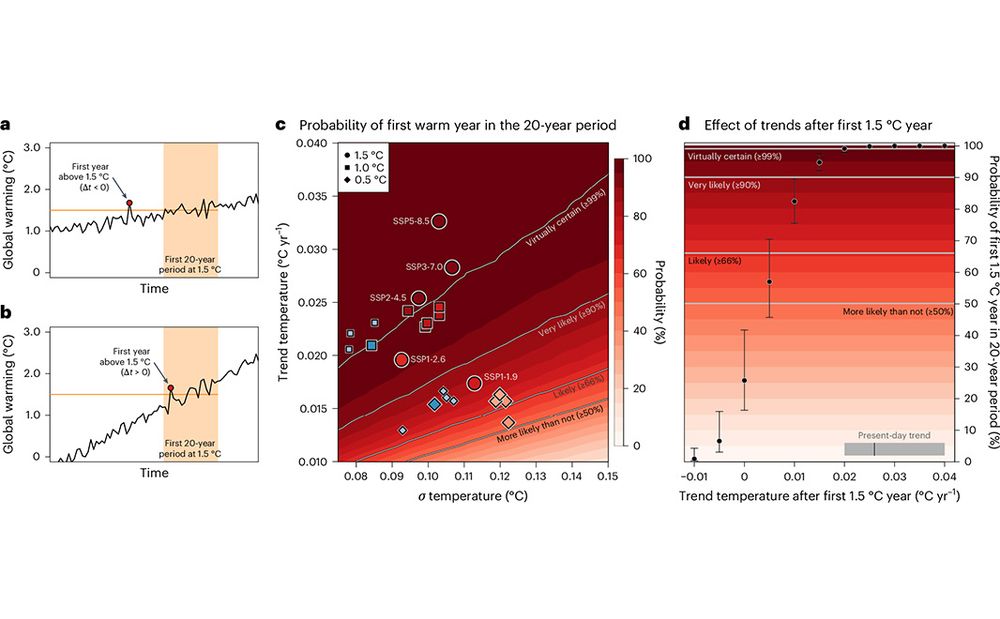
This is figure 2 from “A year above 1.5 °C signals that Earth is most probably within the 20-year period that will reach the Paris Agreement limit.” It shows strong warming trends place the first 1.5 °C year within the 1.5 °C 20-year period.
Two papers in Nature Climate Change suggest that exceeding 1.5 °C in 2024 may indicate that we have entered a multi-decadal period of 1.5 °C average global warming.
https://go.nature.com/4hR9GYO
https://go.nature.com/3WVdJM1
🧪
The results in both papers depend on how CMIP6 models capture relevant climate processes over the next decade or so. See Discussion and bsky.app/profile/clim...
Work @ufz.de together with @carlschleussner.bsky.social and @zscheischlerjak.bsky.social

In contrast, while our results are more conservative by indicating we are in the first part of the 20-year period and not that the goal has been breached, they rely on the occurrence of a calendar year above 1.5°C, which is supported by the average of multiple observational datasets (1.55°C).

Making their result actionable requires the occurrence of 12 consecutive months above 1.5°C, a condition met in ERA5 and BEST observational datasets, but that has not been met based on the mean of multiple observational datasets (plot for consecutive months strictly > 1.5°C by @hoegner.bsky.social).
An extra note is needed to help link our results with another study published by Cannon today. In climate models (SSP245), Cannon found a 76% chance that 12 consecutive months above 1.5°C occur *after* the Paris Agreement goal is reached, that is, after the midpoint of a 20-year window at 1.5°C.
Finally, we highlight that the entry time in the 20-year period at 1.5 °C warming should not be mistaken as the timing of the warming level itself, as the latter is placed at the midpoint of the 20-year period.
Only rapid near-term mitigation can effectively limit peak warming, which is required to hold warming *well below* 2 °C in case of exceedance or overshoot of 1.5 °C. www.nature.com/articles/s43...
A year above 1.5 °C is not the time for despair but a call to action.
Cutting emissions has never been more important. It can lower the chance of reaching the 1.5°C limit soon after 2024, but this demands very stringent mitigation. For example, halving the chance that 2024 will be within the first 20-yr 1.5°C period requires a fivefold reduction in temperature trends.

The IPCC AR6 flags “High Risks” at 1.5°C for unique systems (such as biodiversity) and extreme events. Floods in Brazil, Spain, and Kenya, mega-drought in the Amazon, tropical storms, and heatwaves in 2024 gave us a taste of these risks. We are not prepared for the climate risks at 1.5°C to unfold.
Entering a window at 1.5 °C average warming means entering the same window used by scientists to project the impacts of a 1.5 °C warmer world. Thus, our results warn we are most probably in a period where the impacts of a 1.5 °C world are expected to unfold, underscoring the urgency of adaptations.
Our result is due to the ongoing strong anthropogenic multi-decadal warming trend that, combined with the relatively low variability in the temperature time series, renders it very unlikely for the temperature of a single year to exceed the average temperature over the coming decades (Figure 2c).
That is, the first year above 1.5 °C occurs within the first 20-year period with an average warming of 1.5 °C. We found the same behaviour for other recent warming levels already reached in observations starting from the 1980s (0.6 °C to 1.0 °C; Figure 1a in the paper).

Through climate models, observations, and idealised experiments, we show that unless stringent climate mitigation is implemented, the first year above 1.5°C in 2024 signals that it is highly probable that Earth has already entered the 20-year period that *will* reach the 1.5°C Paris Agreement limit.
However, the implications for the Paris Agreement's 1.5 °C goal are unclear because the goal is understood to refer to temperature averaged over a 20-30 year period to account for natural short-term variability.
The year 2024 was announced as the first calendar year to exceed 1.5 °C of global warming by several international organisations that independently track the global temperature, with a multi-dataset mean of 1.55 °C.

In Nature Climate Change, we show that a year above 1.5 °C signals that Earth is most probably within the 20-year period that will reach the Paris Agreement limit. @natclimchange.bsky.social
Spiralling global temperatures: 2024 edition
Big congrats! @raedhamed.bsky.social

We are delighted to announce the "Compound weather and climate events" session at #EGU25!
We look forward to receiving your exciting abstracts!
@compoundnet.bsky.social
We are delighted to announce the "Compound weather and climate events" session at #EGU25!
We look forward to receiving your exciting abstracts!
@compoundnet.bsky.social
Thanks to all coauthors! Oldrich Rakovec, Dominik L. Schumacher, Rohini Kumar, Stephan Thober, Luis Samaniego, Sonia I. Seneviratne & Jakob Zscheischler
Apologies for crossposting! It is a particular period with social networks!
