Connecting the dots: Similar visual orthographic acquisition for Braille or line junctions - Psychonomic Bulletin & Review
Most written systems share basic shape features with natural objects such as line junctions, a commonality thought to be at the basis of fluent reading. Studies that compared reading acquisition for d...
Out now another piece of my PhD. In short, we show that learning a new script, with or without line junctions (├ v. ⠗), mostly relies on the linguistic mapping of one script to a pre-existing orthography, with limited contribution of the script's visual features
doi.org/10.3758/s13423-025-02788-1
03.03.2026 09:27
👍 13
🔁 3
💬 1
📌 2
🔥 We have a new preprint! 🔥
It's really nice, I recommend reading it
Here's a summary question: Can FFA activation predict RT to faces?
⏬ Check out the answer below ⏬
@hansopdebeeck.bsky.social
www.biorxiv.org/content/10.6...
18.02.2026 22:01
👍 8
🔁 3
💬 1
📌 2

"Moderna's CEO announced the company will no longer invest in new Phase 3 vaccine trials for infectious diseases: 'You cannot make a return on investment if you don't have access to the U.S. market. Vaccines for Epstein-Barr virus, herpes, and shingles have been shelved.”
9:12 AM
Feb 12, 2026
604.8K Views
In terms of what cures are being lost:
- Epstein-Barr virus is perhaps the major trigger for multiple sclerosis
- herpes simplex virus causes cold sores, genital herpes, infections in babies, deadly meningitis
- shingles virus causes an intensely painful disease
13.02.2026 05:44
👍 12541
🔁 6208
💬 444
📌 785

Networks for expertise in the chess players' brain
Chess can be an important way of investigating how learning and expertise are manifest in the nervous system
After a rather long delay, I've finally got a new Science of #Chess post up on lichess! This time I'm looking at a very neat #neuroscience paper (co-authored by @hansopdebeeck.bsky.social) using chess as a model for studying expertise. Enjoy! #cogneuro #PsychSciSky
29.01.2026 16:32
👍 8
🔁 3
💬 1
📌 1
That’s a great perspective Ben, thanks. Excellent blog website also!
29.01.2026 21:43
👍 1
🔁 0
💬 1
📌 0

Super excited to share a new preprint!
We asked a simple-but-big question:
What changes in the brain when someone becomes an expert?
Using chess ♟️ + fMRI 🧠 + representational geometry & dimensionality 📈, we ask:
1️⃣ WHAT information is encoded?
2️⃣ HOW is it structured?
3️⃣ WHERE is it expressed?
1/n
12.11.2025 22:55
👍 36
🔁 11
💬 1
📌 2
This study highlights the power of combining EEG and fMRI, together with hypothesis-driven stimulus designs, to untangle the spatiotemporal dynamics of object representations. 9/9
09.11.2025 13:48
👍 1
🔁 0
💬 0
📌 0
In conclusion, different dimensions related to animacy show very different representational dynamics, and some of them (in this case: animal taxonomy) reflect perceptual selectivity for faces vs bodies. 8/n
09.11.2025 13:48
👍 0
🔁 0
💬 1
📌 0
The same EEG study also revealed that the binary animacy distinction (animate vs inanimate) shows a slower, more sustained profile—emerging later and lasting longer. 7/n
09.11.2025 13:48
👍 1
🔁 0
💬 1
📌 0
🧠 Key finding: The representational dynamics of Face/body and taxonomy distinctions are very similar, with a peak around 150 ms after stimulus onset. 6/n
09.11.2025 13:48
👍 1
🔁 0
💬 1
📌 0
A prediction of this fmri study is that taxonomic selectivity should have a similar time course as selectivity for faces vs bodies. We tested this prediction using EEG, which offers high temporal resolution. 5/n
09.11.2025 13:48
👍 0
🔁 0
💬 1
📌 0
First, the animacy distinction seems gradual rather than binary (‘taxonomic effects’: insects are less animate than mammals …). Second, it is unclear to which extent effects of animacy & taxonomy are driven by the known selectivity for faces and bodies and associated category-selective regions. 3/n
09.11.2025 13:48
👍 0
🔁 0
💬 1
📌 0
Several dimensions and distinctions characterize behavioral and neural representations of objects. The distinction between animate and inanimate objects seems particularly strong, but has proven difficult to understand. The new paper addresses two issues. 2/n
09.11.2025 13:48
👍 0
🔁 0
💬 1
📌 0
It's finally out! Our work with @hansopdebeeck.bsky.social & @costantinoai.bsky.social is published.
We went looking for dissociations between types of recurrence in DNNs, but we found something quite different.. hopefully that can tell us somehting about our models!
rdcu.be/eLwBA
27.10.2025 16:18
👍 20
🔁 2
💬 0
📌 2

Distinct neural processing underlying visual face and object perception in dyslexia
Developmental dyslexia is a disorder marked by difficulties in reading, spelling, and connecting sounds to written language. The high-level visual dys…
Excited to share a new article from @icevislab.bsky.social! In a sample of over 60 people, we found distinct neural differences underlying object and face recognition in dyslexia. These findings highlight crucial domain-general visual processes that may contribute to word reading challenges.
23.09.2025 15:03
👍 16
🔁 9
💬 2
📌 2
“Waar zijn de personages die kinderen leren dat ze niet hoeven te wachten tot iemand anders de wereld redt, maar dat ze zelf het verschil kunnen maken?”
01.08.2025 18:20
👍 0
🔁 1
💬 0
📌 0
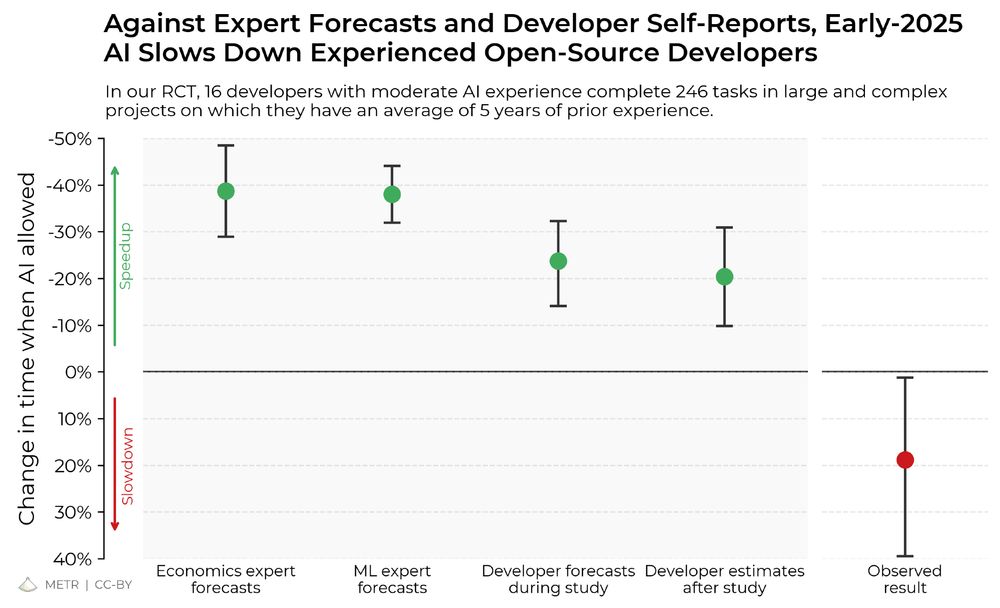
We ran a randomized controlled trial to see how much AI coding tools speed up experienced open-source developers.
The results surprised us: Developers thought they were 20% faster with AI tools, but they were actually 19% slower when they had access to AI than when they didn't.
10.07.2025 19:46
👍 6901
🔁 3016
💬 106
📌 625

Journal of Vision Special Issue
The vision-language interface
Call for papers
Vision and language are often considered to be separate cognitive systems, studied by separate research teams. However, they interact when we use vision for linguistic communication: when reading printed text, when describing verbally the things we see, and when observing the expressions and gestures of an interlocutor (during sign language, for example). The development of these critical skills changes the brain, such that the visual and language systems influence one another. In particular, regions of the cerebral cortex that are typically responsive to visual stimuli are also recruited for linguistic tasks. But some of those ideas are controversial. For instance, for well over a century scientists have debated whether the brains of literate individuals contain a region that is specialized for recognizing written
words.
The Journal of Vision invites submissions for a Special Issue on the interface between vision and language. The unique perspectives and techniques of vision science contribute much to the understanding of language. This special issue welcomes empirical papers that use behavioral/psychophysical, neuroimaging, electrophysiological and stimulation methods.
Topics include, but are not limited to:
- Functional specialization in the brain for reading and naming
- Semantic representations in the brain
- Letter recognition and perceptual learning
- Sign language comprehension
- Eye movements during reading or other linguistic tasks
- Development of visual skills for reading and communication
- Links between visual cortical activity and representations in large language models
- Visual processing differences in dyslexia
Editors:
Susana Chung
Kalanit Grill-Spector
Garikoitz Lerma-Usabiaga
Hans Op de Beeck
Zeynep Saygin
Alex White
Oscar Woolnough
Deadline for submissions: December 31, 2025. All
papers will be subject to peer review.
For everyone out there working at the intersection of vision and language. We are currently accepting submissions for a Journal of Vision Special Issue on the vision-language interface
Submission deadline: Dec 31st
jov.arvojournals.org/ss/visionlan...
#neuroskyence #VisionScience #PsychSciSky
08.07.2025 17:50
👍 9
🔁 8
💬 1
📌 0
NeuroCog » November 17-18, 2025
NEUROCOG 2025 is taking place in Brussels Nov 17–18!
The theme: AI and the Human Brain 🤖 🧠
We’re thrilled to welcome 6 amazing invited speakers:
@evfedorenko.bsky.social, @nicoschuck.bsky.social, @summerfieldlab.bsky.social, @jeffreybowers.bsky.social, @irisgroen.bsky.social & @mtoneva.bsky.social
04.06.2025 13:44
👍 21
🔁 17
💬 1
📌 2

Trump’s new ‘gold standard’ rule will destroy American science as we know it | Colette Delawalla
The new executive order allows political appointees to undermine research they oppose, paving the way to state-controlled science
Trump’s new ‘gold standard’ rule will destroy American science as we know it" by Colette Delawalla (@cdelawalla.bsky.social), Victor Ambros, Carl Bergstrom, Carol Greider, Michael Mann and Brian Nosek for @theguardian.com: www.theguardian.com/commentisfre...
29.05.2025 13:03
👍 365
🔁 221
💬 12
📌 33
I came with my own money (Belgian & international fellowships), and during my stay I spent many tens of thousands of US dollars. I myself motivated and helped other researchers to do the same. This is an unbelievably stupid decision, with global and long-term consequences. 3/3
23.05.2025 11:44
👍 4
🔁 0
💬 1
📌 0
It will make bright researchers from other countries think twice before embarking on a US adventure. This is a major loss, in particular for USA. As I witnessed from within, US science benefited enormously from the presence of the international scholars. The economic gains were also substantial. 2/3
23.05.2025 11:44
👍 0
🔁 0
💬 1
📌 0
As a prior J1 visa holder (postdoc at MIT), I express my support for all those affected by this decision. The possibility of such a sudden and politically motivated stop of enrollment of international students and scholars will have a chilling effect on the prestige of all US institutes. 1/3
23.05.2025 11:44
👍 10
🔁 1
💬 1
📌 0
Tomorrow tuesday afternoon at @vssmtg.bsky.social , our poster about what it takes for the brain and AI models to process the valence of complex and ambiguous social scenes
20.05.2025 03:10
👍 7
🔁 2
💬 0
📌 0

The cuts to NIH and NSF will cost 100s of billions in the short term and will reduce GPT by ~7% over the next 25-30 years
03.05.2025 16:42
👍 7
🔁 2
💬 0
📌 0