The red colour in the umbra is from the light of all the sunsets and sunrises going on around the Earth.
However, the boundary between the red umbra and bright part of the Moon in the penumbra appears a pale blue-pink or magenta colour, from the effect of ozone in the upper atmosphere of Earth absorbing red light.
The Moon passed across the southern half of the umbra at this eclipse so the southern limb of the Moon always remained brighter than the northern limb of the Moon.
This was from home in southern Alberta, with images taken between 3:35 am to 4:05 am MST, Tuesday, March 3, 2026, on a relatively mild winter morning.
Incoming clouds prevented a full sequence during totality and during the partial phases after totality. I had to be happy with getting this set!
Technical:
All but the final image of totality are multi-exposure blends, each image being a blend of short to long exposures, typically 1/25-second to 10 seconds, to preserve the dynamic range between the still directly sunlit side of the Moon and the dark side in the umbra and lit by red sunlight filtering through Earth's atmosphere.
All were with the SvBony Mk127mm Maksutov-Cassegrain telescope at its f/11.8 f-ratio for 1500mm of focal length. The camera was the Canon Ra at ISO 100 to 400.
The original is 20,500 by 4,480 pixels.
This is the total eclipse of the Moon of March 3, 2026, in a sequence over 30 minutes, through the mid-partial phase to totality.
It shows the progression from left to right of the Moon entering the dark inner umbral shadow of the Earth and turning more and more red. Details in Alt Text.
05.03.2026 02:33
👍 18
🔁 5
💬 0
📌 0

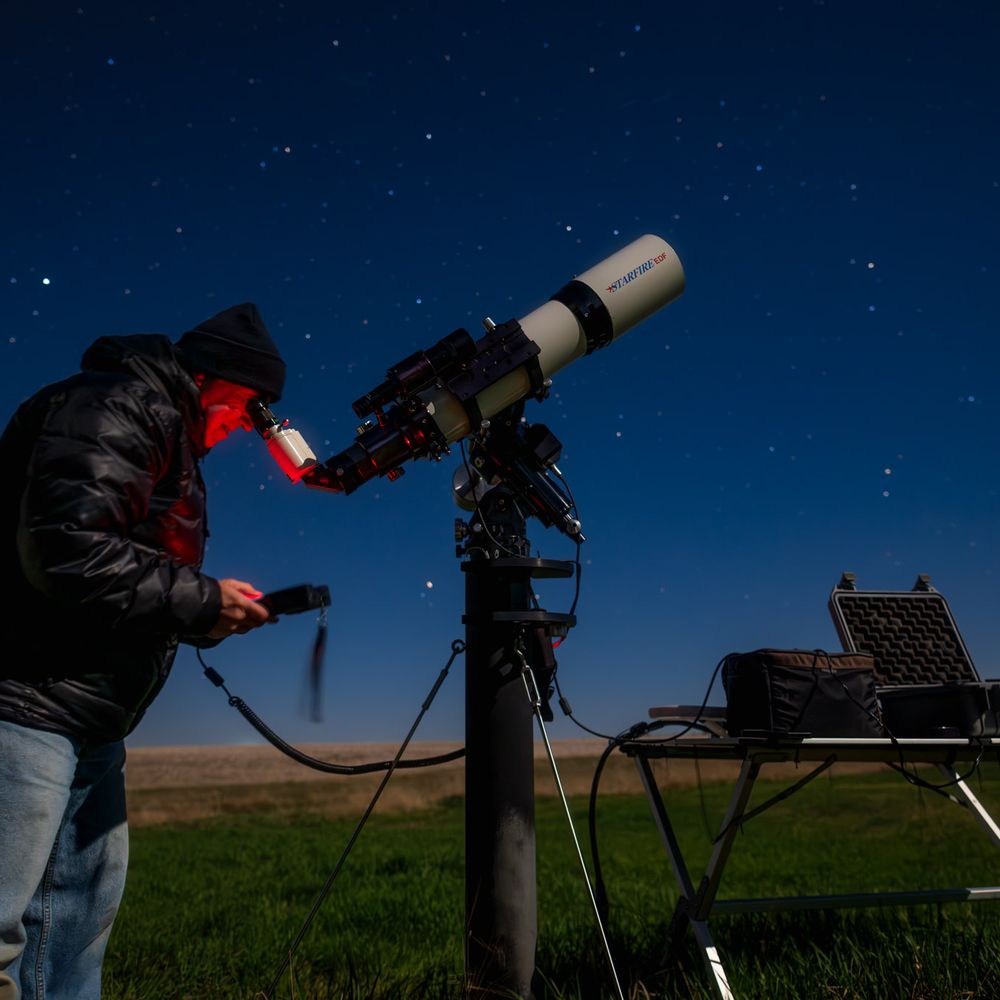
This is a selfie of me while shooting the total eclipse of the Moon on the morning of March 3, 2026, from home in southern Alberta. This was shortly after the start of totality at 4:10 am MST.
I am shooting the eclipse with the Astro-Tech 90CFT refractor on the Sky-Watcher EQM35 mount. It was a mild winter night, but here at the start of totality clouds were beginning to move in from the west, and are lit by the lights from Calgary to the west.
The Moon was in Leo and the bright blue star to the right of the Moon is Regulus.
Technical:
This is a single 10-second exposure at f/2.8 with the Nikkor 35mm lens on the Nimon Z8 at ISO 1600. I was focused for the distance so I am a little fuzzy! but it was 4 am!

This is the total eclipse of the Moon of March 3, 2026, captured close to the time of the start of totality, or "U2.," with the Moon's southeastern limb still bright near the edge of the umbral shadow. The bright edge shows a band of blue, usually created by ozone absorption in Earth's upper atmosphere.
This was near "second contact" and so is sort of a "lunar diamond ring!"
This was from home in southern Alberta at about 4:04 am MST. The field is 3.8º by 2.5º. The Moon was in Leo and some of the field stars show up though none were bright near the Moon. The brightest is 56 Leonis at left at 6th magnitude.
However, it was about this time that high clouds were moving in from the west beginning to dim the Moon and dull the colours. Thus the glow around the Moon. Eventually the clouds won out and the Moon disappeared before the end of totality.
Technical:
This is a blend of 5 exposures from 1/2-second to 8 seconds, taken in rapid succession with Auto Exposure Bracketing, and blended with luminosity masks. This preserved detail in the bright limb while bringing out the darkened disk. All with the stock Canon R5 at ISO 400 on the Astro-Tech CFT90 refractor at f/6 (for 540mm focal length) with the First Light Optics 1x Flattener, and on the Sky-Watcher EQM-35 mount.
Two views of the total eclipse of the Moon in the early morning at 4:04 am MST March 3, 2026, with a selfie with the gear taking the close-up image through the telescope as totality began. And clouds rolled in!
This was from home in southern Alberta.
Details in Alt Text.
03.03.2026 18:32
👍 5
🔁 0
💬 0
📌 0

Of these three planets, only Venus was bright and easily visible to the unaided eye; Saturn was barely so; and Mercury could not be seen even in binoculars, let alone to the eye. Only the very sharp lens picked it up on the frame, and I have exaggerated the visibility of all the planets here so they can be seen when viewing the image at typical sizes on screens. To complete the "parade" Jupiter was bright and easy to see over in the east well out of frame. Neptune was close to Saturn so technically in this image, but is was too faint and impossible to capture or see in the bright twilight. Uranus between Saturn and Jupiter was similarly faint enough to require binoculars to see but only if you knew exactly where to look.
Mercury this night was ending a fine evening appearance, its best for 2026, when it was higher, brighter, and easy to see earlier in the month. However, it was only magnitude 2.0 this night. Venus at magnitude -3.9 was beginning its bright spring evening appearance for 2026, and Saturn at magnitude +1.0 was ending its months-long fine evening show about to go behind the Sun, along with Neptune nearby.
Some faint 4th magnitude stars in Pisces and Cetus also show up in the sky, just!
Technical:
This is a single 0.4-second untracked exposure at f/2.8 with the Nikkor 85mm lens on the Nikon Z8 at ISO 100.

Of these three planets, only Venus was bright and easily visible to the unaided eye; Saturn was barely so; and Mercury could not be seen even in binoculars, let alone to the eye. Only the very sharp lens picked it up on the frame, and I have exaggerated the visibility of all the planets here so they can be seen when viewing the image at typical sizes on screens. To complete the "parade" Jupiter was bright and easy to see over in the east well out of frame. Neptune was close to Saturn so technically in this image, but is was too faint and impossible to capture or see in the bright twilight. Uranus between Saturn and Jupiter was similarly faint enough to require binoculars to see but only if you knew exactly where to look.
Mercury this night was ending a fine evening appearance, its best for 2026, when it was higher, brighter, and easy to see earlier in the month. However, it was only magnitude 2.0 this night. Venus at magnitude -3.9 was beginning its bright spring evening appearance for 2026, and Saturn at magnitude +1.0 was ending its months-long fine evening show about to go behind the Sun, along with Neptune nearby.
Some faint 4th magnitude stars in Pisces and Cetus also show up in the sky, just!
Technical:
This is a single 0.4-second untracked exposure at f/2.8 with the Nikkor 85mm lens on the Nikon Z8 at ISO 100.
The supposed great "Planet Parade" of 2026! This is bright Venus, dimmer Saturn above, and very dim Mercury right of Venus low in the dusk twilight Feb 28. I could not see Mercury even in binoculars, but the camera picked it up. With and without labels. Details in Alt Text.
01.03.2026 18:19
👍 8
🔁 1
💬 1
📌 0

This is the waxing 6-day-old Moon, near the stars of the Pleiades on February 23, 2026, amid light cloud.
The prominent crater at centre with its rim in sunlight but floor in shadow, except for the central peak catching ths Sun, is Albategnius, with Hipparchus above it. This view looks like the famous drawing of the Moon by Galileo (shown in the inset) from 1609 that shows a similar large dark crater at the centre of the Moon's disk. This was one of the first astronomical observations made with a telescope.
Despite the clouds Earthshine is just visible illuminating the dark side of the Moon, as in Galileo's drawing.
The Moon was crossing the northern edge of the Pleiades star cluster this night, and some of the stars are visible, again despite the thin cloud present.
Technical:
A blend of a long 4-second exposure and a short 0.4-second exposure with the SvBony Mk127 Maksutov-Cassegrain telescope at its native f/11.8 and with the Canon R5 at ISO 200.
This is the waxing 6-day-old Moon, near the stars of the Pleiades on Feb 23, 2026, amid light cloud.
The prominent crater at centre with its rim in sunlight is Albategnius. This view looks like the famous drawing of the Moon by Galileo (the inset) from 1609.
Details in the Alt Text.
24.02.2026 18:05
👍 6
🔁 1
💬 1
📌 0

North is at bottom; south is ar top. West is at left; east to the right.
The waxing crescent Moon is bright at upper left. The Big and Little Dippers are below centre. Orion and the winter stars are at top. Jupiter is the brightest object at upper right in Gemini.
Technical:
This is a panorama of 4 segments, with the manual 7Artisans 10mm full-frame fish-eye lens, at f/2.8 on the Nikon Z8 at ISO 800 for 15 seconds each. The camera was turned to landscape orientation but the lens is wide enough to include the horizon up to past the zenith even when turned landscape. I only roughly guessed at the segment spacings when taking the shots, turning the camera about 90º between frames. It stitched perfectly in PTGui, with spherical projection.
This is a 360º all-sky panorama of the auroral arc during a Kp4-5 display on February 21, 2026, from home in southern Alberta on a chilly -20º C night. But it was clear! The aurora appeared just as a diffuse green arc across the north, with a touch of red visible to the camera. Details in Alt Text.
22.02.2026 19:15
👍 10
🔁 1
💬 0
📌 0

This is bright yellowish Saturn, at bottom, below smaller, dimmer and bluish Neptune, the brightest object at top.
They were just 1º 08' apart this night and similarly close through February 2026. They had been close together in the summer of 2025 then pulled apart again. But Saturn's motion brought it back close to Neptune this month for the last time in decades, with the worlds low in the southwest evening sky about to disappear behind the Sun. They were in Pisces.
Though visually not spectacular, this was the last time we will see these two planets this close together in the 21st century. While Saturn passes only 7 arc minutes above Neptune on June 7, 2061 they will be just 3º from the Sun and invisible in the day sky. By the time they emerge into the dawn sky they will be 3º apart. And their meeting in August 2096 isn't very favourable for viewing either. So enjoy this rare meeting of two outer planets.
Saturn's moon Rhea is a dot to the right of Saturn's overexposed disk. Titan was too close to Saturn and Triton was too close to Neptune for either of their largest moons to show up at this scale.
Technical:
This is a stack of 8 x 30-second exposures with the Askar APO120mm refractor at f/5.6 and the Canon R5 at ISO 800, tracking on the ZWO AM5 mount, but with no guiding.
Here is Saturn and Neptune in close conjunction, from Feb 10. They are similarly close all month but this is the last time this century we will see these two worlds this close together in the sky. Details in Alt Text.
11.02.2026 20:41
👍 3
🔁 0
💬 0
📌 0

This frames the stars of the northern autumn sky and Milky Way setting over Head-Smashed-In Buffalo Jump, a U.N. World Heritage Site, in southern Alberta near Fort MacLeod.
Technical -This is a blend of:
— A stack of 4 x 1-minute exposures, tracked for the sky, with no filter. At f/2.8 and ISO 1600.
— A stack of 2 x 2-minute exposures, tracked for the sky with a Maven 20nm H-Alpha filter for the red nebulas. At f/2.8 and ISO 3200.
— A stack of 3 x 30-second exposures, tracked for the sky with a Maven StarWalker diffusion filter for the star glow effect. At f/2.8 and ISO 1600.
— A stack of 3 x 2-minute exposures, untracked for the ground, with no filter, taken with the Moon in the east behind the camera about 5º up at this point and in some cloud but clear enough to light the scene. At ISO 1600 and at f/8 , for depth of field.

This frames the stars of the northern autumn sky and Milky Way setting over Head-Smashed-In Buffalo Jump, a U.N. World Heritage Site, in southern Alberta near Fort MacLeod.
Technical -This is a blend of:
— A stack of 4 x 1-minute exposures, tracked for the sky, with no filter. At f/2.8 and ISO 1600.
— A stack of 2 x 2-minute exposures, tracked for the sky with a Maven 20nm H-Alpha filter for the red nebulas. At f/2.8 and ISO 3200.
— A stack of 3 x 30-second exposures, tracked for the sky with a Maven StarWalker diffusion filter for the star glow effect. At f/2.8 and ISO 1600.
— A stack of 3 x 2-minute exposures, untracked for the ground, with no filter, taken with the Moon in the east behind the camera about 5º up at this point and in some cloud but clear enough to light the scene. At ISO 1600 and at f/8 , for depth of field.
Two versions, with and without labels, of the autumn stars and Milky Way setting over the prairie landscape at Head-Smashed-In Buffalo Jump in southern Alberta, at moonrise on Feb. 5.
Details in the Alt Text.
08.02.2026 04:15
👍 16
🔁 7
💬 0
📌 0

This is the bright star Regulus (the tiny speck above the Moon) just after reappearing from behind the dark limb of the waning gibbous Moon above the Moon at top. This was February 2, 2026 when the Moon occulted Regulus, though from my location only the reappearance was visible, about an hour after moonrise this night, and amid light cloud adding the colours. The Moon was a day past full.
Technical:
A single 1/40th-second exposure with the Canon R5 at ISO 200. on the Askar SQA130 astrographic refractor at its native f/4.8 for 620mm focal length. Processed with separate masks for Moon, sky and star, to retain detail on the bright Moon while bringing out the star and colours in the "lunar corona" from the clouds around the Moon. The image is cropped in from the original.
This is the bright star Regulus (the tiny speck above the Moon) just after reappearing from behind the dark limb of the waning gibbous Moon. This was Feb. 2, 2026 when the Moon occulted Regulus, though from my location only the reappearance was visible. Details in the Alt Text.
03.02.2026 18:46
👍 8
🔁 1
💬 0
📌 1

A display of vertical light pillars caused by lights reflecting off flat ice crystals in the atmosphere on this hazy and misty night. A Kp8 level aurora was also underway and might be contributing the red sky background, but it iwas not producing any discrete arcs or beams obvious through the clouds. Though to the eye these icy light pillars looked like aurora rays.
Jupiter is the bright object at right, in Gemini. This is looking northeast with the Big Dipper at lower left. Cassiopeia is at upper left. Orion is at upper right.
Technical:
A single 30-second exposure with the 7Artisans 10mm full-frame fish-eye lens at f/2.8 on the Nikon Z8 at ISO 1600.

The bright Kp7 level aurora show here showing up during a brief break in the clouds, on January 20, 2026. This was a Kp7-level display this night with here red curtains showing up briefly. But the entire sky was green. Jupiter is at right shining through the clouds. Orion is at far right, with Sirius rising.
Technical:
A single 8-second exposure with the 7Artisans 10mm full-frame fish-eye lens at f/2.8 on the Nikon Z8 at ISO 1600.
Two views on the intense aurora storm nights, January 19 and 20. On the 19th clouds hid the show but turned red, and added vertical light pillars from lights reflecting off ice crystals. On the 20th clouds cleared for a time to show red and green curtains. Details in Alt Text.
22.01.2026 00:36
👍 12
🔁 5
💬 0
📌 1

Orion and its brightest stars blue-white Rigel and orange Betelgeuse is to the south, while Sirius and Canis Major are below in the southeast. Procyon and Canis Minor are above them. Several binocular star clusters are visible, notably, Messier 41 below Sirius, and Messiers 46 and 47 left of Sirius. Messier 48 is on its own well below Procyon. The faint winding stars of eastern Eridanus are to the west (right) of Orion. The faint stars of Lepus are below Orion.
I am using my favourite 9x45mm Maven binoculars, which I used this night to record some binocular observations of winter deep-sky objects.
We had enjoyed several warm mid-winter days so the snow was largely gone from the yard.
Technical:
This is a blend of a single untracked 15-second exposure for the sky and me, with me dimly lit by a red flashlight, blended with a stack of 6 x 15-second exposures for the ground without the light on, to prevent red from spilling out and lighting the trees. All at f/2.5 with the Nikkor 20mm S lens on the Nikon Z8 at ISO 1600.
This is a selfie of me using binoculars to view the Orion Nebula, Messier 42 (I am actually looking at the nebula!), under a clear winter sky on January 18, 2025 from home in southern Alberta at latitude 51º N. Details in Alt Text.
21.01.2026 03:02
👍 4
🔁 0
💬 0
📌 0

Orion is left of the light beam with Sirius and Canis Majpr rising at lower left. The bright object at left of centre is Jupiter below Castor and Pollux in Gemini. Capella and Auriga are at top centre. Aldebaran and the Pleiades in Taurus are at centre. At top is Perseus with Andromeda at upper right.
So the wide sweep of the fish-eye lens takes in the northern winter Milky Way, the winter "hexagon" of bright stars. There is a portrait or vertical orientation version of this as well.
Technical:
A blend of three exposures – two for the ground and me without the light on, and one for the sky with the headlamp on. Untracked, with the 7Artisans MkII 10mm lens wide-open at f/2.8 on the Nikon Z8 at ISO 3200 for 15 seconds each.
While it is a bit of a cliche style of image, here's a nightscape portrait with the light beam aiming to the sky. Taken from home on a clear and mild winter night so I played with a new lens to do some selfies under the winter Milky Way.
Details in the Alt Text.
18.01.2026 23:45
👍 6
🔁 1
💬 0
📌 0

If nightscape photography is your interest I can highly recommend this on-line conference next month. I spoke at it 3 years ago and plan to attend this year as there is a great line-up of speakers.
Check it out at npsummit.live/alan . Registrants have a year's access to the recorded videos.
14.01.2026 16:11
👍 2
🔁 0
💬 0
📌 0

Light from the waxing gibbous Moon off frame to the upper right illumintates the scene and paints the sky deep blue.
Taken from my backyard in southern Alberta on a mild and clear night. This is #3 of 3 variations.
Technical:
A single 15-second untracked exposure at f/2.8 and ISO 200 with the Nikkor 20mm S lens and Nikon Z8.
Happy New Year!
This is Orion above and Sirius below in Canis Major, all nearly due south at midnight on New Year's Eve, December 31, 2025, in the moonlight. Details in the Alt Text.
01.01.2026 18:15
👍 4
🔁 0
💬 0
📌 0


Happy New Year to all! Just a reminder — if you'd like a 2026 Calendar with lots of sky events listed, I have a FREE! one available for download as a PDF at my website at www.amazingsky.com/Books
It features 14 of my favourite astrophotos from 2025. It can be printed locally if you wish.
29.12.2025 23:34
👍 8
🔁 2
💬 1
📌 1

With the new 7 Artisans 10mm full-frame fish eye lens wide open at f/2.8 on the Nikon Z8 at IS0 1600 for 20 seconds untracked.
A labeled view of the winter stars in the eastern sky on a rare clear December night, from the Big Dipper in the northeast, to Orion in the southeast. The Milky Way runs from Perseus at top to Canis Major at bottom. A bit of aurora lights the north. Tech details in the Alt Text.
17.12.2025 03:38
👍 3
🔁 0
💬 0
📌 0

This is from the morning of November 20, 2025 after it had emerged from behind the Sun in late October and was now positioned high enough for a good look and image through amateur telescopes. The comet shows a faint tail to the right of the cyan-tinted head, all typical of normal solar-system comets. It also shows a faint anti-tail pointing to the left ahead of the comet. The comet was travelling along the ecliptic so dust ejected from the comet was spreading along the ecliptic as well. We were seeing its orbit edge-on making the dust more obvious both ahead and behind the comet.
The comet was in Virgo, near the bright star Porrima which is just out of the field at upper left. The field is 2.5º by 1.6º.
Technical:
- This is a stack of 19 x 3 minute exposures for the sky, aligned on the stars, blended with ...
- A stack of 10 of those exposures aligned for the comet, which was moving noticeably (almost a comet diameter) from exposure to exposure, due to its rapid motion through space. I removed the stars from the comet images and aligned just the comet to blend it into the star field..
So the comet comes from that subset of 10 comet-aligned images taken over 30 minutes.
All with the Askar APO120 refractor at its native f/7 for 840mm focal length, and the Canon R5 at ISO 1600. Autoguided on the stars. Taken from home in Alberta on a very fine night, November 19/20, 2025.
This is the infamous interstellar visitor from another solar system, #Comet3iAtlas, from this being the third interstellar comet discovered. It passed through our solar system in late 2025 before heading back into the galaxy and interstellar space.
Details in the Alt Text.
20.11.2025 21:28
👍 4
🔁 0
💬 0
📌 0


My 2026 Amazing Sky Calendar is out and available for downloading at my website.
It's a FREE (!) PDF, suitable for local printing. It has lots of sky events listed in the monthly pages and 14 of my favourite astrophotos from 2025.
www.amazingsky.com/Books
17.11.2025 19:11
👍 15
🔁 6
💬 0
📌 1

This is a 360º panorama of the November 11, 2025 great aurora show, taking in the entire sky, from horizon around the periphery, to the zenith at centre. Aurora fills the sky, with this show being rich in reds, which blended with the greens to produce other colours such as the yellows and oranges here.
North is at top; south at bottom; east to the left and west to the right.
Cassiopeia is just left of centre, with Andromeda and Pegasus below it, with Saturn below the Square of Pegasus. The Summer Triangle stars are at right setting. Capella and Aldebaran in Auriga and Taurus are at left rising, along with the Pleiades. The Big Dipper is low in the north at top.
Technical:
This is a stitch of 10 segments, 36º apart, each 4-second exposure at f/2.8 with the Laowa 10mm rectilinear wide-angle lens on the Nikon Z8 at ISO 1600, and in portrait orientation to extend well beyond the zenith. Stitched in PTGui 13.3.
The original is 9000 by 9000 pixels.

This is a 360º panorama of the November 11, 2025 great aurora show, taking in the entire sky, from horizon around the periphery, to the zenith at centre. Aurora fills the sky, with this show being rich in oxygen reds, which blended with the oxygen greens to produce other colours such as the yellows and oranges here, and with some nitrogen emission briefly adding the vivid pinks or magentas. This was taken early in the evening when the reds were particularly intense.
This panorama doesn't show the sky at one moment in time as it is made of multiple segments which took about a minute to shoot. So it blends time as well as space! But it does show what the sky was delivering this night — a very colourful aurora!
North is at bottom; south at top; east to the right and west to the left.
Cassiopeia is just right of centre near the zenith, with Andromeda and Pegasus to the right and above it, with Saturn above the Square of Pegasus at top right. The Summer Triangle stars are at upper left setting. Capella and Aldebaran in Auriga and Taurus are at lower right rising, along with the Pleiades. The Big Dipper is low in the north at bottom.
Technical:
This is a stitch of 6 segments, 60º apart, each 5-second exposures at f/2.8 with the TTArtisan 11mm full-frame fish-eye lens on the Canon R5 at ISO 1600, and in landscape orientation to just reach up to the zenith. Stitched in PTGui 13.3.
The original is 12000 by 12000 pixels.
Here are two 360º all-sky panoramas of the Great Red Aurora of November 11, 2025.
Both are multi-segment panoramas, not single shots, taking about a minute each to shoot, so the image is not a snapshot of the sky at one instant.
Details in the Alt Text.
15.11.2025 20:04
👍 13
🔁 2
💬 0
📌 0
The Great Red Aurora of November 11, 2025
YouTube video by AmazingSky
My edited music video with time-lapses and still images from the superb aurora of November 11, 2025 is available for your viewing pleasure on YouTube at —
youtu.be/s6tBIj5FZCk
Details are in the video description on the YouTube video page.
Thanks for looking!
14.11.2025 21:58
👍 5
🔁 0
💬 0
📌 0

The almost Full Moon rising over the rangeland prairie of southern Alberta, on November 6, 2025. The Moon was a day and a half past Full at this time but was rising shortly after sunset amid low clouds into a deep blue twilight sky in the northeast.
This is a single metered exposure with the Canon RF100-400mm lens at 270mm on the Canon R5.

The almost Full Moon rising over the rangeland prairie of southern Alberta, on November 6, 2025. The Moon was a day and a half past Full at this time but was rising shortly after sunset amid clouds into a deep blue twilight sky in the northeast.
This is a single metered exposure with the Canon RF100-400mm lens at 400mm on the Canon R5.
Two views of the rising waning Moon from November 6, 2025, the day after the Full Moon. It's here rising into the blue twilight amid some clouds and over the prairie rangeland near home in southern Alberta.
07.11.2025 17:58
👍 5
🔁 2
💬 0
📌 0

This is a "deep" exposure of the constellations of Cassiopeia the Queen and Cepheus the King, to pick up the many reddish emission nebulas in the area, some relatively bright, but others very faint and extensive throughout this region of the northern Milky Way. Also in the frame are many open star clusters. The distinctive 5 stars of the W of Cassiopeia are at left.
Technical:
This is a blend of filtered and unfiltered exposures:
- A stack of 72 x 1-minute exposures through an Astronomik dual narrowband UHC clip-in filter, at ISO 1600.
- A stack of 21 x 1-minute exposures through a mild light pollution filter, a 95mm NISI Night, at ISO 800.
- A single exposure through a 95mm Tiffen Black Mist filter contributed some of the star glows on the bright stars.
- All at f/2 with the Canon RF28-70mm lens at 35mm, on the red-sensitive Canon Ra, and on the MSM Nomad tracker.


This is a "deep" exposure of the constellations of Cygnus the Swan and the southern part of Cepheus the King, to pick up the many reddish emission nebulas in the area, some relatively bright, but others very faint and extensive throughout this region of the northern Milky Way. Also in the frame are many open star clusters. And at top is the bright star Vega in Lyra the Harp.
Between Vega and Deneb is the field the Kepler exoplanet search satellite stared at for several years.
At centre is the bright Cygnus Starcloud, rich in stars and also red nebulas, and bisected by the Dark Rift in the Milky Way from interstellar dust.
Technical:
This is a blend of filtered and unfiltered exposures:
- A stack of 25 x 1.5-minute exposures through an Astronomik dual narrowband UHC clip-in filter, at ISO 1600.
- A stack of 29 x 1.5-minute exposures through a mild light pollution filter, a 95mm NISI Night, at ISO 800.
- A stack of 8 exposures through a 95mm Tiffen Black Mist filter contributed the star glows on the bright stars.
- All at f/2 with the Canon RF28-70mm lens at 35mm, on the red-sensitive Canon Ra, and on the MSM Nomad tracker.

Two views of the rich collections of nebulas and star clusters in the Cygnus and Cepheus areas of the northern Milky Way, in versions with and without labels. Both taken at the end of September at the Southern Alberta Star Party. Tech details in the Alt Text.
05.11.2025 03:43
👍 53
🔁 8
💬 0
📌 1

The comet had passed closest to Earth a week earlier but was still a week away from its closest approach to the Sun, or perihelion. The comet was exhibiting a long straight blue ion tail and a shorter curving shot dust tail, typical of many comets.
Warm light from a low first quarter Moon off camera to the left illuminates the scene and casts the shadows across the river shore.
The comet was departing the constellation of Serpens this night (whose stars are at right) and was heading into southern Hercules.
Technical:
This is a blend of —
– A stack of 8 x 30 seconds, tracked on the Star Adventurer 2i tracker, for the sky, with ...
– A stack of 2 x 60 seconds, untracked, for the ground, with LENR turned on for hot pixel elimination
– All with the Canon R5 at ISO 400 and RF28-70mm lens at 35mm and f/2.
The sky stack was Median combined to eliminate the many Starlink satellite trails. No filters were employed.
This is Comet Lemmon (C/2025 A6) in a moonlit evening sky scene over the Elbow River at Elbow Falls, in Kananaskis Country, southern Alberta.
This was October 29, 2025. Tech details in the Alt Text.
30.10.2025 23:08
👍 25
🔁 9
💬 1
📌 1

This is a panorama of a set of dim red and green arcs of aurora across the northern sky defining the auroral oval, taken from the coast of Norway, on October 21, 2025. At left is the short streak of Comet Lemmon, aka C/2025 A6, then bright in the northern sky, above the bright star Arcturus.
The Kp Index was only about 1.5 this night, but from this location under the auroral oval at latitude 70º N the aurora is active most nights. This was early in the evening; the aurora brightened later this night.
The Big Dipper and Ursa Major are at left of centre. Bright Jupiter is just rising from behind the mountain at right of centre, below Castor and Pollux in Gemini. At right are the stars of Auriga and Taurus rising, including Capella at top and Aldebaran at far right below the Pleiades.
The location is from north of Tromsø, aboard the Hurtigruten ferry ship the m/s Nordkapp. North is at centre; northwest to the left and northeast and east to the right off the stern of the ship. We were on a southwesterly bearing at this time.
Technical:
This is a stitch of 5 segments, each 2 seconds with the Viltrox 16mm lens at f/1.8 on the Nikon Z6III at ISO 6400. Stitched in PTGui with some manual masking adjustments to blend seams and content from shots taken on the moving ship.
A panorama of auroral arcs across the northern sky, along with Comet Lemmon, small and to the left here above bright Arcturus. This was October 21, 2025 on the coast of Norway aboard the m/s Nordkapp. Details in Alt Text.
29.10.2025 19:45
👍 8
🔁 2
💬 0
📌 1

This is Comet Lemmon (aka C/2025 A6) in the western evening sky in a moderately wide view on October 26, 2025. It is showing a straight blue ion gas tail, with a hint of the shorter curving white dust tail.
The comet was just visible to the unaided eye, and in 9x45 binoculars about a 2º - 3º tail was easily visible.
The comet was in Serpens. The bright star at lower right is Arcturus.
The field is about 45º by 30º.
Technical:
This is a blend of —
- stack of 5 x 30-second exposures, tracked, for the sky
- with a stack of 2 x 30-second exposures, untracked, for the ground and clouds
All with the camera on a Star Adventurer 2i tracker. With the Canon RF28-70mm lens at 44mm and f/2 and on the Canon R5 at ISO 400. Taken from home in Alberta with the comet low in the west and setting into the remaining evening twlight and the bright skyglow from Calgary. Satellites plagued every frame but median stacking the sky frames eliminated them.

This is Comet Lemmon (aka C/2025 A6) in the western sky in a telephoto closeup on October 26, 2025. It is showing the two classic tails of comets: a whitish-yellow curving dust tail and the straight blue ion gas tail. The latter is about 7º long here.
The comet was just visible to the unaided eye, and in 9x45 binoculars about a 2º - 3º tail was easily visible.
The comet was in Serpens. The bright star in the tail is Beta Serpentis.
The field is 10º by 15º.
Technical:
This is a stack of 28 x 16-second exposures with the camera on a Star Adventurer 2i tracker. With the Canon RF135mm lens at f/1.8 and on the Canon R5 at ISO 800. Taken from home in Alberta with the comet low in the west and setting into the bright skyglow from Calgary. Satellites plagued every frame but median stacking them eliminated them.
While the comet did move slightly against the background stars during the 7 minutes of accumulated exposure time it did not blur the comet enough at this scale to fuss with the process of aligning stars and comet separately.

This is Comet Lemmon (aka C/2025 A6) in a stack of telephoto closeups, processed to add the frames together, to accumulate the many satellite trails that crossed the frames diuring the exposures, rather than average them out as would normally be done now. This is a stack of 45 x 16-second exposures taken over about 22 minutes (other frames in the sequence were not used as they were trailed slightly due to wind).
Most of the trails are from SpaceX Starlink satellites, if only by virture of the fact that Starlinks are by far the most numerous satellies in orbit. But the trails also look blue (the generation of Starlinks current as of this date are designed to reflect mostly blue light) and they run in sets of parallel streaks from several launch batches crossing the field.
The comet was in Serpens this night, October 26, 2025. The bright star in the tail is Beta Serpentis.
The field is 10º by 15º.
Technical:
This is a stack of 45 x 16-second exposures with the camera on a Star Adventurer 2i tracker. With the Canon RF135mm lens at f/1.8 and on the Canon R5 at ISO 800. Taken from home in Alberta with the comet low in the west and setting into the bright skyglow from Calgary.
The comet's right to left motion against the background stars during the 22 minutes of accumulated exposure time does blur or trail the comet itself slightly.
Three views of Comet Lemmon #cometlemmon (C/2026 A6) from Oct 26: wide in the evening twilight above Arcturus, and a telephoto closeup, without satellites (subtracted via stacking) & with the many satellites that crossed the field in 20 min., most #Starlink. Details in Alt Text.
28.10.2025 00:24
👍 8
🔁 2
💬 0
📌 0

The comet was brightening and rising higher into the northern evening sky at this time, October 10, 2025. The comet was just visible in 50mm binoculars as a fuzzy star. A short tail is visible in the photo, with the aid of contrast enhancement!
The comet was in Ursa Major below the Big Dipper. Taken from home in southern Alberta. The field is 10º by 15º.
Technical:
This is a blend of a stack of:
- 4 x 15-second exposures untracked for the ground,
- 4 x 15-second exposures tracked for the sky,
- with the Canon RF135mm lens at f/2.8 and on the Canon R5 at ISO 1000, and on the Star Adventurer 2i tracker.
This is Comet Lemmon (aka C/2025 A6) in the moonlit evening sky on October 10, over the northern horizon, and the lights of a farm. The waning gibbous Moon was rising in the east off camera, lighting the sky and landscape.
Details in Alt Text.
11.10.2025 04:12
👍 8
🔁 3
💬 0
📌 0

This is Comet Lemmon (aka C/2025 A6) in the moonlit sky over the northern horizon, and above the lights of a large farm. The Moon was just 2 days past full. The comet was brightening and rising higher into the northen evening sky at this time, October 8, 2025. The comet was just visible in 50mm binoculars as a fuzzy star. A short tail is visible in the photo, with the aid of contrast enhancement!
Taken from home in southern Alberta. The field is 10º by 15º.
Technical:
The sky is a stack of 4 x 15-second exposures with the Canon RF135mm lens at f/3.2 and on the Canon R5 at ISO 640, and on the Star Adventurer 2i tracker. The ground is from one of those tracked frames, so it is trailed slightly.

This is Comet Lemmon (aka C/2025 A6) in a bright moonlit sky, in a telescopic closeup, showing the cyan-tinted head and the blue ion gas tail. The tail would have showed up better had the sky been darker, but the waning gibbous Moon was lighting the sky. This was at about 5:00 am on the morning of October 9, 2025 with a very clear but brght sky.
Taken from home in southern Alberta. The field is 5º by 3.3º.
The comet was in the "hind feet" of Ursa Major at this time, and in the northeast dawn sky. But it was circumpolar and visible from my latitude all night. It was just visible in binoculars as a fuzzy star, but only if you knew exactly where to look.
Technical:
This is a stack of 20 x 30-second exposures with the Askar SQA85mm astrographic refractor at its native f/4.8 and the Canon R5 at ISO 1600, and on the Astro-Physics Mach1 mount tracking the stars, but with no auto-guiding. All exposures were through an Optolong L-Pro broad dual-band filter to suppress the moonlight somewhat, using the just-purchased Askar FIlter Drawer to insert the filter into the light path.
I made no attempt to align and process the stars and comet separately, so the motion of the comet against the background stars over the 10 minutes of exposure does blur its image slightly. Contrast enhancements brought out the faint tail against the bright background.
Comet Lemmon (C/2025 A6) in the evening sky (wide shot above the foreground) and morning sky (telescope close-up), in the moonlight, Oct 8/9, 2025. It is visible in binoculars but only just, as a fuzzy star. It will brighten thru October as it moves higher into the evening sky. Details in Alt Text.
10.10.2025 16:55
👍 3
🔁 0
💬 0
📌 0