Happy to have this descriptive piece with @camilantmorales.bsky.social, Kalena Cortes, @julia-turner.bsky.social, & @loismiller.bsky.social out!
Look for more causal work on this topic from our team in the near future 👀
19.01.2026 12:40
👍 24
🔁 8
💬 0
📌 0

Community College Bachelor’s Degrees: How CCB Graduates’ Earnings Compare to AAs and BAs
Founded in 1920, the NBER is a private, non-profit, non-partisan organization dedicated to conducting economic research and to disseminating research findings among academics, public policy makers, an...
A new NBER working paper by @riacton.bsky.social and colleagues finds economic benefits to a community college baccalaureate relative to an associate degree, but that an earnings penalty still exists in tech fields relative to a traditional bachelor's degree.
19.01.2026 10:27
👍 10
🔁 1
💬 0
📌 1
@dubravkaritter.bsky.social Tomas Monarrez and I explore the credit profile of graduate students likely to need private loans after OBBBA’s new loan limits take effect next July. A bit over 1/3 have thin or poor credit and may struggle to get a private loan under typical underwriting practices.
16.12.2025 14:41
👍 8
🔁 4
💬 0
📌 0

Suspended from work and school? Impacts of layoff events and unemployment insurance on student disciplinary incidence
We examine the impact of local labor market shocks and state unemployment insurance (UI) policies on student discipline in U.S. public schools. Analyz…
🚨New publication alert #econsky🚨
Thrilled to have “Suspended from Work and School? Impacts of layoff events and unemployment insurance on student disciplinary incidence” forthcoming at Labour Economics with @riacton.bsky.social and Austin Smith
Paper thread incoming 🧵
tinyurl.com/susp-ws
10.12.2025 13:17
👍 21
🔁 10
💬 1
📌 2
The FTC is hiring economists!
Applications due 12/17 so it’s a quick turnaround!
Happy to chat with anyone interested in the position, especially if you have a non-IO background like me…
04.12.2025 12:48
👍 9
🔁 7
💬 0
📌 0

Line graph showing cumulative state adoption of chiropractic boards over time
I'm John Fallon, a labor economist on the job market. My JMP uncovers something wild: when chiropractors got licensed in the early 1900s, medical boards responded by making it HARDER to become a doctor.
Why would competition lead to stricter regulations?
🧵
john-fallon-econ.com
(1/9)
24.11.2025 20:37
👍 104
🔁 47
💬 5
📌 13
Joe Winkelmann & I have released a new @wheelockpolicybu.bsky.social working paper:
"Labor Market Strength and Declining Community College Enrollment"
We show stronger labor markets since 2009 explain most of the decline in community college enrollments.
wheelockpolicycenter.org/high-quality...
12.11.2025 13:00
👍 46
🔁 17
💬 1
📌 2
🚨There is a lot of policy movement to expand career & technical Ed but little evidence of what to expect from such expansion. Our WP provides evidence from MA on take up & ➕impacts in the first 5 yrs after HS. #cte
05.11.2025 14:45
👍 15
🔁 8
💬 0
📌 0

STATISTICIAN
The Bureau of Economics seeks candidates for the position of Statistician. Statisticians work directly with BE staff economists to (1) provide economic analysis in support of antitrust and consumer pr...
The FTC is hiring Statisticians in the Bureau of Economics!
This is a great opportunity for seniors or recent grads interested in antitrust and consumer protection economics, and applied microeconomics research.
Come work with me! Happy to answer any questions.
www.usajobs.gov/job/845835200
12.09.2025 23:08
👍 11
🔁 8
💬 0
📌 0

Scatter plot comparing median program debt (x-axis, $50k-$300k) vs 10-year cumulative earnings (y-axis, $0.5M-$2M) for professional programs. Medicine MD programs (pink squares) cluster in upper right with high debt ($150k-$250k) and high earnings ($1.4M-$1.8M). Law programs (blue circles) cluster in the bottom left corner with lower debt and lower earnings, though some elite programs show medicine-level earnings and somewhat higher debt than other law schools. Veterinary Medicine (green diamonds), Dentistry (plus signs) and Pharmacy (X marks) are distributed across middle ranges of earnings, but across wide ranges of the distribution of debt, with almost all pharmacy programs having lower debt than almost all dentistry programs. Physical therapy and veterinary programs have law-like earnings (between half a million and a million over 10 years), and while PT has law-like debt as well, veterinary debt is generally much higher and closer to medical school.
New at @pseocoalition.bsky.social, @julia-turner.bsky.social & I have a new report on grad school debt & earnings over the medium term. For some key professional fields (🩺⚖️🦷💊🐾), we show the varied patterns both within & across areas of study, looking at the first decade of earnings after graduation
30.06.2025 17:31
👍 23
🔁 12
💬 3
📌 2
For those interested in education policy and the economics of education, I've put together 4 starter packs:
Faculty and researchers 1: go.bsky.app/GHJzy4L
Faculty and researchers 2: go.bsky.app/TeqwuKM
PhD students & postdocs: go.bsky.app/FUjWT5E
Journalists and writers: go.bsky.app/3XhYmo3
30.05.2025 18:10
👍 57
🔁 31
💬 6
📌 2
We estimate that since 2009 the Great Recession accounts for:
-19-32% of the rise in undergrad student debt
-10-25% of the rise in student loan defaults
09.05.2025 13:13
👍 5
🔁 2
💬 0
📌 0
Sorry I missed it! Next time…
18.04.2025 00:30
👍 2
🔁 0
💬 0
📌 0
OCE Staff Working Papers | Office of the Under Secretary
There's lots more in the report to dig into, so take a look! This is work with @michelgrosz.bsky.social, Sophie McGuinness, @jdmatsudaira.bsky.social, and Raj Darolia, and you can find the full report and data, along with other OCE releases, here: sites.ed.gov/ous/office-o...
17.01.2025 18:17
👍 4
🔁 1
💬 0
📌 0
Really exciting to have this work on graduate borrowing out. See @clibassi.bsky.social thread with the excellent summary…and better yet take a look at the underlying data!
17.01.2025 18:30
👍 6
🔁 0
💬 0
📌 0

My paper with Devesh Raval is now out at Marketing Science!
We find that when the FTC redesigned its complaint website:
-Complaints increased by 40%,
-included more useful and detailed information
-increased most for older consumers and those with less tech savvy
13.12.2024 18:04
👍 16
🔁 3
💬 1
📌 0
Can anyone recommend papers that compare RCT and quasi experimental estimates for the same research question?
#econsky
09.12.2024 22:05
👍 20
🔁 8
💬 9
📌 4
Quarterly Workforce Indicators: Quarterly Data Highlight
Today, we released our first Quarterly Workforce Indicator Highlights!
content.govdelivery.com/accounts/USC...
02.12.2024 16:32
👍 4
🔁 5
💬 1
📌 0

Screenshot of the ASHE account
The American Society of Hispanic Economists (ASHE) is here 🦋🦋🦋
Follow @asheassa.bsky.social ‼️
02.12.2024 03:24
👍 20
🔁 9
💬 0
📌 1

GitHub - clibassi/python-packages-for-applied-economists: A curated collection of Python packages for applied economists, organized by functionality to support econometric analysis, data management, v...
A curated collection of Python packages for applied economists, organized by functionality to support econometric analysis, data management, visualization, and specialized tasks. - clibassi/python-...
Okay, I made an updated version of the guide "Python Packages for Applied Economists" to reorganize a bit, incorporate suggestions, and put it on Github like a grownup: github.com/clibassi/pyt...
Comments welcome!
24.11.2024 22:18
👍 101
🔁 27
💬 7
📌 2
#EconSky #EconTwitter UC Davis Economists starter pack is here. Faculty, Alumni, even Ag Econ. Got everyone I could find so far, but surely missing others. Hit me up and I'll add you. Thank @afoote-econ.bsky.social
go.bsky.app/7hAGUoa
15.11.2024 00:09
👍 11
🔁 6
💬 4
📌 2
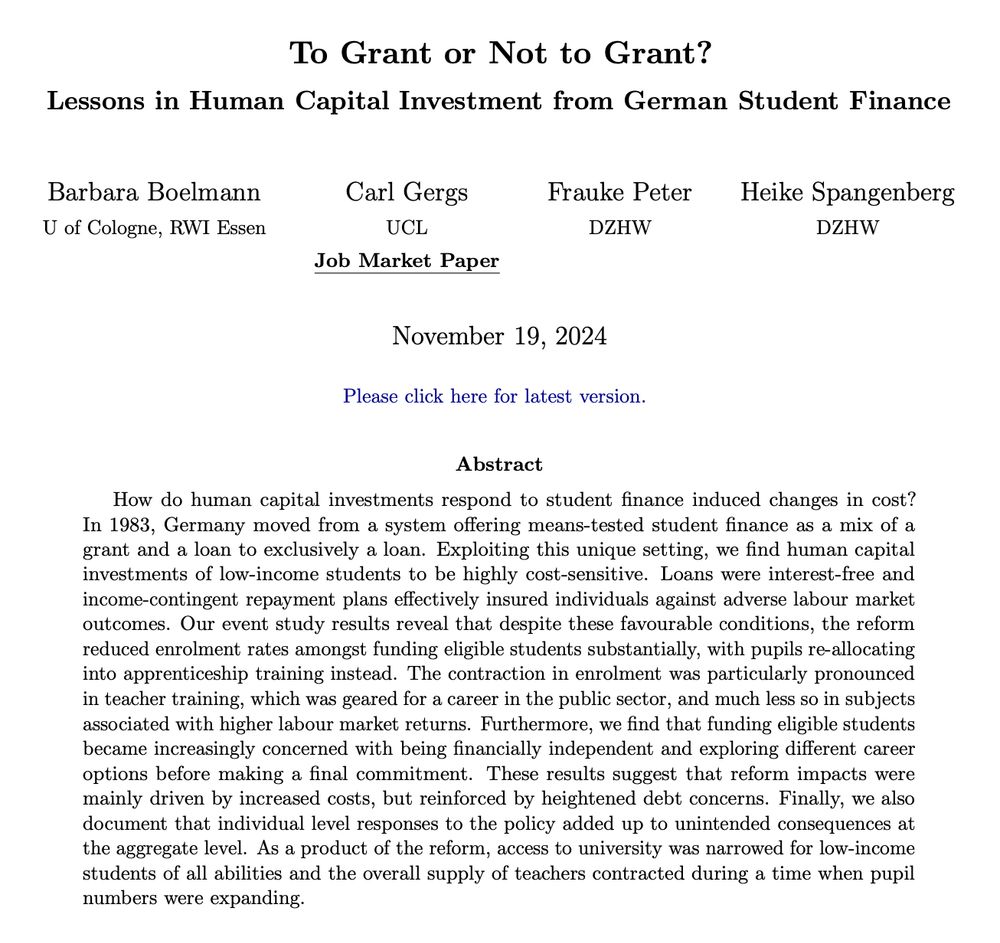
Hello #EconSky 👋 excited to share my JMP!
❓What are the impacts of offering student finance as a grant or a loan?
In the paper, I...
🎓 Study individual university enrolment, subject choice & career motivations
❗️Explore aggregate outcomes e.g. access to university & the occupational structure
🧵👇
19.11.2024 18:28
👍 43
🔁 17
💬 3
📌 5

It’s WALES submission/registration time again! One of the best days of the late-winter if you’re a labor-adjacent economist around DC - check it out!
18.11.2024 20:34
👍 5
🔁 4
💬 2
📌 0

Pell Grants are the cornerstone of federal financial aid for students with low income who are
enrolled in postsecondary education. Currently, these grants are available only to those who seek
an initial undergraduate degree or credential requiring at least a typical semester of instruction.
Because these rules may restrict access to programs providing skills needed for new or better jobs,
in 2011 the U.S. Department of Education (ED) began pilots of two experimental expansions to Pell
Grant eligibility. The first experiment allowed income-eligible students with a bachelor’s degree to
obtain Pell Grants for short-term occupational training programs. The second experiment allowed
income-eligible students to obtain Pell Grants for very short-term programs lasting as little as eight
weeks. This report updates earlier results from a rigorous evaluation of the experiments conducted
by ED’s Institute of Education Sciences (IES), adding new information about the experiments’
impacts on labor market success. This fuller picture could help Congress as it considers legislation
to make Pell Grants for short-term occupational training permanent policy.
Key Findings
• Offering Pell Grants for short-term occupational training programs to students with low income who
have a bachelor's degree increased program enrollment and completion by about 20 percentage
points.
• Offering Pell Grants for very short-term occupational training programs increased program
enrollment and completion by about 10 percentage points.
• More than half of students offered experimental Pell Grants used them, receiving an average grant
amount of $1,800; they were just as likely as those not offered the grants to also use federal student
loans.
• Despite boosting program enrollment and completion, offering experimental Pell Grants did not
increase employment or earnings in the medium to long term.
Allowing students to use Pell Grants for short-term occupational training:
- increased their use of such training but
- did not benefit their employment or earnings.
Great to see a high-quality evaluation of a promising policy idea. Good to know!
ies.ed.gov/ncee/pubs/20...
18.11.2024 20:07
👍 15
🔁 2
💬 2
📌 0
He vuelto a actualizar el starter pack de economistas de habla hispana. Ya somos mas de 90. Ideal si acabas de aterrizar o si piensas que Bluesky todavia no ha despegado.
Si quieres añadir tu nombre, no tienes mas que decirlo.
go.bsky.app/8tkeVED
07.11.2024 21:26
👍 16
🔁 14
💬 6
📌 0
He creado este starter pack que reune a economistas de habla hispana en Bluesky para conectarnos mejor.
Si quieres incluirte, solo tienes que decírmelo go.bsky.app/8tkeVED
01.10.2024 16:59
👍 63
🔁 43
💬 24
📌 4