el apoyo a las familias afectadas y el impulso a la investigación científica que permita mejorar el diagnóstico, el tratamiento y la calidad de vida de quienes conviven con estas patologías. #diamundialenfermedadesraras #rarediseasesday
28.02.2026 12:16
👍 2
🔁 2
💬 0
📌 0

Muy orgullosa de formar parte de este equipazo de investigación que estudia una enfermedad ultrarrara #Laforadisease, para dilucidar sus mecanismos moleculares y encontrar un tratamiento. #FEDER_ONG @rarascsic.bskysocial @ibv-csic.bsky social #diamundialdelasenfermedadesraras #rarediseasesday
28.02.2026 14:05
👍 3
🔁 1
💬 0
📌 0
New lab preprint! Can we study conscious perception of gut sensations in mice to reveal its neuronal basis? Can we train mice to report their gut sensations? Omer Rafael and Stav Shtiglitz in the lab teamed up to discover that…YES! Thread…1/6 www.biorxiv.org/content/10.6...
13.02.2026 13:11
👍 36
🔁 13
💬 1
📌 0

Mapping the genetic landscape across 14 psychiatric disorders - Nature
Genomic analyses applied to 14 childhood- and adult-onset psychiatric disorders identifies five underlying genomic factors that explain the majority of the genetic variance of the individual disorders...
1/4 Thrilled to be sharing new work published today in Nature describing the third wave of results from the PGC Cross-Disorder Group. This reflects a massive group effort to examine shared and unique genetic signal across >1 million cases for 14 psychiatric disorders. www.nature.com/articles/s41...
10.12.2025 16:22
👍 122
🔁 51
💬 2
📌 7
Uauh, muchas felicidades Idoia! Súper merecido!
11.12.2025 16:57
👍 1
🔁 0
💬 1
📌 0

Philosophical Transactions of the Royal Society B: Biological Sciences: Vol 380, No 1939
Our special issue on Evolutionary Functions of Consciousness, coedited with Tecumseh Fitch and Adina Roskies, now online royalsocietypublishing.org/toc/rstb/202...
Contributions by (1) Irina Mikhalevich; (2) Eva Jablonka and Simona Ginsburg; (3) Nicholas Humphrey; (cont'd)
13.11.2025 23:09
👍 71
🔁 28
💬 2
📌 1

Cover of this week's Nature showing a brain rendering
Cover caption from the journal:
Brain development:
Our ability to process information into complex emotions, behaviours and decisions relies on the rich diversity of cell types that make up the human brain. Uncovering the molecular and cellular events that take place during brain development could reveal not only the mechanisms that give rise to this diversity but also shed light on how this process might go awry in neurodevelopmental disorders such as autism and schizophrenia. In this week’s issue, the BRAIN Initiative Cell Atlas Network (BICAN) builds on its previous work creating atlases of cell types in the adult mouse, non-human primate (NHP) and human brains to present cell-type atlases of the developing human, mouse and NHP brains. Across a suite of papers, nine of which are published in Nature, the researchers uncover the complex programs through which cell types emerge during brain development in humans and animals, revealing both the shared and unique features of the human brain. The latest work, along with future research directions, is summed up in a Perspective article by Tomasz Nowakowski and colleagues
New issue of Nature - with NINE studies on #brain #development from the BRAIN Initiative Cell Atlas Network (BICAN) 🧠🧪🔬
An amazing set of resources for all scientists working on the brain!
🧠 Immersive feature:
www.nature.com/immersive/d4...
🧠 Perspective:
www.nature.com/articles/s41...
05.11.2025 18:53
👍 93
🔁 41
💬 0
📌 0
I am thrilled to share our latest work: we identified a population of central amygdala neurons that promote the earliest and perhaps most important social behavior: pup suckling!... We also developed new tools for pup neuroscience
Work by @Jeff Moore now at USC, a collaboration with @Sam Pfaff lab
21.10.2025 10:17
👍 103
🔁 29
💬 2
📌 0
Bebo Valdés & Chucho Valdés.- Tres palabras
YouTube video by Calle54Records
El pianista Chucho Valdés (1941) cumple hoy años
www.youtube.com/watch?v=Jqg5...
09.10.2025 03:54
👍 3
🔁 2
💬 0
📌 0

Postnatal plasticity in the olfactory system of the juvenile swine brain - Brain Structure and Function
Swine have an excellent sense of smell and highly complex olfactory brain structures, which play a crucial role in their complex social interactions. In other mammals the olfactory system is known to exhibit significant plasticity, even during adulthood. The aim of this study was to investigate postnatal plasticity in olfactory areas of juvenile swine brains by studying immature cells immunoreactive for the microtubule-associated protein doublecortin (DCX). Using immunofluorescence, we studied DCX coexpression with the cell proliferation marker Ki-67, and different neuronal markers. Our results show the existence of numerous DCX + cells throughout the olfactory pallial areas. In some of them, we found DCX+/Ki-67 + coexpressing cells, suggesting that they were proliferating. Some of these proliferating cells were grouped in tangentially-oriented migratory-like chains, forming the rostral migratory stream to anterior olfactory area and olfactory bulb. Moreover, chains of DCX + cells were found in the external capsule and white matter adjacent to the temporal horn of the ventricle. Chains of DCX + cells were observed crossing the internal layers of the piriform and entorhinal cortices. In layer II of these cortices, DCX + cells of varying maturity degrees and neuronal phenotypes (including NeuN expression) were present. This suggests the existence of multiple migratory streams along the anteroposterior axis. Most DCX + immature cells in the migratory chains and in the anterior olfactory area, piriform and entorhinal cortices expressed the transcription factor Brn2 (Pou3f2), suggesting the incorporation of new glutamatergic neurons in these areas. Together, these results highlight the interest of swine to study the role of postnatal brain plasticity and their potential for regeneration in large, gyrencephalic brains.
Happy to share our new article with Júlia Freixes, Fatma Abdel-Rahman, Roberto Nebbia and @edesfilis.bsky.social on postnatal plasticity in olfactory areas of the juvenile swine, published in Brain, Structure and Function link.springer.com/article/10.1...
07.10.2025 19:37
👍 4
🔁 3
💬 0
📌 0

The interoceptive origin of reinforcement learning
This Review article represents a true quest for the Holy Grail: the origin of reward!
In short, reward originates deep within our bodies, in our viscera, and not in the external environment!
www.sciencedirect.com/science/arti...
1/n
23.09.2025 16:24
👍 17
🔁 5
💬 2
📌 0

Photo of the organizers and the speakers of PRamón symposium. From left to right, Paula Alonso-Almorox, Sara Jiménez, Nicolas Vidal-Vazquez, Nerea Moreno, Loreta Medina, Luis Puelles, Adrián Chinarro and Júlia Freixes.

Photo of the organizers and the speakers of PRamón symposium. From left to right, Paula Alonso-Almorox, Sara Jiménez, Nicolas Vidal-Vazquez, Nerea Moreno, Loreta Medina, Luis Puelles, Adrián Chinarro and Júlia Freixes.
First day of the #senc 20th meeting in Las Palmas de Gran Canaria. This morning it has been a great symposium of the neuroevodevo PRamón Network, paying tribute to Prof. Rudolf Nieuwenhuys. Congratulations to the organizers @loretamedinah.bsky.social and Nerea Moreno and to all speakers!
03.09.2025 21:02
👍 4
🔁 2
💬 1
📌 0
Nicolás Vidal-Vazquez (Univ. Santiago de Compostela), Adrián Chinarro (Univ. Complutense de Madrid), Sara Jiménez (Achucarro Center for Neuroscience), Júlia Freixes (Univ. de Lleida & IRBLleida), and Paula Alonso-Almorox (Univ. Las Palmas de Gran Canaria)
03.09.2025 21:19
👍 4
🔁 0
💬 0
📌 0
Special thanks to Prof. Luis Puelles (keynote speaker), and five younger researchers that gave excellent talks, as follows
03.09.2025 21:17
👍 3
🔁 0
💬 1
📌 0

Crying spells triggered by thumb-index rubbing after thalamic stroke: a case report
Remarkable. Uncontrollable laughing or crying can happen *without* emotion ("pseudobulbar affect"). Here's a video of one individual whose crying is triggered by real or imagined rubbing of his finger & thumb. Intense response but not sadness. /1
static-content.springer.com/esm/art%3A10...
29.08.2025 19:37
👍 25
🔁 6
💬 1
📌 0
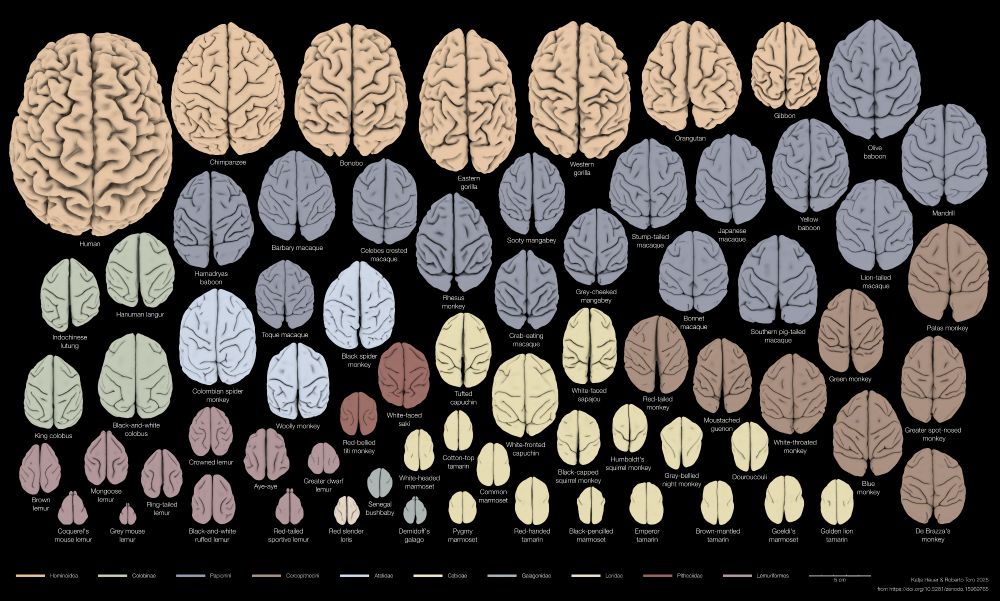
Brain Surfaces of 70 primate species
1
To predict the behaviour of a primate, would you rather base your guess on a closely related species or one with a similar brain shape? We looked at brains & behaviours of 70 species, you’ll be surprised!
🧵Thread on our new preprint with @r3rt0.bsky.social , doi.org/10.1101/2025...
27.07.2025 17:26
👍 512
🔁 233
💬 16
📌 26

Thalamic CGRP neurons define a spinothalamic pathway for affective pain | PNAS
Pain is both a sensory and emotional experience caused by various harmful stimuli.
While numerous studies have explored peripheral and central pain...
New paper out in @pnas.org Thalamic CGRP neurons form a spinothalamic pain pathway relaying pain signal to the amygdala & insular, but not sensory cortex to encode the affective dimension of pain. Huge congrats to first author Sukjae Kang & coauthors. www.pnas.org/doi/10.1073/...
09.07.2025 22:58
👍 17
🔁 6
💬 0
📌 0

Top: Representative images showing the spatial localization of labeled dmPFC neurons with BFP (blue) or retrobeads (red), taken using 10 X (upper) or 40 X (lower) objectives. The majority of labelled neurons were located in layer II/III of dmPFC. Scale bars, 100 μm (10 X) and 25 μm (40 X). Bottom: Summary on the neural circuit mediating the transition from memory retrieval to freezing behavior. Presentation of CS+ activates LA neurons and TeA neurons. The activated LA neurons activate dmPFC T-neurons, which in turn activate dmPFC S-neurons and LC neurons. S-neurons receive inputs from TeA and send their outputs to BLA, which projects to PAG to enable freezing behavior. Activated LC neurons release NE in the dmPFC via their projections.
Which neural circuits allow memory retrieval to influence behaviors? This study shows how #fear #memory activation initiates & sustains #FreezingBehavior in mice via the interplay of #norepinephrine & activation of different prefrontal #neuron subtypes @plosbiology.org 🧪 plos.io/3TGqt7a
15.07.2025 16:34
👍 11
🔁 4
💬 0
📌 0
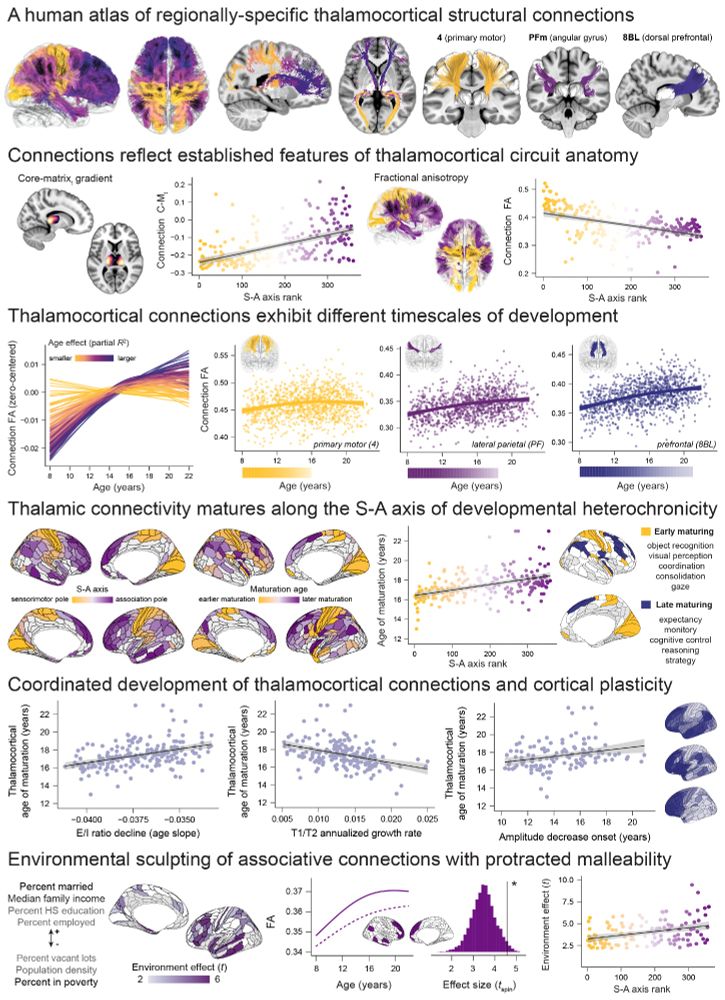
How does the human brain coordinate hierarchical cortical development? Our work in Nature Neuroscience identifies a role for thalamocortical structural connectivity in the expression of hierarchical periods of cortical plasticity & environmental receptivity in youth 🧵 www.nature.com/articles/s41...
08.07.2025 00:00
👍 122
🔁 44
💬 4
📌 8

https://www.garnelio.de/spitzschlammschnecken-lymnaea-stagnalis
1/3 First evidence of anxiety in snails
They exhibit fear responses hours after the source of their anxiety is removed. These responses can be reduced with an anxiolytic, such as alprazolam. They have also demonstrated high-level learning.
(paper) www.nature.com/articles/s41...
03.07.2025 07:01
👍 31
🔁 20
💬 1
📌 3
Alert! ... for the child development world!
@fluxsociety.bsky.social @fitngin.bsky.social
The Healthy Brain and Child Development (HBCD) Study has released its first data wave - it’s massive.
Check here:
docs.hbcdstudy.org
and here:
nbdc-datahub.org
Here’s why it matters 🧠🍼
29.06.2025 02:18
👍 159
🔁 79
💬 1
📌 4

NEW PAPER🎺
How does cognition determine an individual’s fitness? A systematic review of the links between cognition, behaviour and fitness in non-human animals
Lots of studies try to explain how cognition might evolve, by taking a behavioural ecology approach
Has this approach made any progress?🧵
26.06.2025 09:03
👍 36
🔁 18
💬 1
📌 1