Why specialization in science isn’t always a virtue
Researchers are trained to dive deep into niches—but sometimes depth comes at a cost.
Narrow focus can fragment knowledge, hide connections, and suppress interdisciplinary creativity
🧪 #Interdisciplinarity #SciWri #SciComm #philsci #ResearchQuality
15.02.2026 13:19
👍 19
🔁 3
💬 1
📌 1
Metrics provide clarity, but they are blunt instruments. When numbers outweigh curiosity, judgment, and insight, research culture shifts.
Can science truly thrive if what is measurable consistently outranks what is meaningful?
#ResearchIntegrity
#SciComm
#philsci
#ResearchQuality
#Curiosity
🧪
11.01.2026 20:48
👍 13
🔁 1
💬 2
📌 0

a man in a red shirt is sitting on a couch eating noodles with chopsticks while looking at a tablet .
Alt: Sheldon (of the Big Bang Theory series) sitting on a couch eating noodles with chopsticks while looking at a someone, grinning
When careers depend on numbers, behavior adapts. Researchers optimize for citations, prestige journals, and visibility, favoring trendy or safe work while neglecting slow, risky, or foundational questions that matter but rarely score well.
#ResearchIntegrity
#AcademicPrestige
#SciComm
#philsci
🧪
11.01.2026 20:48
👍 18
🔁 1
💬 1
📌 0
Citations, h-indexes, journal rankings: metrics increasingly guide scientific decisions. Designed to signal impact, they now shape what gets studied, how it is framed, and where it is submitted—often before the research question is fully formed.
#ResearchIntegrity
#SciComm
#philsci
#ResearchPolicy
🧪
11.01.2026 20:48
👍 18
🔁 5
💬 1
📌 0

a man in a green coat is holding a container
Alt: a man in a lab coat is putting a container down while saying: "Why!?! Because it's science. That's why!"
3/3
When criticism is met with “this is just how science works,” curiosity turns into compliance. Defending systems is easier than questioning them—but it’s not the same as defending science. Where do you see this line being blurred?
#ScienceCritique
#SciComment
#philsci
#SciWri
#ResearchIntegrity
🧪
07.01.2026 16:20
👍 3
🔁 0
💬 1
📌 0
2/3
What we rarely ask: when scientists defend “science,” what are we actually defending?
Critical inquiry—or the funding structures, incentives, and career systems wrapped around it?
These are not the same thing, but they’re often treated as one.
#ResearchPolicy
#SciComment
#philsci
#SciWri
🧪
07.01.2026 16:20
👍 4
🔁 0
💬 1
📌 0
1/3
Public trust in science is eroding. Not because people suddenly reject evidence, but because “science” is often presented as unquestionable authority.
“Trust this—because it’s science.” That used to work. It doesn’t anymore.
#ResearchIntegrity
#SciComment
#philsci
#SciWri
#TrustInScience
🧪
07.01.2026 16:20
👍 9
🔁 1
💬 4
📌 0
Yep, a box feeling is pretty comfortable. That's why research often stays in their mental boxes
06.01.2026 20:30
👍 1
🔁 0
💬 0
📌 0
3/3
Everyone chases research trends—but what’s nagging at your curiosity?
What questions do you wish someone would tackle?
Where should we look if we dared to step off the popular path?
🧪
#ResearchQuality
#SciComm
#philsci
#ResearchIntegrity
06.01.2026 15:06
👍 6
🔁 0
💬 1
📌 0

a cat is laying in a cardboard box on a wooden floor
Alt: a cat is laying in a cardboard box on a wooden floor. The box is a bit too big for him
2/3
Breaking free means thinking outside the box: exploring less popular, deeper questions. Intellectual independence in science isn’t trendy—it’s risky, quiet, necessary. Dare to look where no trend points.
#TrendChasingScience
#SciComm
#philsci
#ScienceQuality
🧪
06.01.2026 15:06
👍 8
🔁 1
💬 3
📌 0
1/3
Research often follows trends, not curiosity. From AI to resilience, topics explode because they’re visible, fundable, and citable. But real questions? They’re left behind. Are we chasing trends instead of approaching truth?
#ResearchIntegrity
#ResearchQuality
#SciComm
#philsci
#Science
🧪
06.01.2026 15:06
👍 7
🔁 3
💬 2
📌 0
3/3
The issue is not whether popular topics matter—they often do. The question is what gets lost when relevance is defined by momentum rather than by epistemic necessity?
🧪
#SciComm
#philsci
05.01.2026 18:03
👍 4
🔁 2
💬 1
📌 0
2/3
Trend-driven research is rarely an individual failure. It is a structural response to risk management. But this adaptation comes at a cost: slow, theoretical, or inconvenient questions gradually disappear.
🧪
#SciComm
#philsci
05.01.2026 18:03
👍 3
🔁 1
💬 1
📌 0

a man wearing a beanie and a black jacket is smiling and saying `` yeah , science ! '' .
Alt: a young man wearing a beanie and a black jacket is smiling and saying `` yeah , science ! '' while showing somewhere
1/3
Why does research increasingly follow trends? Funding schemes, publication incentives, and visibility metrics reward certain topics—not necessarily the most important ones, but the most fundable and legible.
🧪
#TrendChasingResearch
#SciComm
#philsci
#ScienceFunding
#ResearchQuality
05.01.2026 18:03
👍 5
🔁 4
💬 1
📌 0
Exactly. Funding is a further aspect which goes hand in hand here
03.01.2026 22:22
👍 2
🔁 1
💬 0
📌 0
Forgot, 🧪😉
03.01.2026 17:52
👍 5
🔁 1
💬 0
📌 0
3/3
Mendel reminds us: progress in science depends not only on discovery, but on reception.
When gatekeeping and trends dominate, even solid, innovative work may never get a fair chance.
#ScientificMainstream
#SciComm
#philsci
#SciencePolicy
#ResearchInnovationBlocked
#ScienceInnovationHistory
03.01.2026 16:33
👍 10
🔁 5
💬 0
📌 1

A table of pea crossing after Gregor Mendel
2/3
Not because it was weak science.
But because it didn’t fit the dominant framework of the time.
Different methods, interdisciplinary thinking, no strong institutional network.
It simply didn’t match the mainstream.
2/3
#ResearchInnovation
#SciComm
#philsci
#SciencePolicy
#AcademicMainstream
03.01.2026 16:33
👍 13
🔁 3
💬 2
📌 0

Gregor Mendel, standing in a garden, investigating plants
1/3
Gregor Mendel published his work on inheritance in 1866.
Careful experiments, clear data, quantitative reasoning.
His paper was read — and then ignored.
...
For nearly 40 years.
#SciencePolicy
#SciComm
#philsci
#ScientificInnovation
#ResearchInnovation
#science 🧪
#biology
03.01.2026 16:33
👍 41
🔁 10
💬 2
📌 0
When publication pressure and funding logic define research questions, inquiry slowly turns into compliance.
Not because researchers lack integrity. But because structures reward conformity over risk.
Wish you all a happy and less rushed new year.🎊
🧪
🎉
#ResearchEthics
#philsci
#SciComm
#SlowScience
01.01.2026 11:08
👍 10
🔁 5
💬 1
📌 0

a blue penguin is sitting on a keyboard with a graph behind him that says $ 400m
Alt: a blue penguin is sitting on a keyboard, typing extremely fast. A graph behind him goes up and down between $0 and $4000
Research today is increasingly shaped by trends, funding priorities, and publishing metrics.
What gets studied often depends less on curiosity than on visibility, relevance, and feasibility within the system.
That shift has consequences.
#SciComm
#philsci
#ResearchTrendChasing
#ScienceFunding
01.01.2026 11:08
👍 11
🔁 4
💬 1
📌 0
Protecting research integrity may require more than ethics training or rules.
It may require rethinking incentives, evaluation, and what we count as “good science.” 🧪
Where do you see integrity being most strained today?
#ResearchQuality
#SciComm
#SciWri
#AcademicPressure
#ResearchIntegrity
30.12.2025 12:09
👍 4
🔁 3
💬 0
📌 0
When careers depend on metrics, researchers adapt: selective reporting, flexible analyses, safe questions.
These practices are often rational responses to the system — yet they gradually weaken trust, reproducibility, and interpretability of results.
#SciComm
#SciWri
#SciencePolicy
#ResearchBias
30.12.2025 12:09
👍 3
🔁 3
💬 1
📌 0

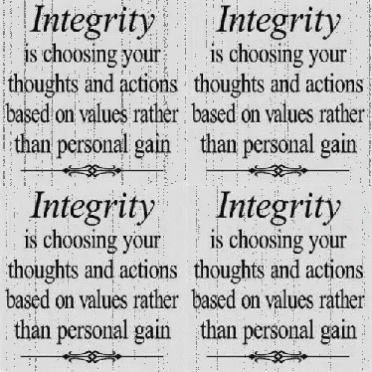
a poster that says integrity is choosing your thoughts and actions
Alt: a poster that says "integrity is choosing your thoughts and actions based on values rather than personal gain".
Research integrity is rarely lost through misconduct alone.
More often, it erodes quietly when incentives reward speed, volume, and strategic alignment over careful reasoning.
Integrity becomes a constraint rather than a shared scientific value.
#ResearchIntegrity
#SciComm
#SciWri
#ResearchQuality
30.12.2025 12:09
👍 20
🔁 9
💬 3
📌 0
Thanks for sharing. I think the whole internet is full of fake ancient quotes, beginning from early natural philosophers through socratic/Platonic times and finally and especially the stoics, which are currently pretty famous, but false interpreted in many ways
28.12.2025 23:07
👍 1
🔁 0
💬 0
📌 0
I found it in the gif section on this platform. It appears in his manner. I don't know if it is truly from him.
28.12.2025 20:02
👍 1
🔁 0
💬 1
📌 0

(PDF) The Lost Spirit of Science: From Historical Inquiry to Modern Research Challenges
PDF | Research in modern academia increasingly emphasizes deliverables, standardized methods, and adherence to externally defined project frameworks.... | Find, read and cite all the research you need...
Our preprint argues for a question-centered research culture: training, mentorship, and funding should enable epistemic freedom, reflective thinking, and interdisciplinary exploration. How can your lab reclaim the spirit of inquiry?
#SciComm
#philsci
#SciWri
#CriticalThinking #HistoryOfScience
28.12.2025 13:53
👍 5
🔁 1
💬 0
📌 0
Historically, scientific inquiry began as exploration, not as output production. Thales, Socrates, and Aristotle remind us: questions, not results, drive understanding. Modern institutions favor metrics, not the curiosity that spark creativity.
#SciComm
#philsci
#SciWri
tinyurl.com/epistemic-open
28.12.2025 13:53
👍 4
🔁 0
💬 1
📌 0

a quote from aristotle that says it is the mark of an educated mind
Alt: a quote from aristotle that says "it is the mark of an educated mind to be able to entertain a thought without accepting it"
Why do some research questions flourish while others fade? Our new preprint explores the roots of scientific curiosity—from Thales to modern labs—and why asking the right questions is at the core of science.
#SciComm
#philsci
#Curiosity
#Epistemology
#ScientificPractice
#Philoso0hyOfScience
#SciWri
28.12.2025 13:53
👍 7
🔁 1
💬 2
📌 1