

16.04.2025 15:09
👍 1
🔁 0
💬 0
📌 0


Inspired by @emilyriederer.bsky.social, I made some pictures for my seminar on causal inference. They are not labeled. Let's see if you can name that research design.
This paper taught me that the competition between advertisers for the most desirable ad slots is really important.

Chat GPT just gave me the best complement on my writing I've ever gotten.
How frequently do you meet with your students? Once a week just doesn't feel like enough when you are in the "thick" of a project.
I need to answer that email about the revision! I'm on-board, but the email got buried in my inbox.
What a week, huh?
Or maybe youse guys data is much cleaner than mine.
Maybe my style of interactive debugging is archaic.
Sometimes I just want to know how many zeros and NAs there are in a field and I don't want to write a long dplyr chain to figure that out.
In reviewing dplyr code written by a PhD student, I'm reminded of how useful base R functions like summary() and str() are for inspecting data and detecting errors.
Happy to report that this paper has been accepted at Management Science! (At least that was reported in the ISMS Newsletter, but I can't find the paper on the Management Science website.

screenshot of cited paper
Joo and Chiong’s recent working paper provides a Gaussian approximation to the regret function that you can use with ✨any✨ asymptotically normal estimator. This means you can use the minimax-regret criteria with your favorite treatment effect estimators: diff-in-diff, ML estimators.
I know you were responding to @blasimon.bsky.social, but wanted to chime in to say I agree they are very strong parametric assumptions. We tried to spell that out as clearly as we could.

Image shows an excerpt from the chapter.
To help marketing reviewers and editors understand the untestable assumptions of causal inference methods, Dominik Papies, Peter Ebbes and I wrote this "menu" as part of our chapter on "Endogeneity and Causal Inference in Marketing". (Preprint: dx.doi.org/10.2139/ssrn...)
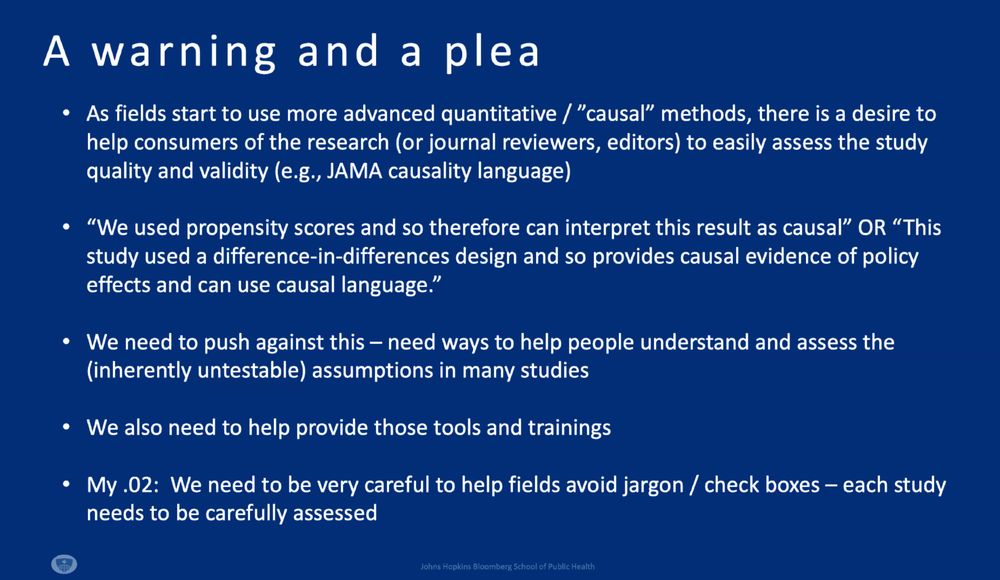
A warning and a plea - As fields start to use more advanced quantitative / "cause" methods, there is a desire to help consumers of the research (four journal reviewers, editor) to easily assess the study quality and validity (e.g. JAMA causality language) ... - We need to push against this - need ways to help people understand and assess the (inherently untestable) assumptions in many studies.
An important plea from @lizstuart.bsky.social in today's SCI-OCIS Special Webinar Series:
Maybe we should get out the vacuums?
bsky.app/profile/sste...
#Eagles and #Dragons fly together!
💚🦅🤍 💙🐉💛
Drexel will close on Friday to join the rest of #Philly in celebrating the Champions!
I made it home! Everyone was a little bleary-eyed on Monday. 🦅🦅🦅

@septaphilly.bsky.social which is it?
We are seeing some impact on reproducibility efforts with the transition to the new US administration. For now, I suggest that you make backups of any data that required you to actively interact with the Federal government, as there may be a delay in response times.... #openscience
That might do it. I'm finding it really annoying that ChatGPT writes in markdown and it doesn't paste well into Google Docs.
Nice! I’m worried I’m not organized enough for this. Sometimes my content is just a list of links to papers. (This is a seminar for PhD students.)
For my other courses, I create a master Google doc that I share with students which includes links to other course materials.
Toying with the idea of using RStudio + #quarto + github to manage content for my doctoral seminar on causal inference. I'd like to be able to create short "explainer" documents that integrate math + code + hyperlinks. I don't want this to be a major project. Thoughts on design and workflow?