
🔸️Solicitação de auxílio para estudantes, pós-doutorandos de SP e participantes de outros estados: até 24/04/2026.
🔸️Pagamento da taxa de inscrição com desconto: até 17/07/2026.
02.02.2026 16:15
👍 0
🔁 0
💬 0
📌 0

⚠️ Estão abertas as inscrições para a XLIX Reunião Anual da SAB!
Prazos:
🔸️Submissão de resumos de trabalhos: até 24/04/2026.
🔸️Solicitação de auxílio para docentes e pesquisadores de instituições de SP: até 28/02/2026.
02.02.2026 16:15
👍 1
🔁 1
💬 1
📌 0

Lançamos hoje o número 28 da Revista Brasileira de Astronomia.
Ele pode ser consultado online gratuitamente através do endereço sab-astro.org.br/wp-content/u...
Aproveitamos para desejar boas festas e um feliz 2026 a todos nossos associados e seguidores!
21.12.2025 22:56
👍 4
🔁 1
💬 0
📌 0


14.12.2025 20:00
👍 0
🔁 0
💬 0
📌 0


14.12.2025 20:00
👍 0
🔁 0
💬 1
📌 0


14.12.2025 20:00
👍 0
🔁 0
💬 1
📌 0


A Diretoria da SAB tem o prazer de anunciar a realização da XLIX Reunião Anual da Sociedade Astronômica Brasileira, que ocorrerá de 25 a 30 de outubro de 2026, no Praiamar Natal Hotel & Convention, em Natal - RN.
Para mais informações, acesse a página do evento:
sab-astro.org.br/eventos/reun...
14.12.2025 20:00
👍 1
🔁 1
💬 1
📌 0

A bright central cluster of stars of various sizes, surrounded by glowing pink and orange clouds of nebular gas. The clouds are uneven, with both smooth regions and thin, threadlike structures. Darker patches appear where dust partially blocks the light, creating contrast against the brightly lit areas.
Ok everyone let's get in formation 💃
NSF–DOE Rubin Observatory’s image of the Trifid and Lagoon Nebulae captures several dazzling open star clusters. 🌌💫 These clusters are young, loosely bound families of stars that will eventually drift apart over millions of years. 🔭🧪
🧵
01.12.2025 23:10
👍 71
🔁 12
💬 2
📌 2

A todos nossos associados e amantes da Astronomia desejamos um feliz dia do astrônomo!
02.12.2025 15:05
👍 3
🔁 2
💬 0
📌 0

The fallacies behind the cult of Loeb
How media hype and misunderstanding fuel pseudoscientific fascination Introduction The word “cult” is used here in the sense given by...
"The fallacies behind the cult of Loeb"
New entry in my blog. Other articles have covered the scientific aspects; this one reflects on the social phenomenon. I argue it’s driven by a series of fallacies
tinieblasyestrellas.blogspot.com/2025/11/the-...
13.11.2025 11:09
👍 57
🔁 24
💬 8
📌 2

Bright green comet with a long blue tail streaking across a star-filled night sky.
Interstellar Comet 3I/ATLAS just delivered its best color image yet—blue CO+ tail, green C₂ head, all classic comet stuff. The twist? A jet is blasting toward the Sun while the tail streams away. Interstellar visitors love drama. More at spaceweather.com.
#CometATLAS #3IATLAS #Astronomy
22.11.2025 15:33
👍 16
🔁 5
💬 0
📌 0

Images of Comet 3I/ATLAS taken by coronagraphs on GOES-19, STEREO-A and SOHO.
🌟 Comet 3I/ATLAS brightens rapidly! 🌟
As it reached perihelion on Oct. 29, spacecraft watching the Sun saw a sudden surge in brightness. Scientists expect it to emerge from solar conjunction much brighter and easier to see from Earth. 🔭
Full story: Spaceweather.com
31.10.2025 01:00
👍 5
🔁 2
💬 0
📌 0

Lançamos hoje o número 27 da Revista Brasileira de Astronomia. Nesta edição, trazemos artigos sobre formação de galáxias, Nuvens de Magalhães, ondas gravitacionais e sobre o antigo Observatório de São Paulo. A revista pode ser consultada gratuitamente em sab-astro.org.br/wp-content/u...
22.09.2025 19:13
👍 26
🔁 6
💬 0
📌 0

Para comemorar uma década da primeira observação direta das ondas gravitacionais, será realizado no Brasil o evento:
1st International Latin American Conference on Gravitational Waves: 10 Years Since First Detection
Instituto Nacional de Pesquisas Espaciais (INPE)
15 a 19 de setembro de 2025
31.07.2025 14:02
👍 2
🔁 0
💬 1
📌 0

24.07.2025 20:43
👍 3
🔁 0
💬 0
📌 0
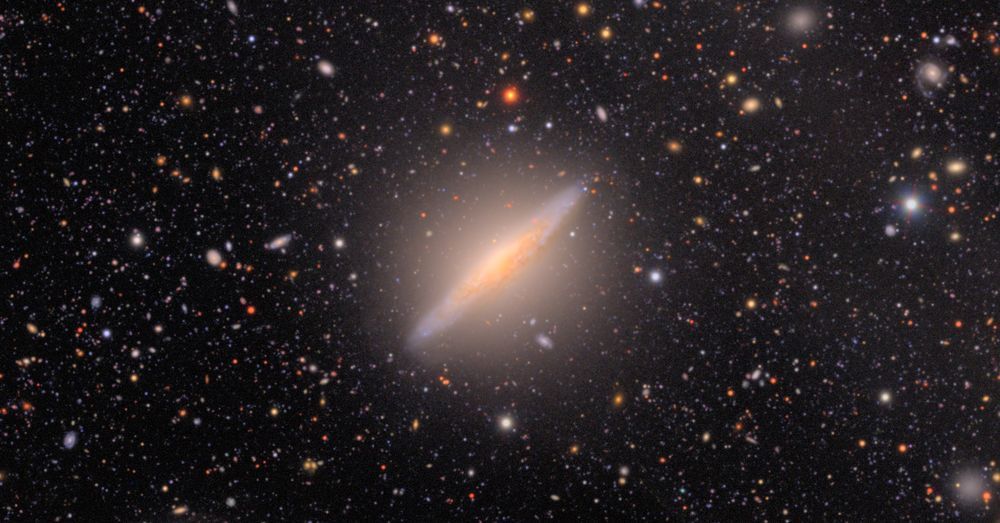
Edge-on spiral galaxy angled pointing lower left to upper right. It's glowing with a bright core that's cut with the dark veins of dust clouds. The background is peppered with a myriad of colorful stars and distant galaxies in black space.
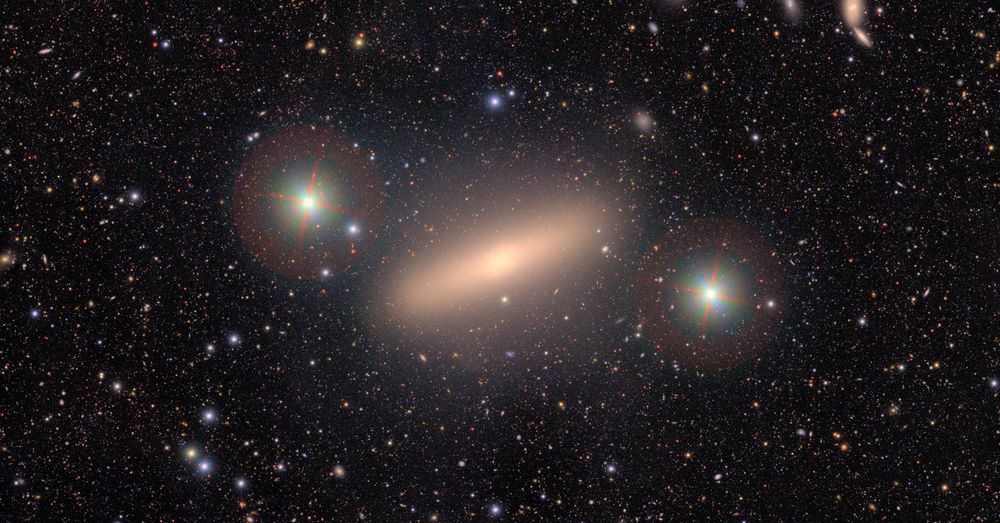
A smooth, cigar-shaped galaxy angled pointing lower left to upper right glowing with a bright core. Two bright stars beam just to the upper left and lower right of the galaxy. The background is peppered with a myriad of colorful stars and distant galaxies in black space.
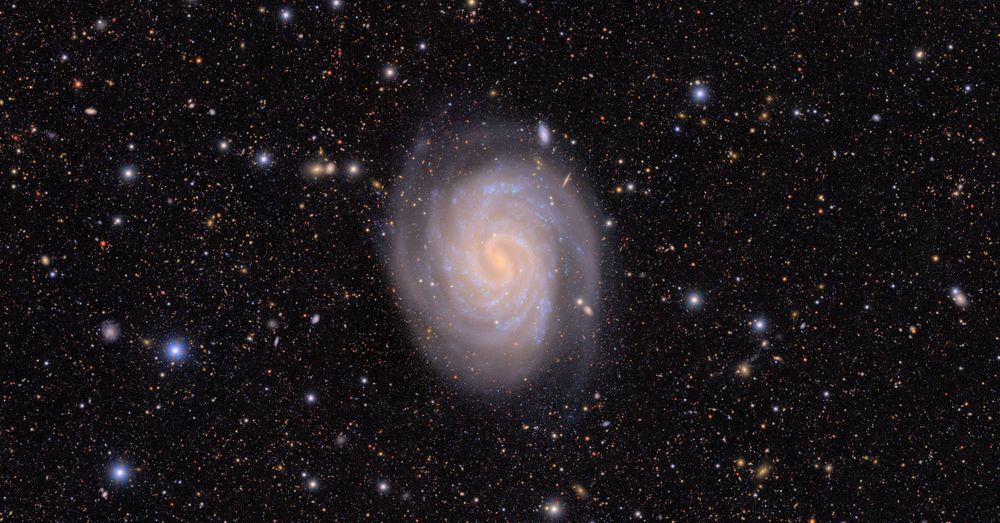
A face-on spiral with a bright core and sweeping arms knotted with blue clusters of star-forming regions. The background is peppered with a myriad of colorful stars and distant galaxies in black space.
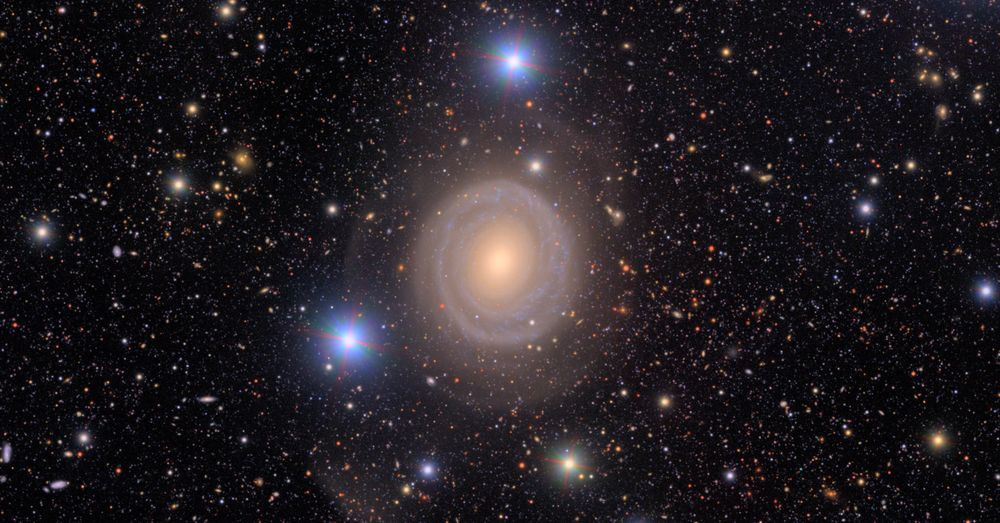
A face-on spiral with a bright core and a single thin arm wrapping all the way around, almost looking like a ring. Two bright blue stars beam above and to the lower left of the galaxy, with a third yellow star to the lower right. The background is peppered with a myriad of colorful stars and distant galaxies in black space.
Happy birthday, Vera Rubin! 🥳✨
What better way to celebrate than with NSF–DOE Rubin Observatory's view of galaxies SHE studied?
NGC 4343, 4526, 4535, and 4378 are just a few gems from our Cosmic Treasure Chest. Explore them and more at skyviewer.app 🔭🧪
23.07.2025 21:14
👍 183
🔁 53
💬 4
📌 0
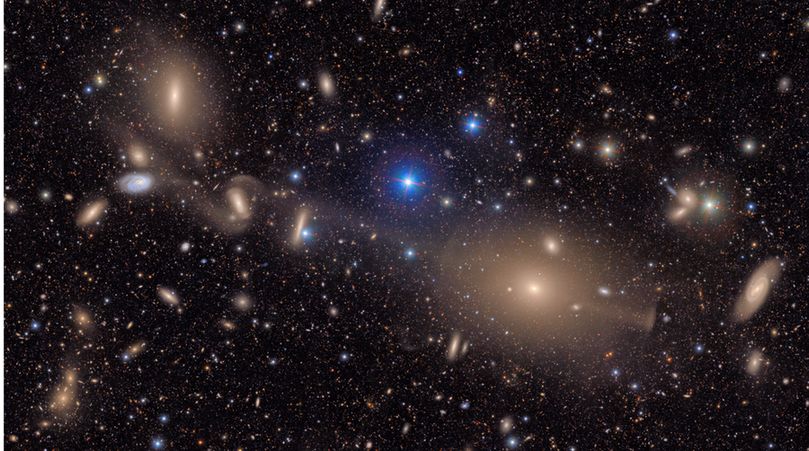
A sprawling, textured field of galaxies scattered across the deep black of space. It is filled with the delicate smudges and glowing cores of galaxies of many shapes, sizes and colors, as well as the bright multi-colored points of stars. The image focuses on a collection of interacting galaxies connected by delicate streams of stars. At top center lies a large elliptical galaxy that is dense and smooth, like a polished stone glowing with golden light. Like delicate spider silk or stretched taffy, these stellar bridges link the large elliptical to the few larger galaxies beneath, evidence of past collisions.
All throughout the image, thousands of galaxies gather in clusters or are spread throughout, like glittering gems strewn on a table. Some are sharp-edged and spiral, like coiled ribbons; others round and diffuse, like polished pebbles. Still others are just smudges of various colors against the black of space. The background is peppered with pinpoint stars in reds, yellows, and blues, crisp against the velvet black.
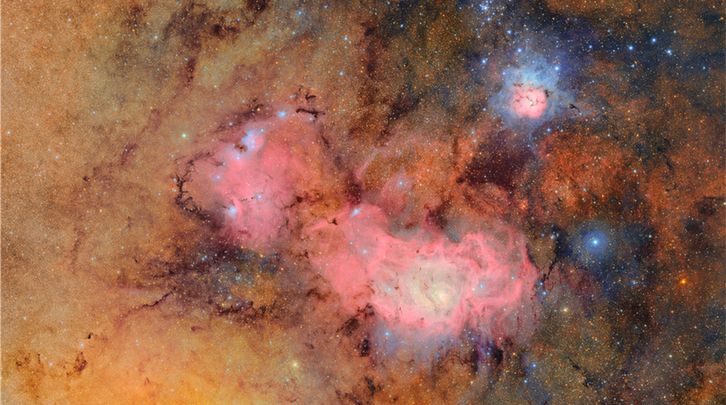
A cosmic tapestry of glowing tan and pink gas clouds with dark dust lanes. In the upper right, the Trifid Nebula resembles a small flower in space. Its soft, pinkish gas petals are surrounded by blue gas, and streaked with dark, finger-like veins of dust that divide it into three parts. It radiates a gentle, misty glow, diffuse and soft like the warmth of breath on a cold hand. To the lower left, the much larger Lagoon Nebula stretches wide like a churning sea of magenta gas, with bright blue, knotted clumps sprinkled throughout where new stars are born. Both nebulae are embedded in a soft tan backdrop of gas that is brighter on the left than on the right, etched with dark tendrils of dust and sprinkled with the pinpricks of millions of stars.
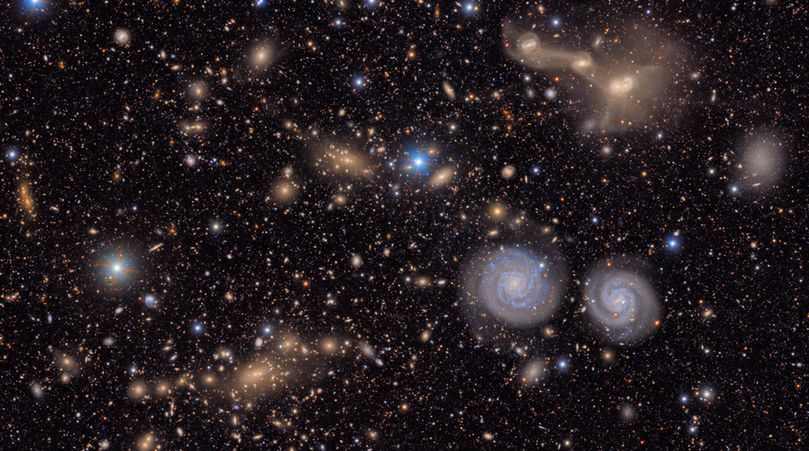
A sprawling, textured field of galaxies scattered across the deep black of space. It is filled with the delicate smudges and glowing cores of galaxies of many shapes, sizes and colors, as well as the bright multi-colored points of stars. To the lower left is a region filled with the hundreds of golden glittering gems of a distant galaxy cluster. In the foreground, below and right of center, two blue spiral galaxies look like eyes beneath the entangled mass of a triple galaxy merger in the upper right. A few bright blue points of foreground stars pierce the glittering tapestry.
All throughout the image, thousands of galaxies gather in clusters or are spread throughout, like glittering gems strewn on a table. Some are sharp-edged and spiral, like coiled ribbons; others round and diffuse, like polished pebbles. Still others are just smudges of various colors against the black of space. The background is peppered with pinpoint stars in reds, yellows, and blues, crisp against the velvet black.
Introducing...your sneak peek at the cosmos captured by NSF–DOE Vera C. Rubin Observatory!
Can you guess these regions of sky?
This is just a small peek...join us at 11am US EDT for your full First Look at how Rubin will #CaptureTheCosmos! 🔭🧪
#RubinFirstLook
ls.st/rubin-first-look-livestream
23.06.2025 04:06
👍 701
🔁 332
💬 22
📌 105

A photo of the slide with the December 2026 release date
Finding out about Gaia at #EAS2025Cork! ☄️
Just announced: Gaia DR4 will be released in December 2026!
26.06.2025 14:11
👍 96
🔁 37
💬 1
📌 1

Image cutout shows a large mound of layered rock that straddles the boundary between two geological units, Ophir Chasma and Candor Chasma, on Mars. The scene is less than 5 km, 3 miles, across. (NASA/JPL-Caltech/University of Arizona)

Enhanced color cutout shows a closeup of part of the large rocky mound between Ophir Chasma and Candor Chasma. The scene is less than 1 km, under 1 mile, across. (NASA/JPL-Caltech/University of Arizona)
HiPOD: Chasmata Boundary
The science of goal of this observation is to investigate the superposition relationship between the layered rocks and wall rock spurs along the boundary between Ophir Chasma and Candor Chasma.
uahirise.org/hipod/ESP_07...
NASA/JPL-Caltech/University of Arizona
#Mars #NASA
27.06.2025 13:00
👍 29
🔁 8
💬 1
📌 0


O cair da noite da quinta-feira (26/06) foi espetacular: a olho nu, o colorido crepúsculo foi palco para Mercúrio e a Lua, ao telescópio, a estrela 79 Geminorum surgia após ter sido ocultada pela Lua.
Pra hoje (27/06): A Lua hoje vai estar mais alta no céu e vc vai poder observar por mais tempo.
27.06.2025 11:40
👍 23
🔁 5
💬 1
📌 1

Thick and thin disk galaxies observed by the James Webb Space Telescope in a new study published in Monthly Notices of the Royal Astronomical Society.
🔬Research News 🔬
Galaxies, through thick and thin…🌌
Astronomers used the James Webb Space Telescope to look at 111 edge-on disk galaxies of various ages to better understand changes in galaxy disks over time, and how star-formation shapes them.
⤵️
27.06.2025 14:51
👍 12
🔁 5
💬 1
📌 0

Lançamos hoje o volume 26 da Revista Brasileira de Astronomia. O volume pode ser gratuitamente consultado no endereço sab-astro.org.br/wp-content/u...
27.06.2025 14:57
👍 3
🔁 1
💬 0
📌 0


