
新年快乐!
17.02.2026 21:06
👍 3
🔁 1
💬 1
📌 0
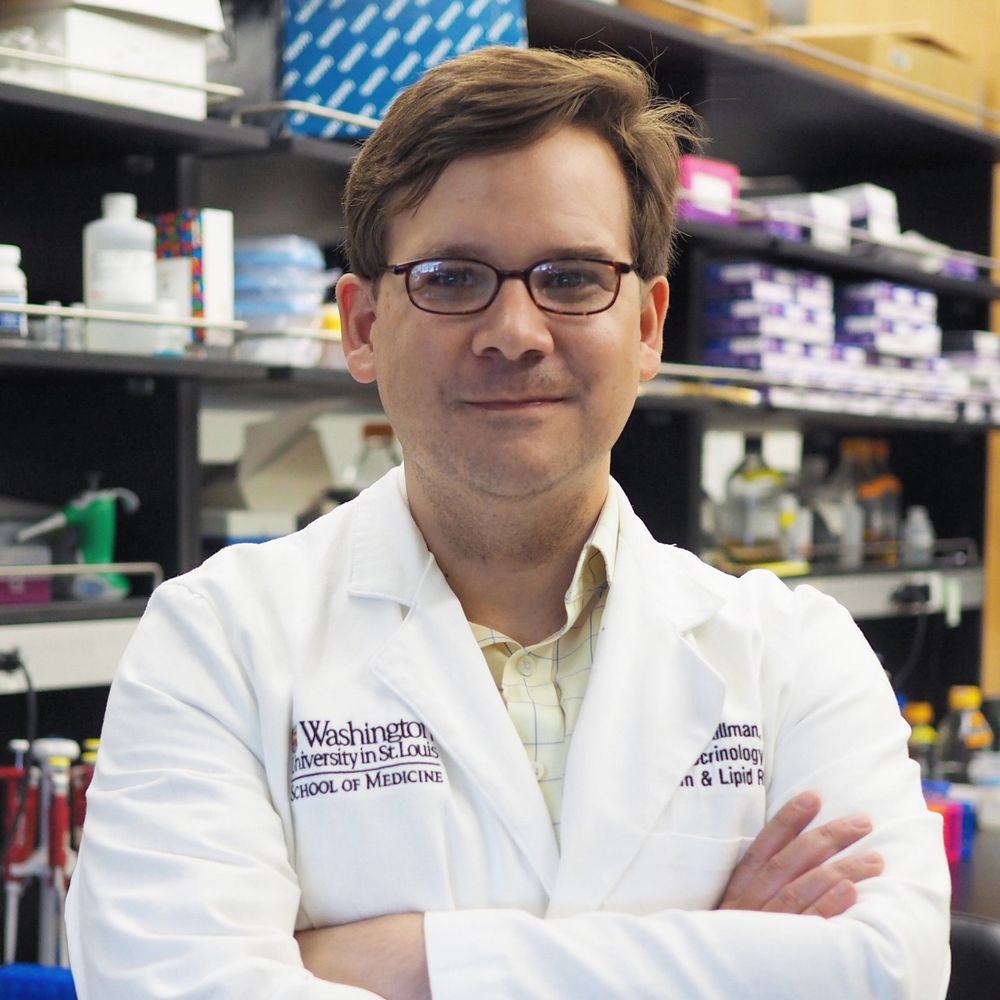
@jeffreymillman
Washington University School of Medicine Professor | Diabetes Researcher | Stem Cell Biologist | Bioengineer | Inventor | STEM Educator | Former MIT & Harvard | Former Biotech VP | https://sites.wustl.edu/millmanlab/
Honored to be appointed the Alan A. and Edith L. Wolff Professor of Endocrinology at @washumedicine. Grateful to my colleagues, trainees, and collaborators helping us to advance stem cell-derived islet therapies toward transformative treatments for type 1 diabetes.

Excited to share our new publications working with Dr. Albert Kim. We developed a stem cell model of glioblastoma (GBM) and uncovered how INSM1 programs a progenitor network that fuels GBM progression www.nature.com/articles/s41...

(please share) Immediate #postdoc job opening in the Millman lab at WashU Med (St. Louis, MO).
Want to develop next-generation pancreatic islets for the study and treatment of diabetes? Email your CV to apply
sites.wustl.edu/millmanlab/
(please share) Immediate #postdoc job opening in the Millman lab at WashU Med (St. Louis, MO).
Want to develop next-generation pancreatic islets for the study and treatment of diabetes? Email your CV to apply
sites.wustl.edu/millmanlab/


Grateful to be celebrating this holiday season with these amazing scientists! We look forward to further advances in 2026! @WashUMedEndo @WashUDeptMed
I think there were some early reports of an uptick in T1D when COVID hit but don't think that has panned out with time? I'm not certain about other novel viruses.
The only firm statistical correlation that I am aware of is CVB.
I find the idea of dsRNA being causative a compelling idea. Yuval Dor's data helps with this idea. However, CVB and SARS-Cov-2 both produce dsRNA during its replication, as I understand, so idk how to separate them in this context.
Very good question, but I don't have a good answer for you. Simply - I don't know.
We put a proposal into the NIH to investigate this question but were not selected for funding. If funders won't fund this work, I can't say for certain.

Dr. Veronese-Paniagua and I just published a review examining type 1 diabetes (T1D) as the consequence of genetic susceptibility and environmental viral exposures converging to drive autoimmune destruction of pancreatic β cells. Check it out here! www.frontiersin.org/journals/end...

Congratulations #MillmanLab Dr. Marlie Maestas for successfully defending her PhD!
doing academic research right now
🚀 Ready to launch your postdoc journey?
Check out WashU’s new Postdoc Passport for everything you need to get started. Register for the virtual event December 4th.
postdoc.wustl.edu/prospective-...

This is what I am going to get to protect my sequencing data

Our qPCR data is now protected by sharks!
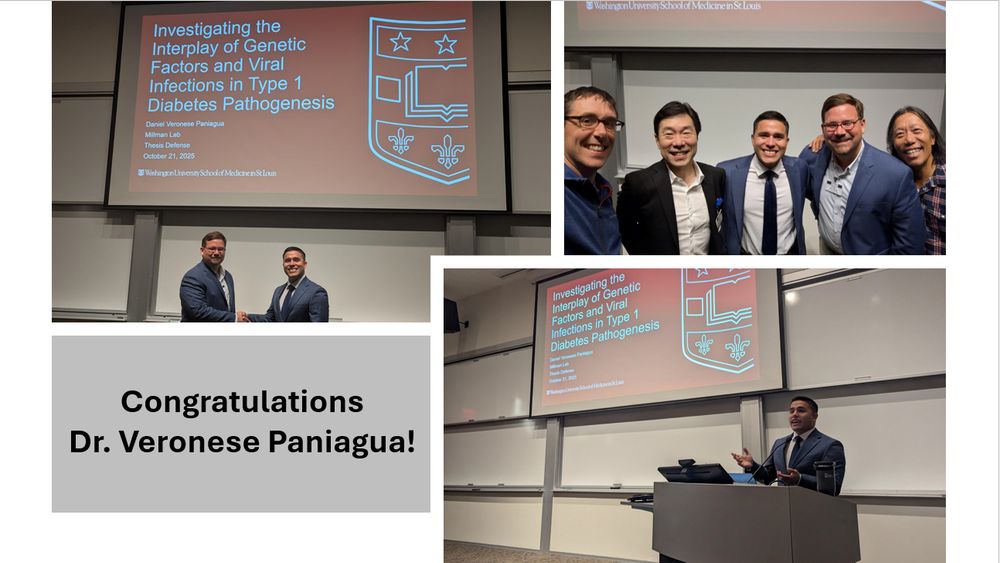
Congratulations #MillmanLab member Dr. Veronese Paniagua for successfully defending his PhD yesterday!

The #MillmanLab had a great time at the Breakthrough T1D walk yesterday! Happy to share our excitement for science with so many young people and support people living with #T1D!

If you would like to donate to support T1D research, please do so here: www2.breakthrought1d.org/site/TR?fr_i...

The #MillmanLab is excited to be part of Vendor Village at the St. Louis @BreakthroughT1D Walk Sunday October 19!
Come visit us to learn more about our cutting-edge research into stem cell-derived therapies for type 1 #diabetes and how we’re working toward a future without T1D.
The Millman Lab is proud to join the @BreakthroughT1D Walk in St. Louis on Oct 19 to support everyone living with type 1 diabetes.
🔗 Please consider donating to advance T1D research: www2.breakthrought1d.org/site/TR?fr_i...
@washumedicine.bsky.social
Overall, CVB3 sparks diverse, cell type-specific stress pathways in islets, with MIR7-3HG emerging as a regulator of infection + survival. These insights could help unravel viral contributions to T1D.
We also identified the lncRNA MIR7-3HG as a key player. Knockdown in stem cell-derived islets ↓ viral genome levels, ↓ apoptosis, and altered autophagy, suggesting new therapeutic angles.
CVB3 disrupted mitochondria differently across cell types. Beta cells had increased mitochondrial size but lose efficiency. Alpha cells had shrunken mitochondria. These are potentially protective acclimations.
Beta, alpha, and duct cells had the strongest responses. Beta and alpha cells demonstrated mitochondrial dysfunction. Duct had the strongest interferon & HLA responses. All cells had unique stress and immune signatures.

Out today in @cp-cellreports.bsky.social! We found that coxsackievirus B3 (CVB3), associated with increased risk of #T1D, infects all human pancreas cell types, not just beta cells. Great collab w/ Hubert Tse (KUMC). Led by WashU DBBS PhD student Daniel Veronese-Paniagua www.cell.com/cell-reports...

[please retweet] I’m #hiring! The Millman Lab is looking for a postdoctoral researcher to lead an exciting new project focused on vascularized #stemcell-derived islets for #diabetes disease modeling and cell replacement therapy. Email me your CV and cover letter.

Join us for the 2025 Rachmiel Levine-Arthur Riggs Diabetes Research Symposium. We have an amazing program this year focusing on type 1 #diabetes. We have also extended the abstract submission deadline to Sept 19. Register and submit your abstract a www.levinesymposium.com
It has been a decade filled with challenges, breakthroughs, and the joy of discovery.
I cannot wait to see what the next ten years bring for my lab, my trainees, and the field of SC-islets.
Here’s to the next chapter. 🙌
I’m continually inspired by my interactions with people living with diabetes. Hearing your experiences reminds my team and me why our work matters and fuels our commitment to advancing SC-islet research. Your stories are the heart behind the science. Thank you!
