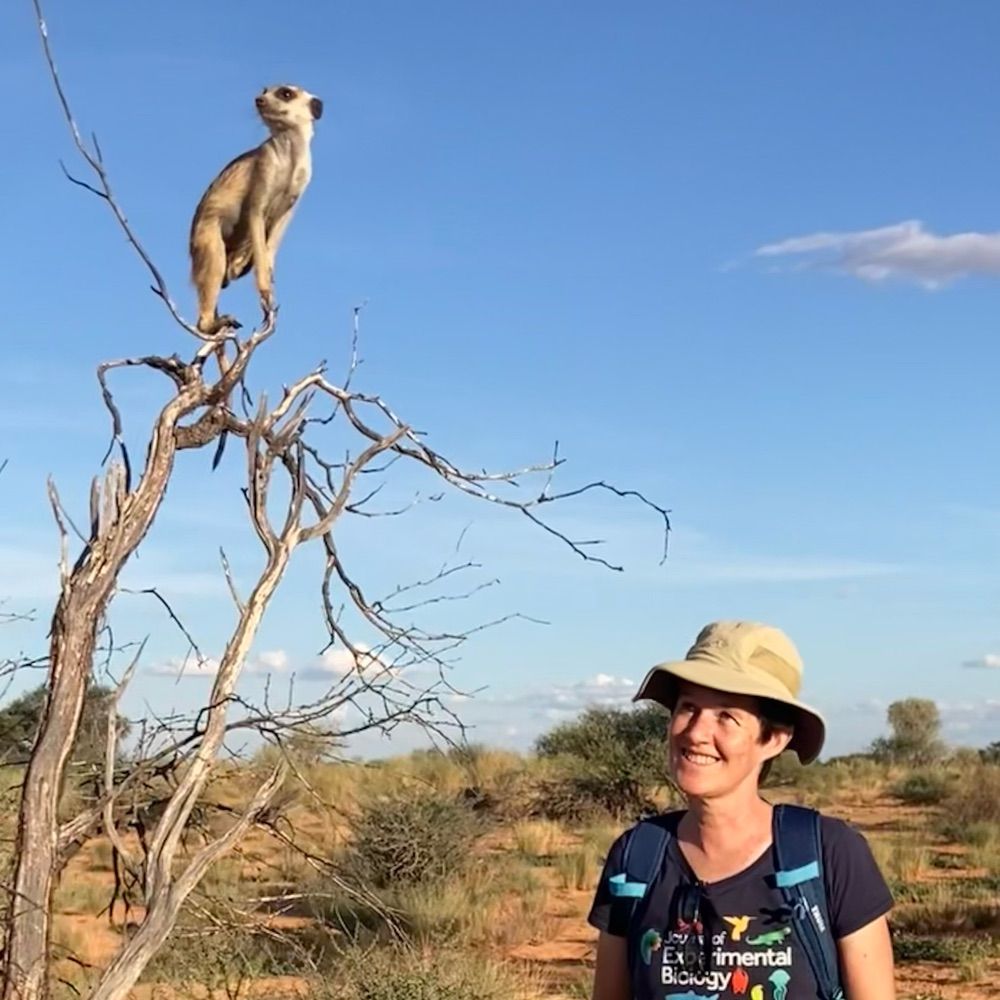
So disappointed for my PhD student who has had to withdraw from the @biologists.bsky.social Global South Workshop in India as a result of Emirates flight disruptions (and very high costs to try book alternative travel). Flight cancellation penalties for internal travel to be paid now too. #IranWar
04.03.2026 17:23
👍 2
🔁 0
💬 0
📌 0

✳️ #SpecialIssue call for papers ✳️
We are accepting submissions for a NEW special issue: Applications of mechanistic #modelling in biodiversity conservation 🖥️🌎
Edited by Sean Tomlinson & Brian Helmuth
Full info and submission instructions ➡️ academic.oup.com/conphys/page...
@sebiology.bsky.social
03.03.2026 15:51
👍 3
🔁 5
💬 1
📌 0
Brian Helmuth is sure to deliver a stimulating and enjoyable talk - please join us for this free webinar, and share with others.
03.03.2026 10:22
👍 1
🔁 1
💬 0
📌 0

A cellular basis for the mammalian nocturnal-diurnal switch
Early mammals were nocturnal while dinosaurs dominated the daytime. Mammalian transition to daytime activity accelerated after the Cretaceous-Paleogene extinction, but the underlying mechanisms remain...
Since I moved to @mrclmb.bsky.social I’ve been trying to answer this: Why are some mammals active at night and others in the day? Today our answer is out @science.org www.science.org/doi/10.1126/....
If you’re interested in circadian biology, evolution or how timing shapes physiology, take a look
27.02.2026 11:29
👍 66
🔁 22
💬 5
📌 2

We are excited for the next installment of our #CommunityConversations webinar series 🌍 💬
Dr Brian Helmuth @Aquanaut1967 will discuss how removing the "human lens" can help design more effective #Conservation strategies.
17/3 2-3pm GMT
Full info ➡️ shorturl.at/bOGfn
02.03.2026 15:30
👍 3
🔁 2
💬 0
📌 1


Animal Physiology 2026 - join us in Brazil!
02.03.2026 09:46
👍 1
🔁 0
💬 0
📌 0
What the heck is going on with these springbok?
(other than "hidden trampoline concealed in the grass")
The stiff-legged jumping behavior shown here is called "pronking" or "stotting" & it's a bit of a puzzle why they do it.
It's observed in a wide variety of ungulates under different conditions.
01.03.2026 20:35
👍 176
🔁 40
💬 24
📌 12

📢7th Workshop of Ecological and Behavioral Physiology (iimyc.gob.ar/fisioclim). Organizing this event is a significant challenge, especially given the current circumstances facing science in Argentina. For this reason, I warmly invite you to participate.
📍Córdoba, Argentina - March 10-12, 2027
27.02.2026 13:24
👍 3
🔁 3
💬 0
📌 0

Do you work in a Global South country and would like to host a Workshop?
Next deadline for topic proposals: 29 May 2026
The Company of Biologists logo to the left and a map of the world to the right, highlighting Global South countries in orange.
Additionally, we are again looking for proposals for the Global South. These proposals will differ from the standard Workshop programme as we will bring the event to your region. Find out more at
biologists.com/workshops/pr...
#BiologistsWorkshops
16.02.2026 13:42
👍 1
🔁 4
💬 1
📌 0

#DNAmethylation data provides an exciting avenue for studying wildlife health. This paper reviews methods used to study methylation, and discusses the potential applications in wildlife, using bottlenose dolphins 🐬 as a case study.
Read it here ➡️ doi.org/10.1093/conp... #Epigenetics #Conservation
26.02.2026 12:35
👍 1
🔁 1
💬 0
📌 0

The Vatican Museums' Bramante Staircase provides a striking visual metaphor for a vicious feedback cycle in scholarly publishing: rising paper submissions across an expanding landscape of journals strains the limited supply of volunteer peer review labor, which in turn makes editorial decisions less predictable and encourages authors to submit their work more ambitiously, increasing the burden on peer reviewers further still. Image credit: Carl T. Bergstrom
The process of #PeerReview is vital to contemporary science, but is also under enormous strain. @carlbergstrom.com & Kevin Gross use mathematical models to dissect the threats to the long-term viability of peer review, suggesting ways to stabilize it @plosbiology.org 🧪 plos.io/4kR02bo
25.02.2026 13:55
👍 23
🔁 13
💬 0
📌 2

SEB Annual Conference Florence 2026
Abstract submissions is open from Thursday 8th January until Friday 6th March 2026
📣 Abstract submissions are now open for the #SEBconference 2026!
Share your cutting-edge biology research and present in Florence, Italy 🇮🇹 this July.
🗓️ Deadline: 6 March 2026 (Midnight GMT)
www.sebiology.org/events/seb-a...
Submit your work and be part of an amazing scientific programme!
25.02.2026 10:03
👍 0
🔁 1
💬 0
📌 1

Join Heath at the #SEBconference in Florence.
Submit your abstract now ⬇️
www.sebiology.org/events/seb-a...
Check out our OED sessions ⬇️
www.sebiology.org/events/seb-a...
Book your place now ⬇️
www.sebiology.org/events/seb-a...
23.02.2026 15:48
👍 0
🔁 1
💬 0
📌 0

Early life stages have been hypothesised to be particularly vulnerable to environmental stressors. This new study highlights a shortage of research into embryos in the #ConPhys field and calls for more research into early life stages 🪺 🐦⬛
➡️ doi.org/10.1093/conp...
#Ontogony #DevelopmentalBio
23.02.2026 10:15
👍 3
🔁 1
💬 0
📌 1

Logo for symposium A13 "Adaptice responses of endotherms to short-term weather events and rapid environmental changes" to be held at the SEB annual conference in Florence, Italy, 2026. The image shows vertical colour bars of which the top half represents the global annual temperature increase (from light blue to dark red) and the bottom half shows the biodiversity index decline (from dark green to gray). Superimposed are four animal silhouettes, from top-left to bottom-right: a bat, songbird, a deer, and a rodent.
Join me, @julianowack.bsky.social and Matt Noakes at the @sebiology.bsky.social in Florence in July! We will discuss how mammals and birds cope physiologically with rapid and extreme environmental changes. Sponsored by @thermal-biology.bsky.social, @staroddi.bsky.social and @sablesys.bsky.social
20.02.2026 10:20
👍 10
🔁 7
💬 1
📌 2

Tomorrow FINE Spring 2026 will start. The 12th season of this free online seminar on social evolution.
23.02.2026 04:06
👍 4
🔁 4
💬 0
📌 0

The due date for the PLNB #PhD project has been extended to 30th March. 🦇
Apply now: www.murdoch.edu.au/study/schola...
20.02.2026 04:23
👍 4
🔁 2
💬 0
📌 0

Captive Asian elephants 🐘 in Thailand are increasingly exposed to fine particulate matter, yet little is known of the health impacts. This study found that particulates increased stress hormone concentrations and triggered complex #OxidativeStress patterns in elephants.
➡️ doi.org/10.1093/conp...
19.02.2026 15:18
👍 3
🔁 1
💬 0
📌 0

New 2026 paper led by @patricepottier.bsky.social, @kruthsatz.bsky.social & I in @conphysjournal.bsky.social show studies on embryos make up <10% of conservation physiology studies, highlighting a major blind spot in predicting vulnerable life stages to climate change.
🔗 doi.org/10.1093/conp...
19.02.2026 07:59
👍 15
🔁 8
💬 0
📌 0

Etchings on a smoked surface...Find out what a rotating brass drum covered with smoked paper could record about the inner workings of the human body. In this blog, Alireza Mani and colleagues from @ucl tell us the #ScienceHistory of the kymograph 🔗 www.physoc.org/blog/the-kym... #HealthData
18.02.2026 12:01
👍 2
🔁 2
💬 0
📌 0

A unique faunal community resides in the groundwater systems of the Yucatan Peninsula. This study of a cave isopod showed how its physiology enables it to survive in this harsh and changeable environment.
Read it here ➡️ doi.org/10.1093/conp...
18.02.2026 12:14
👍 0
🔁 1
💬 0
📌 0

Final Call: Only Weeks Left to Apply for SEB Awards at Florence 2026
Submit your application by 6 March 2026 for the YSAS and Irene Manton Awards in Florence.
🚨 Early career researchers, final moments! 🚨
Applications are open for SEB Awards (Young Scientist Award & Irene Manton Prize) at SEB Florence 2026 🇮🇹.
🗓️ Deadline: 6 March 2026
Apply now:
👉 www.sebiology.org/resource/fin...
#SEBconference #Biology #ResearchOpportunities
17.02.2026 11:09
👍 1
🔁 2
💬 1
📌 0