

🧬New in today's issue!
📄Mendelian randomization linking metabolites with enzymes reveals pathway regulation and therapeutic avenues
🧑🤝🧑 @zkutalik.bsky.social & co
05.02.2026 17:49
👍 4
🔁 1
💬 0
📌 0
🧬New in today's issue!
📄Mendelian randomization linking metabolites with enzymes reveals pathway regulation and therapeutic avenues
🧑🤝🧑 @zkutalik.bsky.social & co

🧬 New preprint alert! After years of collaborative work across 52 datasets we are presenting eQTLGen phase 2: a genome-wide eQTL meta-analysis covering 43,301 blood samples: www.medrxiv.org/content/10.6... (1/8)

My second dissertation paper is now out in @natcomms.nature.com! Here we introduce the co-expression-wide association study (COWAS) method for identifying pairs of genes or proteins whose genetically regulated co-expression is associated with complex traits. 🧵⬇️
www.nature.com/articles/s41...

I'm excited to present this new model to detect positive selection on regulatory sequences, which has been 3 years in the making!
Thanks to Alexandre Laverré and @phylogenetrips.bsky.social for their amazing work on this project. 😃
doi.org/10.1101/2025...
Thread!
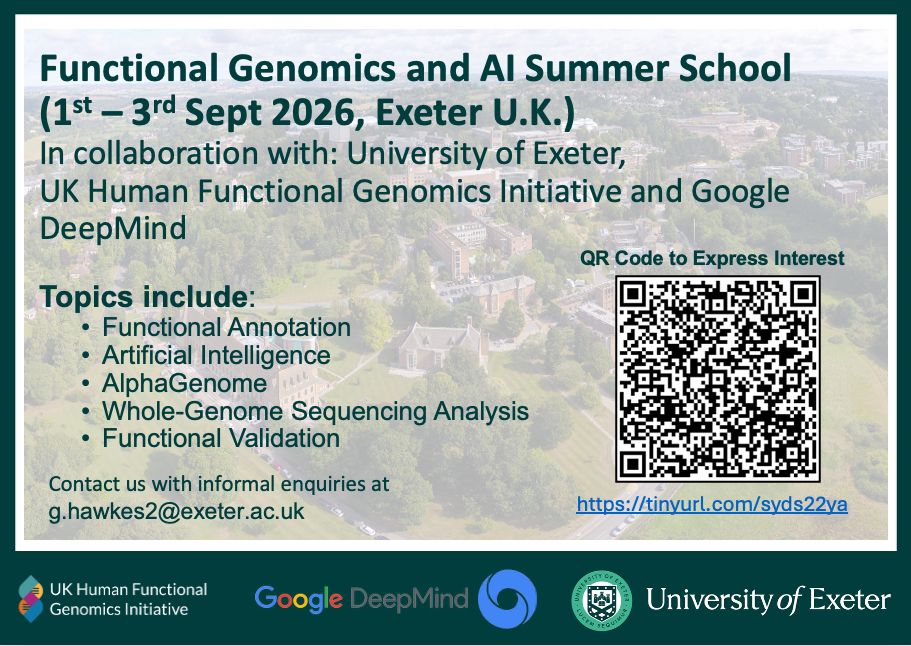
Interested in whole genomes, AI and functional validation? Sign up to hear more about our summer school in the sunny southwest U.K. @exeter.ac.uk in Sept 2026, in partnership with the U.K. Functional Genomics Initiative @uk-fgx.bsky.social and Google Deepmind @nihrexeterbrc.bsky.social

It has been disappointing to see the general lack of interest and investment into population genetics and genomic medicine in Switzerland. While we can resort to other national cohorts for research the country can only benefit if the know-how can be applied locally
www.sfa-phrt.ch/success-stor...

Approximate global average temperature from –9340 BCE to 2020 CE, showing a gradual increase then decrease until fossil fuel use accelerates ≈1850, after which there is a very rapid increase. A dotted line shows peak warming at +3°C by 2100 if currrent policies continue.
The 2025 state of the climate report: a planet on the brink
doi.org/10.1093/bios...
SIB is organizing the next edition of #eccb2026 (Geneva, 31.08.2026 - 04.09.2026), and we are now inviting the community to submit their tutorial and workshop proposals.
👉 A great opportunity to share tools, methods and expertise with 1,000+ international participants. Deadline: 5 January 2026.

🧵1/ Excited to share our new paper introducing a new #singlecell assay: scTF-seq, a high-throughput single-cell approach to explore how transcription factor (TF) dose shapes cell identity and reprogramming outcomes. 🔗 www.nature.com/articles/s41... Big congrats to the entire team @EPFL & @SIAT_China

🚨 New preprint out!
We reconstructed parental haplotypes in >440k individuals (UK & Estonian biobanks) to estimate assortative mating directly in the parental generation.
This reveals intensified assortment in recent generations.
www.biorxiv.org/content/10.1...
Wow! If this holds up, it will be a triumph of science (i.e., of many hundreds of dedicated scientists over decades) over a devastating disease.

Excited to share our latest manuscript, "Exposure accumulation drives age-dependent disease architectures and polygenic risk scores," led by Xilin Jiang: www.medrxiv.org/content/10.1...
I am attempting an explainer thread for the first time here:
(I am usually too exhausted to post one)

I wrote about gene-gene interactions (epistasis) and the implications for heritability, trait definitions, natural selection, and therapeutic interventions. Biology is clearly full of causal interactions, so why don't we see them in the data? A 🧵:
Study of 230,000 people finds many examples where the effect of a genetic variant differs depending on the parent of origin, especially for growth and metabolism - fascinating!
Amazing study, congrats @rjhfmstr.bsky.social, @zkutalik.bsky.social and team 👏
Extremely cool paper from @rjhfmstr.bsky.social @zkutalik.bsky.social and team. I still need to get my head around how the same genetic variant has opposite effects depending if it’s maternally or paternally inherited and why.
🚨 News recherche
Des caractéristiques telles que la taille, le métabolisme ou encore le risque de développer certaines #maladies peuvent être influencées de manière différente selon que le variant #génétique en cause provient de la mère ou du père.
➡ www.unil.ch/news/1754464...

Congratulations to Zoltan @zkutalik.bsky.social , Robin @rjhfmstr.bsky.social and the whole team for this fantastic work out today in @nature.com 👍 www.nature.com/articles/s41... Your parents' genome matters more than you think 😉https://www.unil.ch/dbc/en/home.html @fbm-unil.bsky.social

🚨 Our parent-of-origin study is out in Nature! 🧬
Maternal and paternal alleles can have distinct — even opposite — effects on human traits, revealing a hidden layer of genetic architecture that standard GWAS miss.
🔗 www.nature.com/articles/s41...
Highlights below!
Thrilled to see this project come to life — a huge team effort with collaborators in 🇨🇭 🇪🇪 🇳🇴! Huge thanks to all co-authors and funders!
@zkutalik.bsky.social @lilimilani.bsky.social @srubinacci.bsky.social @adriaan-vd-graaf.bsky.social @unil.bsky.social @estbiobank.bsky.social and many more !
Traits like disease risk can be affected differently, and in opposite ways, depending on which parent the genetic variant responsible comes from. Work led by SIB scientists @zkutalik.bsky.social & Robin Hofmeister at @unil.bsky.social/UniSanté & published in Nature👇
www.sib.swiss/news/the-imp...

🚨New preprint is out!
How do genetic effects on complex traits change with age? In this work, we compare different approaches to obtain age-varying genetic effects, and show how design and modeling choices can impact the conclusions we draw.
shorturl.at/17snd
A thread 🧵👇
This represents a real tour-de-force by @adriaan-vd-graaf.bsky.social. It has so many strong aspects: (i) establishment of large scale ground truth data for causal inference [metabolomics/transcriptomics]; (ii) sophisticated method and (iii) biological insights through real data application.
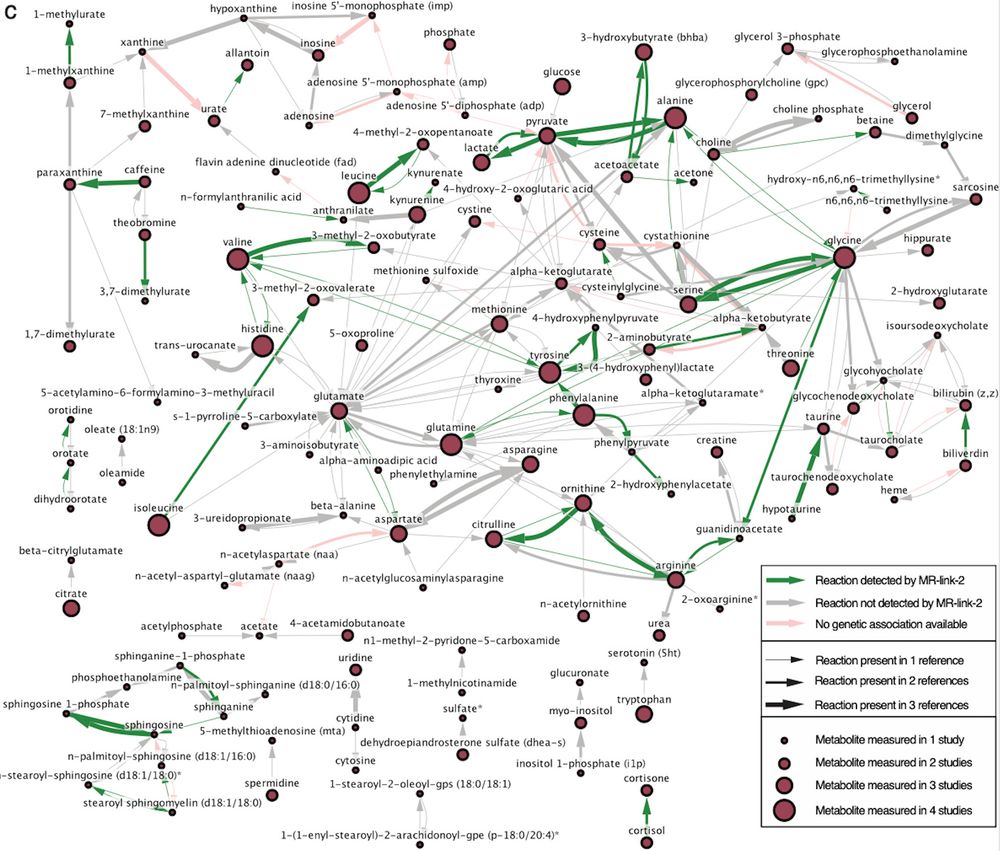
A network of metabolites and their potential causal relationships. Green edges are Detected by the statistical causal inference method MR-link-2
Our paper, MR-link-2 has just been published! Offering pleiotropy robust Mendelian randomization from a single region! www.nature.com/articles/s41...

Lausanne Comp Bio Symposium 2025 (cbiosymposium.unil.ch)
🗓 Abstract deadline 30 June (𝟑 𝐝𝐚𝐲𝐬 𝐭𝐨 𝐠𝐨!!!)
🎤 Oral presentation notifications: 7 July
✅ Early Bird registration deadline: 11 July
💰 Registration fee for non-PI: 150 CHF


🔥 18-19/9/25 🔥 Computational Biology Symposium in Lausanne! Meet the speakers: Mo Lotfollahi @sangerinstitute.bsky.social is expert of cutting-edge #AI approaches to study #singlecell biology , #generativeAI, and #spatialbiology lotfollahi.com
You can still apply to this postdoc job opportunity!
Come join 5Prime as we grow our team to use human genetics and other —omics to accelerate drug development.
New post for a Software Engineer:
5primesciences.com/careers/
We have 2-3 group leader positions opening @fimm-uh.bsky.social !!
We are looking for outstanding candidates in human genetics and precision medicine.
This time we have a focus on population health data science. E.g. AI for EHR/health data
Generous starting package 💰
shorturl.at/FAk6n
Join us 18-19 September in Lausanne! *Abstract submission deadline (2 June) is approaching!*

Meet another speaker of the Computational Biology Symposium [https://cbiosymposium.unil.ch/]: Blagoje Soskic [https://tinyurl.com/ybs82xuu]! He studies the genetic control of T – B cell interaction and antibody production with innovative combinations of experimental and computational approaches.