Doriane Mignon's Avatar

Doriane Mignon

@domignon

Research Fellow (Productivity Institute) at The University of Manchester Health economist leaning towards education and labor French - previously in Norway

259
Followers
414
Following
2
Posts
29.09.2023
Joined
Posts Following

Latest posts by Doriane Mignon @domignon

A table showing profit margins of major publishers. A snippet of text related to this table is below.

1. The four-fold drain
1.1 Money
Currently, academic publishing is dominated by profit-oriented, multinational companies for
whom scientific knowledge is a commodity to be sold back to the academic community who
created it. The dominant four are Elsevier, Springer Nature, Wiley and Taylor & Francis,
which collectively generated over US$7.1 billion in revenue from journal publishing in 2024
alone, and over US$12 billion in profits between 2019 and 2024 (Table 1A). Their profit
margins have always been over 30% in the last five years, and for the largest publisher
(Elsevier) always over 37%.
Against many comparators, across many sectors, scientific publishing is one of the most
consistently profitable industries (Table S1). These financial arrangements make a substantial
difference to science budgets. In 2024, 46% of Elsevier revenues and 53% of Taylor &
Francis revenues were generated in North America, meaning that North American
researchers were charged over US$2.27 billion by just two for-profit publishers. The
Canadian research councils and the US National Science Foundation were allocated US$9.3
billion in that year.

A table showing profit margins of major publishers. A snippet of text related to this table is below. 1. The four-fold drain 1.1 Money Currently, academic publishing is dominated by profit-oriented, multinational companies for whom scientific knowledge is a commodity to be sold back to the academic community who created it. The dominant four are Elsevier, Springer Nature, Wiley and Taylor & Francis, which collectively generated over US$7.1 billion in revenue from journal publishing in 2024 alone, and over US$12 billion in profits between 2019 and 2024 (Table 1A). Their profit margins have always been over 30% in the last five years, and for the largest publisher (Elsevier) always over 37%. Against many comparators, across many sectors, scientific publishing is one of the most consistently profitable industries (Table S1). These financial arrangements make a substantial difference to science budgets. In 2024, 46% of Elsevier revenues and 53% of Taylor & Francis revenues were generated in North America, meaning that North American researchers were charged over US$2.27 billion by just two for-profit publishers. The Canadian research councils and the US National Science Foundation were allocated US$9.3 billion in that year.

A figure detailing the drain on researcher time.

1. The four-fold drain

1.2 Time
The number of papers published each year is growing faster than the scientific workforce,
with the number of papers per researcher almost doubling between 1996 and 2022 (Figure
1A). This reflects the fact that publishers’ commercial desire to publish (sell) more material
has aligned well with the competitive prestige culture in which publications help secure jobs,
grants, promotions, and awards. To the extent that this growth is driven by a pressure for
profit, rather than scholarly imperatives, it distorts the way researchers spend their time.
The publishing system depends on unpaid reviewer labour, estimated to be over 130 million
unpaid hours annually in 2020 alone (9). Researchers have complained about the demands of
peer-review for decades, but the scale of the problem is now worse, with editors reporting
widespread difficulties recruiting reviewers. The growth in publications involves not only the
authors’ time, but that of academic editors and reviewers who are dealing with so many
review demands.
Even more seriously, the imperative to produce ever more articles reshapes the nature of
scientific inquiry. Evidence across multiple fields shows that more papers result in
‘ossification’, not new ideas (10). It may seem paradoxical that more papers can slow
progress until one considers how it affects researchers’ time. While rewards remain tied to
volume, prestige, and impact of publications, researchers will be nudged away from riskier,
local, interdisciplinary, and long-term work. The result is a treadmill of constant activity with
limited progress whereas core scholarly practices – such as reading, reflecting and engaging
with others’ contributions – is de-prioritized. What looks like productivity often masks
intellectual exhaustion built on a demoralizing, narrowing scientific vision.

A figure detailing the drain on researcher time. 1. The four-fold drain 1.2 Time The number of papers published each year is growing faster than the scientific workforce, with the number of papers per researcher almost doubling between 1996 and 2022 (Figure 1A). This reflects the fact that publishers’ commercial desire to publish (sell) more material has aligned well with the competitive prestige culture in which publications help secure jobs, grants, promotions, and awards. To the extent that this growth is driven by a pressure for profit, rather than scholarly imperatives, it distorts the way researchers spend their time. The publishing system depends on unpaid reviewer labour, estimated to be over 130 million unpaid hours annually in 2020 alone (9). Researchers have complained about the demands of peer-review for decades, but the scale of the problem is now worse, with editors reporting widespread difficulties recruiting reviewers. The growth in publications involves not only the authors’ time, but that of academic editors and reviewers who are dealing with so many review demands. Even more seriously, the imperative to produce ever more articles reshapes the nature of scientific inquiry. Evidence across multiple fields shows that more papers result in ‘ossification’, not new ideas (10). It may seem paradoxical that more papers can slow progress until one considers how it affects researchers’ time. While rewards remain tied to volume, prestige, and impact of publications, researchers will be nudged away from riskier, local, interdisciplinary, and long-term work. The result is a treadmill of constant activity with limited progress whereas core scholarly practices – such as reading, reflecting and engaging with others’ contributions – is de-prioritized. What looks like productivity often masks intellectual exhaustion built on a demoralizing, narrowing scientific vision.

A table of profit margins across industries. The section of text related to this table is below:

1. The four-fold drain
1.1 Money
Currently, academic publishing is dominated by profit-oriented, multinational companies for
whom scientific knowledge is a commodity to be sold back to the academic community who
created it. The dominant four are Elsevier, Springer Nature, Wiley and Taylor & Francis,
which collectively generated over US$7.1 billion in revenue from journal publishing in 2024
alone, and over US$12 billion in profits between 2019 and 2024 (Table 1A). Their profit
margins have always been over 30% in the last five years, and for the largest publisher
(Elsevier) always over 37%.
Against many comparators, across many sectors, scientific publishing is one of the most
consistently profitable industries (Table S1). These financial arrangements make a substantial
difference to science budgets. In 2024, 46% of Elsevier revenues and 53% of Taylor &
Francis revenues were generated in North America, meaning that North American
researchers were charged over US$2.27 billion by just two for-profit publishers. The
Canadian research councils and the US National Science Foundation were allocated US$9.3
billion in that year.

A table of profit margins across industries. The section of text related to this table is below: 1. The four-fold drain 1.1 Money Currently, academic publishing is dominated by profit-oriented, multinational companies for whom scientific knowledge is a commodity to be sold back to the academic community who created it. The dominant four are Elsevier, Springer Nature, Wiley and Taylor & Francis, which collectively generated over US$7.1 billion in revenue from journal publishing in 2024 alone, and over US$12 billion in profits between 2019 and 2024 (Table 1A). Their profit margins have always been over 30% in the last five years, and for the largest publisher (Elsevier) always over 37%. Against many comparators, across many sectors, scientific publishing is one of the most consistently profitable industries (Table S1). These financial arrangements make a substantial difference to science budgets. In 2024, 46% of Elsevier revenues and 53% of Taylor & Francis revenues were generated in North America, meaning that North American researchers were charged over US$2.27 billion by just two for-profit publishers. The Canadian research councils and the US National Science Foundation were allocated US$9.3 billion in that year.

The costs of inaction are plain: wasted public funds, lost researcher time, compromised
scientific integrity and eroded public trust. Today, the system rewards commercial publishers
first, and science second. Without bold action from the funders we risk continuing to pour
resources into a system that prioritizes profit over the advancement of scientific knowledge.

The costs of inaction are plain: wasted public funds, lost researcher time, compromised scientific integrity and eroded public trust. Today, the system rewards commercial publishers first, and science second. Without bold action from the funders we risk continuing to pour resources into a system that prioritizes profit over the advancement of scientific knowledge.

We wrote the Strain on scientific publishing to highlight the problems of time & trust. With a fantastic group of co-authors, we present The Drain of Scientific Publishing:

a 🧵 1/n

Drain: arxiv.org/abs/2511.04820
Strain: direct.mit.edu/qss/article/...
Oligopoly: direct.mit.edu/qss/article/...
11.11.2025 11:52 👍 642 🔁 453 💬 8 📌 66
Post image

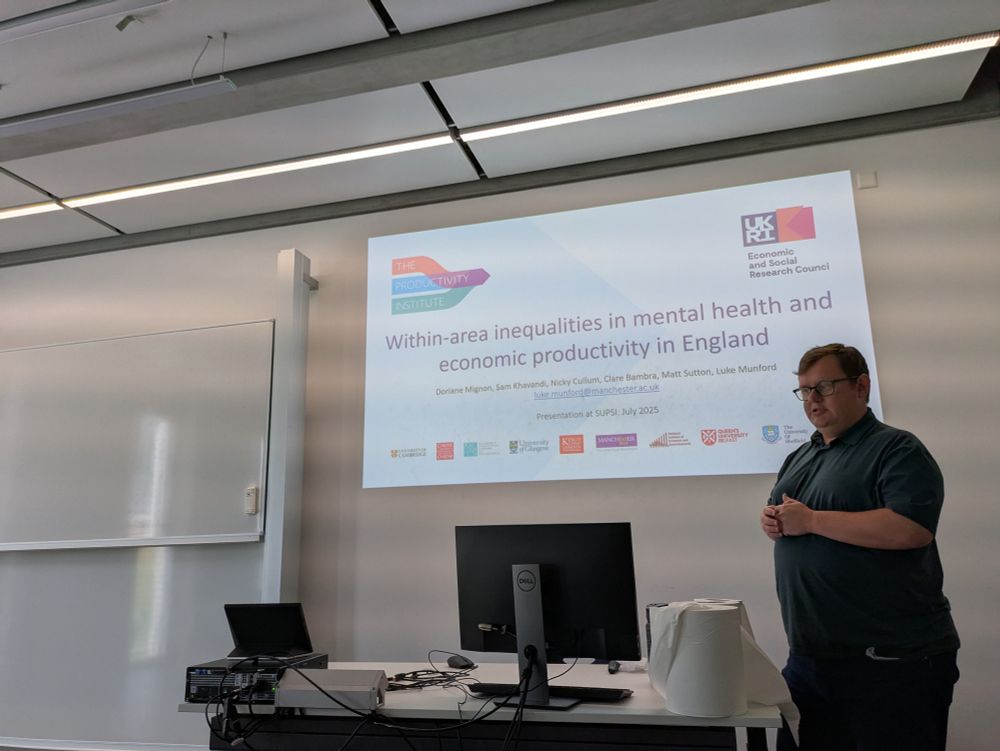
Very pleased for the insightful seminar by @lukemunford.bsky.social at SUPSI today. Luke presented ongoing work in mental health and productivity in England, joint with @domignon.bsky.social S. Khavandi C. Bambra and @mattxsutton.bsky.social.

@manchester.ac.uk @productivity.bsky.social

08.07.2025 12:42 👍 5 🔁 4 💬 0 📌 0
Redirecting

💻 We studied Norway’s high school laptop roll-out (2006–2011) and found:

- No clear impact on student well-being

- A drop in bullying, appears to be driven by schools where teachers' quality was high

Read more here 👉
doi.org/10.1016/j.ec...

30.04.2025 09:48 👍 0 🔁 0 💬 0 📌 0
Redirecting

🚨 New publication alert! 🚨

Excited to share that our paper "Well-being and Technology: The Effect of Individual Laptops in High School" (with Sigrid Johanne Husøy Trønnes) is now out in Economics of Education Review!

30.04.2025 09:48 👍 0 🔁 0 💬 1 📌 0
Preview
Research Associate in Health Economics:Oxford Road

Vacancy - Research Associate in Health Economics

The postholder will be assessing the impact of different models of integrating new or extended roles into primary care across England and Scotland.

Details here:
www.jobs.manchester.ac.uk/Job/JobDetai...

15.04.2025 14:21 👍 0 🔁 1 💬 0 📌 0
Toulouse Welcomes U.S. Researchers Facing Unprecedented Challenges | Communauté d'universités et établissements de Toulouse In response to the targeted and drastic budget cuts threatening scientific research in the United States, the Toulouse academic community is launching an initiative to host researchers whose work is a...

For academics in the US: the University of Toulouse has quickly put together a program to help bring scholars to France whose work is under attack by the Trump administration. The priorities area are: humanities, climate sciences, health, and space research.

en.univ-toulouse.fr/news/toulous...

08.04.2025 09:49 👍 797 🔁 390 💬 17 📌 36
Paper of interest: Women in UK Academic Health Economics: an evaluation of progress since the 1970s From: Joanna Coast Subject: Paper of interest: Women in UK Academic Health Economics: an evaluation of progress since the 1970s Dear all, This paper has just been published in SSM, and I think may be of general interest to those in the discipline - all…

Paper of interest: Women in UK Academic Health Economics: an evaluation of progress since the 1970s #healtheconomics

17.02.2025 15:30 👍 5 🔁 2 💬 0 📌 0
Preview
Mental Health and Economic Prosperity: An analysis of Place-Based Data in England - The Productivity Institute An analysis of granular measures of economic prosperity and health by location, examining how population mental health is associated with economic activity.

The UK experiences some of the widest regional inequalities among OECD countries. This is particularly reflected in measures of health and productivity. Find out more in a new blog by @hope-uom.bsky.social's @lukemunford.bsky.social & @domignon.bsky.social: www.productivity.ac.uk/the-producti...

13.02.2025 09:17 👍 4 🔁 6 💬 0 📌 0
Preview
Research Fellow in Health Economics :Oxford Road

VACANCY: Research Fellow in Health Economics with @hope-uom.bsky.social at University of Manchester www.jobs.manchester.ac.uk/Job/JobDetai...

14.12.2024 10:45 👍 6 🔁 5 💬 0 📌 0

Health economics Starter Pack:
bsky.app/starter-pack...
Message me if you know others or want to be added.

23.07.2024 15:48 👍 34 🔁 15 💬 9 📌 5