

www.nature.com/articles/s41...
06.03.2026 14:04
👍 1
🔁 0
💬 0
📌 0
I am looking for prospective Bachelor/MSc students willing to embark in the development of new methods for the extraction, processing, sequencing and analysis of historical and ancient RNA molecules from museum-preserved animal specimens.
Read below and apply!!
ucph.jobteaser.com/en/job-offer...

It's that time again... AaRCTikTalk this Friday!! Anne Runge will talk about microbial/pathogen DNA from prehistoric faunal remains🦠🦴🧬, & Anna Nagel will explore multispecies time calibrations! 🧬🕰️ Hurray! Don't miss it! 🕺 @aarc-community.bsky.social

Happening today!! Come to the Maersk Tower Copenhagen at 15:30 for a new session of CPH RNA Club.
#RNA #Copenhagen
New #AaRC Blog entry from @aarc-community.bsky.social where we interviewed Dr. @tatianafeuerborn.bsky.social about her research project on the genetic legacy of Greenland's sled dogs (Qimmit) she presented in January 2026 #AaRCTikTalks.
#Greenland #Dog #aDNA
www.animal-adna.org/blog/2026/01...
New year, new #AaRC blog!!
Are you interested in ancient horse genomics? Then have a look at our new 2026 Blog entry from @aarc-community.bsky.social where we interviewed Arianna Weingarten about the research project she presented in January 2026 #AaRCTikTalks
www.animal-adna.org/blog/2026/01...
I just got back a review for one of my stuck-in-revision papers so full of em dashes, like literally present in every other sentence, but also so politely hatefull in tone that it must have been written by some angry beta soviet mother version of all AIs joined together.

Thanks to Sébastien Calvignac-Spencer (@scs22.bsky.social) and Carles Lalueza-Fox for their commentary on our work about ancient RNAs in the extinct wolly mammoth
A trunkload of ancient RNA
www.cell.com/cell/fulltex...
I have heard the same joke about my surname like thousand times during my life.
Get a new one!

Good read about mammoth ancient RNAs
www.livescience.com/animals/mamm...
Read the whole paper and more information about my research and ongoing projects at:
emiliomarmol.academicwebsite.com
www.cell.com/cell/fulltex...
We sincerely thank our funders for trusting in our research ideas and for enabling us to carry out this challenging work. Their support helped us pushing forward the study of ancient #RNA molecules in extinct species.
@vetenskapsradet.bsky.social
@villumfonden.bsky.social
@erc.europa.eu
These are the oldest ancient #RNAs ever sequenced, obtained from the extinct woolly #mammoth 🦣🦣
Many thanks to all the people that contributed to make this groundbreaking work possible.
@cpgsthlm.bsky.social @scilifelab.se @stockholm-uni.bsky.social @ucph.bsky.social @uitnorgesarktiske.bsky.social

Intriguingly enough, some of these #RNAs indicated that Yuka might have died under quite stressful conditions.
Indeed, claw marks in its skin could indicate that Yuka was attacked by cave lions before its death!! ☠️


Interestingly, we discovered the expression of muscle-specific protein-coding and #microRNA genes. We were even able to detect two completely novel microRNAs solely based on #RNA data!

Yuka was thought to be a female ♀️ mammoth, based on previous external examination. Surprisingly, we found evidence at both #RNA and #DNA levels revealing that Yuka was in fact a male! ♂️

The ancient #RNA sequences from Yuka showed increased chemical damage, as expected for such old molecules.

The best performing sample was mammoth 1, also known as #Yuka, a 5-year-old juvenile woolly mammoth that died nearly 40,000 years ago and that is one of the best preserved specimens ever found.


Only 3 out of the 10 mammoths had #RNA and #DNA of good quality, and the ancient RNA molecules were strongly concentrated in exonic regions.

We extracted both ancient #RNA and #DNA from soft tissues that have been preserved in the Siberian permafrost for thousands of years.
Did we find any mammoth-like molecules? Yes ✅, both in the RNA and DNA fraction, but not for all the mammoths we analyzed.
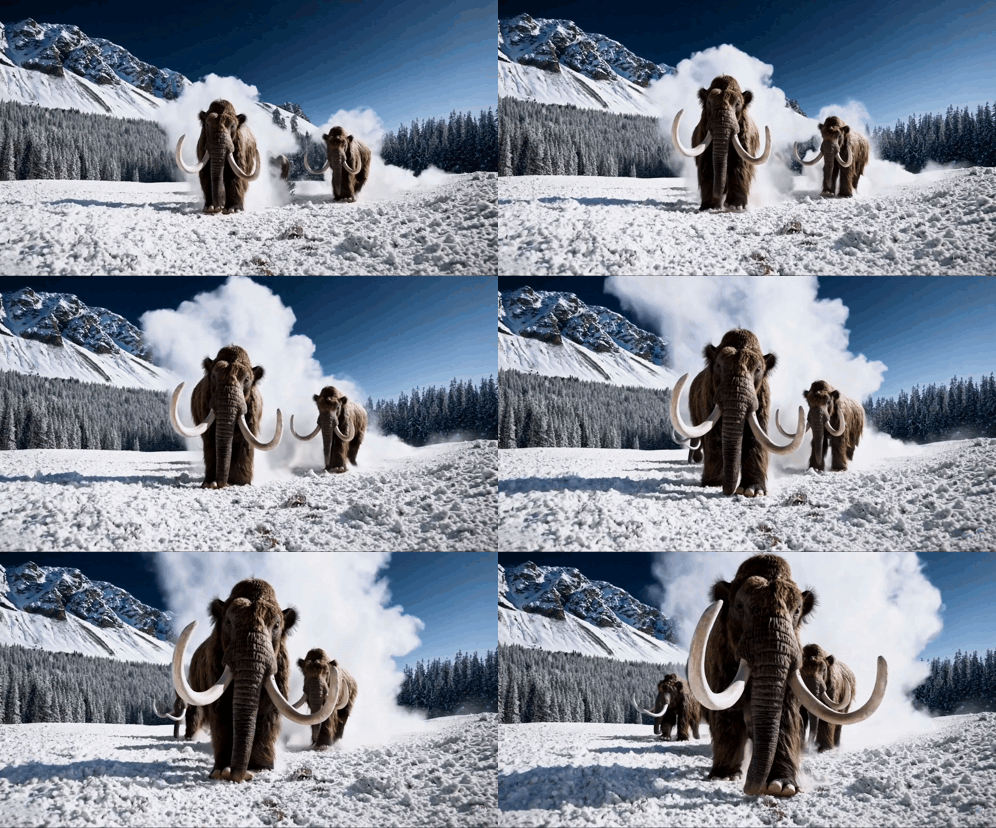
We sought to challenge this, and decided to double down the bet to look for ancient #RNA molecules in the extinct woolly mammoth.
We analyzed 10 samples from #mammoths that lived between 10,000 and 50,000 years ago in the Northern region of Siberia during the last Ice Age🥶
So far, isolating, sequencing, and analyzing #RNA molecules from old remains was considered such a difficult task full of past failures and only a handful of successes, that researchers seemed to have just lost hope.

So why should we bother about #RNA?
Contrary to #DNA:
📌RNA tells which genes are "turned on".
📌 We can detect tissue-specific gene expression and metabolic changes (stress, infections...)
📌Novel active genes can be found.
📌We can decipher regulatory mechanisms.
During past years, research focused on ancient #DNA has gained a lot of interest, with dozens of papers being routinely published each year📃
But what about ancient #RNA?
The common preconception is that these molecules, as opposed to DNA, do not last long after cell death.

🦣🧬🦣🤯💥We are pleased to share our new paper about ancient RNA expression profiles from the Woolly Mammoth, now published in Cell @cellpress.bsky.social
www.cell.com/cell/fulltex...
If you want to know more, read the 🧵 below:

Are you interested in microRNAs 🧬 and goats 🐐? We are!!
Then have a look at our preprint on how microRNA mutations segregate worldwide 🌍 in goat populations and the potentially derived consequences of prolonged inbreeding and geographical isolation.
www.biorxiv.org/content/10.1...


