
Developing a step-by-step guide to leniency designs, drawing on recent econometric literatures, from Paul Goldsmith-Pinkham, @instrumenthull.bsky.social, and Michal Kolesár www.nber.org/papers/w34473
18.11.2025 18:02
👍 22
🔁 7
💬 0
📌 2
Why Don't Struggling Students Do Their Homework? Disentangli
Using field-experimental data (study-time tracking and randomized incentives), we identify a structural model of learning. Student effort is influenced by external costs/benefits and unobserved hetero
Why Don't Struggling Students Do Their Homework? In a new study we use a field experiment to identify a structural model of learning.
We find that low productivity, not low motivation, is the stronger predictor of academic struggles. Study is available here: ideas.repec.org/p/feb/framed...
22.09.2025 16:44
👍 6
🔁 3
💬 1
📌 0
I love the Golden song!!!
13.09.2025 20:53
👍 1
🔁 0
💬 1
📌 0
Recording of the presentation here: youtu.be/C5mJ79bFwpw?...
13.07.2025 15:05
👍 18
🔁 4
💬 0
📌 0

We’re excited to introduce the Swedish Municipal Council Database! This open-access resource contains our hand-coded data for all local politicians in Sweden's democratic local elections between 1919 and 2018. A 🧵
Co-authors 🤩 @abrarbawati.bsky.social, @josefinemagnusson.bsky.social Moa Frödin
16.04.2025 14:06
👍 107
🔁 33
💬 1
📌 1

Cognitive skills are commonly assumed to begin deteriorating from the age of 30, which could pose a significant challenge for rapidly ageing populations. But this assumption relies largely on cross-sectional data that cannot distinguish between ageing patterns and cohort differences. Using German longitudinal data, this column finds that skills, on average, increase markedly into one’s 40s before decreasing slightly in literacy and more severely in numeracy. In addition, skills decline at older ages only for those with below-average skill usage, outlining a clear policy pathway for avoiding skill declines.
Cognitive skill decline with age is not as strong as previous studies suggest. Skills decline in old age only for those with below-average skill usage - use it or lose it.
Eric Hanushek, @kinnelavinia.bsky.social, Frauke Witthoeft, @woessmann.bsky.social
cepr.org/voxeu/column...
#EconSky
14.04.2025 08:33
👍 14
🔁 13
💬 0
📌 1
Thank you, Thomas for your support!
01.04.2025 11:23
👍 0
🔁 0
💬 0
📌 0
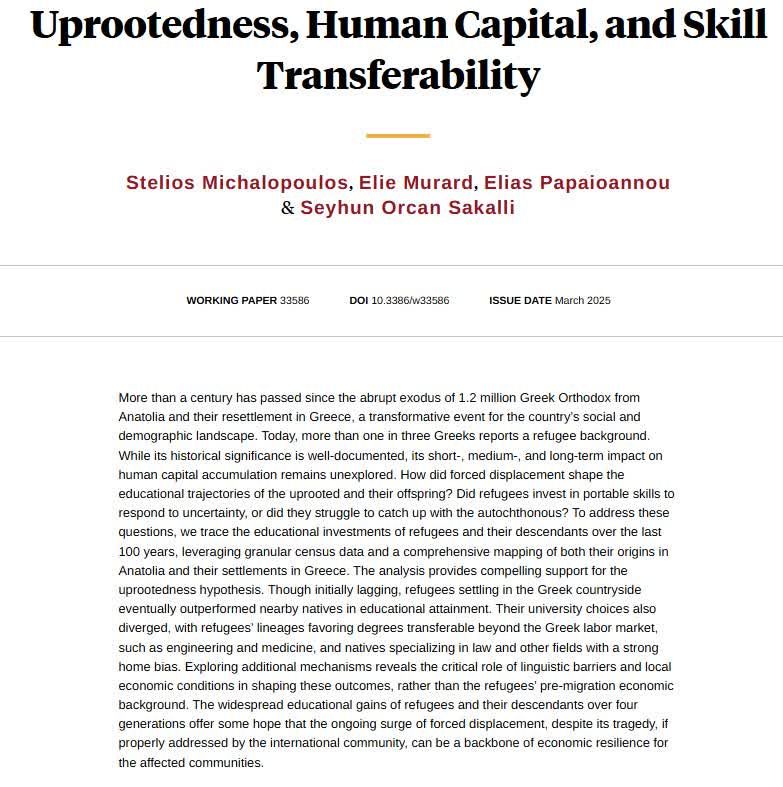
Over a century ago, 1.2 million Greek Orthodox refugees reshaped Greece. While initially lagging, they outperformed natives in education, favoring transferable degrees over local fields, from Michalopoulos, Murard, Papaioannou, and Sakalli https://www.nber.org/papers/w33586
24.03.2025 19:30
👍 11
🔁 5
💬 0
📌 2
**New Paper Alert**
Our new field experiment explores the inter-relationship between risk and ambiguity preferences of mothers, their early childhood investments, and their children's outcomes. Available for free download: ideas.repec.org/p/feb/artefa...
22.03.2025 19:07
👍 11
🔁 5
💬 1
📌 0

Stylised painting featuring a female figure facing left with birds, flowers and fish motifs under an orange sun and green blue sky
Bharti Dayal, Indian artist specialising in Madhubani art, originating as a women-only art form in the region of Mithila, India #womensart
17.03.2025 06:06
👍 342
🔁 52
💬 0
📌 2

By examining how parental income interacts with factors like race, education, and parenting age, this study offers a new understanding of intergenerational income mobility, from Y. Chang, @durlauf.bsky.social, B. Hu, and J. Park.
bit.ly/40hINpU
13.01.2025 17:47
👍 13
🔁 5
💬 0
📌 0
Tutorial reproducibility
Was thrilled to learn that @larsvil.bsky.social has a tutorial on reproducibility! Check it out, #EconSky.
larsvilhuber.github.io/tutorial-rep...
04.01.2025 22:40
👍 90
🔁 30
💬 2
📌 3
Question about std errors:
In an RCT, treated people are randomly assigned to "pods" and interact (e.g., treatment = WhatsApp group membership). The norm (e.g. Cai-Szeidl) is to cluster on indiv for control group + on pod for treatment group. Why is clustering needed if any ICC is due to treatment?
21.11.2024 18:32
👍 94
🔁 15
💬 13
📌 9


