Every spring, thousands of fish swim through the Oudegracht in Utrecht, looking for a place to lay their eggs. But the Weerdsluis is often closed. The Fish Doorbell helps. When you spot a fish on the livestream, press the doorbell. The lock keeper will check to see if the lock can be opened.
27.02.2026 06:47
👍 6
🔁 4
💬 0
📌 0


Successful second edition of OSM Soccer at #OSM26 yesterday - guess we’ll need to keep it going in 2028 🌊
26.02.2026 12:40
👍 2
🔁 0
💬 0
📌 0

Organizers clearly don’t trust the life skills of a room full of scientists #OSM26
23.02.2026 12:45
👍 2
🔁 0
💬 0
📌 0

SAVE THE DATE! Aug. 2026 @globaloceanbgc.bsky.social Float Data Workshop in Seattle! Get the deets & submit expression of interest here: www.us-ocb.org/go-bgc-float... 🌊
20.02.2026 15:57
👍 5
🔁 2
💬 0
📌 0

Average Vini Jr discourse:
18.02.2026 21:19
👍 2
🔁 1
💬 1
📌 0

Taking a Deep – and Wider – Breath
Examining one of our ocean’s lungs reveals some surprises
Do you like (ocean) science, fun interactive graphics, or cake metaphors? Then check out this StoryMap about our paper created by Annette deCharon & ODYSEA! arcg.is/1PXPSH1
Full paper: agupubs.onlinelibrary.wiley.com/doi/10.1029/...
More StoryMaps: ecco-group.org/publications...
🌊🧪
12.01.2026 16:07
👍 8
🔁 2
💬 1
📌 0
The meeting didn't happen yet but I'll make sure to go there when I'm in Glasgow, thanks for the suggestion!
10.01.2026 01:08
👍 1
🔁 0
💬 0
📌 0
Hi, could you add me to the feed please? Thanks!
Google scholar link: scholar.google.com/citations?us...
Website: jkoell.github.io
09.01.2026 21:57
👍 1
🔁 0
💬 2
📌 0
Yes the form should still work, so just fill it out if you’d like to join!
28.12.2025 06:25
👍 1
🔁 0
💬 0
📌 0
🌊⚽ Coming to Ocean Sciences Meeting '26 in Glasgow and looking for some non-science fun?
Then fill out this interest form for the second ever edition of OSM football*: forms.gle/GbjvxnhCBDVy...
Everyone's welcome, and no firm commitment required (yet 👀)
*soccer for my American friends
#OSM26
02.12.2025 22:30
👍 5
🔁 2
💬 3
📌 0
Finally Bach decides to drop some new tracks, feels like it’s been 200 years since the last one
17.11.2025 21:39
👍 0
🔁 0
💬 0
📌 0
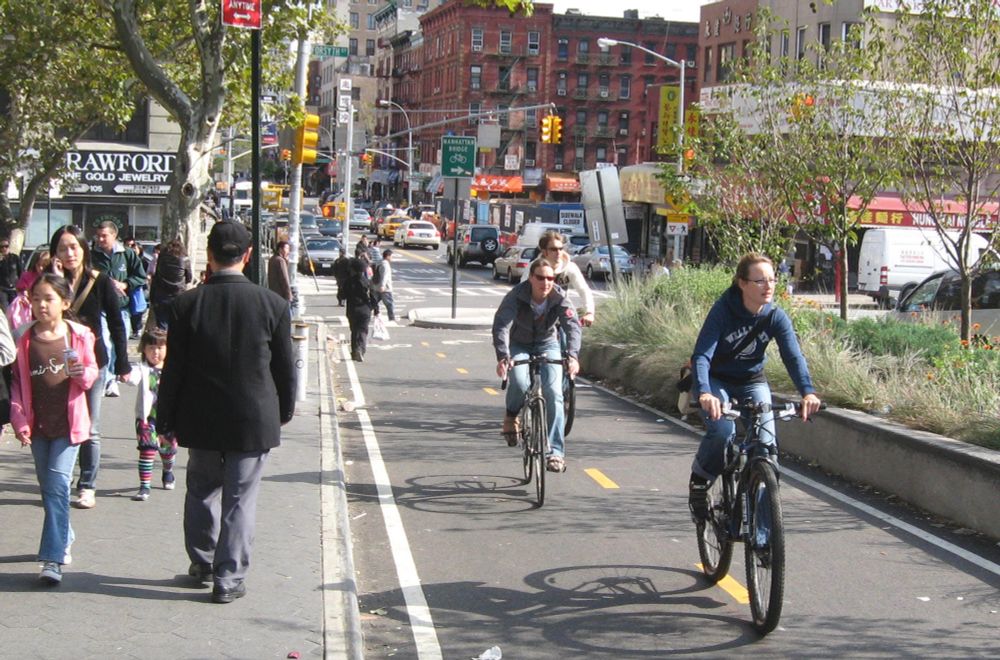
Separated Bike Lanes Means Safer Streets, Study Says — Streetsblog USA
Cities that build protected lanes for cyclists end up with safer roads for people on bikes and people in cars and on foot, a new study of 12 large metropolises revealed Wednesday.
Another reminder that a 13-year study found that protected bike-lanes led to a drastic decline in fatalities for all road users.
ALL ROAD USERS.
And painted bike-lanes? No safety improvement at all.
For sharrows, it’s actually safer to NOT have them.
Via @usa.streetsblog.org @nyc.streetsblog.org
17.11.2025 05:19
👍 606
🔁 217
💬 8
📌 8

A Katie Wilson campaign graphic that says Seattle! did your vote count? swipe to make sure. followed by a King County elections graphic showing challenged ballots by age, challenge ballots by language, and challenge ballads by gender.

A Katie Wilson for mayor campaign graphic with a QR code to track your ballot

A Katie Wilson for mayor graphic with a QR code for those with ballots whose signature has been challenged
Katie’s path to the Mayor’s office depends upon your ballot — and probably your friends’ and coworkers’, too! Track your ballot and fix any issues at the following links! Next, send these links to 10 friends and family to make sure Katie wins. #thisisyourcity
10.11.2025 21:41
👍 188
🔁 68
💬 0
📌 10
“Essentially we are adding more carbon debt to our planetary credit card, leaving future generations with an unpayable liability.”
07.11.2025 08:21
👍 0
🔁 0
💬 0
📌 0

Graphic showing the ocean’s importance for producing oxygen on geological vs biological time scales
There’s also this (much longer, but very helpful) science brief: oceanrep.geomar.de/id/eprint/59... which includes a nice graphic on it:
05.11.2025 17:50
👍 2
🔁 0
💬 0
📌 0
The change in the figure is mostly spatial (eastern vs western SPNA), but certainly would expect these processes to change over time too.
I’m currently looking at that, and preliminary results indicate O2 uptake & change are strongest in 2015/16, possibly related to North Atlantic Oscillation
04.11.2025 16:42
👍 1
🔁 1
💬 0
📌 0
How Climate Change is Strangling our Oceans
YouTube video by SciShow
And as a bonus, here is a video by @scishow.bsky.social which does a great job explaining ventilation based in part on my previous work: youtu.be/rIvt4s7CX2M - though I’d now argue the whole subpolar North Atlantic is the “lung” of the ocean rather than just the Labrador Sea 🙂
15/🧵
03.11.2025 20:48
👍 7
🔁 0
💬 0
📌 1
Lastly, a big thanks to my coauthors - @aj-fassbender.bsky.social, @jdsharp.bsky.social, @dcarrollsci.bsky.social, Alison Gray, and Greg Johnson - to Sarah Battle for creating the schematic, our two reviewers, and everyone involved with @bgc-argo.bsky.social and @globaloceanbgc.bsky.social!
14/🧵
03.11.2025 20:48
👍 4
🔁 1
💬 1
📌 0
Read the paper for much more than I could fit here, including
- Actual numbers and uncertainties
- Which gas exchange parameterization we used (and why)
- All the nitty gritty calculations - also available @ github.com/jkoell
- What all this means for how we define ocean ventilation in models
13/🧵
03.11.2025 20:47
👍 2
🔁 0
💬 1
📌 0
Not at all! As shown in the schematic, the Labrador Sea is where the accumulated O2 can reach the deep ocean. Exactly how that happens still needs to be researched further - luckily Una Miller (et al) is doing just that, so stay tuned (and go to @jaimepalter.bsky.social’s talk at #OSM26!)
12/🧵
03.11.2025 20:46
👍 2
🔁 0
💬 1
📌 0

Which brings us back to our lovely schematic. Our results highlight that ventilation occurs all along the subpolar gyre pathway, in contrast to previous studies (including my own) that focused largely on the Labrador Sea for O2 uptake/ventilation
So does this mean the Lab Sea doesn’t matter?
11/🧵
03.11.2025 20:45
👍 4
🔁 0
💬 2
📌 0

To understand why, we turned to an Argo float that tracked the circulation through the SPNA.
The data shows that water is progressively modified: light water becomes SPMW, which becomes denser SPMW, which becomes LSW. The high O2 of LSW is the end result of uptake throughout this process
10/🧵
03.11.2025 20:45
👍 4
🔁 0
💬 1
📌 0

Going back to the observational data, O2 levels increase during winter in different water masses - ocean layers defined by their density - as a result of the uptake.
Surprisingly, the change is strongest in subpolar mode water (SPMW), not Labrador Sea Water (LSW), the highest O2 water mass
9/🧵
03.11.2025 20:44
👍 3
🔁 0
💬 1
📌 0

Map showing annual air-sea exchange , biological sources and sinks, and physical transport of oxygen in the North Atlantic from an ocean model
Analyzing data from an ocean model we find similar patterns, and also see that the positive oxygen uptake is balanced by a negative transport divergence - implying that the oxygen absorbed from the atmosphere is subsequently carried away by ocean currents.
8/🧵
03.11.2025 20:44
👍 2
🔁 0
💬 1
📌 0
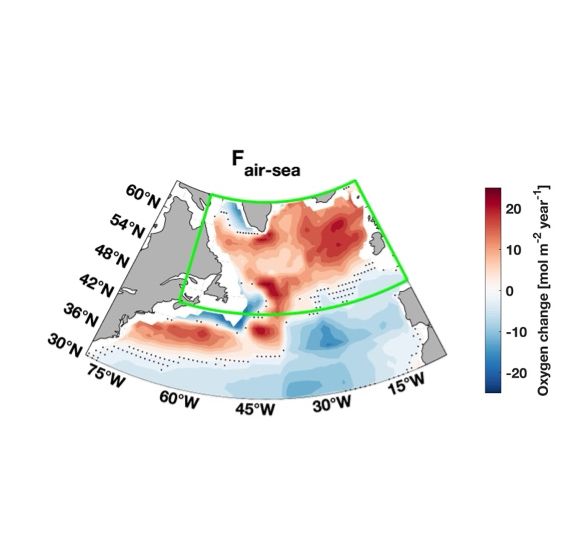
Map showing annual air-sea exchange of oxygen in the North Atlantic
This allowed us to estimate the air-sea exchange of oxygen for the whole SPNA; previous studies had only been able to sample at a single location.
We find that almost the entire SPNA (green box) is an annual oxygen sink, meaning O2 flows from the atmosphere into the ocean year after year
7/🧵
03.11.2025 20:43
👍 3
🔁 0
💬 1
📌 0

Global map showing locations of biogeochemical-Argo floats
Which is where our study comes in - improving our understanding of how the North Atlantic is ventilated currently
To find out, we used GOBAI-O2, a data product created by @jdsharp.bsky.social with the help of an army of ocean robots that sample all over the world (@bgc-argo.bsky.social)
6/🧵
03.11.2025 20:42
👍 4
🔁 1
💬 1
📌 0
Deoxygenation is projected to further accelerate in the future, and decreased ventilation is a likely reason (doi.org/10.1038/s415...)
But we don’t fully understand when, where, or how much O2 the ocean “breathes in” now, making it difficult to accurately predict future changes
5/🧵
03.11.2025 20:40
👍 2
🔁 0
💬 1
📌 0
Oxygen levels in the ocean interior are set by the balance between this supply and oxygen demand from organisms. ⚖️
But - surprise surprise - this delicate balance is threatened by climate change. The ocean has lost 2% of its oxygen since the 1950s, with serious consequences for marine life
4/🧵
03.11.2025 20:40
👍 6
🔁 0
💬 1
📌 0