Finally, despite broad skill transfer, when Third Thumb use was optional in a set of naturalistic tasks, participants preferred their hand over the device. This suggests that real-world adoption of these technologies will depend on more than skill transfer, cognitive effort, or embodiment.
02.03.2026 12:36
👍 0
🔁 0
💬 1
📌 0

However, we observed that the toe-based control mechanism led to a small reduction in balance, suggesting modest behavioural trade-offs associated with device use.
02.03.2026 12:36
👍 0
🔁 0
💬 1
📌 0

We also found that training improved participants’ sense of agency over the Third Thumb. The greater their motor gains after training, the stronger their sense of agency over the device❗
02.03.2026 12:36
👍 0
🔁 0
💬 1
📌 0

If Third Thumb skill isn’t tied to low-level body mappings, it may draw on cognitive mechanisms and be sensitive to increased cognitive load. Third Thumb performance dropped slightly while simultaneously doing a math task — but training reduced the cognitive effort required to use the device❗
02.03.2026 12:36
👍 0
🔁 0
💬 1
📌 0
Next, we tested two new Third Thumb–body mappings: 1) the Third Thumb was controlled by the heels instead of the toes; 2) it was worn on the left hand instead of the right. Motor skill still transferred, suggesting learning isn’t tied to specific sensorimotor body mappings‼️
02.03.2026 12:36
👍 0
🔁 0
💬 1
📌 0

We then tested participants on an untrained task involving new control demands. Participants still improved, showing that Third Thumb skill transferred to new task demands❗
02.03.2026 12:36
👍 0
🔁 0
💬 1
📌 0

First, we trained participants intensively with the Third Thumb for 7 days across a range of motor tasks. Despite most training happening at home with minimal supervision, participants improved in every task.
02.03.2026 12:36
👍 0
🔁 0
💬 1
📌 0

We tested whether motor skill with an extra robotic thumb (the Third Thumb), worn on the right hand and controlled by the toes, transfers beyond the tasks and conditions participants trained on.
02.03.2026 12:36
👍 0
🔁 0
💬 1
📌 0
If learning is tied to a specific body mapping (i.e., a particular limb wearing/controlling the device), motor skill may not transfer well when the mapping/context changes. If learning relies on body-independent, abstract representations, it may be more flexible but may increase cognitive demands.
02.03.2026 12:36
👍 0
🔁 0
💬 1
📌 0
Wearable robotic limbs for body augmentation could transform how we interact with the world — but their everyday use will depend on whether learned motor skills transfer beyond training contexts.
02.03.2026 12:36
👍 0
🔁 0
💬 1
📌 0
Can we use robotic augmentation limbs as flexibly as our natural limbs⁉️
🧨 Our new study, just out in @currentbiology.bsky.social, tested this using the Third Thumb @daniclode.bsky.social: a wearable robotic
extra thumb you control with your toes!
www.cell.com/current-biol... ‼️‼️
02.03.2026 12:36
👍 18
🔁 9
💬 1
📌 1
Markerless tracking shouldn’t feel like a coding project!
We released TrackStudio (arxiv.org/abs/2511.07624), a fully graphical, open-source toolkit for markerless human motion tracking. It enables use of current 2D/3D tools and video synchronisation without coding.
17.11.2025 13:29
👍 6
🔁 4
💬 0
📌 0

Donate to From Trauma to Triumph: My 18-Year Life Day Journey, organized by Kirsty Mason
❤️ When Everything Changed
As I type this, on the 7th November 2… Kirsty Mason needs your support for From Trauma to Triumph: My 18-Year Life Day Journey
Our lab has been lucky to know and work with Kirsty Mason for many years - she’s an incredible woman whose strength and openness have taught us so much about recovery and resilience 💛 If you can, please check out her GoFundMe and show some support! gofund.me/0283e864d
11.11.2025 14:11
👍 5
🔁 2
💬 1
📌 3
Super pleased to see this heroic effort finally in print!! Many thanks to Hunter, our amazing study participants, and everyone else who made this fantastic study come true.
21.08.2025 10:07
👍 24
🔁 5
💬 0
📌 0
Homepage of the Action, Computation, & Thinking (ACT) Lab, Yale department of psychology
Happy to announce that my lab @ Yale Psychology (actcompthink.org) will be accepting PhD applications this year (for start in Fall '26)!
Come for the fun experiments on human learning, memory, & skilled behavior, stay for the best 🍕 in the US.
Please reach out if you have any questions!
24.07.2025 13:29
👍 111
🔁 51
💬 4
📌 0
In summary:
– Force control offers better early motor performance
– EMG fosters learning generalization
– Raw EMG contains hidden potential
Read the full preprint at doi.org/10.1101/2025.06.16.658246. Thanks to all co-authors and participants!
12/12
17.07.2025 10:57
👍 1
🔁 1
💬 0
📌 0
So, what does this tell us?
EMG control may be harder initially, but it offers a richer signal and better transfer of learning. With optimised hardware and software, it could be a powerful interface for future augmentation device control.
11/12
17.07.2025 10:57
👍 1
🔁 0
💬 1
📌 0

And how do users perceive the Thumb? Participants reported a strong sense of agency (control over the Thumb) but no body ownership (it didn’t feel like part of the body). All categories of embodiment were rated similarly for both EMG and FS.
10/12
17.07.2025 10:57
👍 0
🔁 0
💬 1
📌 0
Using predictive modelling, we found the force control signal could predict performance, whilst the processed EMG control signal could not predict EMG performance.
But importantly, the raw EMG signal could act as a predictor. This suggests pre-processing might discard important information.
9/12
17.07.2025 10:57
👍 0
🔁 0
💬 1
📌 0

To provide a mechanistic insight into this generalisation, we cross-correlated the toe-movement signal and muscle signal, and observed a high correlation during EMG control, suggesting participants are expressing force-related toe movements while using the EMG control, contributing to learning!
8/12
17.07.2025 10:57
👍 0
🔁 0
💬 1
📌 0
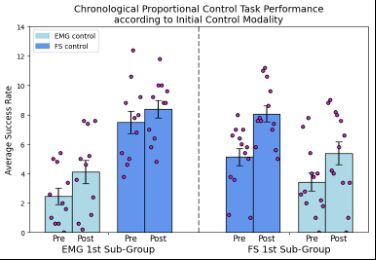
But we also saw that the control method participants started with impacted learning transfer to their second control method.
Beginning with EMG control led to superior transfer when switching to force control – suggesting muscle control is a better tutor for generalisable learning.
7/12
17.07.2025 10:57
👍 0
🔁 0
💬 1
📌 0

On the proportional control task completed before and after training, force control continued to demonstrate a clear advantage. However, participants showed similar learning gains across both control modalities.
6/12
17.07.2025 10:57
👍 0
🔁 0
💬 1
📌 0

Surprisingly, an additional cognitive load during the collaboration motor task did not affect performance for either control modality. Participants also performed similarly in the cognitive load arithmetic task, regardless of control.
5/12
17.07.2025 10:57
👍 0
🔁 0
💬 1
📌 0
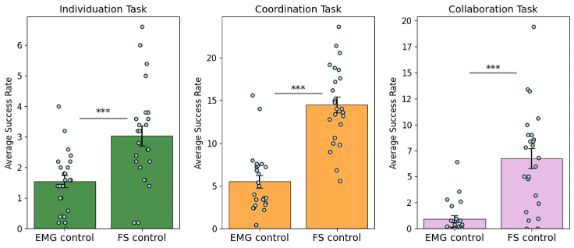
Across all training tasks, both control methods enabled use of the Third Thumb, but force control consistently yielded better task performance.
4/12
17.07.2025 10:57
👍 0
🔁 0
💬 1
📌 0

EMG-based control is closer to the neural source; muscle activity precedes motion. Our initial hypothesis: EMG should enable more intuitive and efficient learning.
We compared both control modalities across multiple motor tasks using a counterbalanced within-participants design.
3/12
17.07.2025 10:57
👍 0
🔁 0
💬 1
📌 0

The Third Thumb is designed to extend and enhance the motor abilities of an already fully functional hand. It was initially designed to be proportionally controlled by movement of the wearer’s toes via force sensors.
But what if we tapped into muscle signals directly instead?
2/12
17.07.2025 10:57
👍 0
🔁 0
💬 1
📌 0
Can you control an extra robotic finger just by flexing your leg muscles?
In our new study, we put EMG-based muscle control to the test, comparing it to traditional toe force sensor control for operating the Third Thumb (designed by @daniclode.bsky.social).
1/12
17.07.2025 10:57
👍 8
🔁 3
💬 1
📌 0