The Places We Make Memories Help Us Inscribe Them
Psychology researchers used virtual reality and MRI technology to better understand how locations help us encode memories.
Nice article from Columbia News on our new paper about neural representations of places and remembered items - including a video of the creative VR environment made by @xrmasiso.bsky.social ! news.columbia.edu/news/places-...
08.01.2026 19:27
👍 30
🔁 3
💬 0
📌 1
Great Q - here a "good" spatial representation is distinct from all others, but you'd also want some way of linking places into larger maps. We have some other projects now trying to understand how you could accomplish both of these things, e.g. for people's mental maps when using the Method of Loci
05.01.2026 22:26
👍 0
🔁 0
💬 1
📌 0
Our new paper out in NHB! We started this back in @ptoncompmemlab.bsky.social's lab when I was a postdoc and Rolando was a grad student, showing that stable fMRI representations of places (learned in Rolando's custom-made VR world) provide the best anchors for later item learning
05.01.2026 19:10
👍 40
🔁 14
💬 1
📌 0
Apply - Interfolio
{{$ctrl.$state.data.pageTitle}} - Apply - Interfolio
Columbia Psych is hiring *two* junior faculty in Cognitive Science/Neuroscience this year! If you work on cognition (broadly defined), submit your application materials as soon as possible (review starts Nov 1). If you have questions you can reach out to me by email! apply.interfolio.com/175428
23.10.2025 18:28
👍 68
🔁 46
💬 1
📌 0

I'm recruiting PhD students to join my new lab in Fall 2026! The Shared Minds Lab at @usc.edu will combine deep learning and ecological human neuroscience to better understand how we communicate our thoughts from one brain to another.
01.10.2025 22:39
👍 121
🔁 72
💬 9
📌 3
Years ago my lab tried to brainstorm ways to separately manipulate low-level (texture/pattern) and high-level (scene/object) image properties, for studying visual representations in the brain. Thanks to imaginative work by PhD student Zall Hirschstein, we now have a stimulus set that does just that!
22.09.2025 19:57
👍 24
🔁 4
💬 1
📌 0
What happens when we learn a new shortcut between places we thought were unconnected? Hannah found that the hippocampus rapidly adjusts its representations of environments to join them into a connected map - excited to share this final paper from her PhD work with me and @mariamaly.bsky.social !
16.09.2025 19:42
👍 41
🔁 10
💬 2
📌 0
Does watching a movie over and over make events slower or faster in the brain? With Narjes Al-Zahli and @mariamaly.bsky.social we find that different regions actually change in different directions, e.g. visual regions show finer-scale event structure and STS shows coarser-scale structure!
02.09.2025 21:04
👍 21
🔁 2
💬 0
📌 0
Out now: a unique multi-lab collaboration led by @matthiasnau.bsky.social showing that recalling a movie reactivates both neural and gaze patterns for sequences of scenes!
25.08.2025 21:31
👍 23
🔁 2
💬 0
📌 0
Check out the first paper from Halle’s lab: using a false-memory paradigm to challenge classical ideas about how memories are stored and change with age
14.08.2025 17:53
👍 5
🔁 0
💬 0
📌 0

Aging and false memories: Comparing effects of item-relatedness and list position
Semantic false memories are traditionally more frequent from early list positions and thought to arise from presumed long-term memory stores whereas phonological false memories traditionally are more ...
I'm not a big poster, but had to share how proud I am of my postdoc, Lauri Gurguryan, for submitting the FIRST paper from my lab 🎉
Here, we ask a classic ? Do short- and long-term memory rely on separate or shared underlying stores
Checkout the preprint: bit.ly/3Hyyl83
#neuroskyence #PsychSciSky
14.08.2025 16:28
👍 68
🔁 11
💬 2
📌 1
How does the soundtrack of a movie change your memory of the story? New work led by @jayneuro.bsky.social finds that repeated musical motifs can reactivate neural patterns from earlier scenes, and reactivation is related to better subsequent memory!
08.07.2025 15:39
👍 13
🔁 0
💬 0
📌 0
Groundbreaking work by @martamasilva.bsky.social using intracranial recordings to study event boundaries and event memory, revealing neural mechanisms that we haven't been able to measure with fMRI!
03.07.2025 19:20
👍 20
🔁 3
💬 0
📌 0
🥳Excited to share that I am joining Columbia July 2025
@columbiauniversity.bsky.social
Looking for🚨lab managers🚨postdocs🚨grad students! Pls REPOST🙏
We study⭐️person perception⭐️social cognition using experimental, cross-cultural, & computational methods!
App👉shorturl.at/5UVPl
More👉shorturl.at/q18GM
21.05.2025 17:18
👍 54
🔁 19
💬 10
📌 2
I’m thrilled to announce that I will start as a presidential assistant professor in Neuroscience at the City U of Hong Kong in Jan 2026!
I have RA, PhD, and postdoc positions available! Come work with me on neural network models + experiments on human memory!
RT appreciated!
(1/5)
08.05.2025 01:16
👍 130
🔁 39
💬 14
📌 4
OSF
What drives human curiosity? Is it a need to balance stimulation — or something we learn over time?
In our 🚨 new preprint, we show that learning reinforces curiosity, especially for related content.
osf.io/9bw6j_v2
w/ Jane Mok, @chrisbaldassano.bsky.social , Caroline Marvin, Daphna Shohamy
🧵👇
18.04.2025 21:03
👍 14
🔁 4
💬 1
📌 0
This work was a true team effort, led by Caroline Lee in my lab with former lab members Samantha Cohen and Sam Hutchinson, in collaboration with Nim Tottenham and her lab!
10.04.2025 16:06
👍 0
🔁 0
💬 0
📌 0
On the contrary, kids who currently feel strong attachment to their caregivers may be processing these same narratives using a top-down approach where schema regions in the PFC are activated. There are even more results and cool methods in the paper, so check it out!
10.04.2025 13:47
👍 2
🔁 0
💬 1
📌 0
All in all, we think that kids with unstable caregiving histories may not have learned a stable (or what we would consider “standard”) attachment schema, so they’re activating episodic memory and visual processing regions when watching an attachment narrative.
10.04.2025 13:47
👍 2
🔁 0
💬 1
📌 0
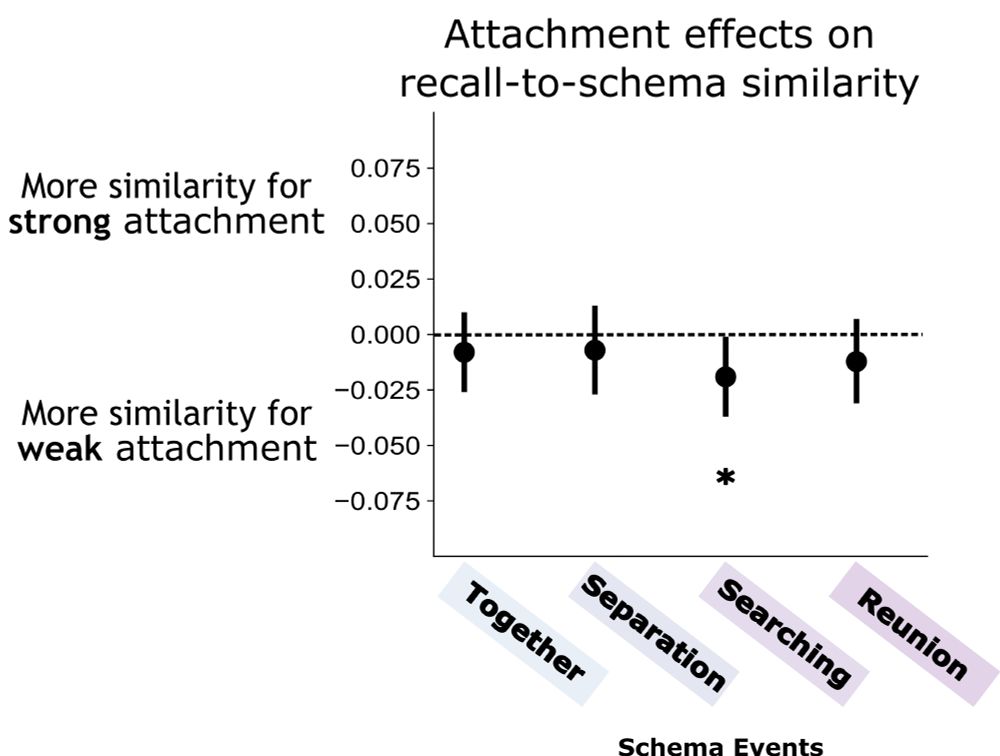
Data figure comparing the schematic content of children's recalls based on whether they feel strong or weak attachment to their current caregivers. Children with weak attachment showed significantly greater similarity to the "Searching" schema event
We also looked at kids' verbal recalls of the movies! Interestingly, we found that recalls in kids who report weaker attachment are more focused on the Searching event in the attachment schema.
10.04.2025 13:47
👍 2
🔁 0
💬 1
📌 0
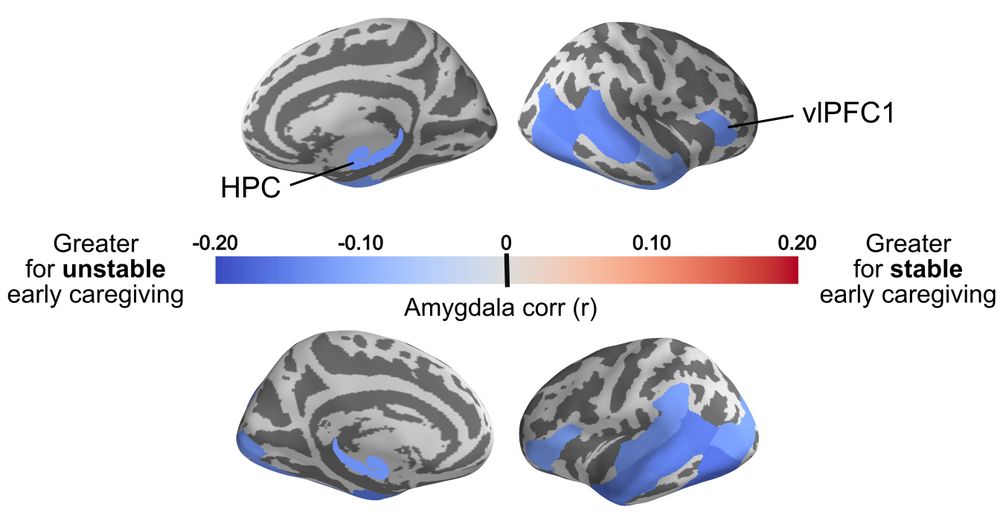
Brain map showing regions that are more connected to the amygdala for children with unstable early caregiving, including the hippocampus and lateral temporal regions
Looking at kids’ brain activity related to caregiver stability, we show that kids with unstable caregiver histories have more connectivity between the amygdala and visual processing regions + hippocampus.
10.04.2025 13:47
👍 2
🔁 0
💬 1
📌 0
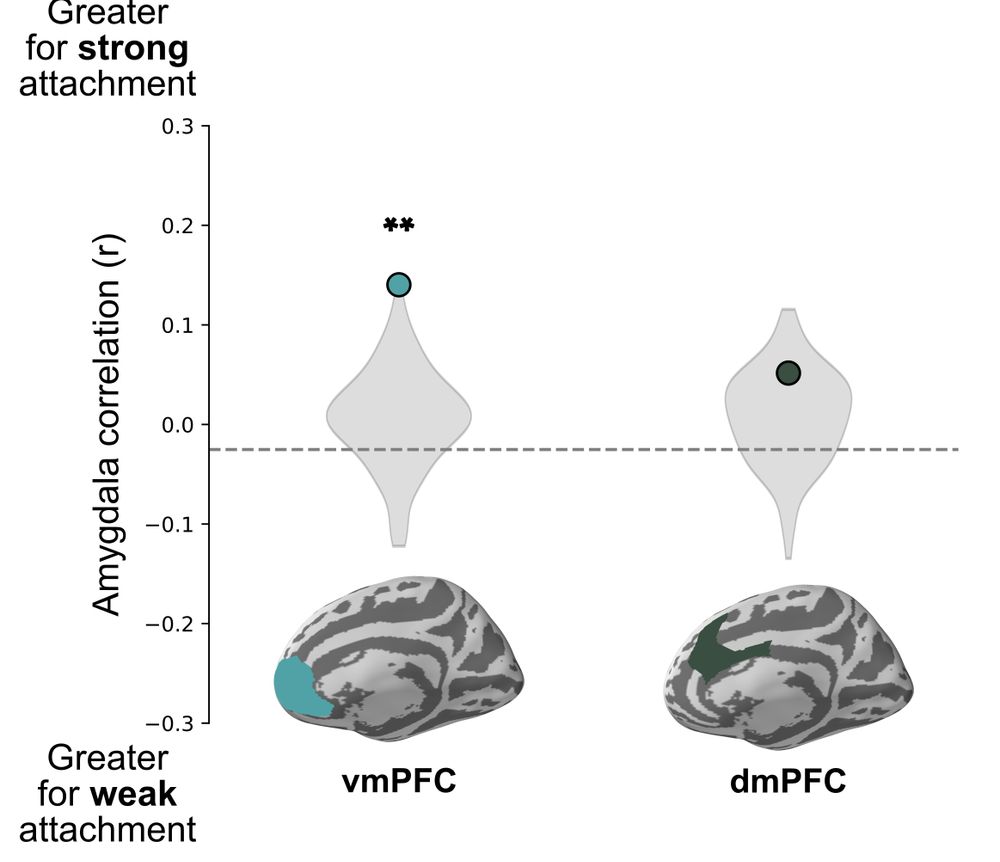
Data figure showing that amygdala-vmPFC correlation is higher for children with strong attachment, while there is no significant effect on amygdala-dmPFC connectivity
Our results show that there are indeed differences in brain responses! Kids who report stronger attachment to their current caregiver(s) have more connectivity between the amygdala and vmPFC. Whole-brain results show that heightened amygdala connectivity also shows up in lateral frontal regions.
10.04.2025 13:47
👍 2
🔁 0
💬 1
📌 0
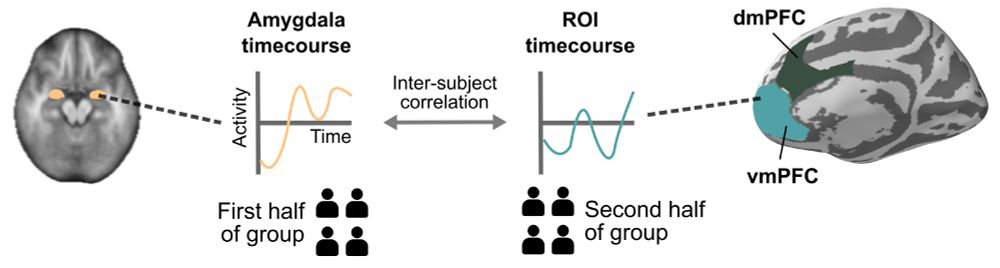
Figure showing how inter-subject correlation is computed. The average timecourse in the amygdala is computed in one half of the group, and the average timecourse in another brain region such as vmPFC or dmPFC is computed in the other half of the group, and then these two timecourses are correlated.
We compared brain responses to the movies based on childhood experiences: caregiver stability (caregiver switch/es vs no switch) and caregiver attachment (weak vs strong). We examined response patterns in the amygdala to other regions in the brain with ISFC (Inter-Subject Functional Connectivity).
10.04.2025 13:47
👍 2
🔁 0
💬 1
📌 0
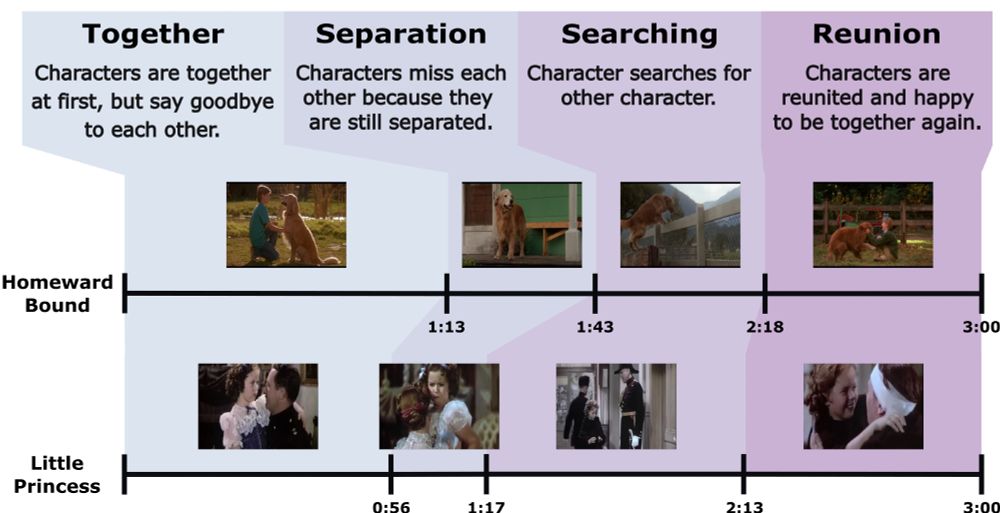
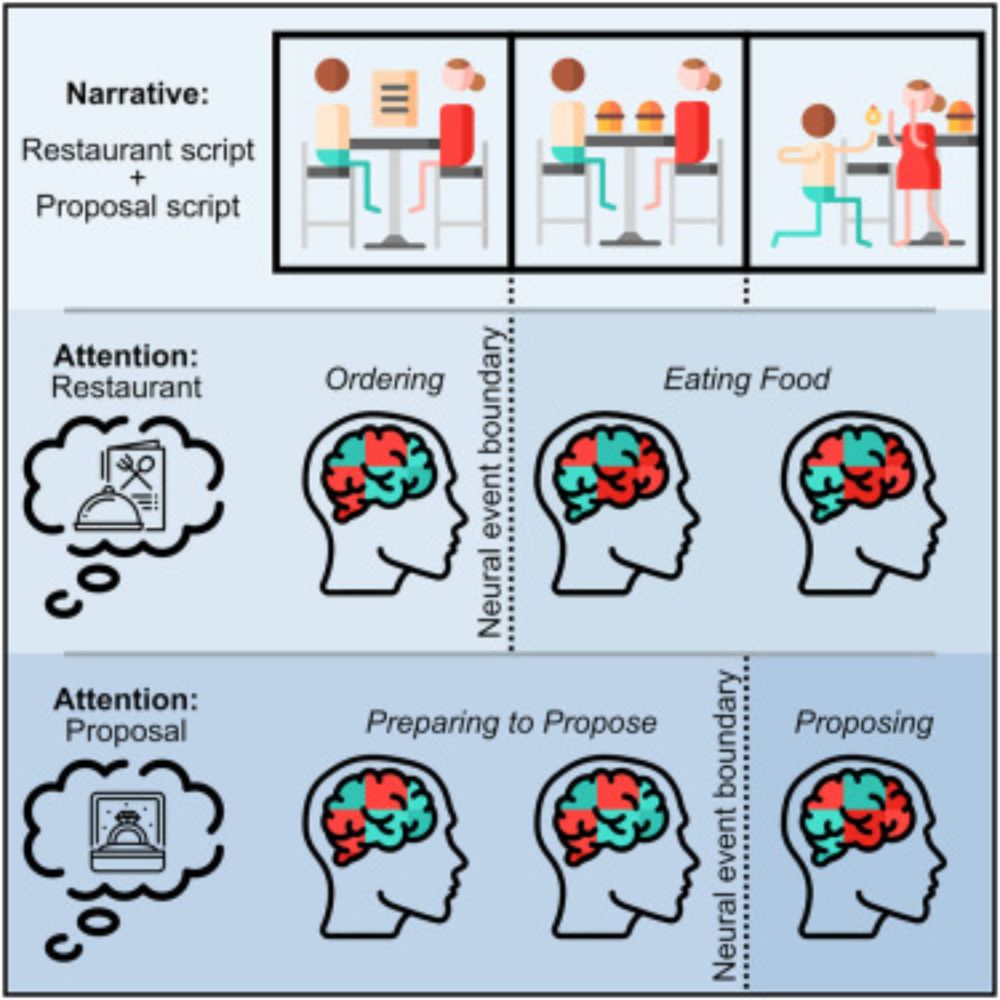
Diagram showing the two videos used in the study (Homeward Bound and the Little Princess), and how each video proceeds through four events: "Together" (Characters are together at first, but say goodbye to each other), "Separation" (Characters miss each other because they are still separated), "Searching" (Character searches for other character), and "Reunion" (Characters are reunited and happy to be together again)
To understand whether childhood experiences such as changing caregivers (in the past) and attachment security (in the present) impact how kids view attachment narratives in movies, we had kids watch a short movie edited to depict 4 crucial events of an attachment schema while collecting fMRI.
10.04.2025 13:47
👍 4
🔁 0
💬 1
📌 0

Brain scans show areas that tend to activate when viewing art that is representational (left) vs abstract (right). (Credit: Piet Mondrian / Celia Durkin / Shohamy lab).
How does the brain respond to art? In a new @pnas.org study, by showing paintings to people while scanning their brains, Daphna Shohamy, Celia Durkin and colleagues provide a scientific test of a longstanding idea in art theory. Read:
zuckermaninstitute.columbia.edu/art-brain-be...
#neuroscience 🧠🎨
07.04.2025 19:44
👍 9
🔁 3
💬 0
📌 1

MDRS
MDRS is a professional society dedicated to the study of memory. �Members engage in basic and clinical research into how memory works and why it fails.
My favorite conference is the Memory Disorders Research Society meeting. It's a delightful community: top-notch research & wonderful people who have been so supportive in my career.
Want to join? Nominations for membership (including self-nominations) are open until April 9! Form at the top👇🏼
03.04.2025 17:00
👍 34
🔁 15
💬 2
📌 0
Symposium Talk - Cognitive Neuroscience Society
March 29-April 1 | 2025 Submit a Symposium Submit a Poster Latest from Twitter
For anyone at #CNS2025 - check out @xrmasiso.bsky.social's talk tomorrow afternoon, showing that we can use fMRI to predict which (VR) locations will be good anchors for creating *future* memories!
www.cogneurosociety.org/talk/?id=5579
31.03.2025 14:00
👍 13
🔁 2
💬 0
📌 0