‘How Great Ideas Happen’ Review: Building a Brainstorm
The romantic idea of an insight that suddenly dawns is misleading. Most breakthroughs come slowly.
"... the belief that great ideas are entirely new. In practice, he argues, many innovations grow out of existing ones, often by borrowing or transplanting concepts from one field to another."
www.wsj.com/arts-culture...
06.02.2026 17:39
👍 1
🔁 1
💬 0
📌 0

Labor Market Competition symposium in the JEP-- all articles look like a must-read.
04.02.2026 15:50
👍 13
🔁 2
💬 0
📌 0

How does a large structural change to the labor market affect education investments made at young ages? Exploiting differential exposure to the national decline in routine-task intensity across local labor markets, we show that the secular decline in routine tasks causes major shifts in education investments of high school students, where they invest less in vocational-trades education and increasingly invest in college education. Our results highlight that labor demand changes impact inequality in the next generation. Low-ability and low-SES students are most responsive to task-biased demand changes and, as a result, intergenerational mobility in college education increases.
𝗞𝗷𝗲𝗹𝗹 𝗚. 𝗦𝗮𝗹𝘃𝗮𝗻𝗲𝘀 (Norwegian School of Economics) will present his paper on 𝗙𝗲𝗯𝗿𝘂𝗮𝗿𝘆 𝟭𝟬, 𝟮𝟬𝟮𝟲. #EconSky #Socsky
Title: 𝗧𝗵𝗲 𝗗𝗲𝗰𝗹𝗶𝗻𝗲 𝗼𝗳 𝗥𝗼𝘂𝘁𝗶𝗻𝗲 𝗧𝗮𝘀𝗸𝘀, 𝗘𝗱𝘂𝗰𝗮𝘁𝗶𝗼𝗻 𝗜𝗻𝘃𝗲𝘀𝘁𝗺𝗲𝗻𝘁𝘀, 𝗮𝗻𝗱 𝗜𝗻𝘁𝗲𝗿𝗴𝗲𝗻𝗲𝗿𝗮𝘁𝗶𝗼𝗻𝗮𝗹 𝗠𝗼𝗯𝗶𝗹𝗶𝘁𝘆
Time : 𝟭𝟬 𝗔𝗠 𝗘𝗦𝗧 ||𝟰 𝗣𝗠 𝗖𝗘𝗧 || 𝟭𝟭 𝗣𝗠 𝗖𝗵𝗶𝗻𝗮
Registration: 👉 tinyurl.com/ekdw93ma
👇Abstract:
04.02.2026 17:22
👍 6
🔁 3
💬 0
📌 1

Standard intergenerational measures have been shown to understate the long-run persistence of socioeconomic advantages in developed countries. We study theoretically and empirically whether this pattern extends to less developed settings, using Indonesia as a case study. We estimate multigenerational correlations in education across three generations, using five waves of the Indonesian Family Life Survey (IFLS) and the 1995 and 2005 Censuses. Contrary to previous findings, we find a negative grandparent-grandchild coefficient, implying greater educational mobility than the intergenerational correlations from developing contexts typically suggest. We build a theoretical framework to identify two key factors influencing multigenerational transmission in developing countries: (1) financial and credit constraints, and (2) cultural norms surrounding marital sorting. To test the salience of these mechanisms in Indonesia, we analyze regional variations in marital practices, education expenditures, and the impact of 1997 Asian financial crisis.
𝗔𝗻𝘁𝗼𝗻𝗶𝗼 𝗗𝗮𝗹𝗹𝗮-𝗭𝘂𝗮𝗻𝗻𝗮 (Bank of Italy) will present his paper on 𝗝𝗮𝗻𝘂𝗮𝗿𝘆 𝟯𝟬, 𝟮𝟬𝟮𝟲. #EconSky #AcademicSky #Socsky Join us!
Title: 𝗘𝗱𝘂𝗰𝗮𝘁𝗶𝗼𝗻𝗮𝗹 𝗠𝗼𝗯𝗶𝗹𝗶𝘁𝘆 𝗔𝗰𝗿𝗼𝘀𝘀 𝗠𝘂𝗹𝘁𝗶𝗽𝗹𝗲 𝗚𝗲𝗻𝗲𝗿𝗮𝘁𝗶𝗼𝗻𝘀 𝗶𝗻 𝗜𝗻𝗱𝗼𝗻𝗲𝘀𝗶𝗮
Time : 𝟭𝟬 𝗔𝗠 𝗘𝗦𝗧 ||𝟰 𝗣𝗠 𝗖𝗘𝗧 || 𝟭𝟭 𝗣𝗠 𝗖𝗵𝗶𝗻𝗮
Registration: 👉 tinyurl.com/ekdw93ma
👇Abstract:
25.01.2026 22:31
👍 3
🔁 3
💬 1
📌 0
Convexity and Latent Status: Understanding the Evolution of Intergenerational Educational Mobility in Japan
We study intergenerational educational mobility in Japan, with a focus on its evolution from the 1940s to the 1990s birth cohorts. Japan is an excellent c
The linear model of educational mobility is misleading for understanding the evolution in Japan. It suggests no changes between the 1940s and 1990s birth cohorts, but the mobility curve was concave in the 1940s, and became convex in the 1990s.
Link to the paper: papers.ssrn.com/sol3/papers....
13.01.2026 18:29
👍 5
🔁 2
💬 0
📌 0
Researching social mobility is hard in countries that only have data on coresident family members. This paper suggests that sibling similarity is a more robust measure in this case than parent-child similarity.
08.01.2026 06:38
👍 7
🔁 4
💬 0
📌 0
To understand if we are truly equalizing educational opportunity, we need measures that aren't distorted by the "lumpy" nature of education data. (13/14)
23.12.2025 23:56
👍 1
🔁 1
💬 1
📌 0
Is the popular rank-rank model (Chetty et al., 2014) valid for measuring educational mobility?
While rank-based measures of mobility work well for continuous variables such as income, they face intractable challenges when applied to discrete variables, such as years of schooling. #Econsky (1/14)
23.12.2025 23:56
👍 1
🔁 1
💬 1
📌 0
🔗 𝙊𝙥𝙚𝙣 𝘼𝙘𝙘𝙚𝙨𝙨: doi.org/10.1016/j.je... 𝙋𝙡𝙚𝙖𝙨𝙚 𝙛𝙚𝙚𝙡 𝙛𝙧𝙚𝙚 𝙩𝙤 𝙨𝙝𝙖𝙧𝙚 𝙬𝙞𝙩𝙝 𝙖𝙣𝙮𝙤𝙣𝙚 𝙬𝙝𝙤 𝙢𝙞𝙜𝙝𝙩 𝙗𝙚 𝙞𝙣𝙩𝙚𝙧𝙚𝙨𝙩𝙚𝙙! 📝💬👏
22.12.2025 18:43
👍 2
🔁 1
💬 1
📌 0
#IntergenerationalMobility #SocialMobility #UpwardMobility #EconomicOpportunity #DevelopmentEconomics #SocialSustainability #EconSky
22.12.2025 18:44
👍 2
🔁 1
💬 0
📌 0

🚨 🎉 I’m thrilled to share that our paper, “𝙄𝙨 𝙂𝙚𝙣𝙙𝙚𝙧 𝘿𝙚𝙨𝙩𝙞𝙣𝙮? 𝙂𝙚𝙣𝙙𝙚𝙧 𝘽𝙞𝙖𝙨 𝙖𝙣𝙙 𝙄𝙣𝙩𝙚𝙧𝙜𝙚𝙣𝙚𝙧𝙖𝙩𝙞𝙤𝙣𝙖𝙡 𝙀𝙙𝙪𝙘𝙖𝙩𝙞𝙤𝙣𝙖𝙡 𝙈𝙤𝙗𝙞𝙡𝙞𝙩𝙮 𝙞𝙣 𝙄𝙣𝙙𝙞𝙖” (with amazing coauthors @shahe-emran-econ.bsky.social and Forhad Shilpi), has recently been published in the 𝐉𝐨𝐮𝐫𝐧𝐚𝐥 𝐨𝐟 𝐄𝐜𝐨𝐧𝐨𝐦𝐢𝐜 𝐁𝐞𝐡𝐚𝐯𝐢𝐨𝐫 & 𝐎𝐫𝐠𝐚𝐧𝐢𝐳𝐚𝐭𝐢𝐨𝐧!!! 🚀 🚀 🚀
22.12.2025 18:34
👍 1
🔁 1
💬 1
📌 0
Thanks for sharing! This is still a preliminary draft, and any comments would be greatly appreciated!
15.12.2025 13:58
👍 2
🔁 1
💬 0
📌 0

The Economy After the September Jobs Report
The September jobs report shows weak job growth, higher unemployment, and a cooling labor market driven mostly by healthcare gains.
My interview with Joe Stiglitz in which we talk about, among other things, how bankruptcy and intellectual property laws were structured to make billionaires richer cepr.net/publications...
22.11.2025 18:41
👍 31
🔁 15
💬 1
📌 1

𝗞𝗼𝗵𝗲𝗶 𝗧𝗮𝗸𝗲𝗱𝗮 (NUS) will present his paper 𝗼𝗻 𝗢𝗰𝘁𝗼𝗯𝗲𝗿 𝟮𝟮. #EconSky #AcademicSky #Socsky Join us!
Title: 𝗧𝗿𝗮𝗱𝗲 𝗮𝗻𝗱 𝗜𝗻𝘁𝗲𝗿𝗴𝗲𝗻𝗲𝗿𝗮𝘁𝗶𝗼𝗻𝗮𝗹 𝗜𝗻𝗰𝗼𝗺𝗲 𝗠𝗼𝗯𝗶𝗹𝗶𝘁𝘆: 𝗧𝗵𝗲𝗼𝗿𝘆 𝗮𝗻𝗱 𝗘𝘃𝗶𝗱𝗲𝗻𝗰𝗲 𝗳𝗿𝗼𝗺 𝘁𝗵𝗲 𝗨.𝗦
Time: 𝟭𝟬 𝗔𝗠 𝗘𝗦𝗧 || 𝟰 𝗣𝗠 𝗖𝗘𝗧 || 𝟭𝟬 𝗣𝗠 𝗖𝗵𝗶𝗻𝗮
Registration: 👉 tinyurl.com/ekdw93ma
👇Abstract:
17.10.2025 04:46
👍 2
🔁 2
💬 0
📌 0

Shared Prosperity in a Fractured World: A New Economics for the Middle Class, the Global Poor, and Our Climate by Dani Rodrik. New, practical approaches to confronting today’s most daunting global issues.
In Shared Prosperity in a Fractured World, @drodrik.bsky.social presents new, practical approaches to confronting today’s most daunting global issues.
Publishing November 4. Learn more and preorder yours: press.princeton.edu/books/hardco...
06.10.2025 17:23
👍 8
🔁 7
💬 1
📌 0

📢 𝗭𝗮𝗰𝗵𝗮𝗿𝘆 𝗕𝗹𝗲𝗲𝗺𝗲𝗿 (Princeton U) will present his paper on college mobility on 𝗦𝗲𝗽𝘁𝗲𝗺𝗯𝗲𝗿 𝟭𝟲, 𝟮𝟬𝟮𝟱. #EconSky #AcademicSky #Socsky Join us!
Title: 𝗖𝗵𝗮𝗻𝗴𝗲𝘀 𝗶𝗻 𝘁𝗵𝗲 𝗰𝗼𝗹𝗹𝗲𝗴𝗲 𝗺𝗼𝗯𝗶𝗹𝗶𝘁𝘆 𝗽𝗶𝗽𝗲𝗹𝗶𝗻𝗲 𝘀𝗶𝗻𝗰𝗲 𝟭𝟵𝟬𝟬
Time: 𝟭𝟬 𝗔𝗠 𝗘𝗦𝗧 || 𝟰 𝗣𝗠 𝗖𝗘𝗧 || 𝟭𝟬 𝗣𝗠 𝗖𝗵𝗶𝗻𝗮
Registration: 👉 tinyurl.com/ekdw93ma
👇Abstract:
10.09.2025 13:27
👍 3
🔁 3
💬 0
📌 0
Gwen
YouTube video by ScienceSavedMe
Proposed cuts to NIH and NSF threaten to shut down labs, end promising clinical trials, and stall the progress that millions of families are counting on. Listen to Gwen. #sciencesavedme
www.youtube.com/watch?v=A-HT...
05.09.2025 15:14
👍 14
🔁 3
💬 0
📌 0
Public Primary School Expansion, Gender-based Crowding Out, and Intergenerational Educational Mobility
Using full-count census data from Indonesia and a difference-in-difference design, we analyze the effects of primary school expansion on intergenerational educa
Evidence from the matrilineal tribe of West Sumatra (Minangkabau) confirms the fundamental role of gender norms, where boys were crowded out, not girls! This highlights that educational policies must consider potential bottlenecks & social norms for equitable outcomes. Paper: tinyurl.com/3s6sn6xy
03.08.2025 04:34
👍 2
🔁 1
💬 0
📌 0
Facing the bottleneck, boys crowded out girls at the secondary level, irrespective of a girl’s family background. Labor market returns don't explain this. Instead, we find strong evidence that #SocialNorms, specifically son preference in a patrilineal society, drives this crowding out.
03.08.2025 04:34
👍 1
🔁 1
💬 1
📌 0
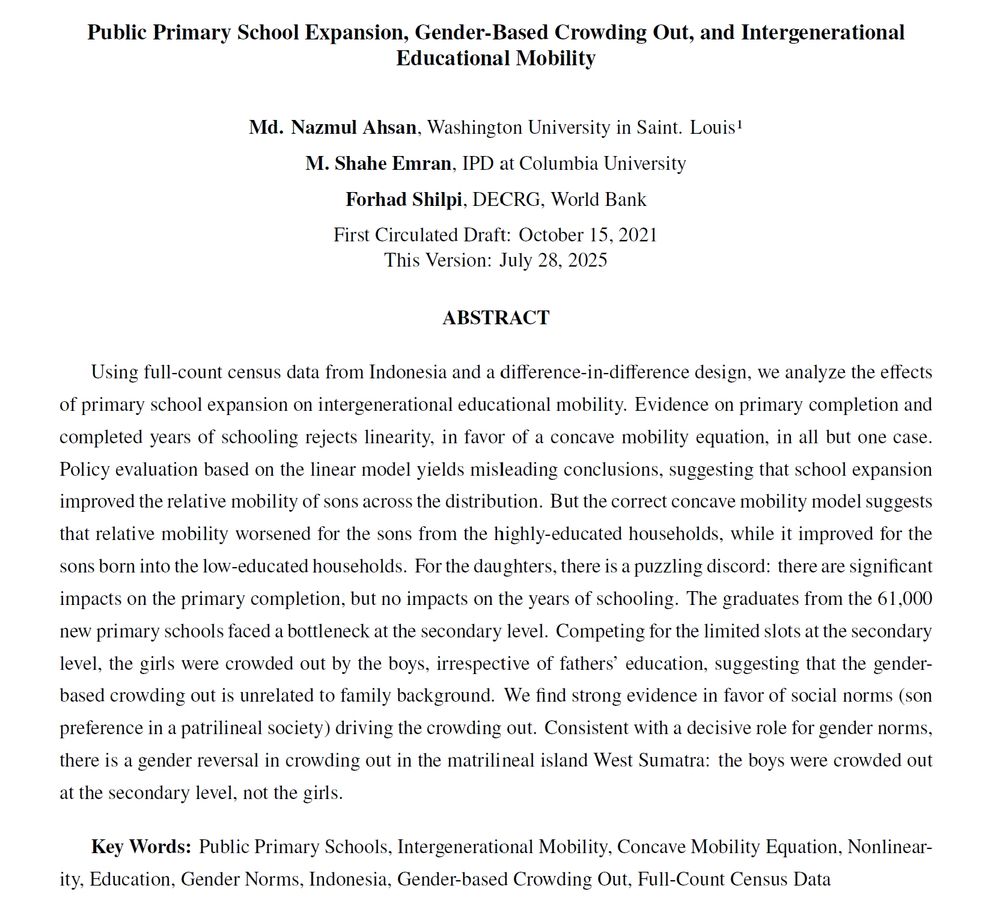
Does large-scale public primary school construction improve educational mobility in developing countries? No credible evidence on this. We estimate the effects of 61k primary schools in Indonesia. Short answer: improved mobility for disadvantaged sons, but not for daughters. Why? #Econsky
03.08.2025 04:34
👍 8
🔁 4
💬 1
📌 0

𝗔𝗻𝗻𝗮 𝗦𝘁𝗮𝗻𝘀𝗯𝘂𝗿𝘆 (𝗠𝗜𝗧) [ annastansbury.bsky.social ] will present on June 20, 2025. #EconSky Join us!
Title: 𝗧𝗵𝗲 𝗖𝗹𝗮𝘀𝘀 𝗚𝗮𝗽 𝗶𝗻 𝗖𝗮𝗿𝗲𝗲𝗿 𝗣𝗿𝗼𝗴𝗿𝗲𝘀𝘀𝗶𝗼𝗻: 𝗘𝘃𝗶𝗱𝗲𝗻𝗰𝗲 𝗳𝗿𝗼𝗺 𝗔𝗰𝗮𝗱𝗲𝗺𝗶𝗮
Time: 𝟭𝟬 𝗔𝗠 𝗘𝗦𝗧 || 𝟰 𝗣𝗠 𝗖𝗘𝗧 || 𝟭𝟬 𝗣𝗠 𝗖𝗵𝗶𝗻𝗮
Registration: 👉https://sites.google.com/view/rnim-seminar/home?authuser=0
👇Abstract:
16.06.2025 17:47
👍 2
🔁 1
💬 0
📌 0
📢 𝗔𝗻𝗻𝗮 𝗦𝘁𝗮𝗻𝘀𝗯𝘂𝗿𝘆 (𝗠𝗜𝗧) will present on June 20, 2025. Please join the seminar!
Title: 𝗧𝗵𝗲 𝗖𝗹𝗮𝘀𝘀 𝗚𝗮𝗽 𝗶𝗻 𝗖𝗮𝗿𝗲𝗲𝗿 𝗣𝗿𝗼𝗴𝗿𝗲𝘀𝘀𝗶𝗼𝗻: 𝗘𝘃𝗶𝗱𝗲𝗻𝗰𝗲 𝗳𝗿𝗼𝗺 𝗔𝗰𝗮𝗱𝗲𝗺𝗶𝗮
Time: 𝟭𝟬 𝗔𝗠 𝗘𝗦𝗧 || 𝟰 𝗣𝗠 𝗖𝗘𝗧 || 𝟭𝟬 𝗣𝗠 𝗖𝗵𝗶𝗻𝗮
Registration: 👉https://sites.google.com/view/rnim-seminar/home?authuser=0
👇Abstract:
14.06.2025 22:44
👍 2
🔁 1
💬 0
📌 0

The standard measures of intergenerational mobility do not account for risk. We develop a broader approach where conditional variance of children's outcome is a summary statistic for life-time risks. Conditional variance of children's schooling declines with father's education. We derive risk-adjusted measures of educational mobility by accounting for the risk premium implied by conditional variance. Estimates of risk-adjusted mobility in China, India, and Indonesia suggest that the standard measures overestimate relative and absolute educational mobility. The overestimation is substantial for the disadvantaged children and daughters, but negligible for the children of college-educated fathers.
📢 Join the RNIM Seminar on May 23 to learn about Dr. Forhad Shilpi's latest research on Intergenerational Mobility.
Title: Opportunity and Risk
Time: 10 AM EST || 4 PM CET || 10 PM China
Registration: 👉 sites.google.com/view/rnim-se...
Abstract:👇
21.05.2025 14:58
👍 3
🔁 2
💬 0
📌 0

RNIM Seminar
The Research Network on Intergenerational Mobility (RNIM) is an initiative by scholars working on intergenerational mobility. The aim of the network is to provide a platform for both senior and junior...
📢 Announcing a virtual seminar on May 23 at 10 AM (EST). Dr. Forhad Shilpi (DRG,World Bank) will present her latest research paper, 'Opportunity and Risk.' All are welcome!
Register here:👉 sites.google.com/view/rnim-se...
#Intergenerational-Mobility #Academic #Seminar #Economics #Sociology
20.05.2025 03:50
👍 5
🔁 3
💬 0
📌 0

🚀 Excited to share that our paper, "𝗠𝗮𝗸𝗶𝗻𝗴 𝘁𝗵𝗲 𝗠𝗼𝘀𝘁 𝗼𝗳 𝗖𝗼𝗿𝗲𝘀𝗶𝗱𝗲𝗻𝘁 𝗗𝗮𝘁𝗮: 𝗖𝗿𝗲𝗱𝗶𝗯𝗹𝗲 𝗘𝘃𝗶𝗱𝗲𝗻𝗰𝗲 𝗼𝗻 𝗜𝗻𝘁𝗲𝗿𝗴𝗲𝗻𝗲𝗿𝗮𝘁𝗶𝗼𝗻𝗮𝗹 𝗠𝗼𝗯𝗶𝗹𝗶𝘁𝘆 𝘄𝗶𝘁𝗵 𝗦𝗶𝗯𝗹𝗶𝗻𝗴 𝗖𝗼𝗿𝗿𝗲𝗹𝗮𝘁𝗶𝗼𝗻," is now officially published in the 𝙅𝙤𝙪𝙧𝙣𝙖𝙡 𝙤𝙛 𝘿𝙚𝙫𝙚𝙡𝙤𝙥𝙢𝙚𝙣𝙩 𝙀𝙘𝙤𝙣𝙤𝙢𝙞𝙘𝙨 with 𝘖𝘱𝘦𝘯 𝘈𝘤𝘤𝘦𝘴𝘴! 📚🌍
Link 👉: doi.org/10.1016/j.jd...
23.04.2025 14:27
👍 9
🔁 5
💬 1
📌 0