NSF GRFP applicants (and mentors): Was your application Returned Without Review and deemed ineligible despite fitting in the allowed topics?
1) Write NSF
2) Write your Congressperson
3) CC us at grfp@grant-witness.us so we can compile + follow up
Details and template at grant-witness.us/grfp-letter
02.02.2026 17:58
👍 159
🔁 199
💬 6
📌 17

Genetic Data From Over 20,000 U.S. Children Misused for ‘Race Science’
The New York Times reports that a group of “scientific” racists misused National Institute of Health data (that families were assured would be protected) to write bogus papers on supposed to biological racial differences. Gift link.
24.01.2026 15:15
👍 432
🔁 226
💬 10
📌 28

Exclusive: key NIH review panels due to lose all members by the end of 2026
Thirteen of the agency’s advisory councils, which must review grant applications before funding is awarded, are on track to have no voting members.
🚨 New from me: Grant review at more than half of NIH's institutes could be frozen by the end of the year.
That's because crucial NIH grant-review panels are slated to be empty at those institutes by Jan 2027.
A wonky bureaucratic problem with big implications.
A short 🧵
22.01.2026 19:46
👍 322
🔁 259
💬 2
📌 36
⚡ this project was powered by many brilliant undergrads over the years, most notably Sachin Allums, Mercedes Muñoz, Natalie Sarmiento, and Kamilah Cole. thanks to these folks for pushing the science along! (/end)
03.12.2025 21:48
👍 1
🔁 1
💬 0
📌 0
this project started in 2020 during George Floyd, when my friend Nicky and I wanted causal evidence to inform media claims about how (white) parents should talk to their kids about race. science is slow & US political context has changed a lot, but even more important to talk to kids about race
03.12.2025 21:48
👍 2
🔁 0
💬 1
📌 0

bar plot titled "Open-ended explanation: Why do you think the dotted kids didn't do well on their reading tests?", with condition on x-axis (colorblind, no explanation, or structural), and colors indicating explanation (intrinsic, mixed, extrinsic, or other). Intrinsic explanations are the overwhelming majority of explanations in colorblind and no explanation conditions, while extrinsic explanations predominate in the structural condition
in contrast, giving children an explanation about differential resource access caused children to attribute the disparity to structural factors, both in their explanations for the disparity and their interventions to fix the disparity! (3/5)
03.12.2025 21:48
👍 0
🔁 0
💬 1
📌 0

7- to 9-year-olds watch a conversation between a parent and child reading a book about a novel academic achievement disparity. left side shows a page from a book with striped aliens with lots of stars and dotted aliens with few stars. a speech bubble above the page, labeled child asks a question: "Why aren't the dotted kids doing well on the reading test?" right side shows parent responds with either no explanation ("I'm not sure..."), colorblind messaging (..."whether you're dotted or striped is not important...", or structural explanation (..."they have fewer books than the striped kids...")
after giving 7-10yo one of these messages about a fictional achievement disparity 🏫, we found that children attributed the disparity to groups' intrinsic capacities (their abilities, or work ethic), which could support stereotypes... (2/5)
03.12.2025 21:48
👍 0
🔁 0
💬 1
📌 0
congrats tyler!!!
26.11.2025 16:37
👍 1
🔁 0
💬 1
📌 0
Another ~monthly update on the state of the #psychjobs market: more jobs continue to trickle in, though at a decreasing pace. We've nearly hit parity with covid in absolute terms, although the prior year baseline was higher this year than that, so we still see a slightly larger relative decrease.
04.11.2025 18:54
👍 24
🔁 6
💬 0
📌 0

Scientists had to change more than 700 grant titles to receive NIH funding. Health disparities researchers fear what’s next
The titles of more than 700 multi-year NIH grants have been changed this year, according to an analysis by Jeremy Berg, a former agency official
Absolutely chilling story by @aniloza.bsky.social on censorship in grant titles at NIH and how researchers are complying and sometimes fighting back. "They are trying to make people afraid to use the word equity," said one program officer. "It's highly effective." www.statnews.com/2025/10/29/n...
29.10.2025 13:35
👍 86
🔁 43
💬 4
📌 4
this is also difficult for PhD programs at institutions on the quarter system, where first-year students have only 3 weeks to get to know their advisor, settle in, and submit a proposal on the typical GRFP timeline! (most wait for 2nd year)
27.09.2025 07:38
👍 0
🔁 0
💬 0
📌 0

This means individuals in the following statuses at the time of application are eligible:
Undergraduate in the final (senior) year of a bachelor’s degree program
Bachelor’s degree-holder with NO enrollment in a graduate degree program (non-degree graduate coursework allowed)
Individual enrolled in a joint bachelor’s-master’s degree program with at least three undergraduate years completed
First-year graduate student in their first graduate degree program with less than one academic year completed in the degree program (according to institution’s academic calendar)
Individuals enrolled in joint bachelor’s-master’s degree programs are considered graduate students. For GRFP, joint bachelor’s-master’s degrees are defined as degrees concurrently pursued and awarded.
Not be a current NSF employee.
Applications that do not meet eligibility requirements will be returned without review as being ineligible for a fellowship.
Announcing such a major change to NSF GRFP this late in the cycle is incredibly cruel. 2nd yr students (mine included) have been working so hard on their proposals despite ongoing uncertainty. They are driven and passionate about being outstanding scientists and helping those coming up behind them.
26.09.2025 17:46
👍 163
🔁 77
💬 7
📌 11
Presidential Postdoctoral Research Fellows
We encourage early career scholars to pursue a career in academia by supporting their postdoctoral work at Princeton
Princeton is running its Presidential Postdoctoral Program again this year. If you are interested in applying to work with me, please reach out by October 10 so that I can consider all interested applicants and support a candidate for my lab this year.
dof.princeton.edu/faculty-deve...
11.09.2025 20:27
👍 15
🔁 18
💬 0
📌 0

The Court finds that it likely lacks jurisdiction over Plaintiffs’ retrospective APA claims,
so it must deny Plaintiffs’ motion for preliminary relief as to those claims. In analyzing Plaintiffs’
remaining claims, the Court concludes that Plaintiffs have failed to show irreparable harm flowing
from their prospective APA claims and have not shown a likelihood of success on the merits of
their constitutional claims. As a result, the Court will deny Plaintiffs’ motion for a preliminary
injunction without considering the other preliminary injunction factors.
Accordingly, Plaintiffs’ Motion for a Preliminary Injunction, ECF 3, is DENIED. A
separate order accompanies this memorandum opinion.
New: A legal challenge to NSF's 1600+ grant terminations just hit a roadblock. Judge Cobb (appointed by Biden) ruled against the plaintiffs, largely on the basis that district courts no longer have jurisdiction for contract-based APA violations. storage.courtlistener.com/recap/gov.us...
10.09.2025 23:51
👍 11
🔁 3
💬 1
📌 0

Flyer How to apply to the NSF-GRFP (in 7 weeks!). Check out our comprehensive guide and timeline for applying to the NSF-GRFP (or any fellowship!) on a deadline.
Give it a shot — it’s not too late! Resource by Olivia Goldman, PhD and John Lê. Photos of authors. Cientifico Latino, Inc. logo. Link: cientificolatino.com/apply-in-7-weeks
Applying to the NSF-GRFP (or another fellowship) on a tight deadline?
We built a 7-week guide + timeline to get you from draft to submission. It’s not too late — you’ve got this! ✨
🔗 cientificolatino.com/apply-in-7-weeks
#NSFGRFP #GradSchool #Fellowship
09.09.2025 16:14
👍 64
🔁 65
💬 0
📌 3
not sure, but if I had to guess, maybe they're archiving it so they can make changes and post a new solicitation, based on new agency priorities/budget?
20.08.2025 14:33
👍 1
🔁 0
💬 0
📌 0
this happened to a friend of mine who applied for a postdoc fellowship too! heartbreaking
20.08.2025 14:08
👍 1
🔁 0
💬 0
📌 0

Improving Oversight of Federal Grantmaking
By the authority vested in me as President by the Constitution and the laws of the United States of America, and to improve the process of Federal
1. Federal funding for research promotes tech, biomedical, and scientific discovery in the US, and provides training for the sci/tech workforce that has brought immeasurable wealth to the US over the past 75 years.
Today's executive order includes a provision that will obliterate both functions.
08.08.2025 01:13
👍 1004
🔁 543
💬 25
📌 76
I think the effect of generics ends up being mostly in the semantics but there's also a lot of feature variability, which we're digging into in future work!
31.07.2025 21:18
👍 1
🔁 0
💬 0
📌 0
I noticed that too - overall the literal listener only does a bit better than null, but for the generics condition specifically, it does quite a bit better (the orange dot is much closer to the diagonal)!
31.07.2025 21:18
👍 0
🔁 0
💬 1
📌 0
the effect of generics is a replication of prior work, but the effect of specifics wasn't obvious to us! specifics could have increased inductive potential, particularly when they invoke the category label ("This Zarpie...."), or could have had no effect since they aren't explicitly about categories
31.07.2025 21:16
👍 0
🔁 0
💬 0
📌 0
yes other aspects of a category could matter too! it's interesting though that in our study language changes how coherent we think the same social category is. language also shapes whether we think of a category as more inherent/transient (eg "carrot eater" vs "people who eat carrots")
31.07.2025 21:13
👍 1
🔁 0
💬 1
📌 0
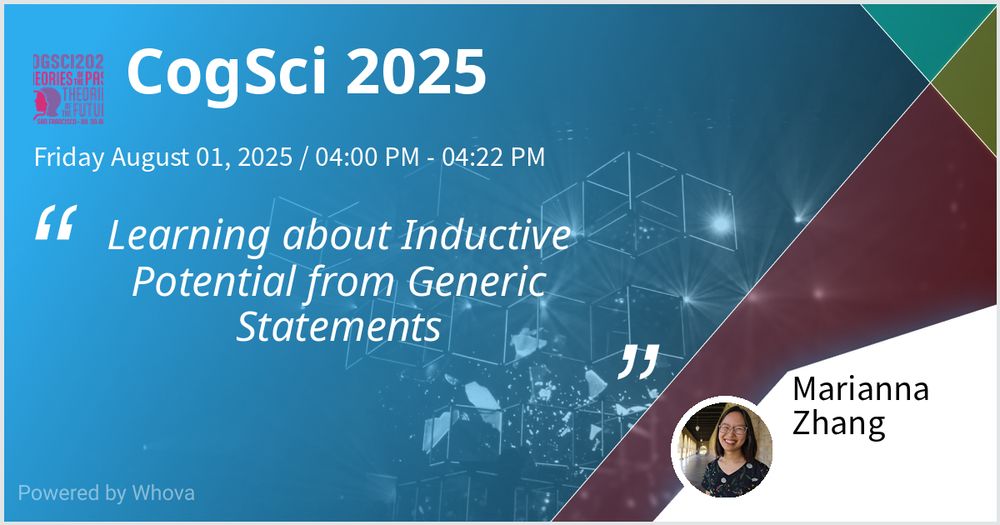
blue banner reading CogSci 2025, Friday August 1, 2025 4-4:22pm, with large text "Learning about Inductive Potential from Generic Statements" with a picture and icon of Marianna Zhang in the bottom right
this project was a fun intro to computational modeling 🤖 for me & a dream collab w/ @markkho.bsky.social, @marjorierhodes.bsky.social & Sarah-Jane Leslie! learn more at our 🧑🏫 #CogSci2025 talk this Fri 4pm (Language and Computation 3) or 📄 proceedings paper escholarship.org/uc/item/2rs3...
31.07.2025 06:10
👍 7
🔁 1
💬 0
📌 0

three scatterplots each plotting prevalence (model) on x-axis, prevalence (data) on y-axis. scatterplots left to right: null model (reasoning about individuals and features only), literal listener (reasoning about categories and literal meaning of generics), pragmatic listener (reasoning about categories and what the speaker meant). in the null model plot, the dots are all in the same vertical line, with generics and specifics being off the diagonal. in the literal listener plot, the orange dot (generics) is brought onto the diagonal. in the pragmatic listener plot, the blue dot (specifics) is also brought onto the diagonal. the r^2 increases with each plot.
capturing the effect of generics requires a semantic understanding of how generics are related to categories 🐯, while the effect of specifics requires pragmatic reasoning 🤔(speaker could have said a generic but chose to say a specific)! (5/6)
31.07.2025 06:10
👍 4
🔁 0
💬 1
📌 0

text on left says "adults generalized a novel feature more after hearing generics, and less after hearing specifics". plot on the right shows with generic, baseline, specific on the x-axis and prevalence on the y-axis. small transparent dots indicate participant and trial level responses, large dots with bars indicate means with 95% CIs. generic is higher than baseline which is higher than specific.
our model predicts that learners generalize a novel feature of a category member 🐯 to other members 🐅 *more* after hearing generics about the category, and *less* after hearing specifics. both were confirmed by adults learning about a novel social category! (4/6)
31.07.2025 06:10
👍 7
🔁 0
💬 2
📌 0

a conversation between an adult and a child on the left side of the screen, with a tiger on the savanna in the background labelled "context". a speech bubble above the adult says "Tigers roar". a thought bubble above the child reads "tiger representation" and contains "coherence = ?" with arrow pointing to a set containing "roaring". on the right, a graphical model with category coherence pointing to category-linked features pointing to informative speaker. speaker and individual point to utterance. individual and utterance are observed (grayed) nodes.
in our model, a learner learns about a category's coherence and linked features by reasoning about what a speaker meant to communicate about the latter. (coherence = our formalization of inductive potential, an overhypothesis about a feature of an individual being category-linked) (3/6)
31.07.2025 06:10
👍 3
🔁 0
💬 1
📌 0