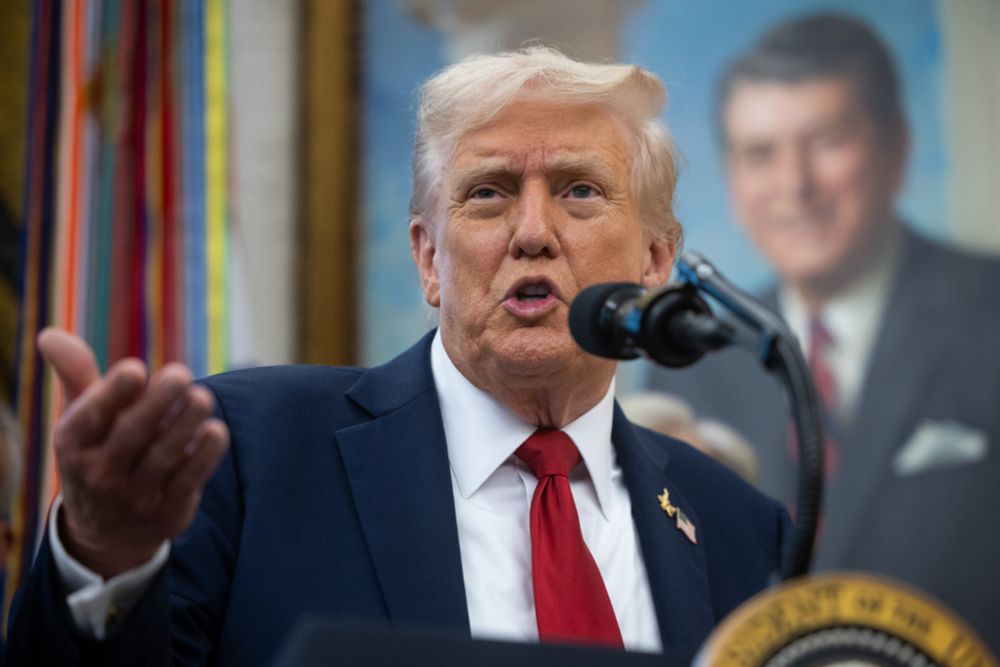
‘Amazing meeting’: Trump touts progress on multiple fronts with China after meeting Xi
The president said the meeting with the Chinese leader exceeded expectations, and he lowered the tariff rate.
"Trump said he got a commitment from Xi to purchase soybeans from American farmers, curb the flow of fentanyl and postpone its export restrictions on rare earths" But that TikTok "deal" remains in limbo.... www.politico.com/news/2025/10...
30.10.2025 11:06
👍 11
🔁 5
💬 5
📌 0

America’s Soybean Farmers Are Panicking Over the Loss of Chinese Buyers
China, the world’s biggest soybean buyer, hasn’t booked any U.S. soybean purchases in months. Farmers warn of a “bloodbath.”
America’s Soybean Farmers Are Panicking Over Loss of Chinese Buyers
* China hasn’t booked any U.S. soybean purchases in months
* Without a deal soon, one farmer warns of “a bloodbath”
* The economics are bad enough that some farmers are already calling it quits
www.wsj.com/economy/trad...
07.10.2025 23:49
👍 40
🔁 16
💬 9
📌 1


"A Country-Specific View of Tariffs" via @NewYorkFed libertystreeteconomics.newyorkfed.org/2025/10/a-co...
"the bulk of cross-country differences in tariff rates is explained by two factors: the U.S.-Canada-Mexico free trade agreement and differing sales shares in tariff-exempt categories"
07.10.2025 11:45
👍 4
🔁 2
💬 0
📌 1

Impact of Trump tariffs is beginning to show in US consumer prices
Trade levies are starting to drive up costs for goods from cans of soup to car parts
Tariff impact beginning to show in prices
⚡Citigroup estimates firms have eaten 60% of tariff cost, but that will flip to 40%, with rest paid by consumers
⚡AutoZone tells investors customers will be willing to pay it, since cars won't start without needed parts
www.ft.com/content/f4bd...
06.10.2025 14:52
👍 6
🔁 1
💬 1
📌 0

Both countries prioritize semiconductors, information tech, aviation, and nuclear energy.
Japan's bills never mention China directly and focus on resource scarcity.
US bills name China as a threat, and securitize things like TikTok with tenuous national security links.
08.10.2025 14:36
👍 0
🔁 0
💬 0
📌 0

Japan took a different path: fewer bills, tighter focus.
The 2022 ESPA law created a framework to securitize 11 materials based on criteria like supply chain vulnerability and everyday necessity. Budget: <$10B.
Compare that to the US CHIPS Act alone: >$50B.
08.10.2025 14:36
👍 0
🔁 0
💬 0
📌 0

From 2018-2024, US lawmakers introduced 166 "tough on China" bills (mostly Republican-authored).
Only 9 became law.
But in 2023 alone, proposals increased tenfold, signaling sharp acceleration in legislative appetite for restrictions.
08.10.2025 14:35
👍 0
🔁 0
💬 0
📌 0

The Politics of De-Risking
As Washington and Tokyo tighten controls on trade with China, their approaches reveal both shared anxieties and strikingly different priorities.
How are the US and Japan de-risking with China?
Despite targeting many of the same sectors, their approaches reveal fundamentally different priorities.
A thread on what the legislative data shows: 🧵
www.tradewarlab.com/p/the-politi...
08.10.2025 14:34
👍 1
🔁 0
💬 3
📌 0

By Supporters' Own Standards, the Steel Tariffs Haven't Been "Effective"
Commerce Secretary Gina Raimondo’s misplaced agreement with Trump’s tariffs.
The Trump administration already put Section 232 tariffs on automobiles and parts, copper, steel and aluminum. Have they worked?
No. These tariffs have created few US jobs while increasing costs for many US consumers & producers that use these inputs.
www.cato.org/blog/no-secr...
25.09.2025 13:07
👍 0
🔁 0
💬 0
📌 0

Who is paying for Trump's tariffs? So far, it's US businesses.
President Donald Trump promised during his recent campaign to impose steep tariffs on other countries, assuring voters that the cost would be paid by foreign sellers, not Americans. In September 2024,...
NEW: Data suggest US businesses have absorbed most of the tariff costs through July 2025, not foreign sellers.
There is very little support for Trump’s thesis that foreign sellers are absorbing tariffs by lowering their prices on US imports.
More:
16.09.2025 15:48
👍 5
🔁 8
💬 1
📌 0

China’s Strategic Advances in the Global Economy
Ka Zeng discusses China’s role in the global economy amid economic competition with the U.S.
How is China reshaping the global economic order?
Ka Zeng (@umassamherst.bsky.social) discusses China’s role in the global economy amid economic competition with the U.S.
▶️ Watch: https://www.ncuscr.org/video/china-global-economy/
05.09.2025 20:05
👍 1
🔁 1
💬 0
📌 0

From groceries to energy bills, Trump's tariffs and economic chaos are increasing costs for Americans.
15.09.2025 22:27
👍 156
🔁 50
💬 25
📌 6
But the evidence shows broad tariffs have not succeeded in restoring lost industries. Instead, they raise costs.
The 2018 washing machine tariffs raised washer/dryer prices by about 12%, adding $1.55B annually for consumers, while creating jobs at an estimated cost of over $800,000 each per year.
17.09.2025 15:53
👍 0
🔁 0
💬 0
📌 0
The move reflects real grievances.
NAFTA brought concentrated regional job losses and the China Shock caused widespread & concentrated labor market disruption.
But research also finds that trade openness enhances 🇺🇸 economic strength by supporting growth, higher incomes, and innovation.
17.09.2025 15:51
👍 0
🔁 0
💬 1
📌 0

Why Farmers Kept Planting Crops China Wouldn’t Buy
How partisan loyalty shaped farmers’ planting decisions during the U.S.–China trade war.
During Trump’s first trade war (2018–2020), China hit U.S. farmers with tariffs on soybeans and other crops. Exports collapsed. Prices fell.
Logic says farmers should’ve shifted away. Many didn’t. Some even planted more. Why? 👇
www.tradewarlab.com/p/why-farmer...
04.09.2025 01:51
👍 3
🔁 1
💬 2
📌 0

Assessing the Costs of America’s Protectionist Turn
Tracing back trade expansion
America’s protectionist turn has accelerated at historic speed.
Tariffs now average 15.8%, the steepest rise since the 1930s, surpassing even Smoot-Hawley
We review the #economics literature to understand the causes & consequences of the free trade backlash!
www.tradewarlab.com/p/assessing-...
17.09.2025 15:47
👍 2
🔁 0
💬 1
📌 0
Today Trump’s “Liberation Day” IEEPA tariffs extend this dynamic, targeting an even broader set of countries.
As the executive branch increasingly picks trade winners and losers, lobbying is set to remain a central element corporate strategy for those that can afford it.
11.09.2025 04:21
👍 0
🔁 0
💬 0
📌 0

Our data also show lobbying becoming more China-focused over time, interest in China surged as firms sought tariff exclusions.
After dipping in 2020 due to the Phase One Trade Deal & COVID, it surged again under Biden as firms sought to shape semiconductor subsidies and regional trade frameworks.
11.09.2025 04:11
👍 1
🔁 0
💬 1
📌 0

The numbers are striking: in 2016, only 482 firms lobbied USTR on trade issues.
By 2018—after Trump’s Section 232 and 301 tariffs on $370B of Chinese goods—that figure jumped to 698 firms.
Lobbying expenditures rose 37.5% from 2016–2019, peaking at at $1.1B.
11.09.2025 04:06
👍 1
🔁 0
💬 1
📌 0

How Corporate Influence Reacts to U.S.–China Trade Policy
New Trade War Lab data sheds light on how American firms are lobbying the USTR.
Corporate influence has quietly become a defining feature of US–China trade tensions.
Trade War Lab data shows that as tariffs uncertainty & industrial policy mounted American firms dramatically expanded their lobbying of the US Trade Representative (USTR).
www.tradewarlab.com/p/how-corpor...
11.09.2025 04:05
👍 3
🔁 0
💬 1
📌 0

Tariffs can’t bend the laws of nature. Bananas need tropics, coffee needs altitude. You can't onshore these things. So tariffs just raise prices. The White House just worked this out.
So we're getting carveouts. But only if you do a deal with the White House.
www.whitehouse.gov/fact-sheets/...
07.09.2025 17:56
👍 829
🔁 311
💬 81
📌 20
On the latest “When Experts Attack!” episode, @universityofkansas.bsky.social trade law expert Raj Bhala addresses “the greatest disruption in trade since the end of World War II,” including what tariffs mean for Canada. Listen and subscribe.
whenexpertsattack.libsyn.com/trumps-trade...
03.09.2025 17:32
👍 1
🔁 1
💬 0
📌 0

Please, don’t abandon the World Trade Organization
Michael Froman, former U.S. trade representative and current president of the Council on Foreign Relations, has called for the abandonment of the rule-based international trading system overseen by…
Strong trade keeps peace strong. "Commercial wars always present the possibility of turning into shooting wars. That is one of the main reasons we created first the General Agreement on Tariffs and Trade and its institutional successor, the WTO, in the first place". Read more from James Bacchus ⬇️
02.09.2025 21:40
👍 15
🔁 7
💬 0
📌 0

Trump's tariff revenue tracker: How much is the US collecting? Which imports are hit?
President Trump’s tariffs are raising government revenues, but how much is the US Treasury actually collecting from US importers after the starts, stops, delays, exclusions, & other factors? And what products & countries are hit? We explore: https://bit.ly/45QWyPc
28.08.2025 18:38
👍 3
🔁 1
💬 0
📌 1