

“Uncertainty is a tax without revenue.” Powerful insight from Markus Brunnermeier today @piie.com
24.04.2025 17:47
👍 38
🔁 8
💬 2
📌 0
“Uncertainty is a tax without revenue.” Powerful insight from Markus Brunnermeier today @piie.com
I don't think people realize that in important respects tariffs are now higher & more inflationary than what was announced on last Wednesday.
Since then we've gone from 54% to 125% on China, our 3rd largest trading partner. That outweighs delaying the increases on 70+ others.

Cool to be cited in @cnn.com on Chips and Tariffs!
Nice to be able to post the link w/o penalty...
CNN story here: www.cnn.com/2025/04/08/b...
and data deep dive incl whether tariffs can reshore chip mfg (not as much as CHIPS and with massive collateral damage) www.piie.com/blogs/realti...
The order shows the hawkish bureaucracy is still full steam ahead despite Trump's positive statements abt US and China investing in each other. Interestingly, Russia is also listed as an "adversary" for investment curbs, not sure how aligned the President is with his own order! /Fin

4/the good news is that they promise to create a "fast track" for allied investment (only if they can show independence from CN), a big deal because the current "excepted foreign investor" process does not work. US allies face way more CFIUS reviews than Chinese today!
It creates uncertainty for investors in both directions US/CN, considering revoking a double taxation treaty, reviewing VIE structure CN firms use to list in the US, and an audit deal that allows CN firms to stay listed on US stock exchanges
2/The Order directs Treasury to restrict more CN investment into the US & add to sectors where US investing in China is off limits. Biggest deal--exploring whether to give CFIUS power to block CN greenfield investment in the US. Would require congress, and hard to implement

Just out! My piece on Trump's America First Investment executive order which has bad news for China but could finally give allies badly needed relief on security reviews. A short thread of what's in there and what it means 1/
www.piie.com/blogs/realti...

Here is the video of yesterday's discussion featuring our second fellowship cohort’s Trade & Competitiveness team @chorzempa.bsky.social, @zoe-liu.bsky.social & Huan Zhu presenting their working papers (global.upenn.edu/future-of-us...), expertly moderated by Mark Wu: www.youtube.com/watch?v=SU-C...
On Lutnick saying tariffs would have prevented DeepSeek breakthrough: If you have a hammer everything looks like a nail, but if you don’t have any nails then all your hammer does is break stuff. Lot of policy areas, including AI, where there are no nails for the tariff hammer.
Trumpism will cede global leadership to China in multiple areas because most other countries and institutions would prefer to deal with a lawful evil system than a chaotic evil one.
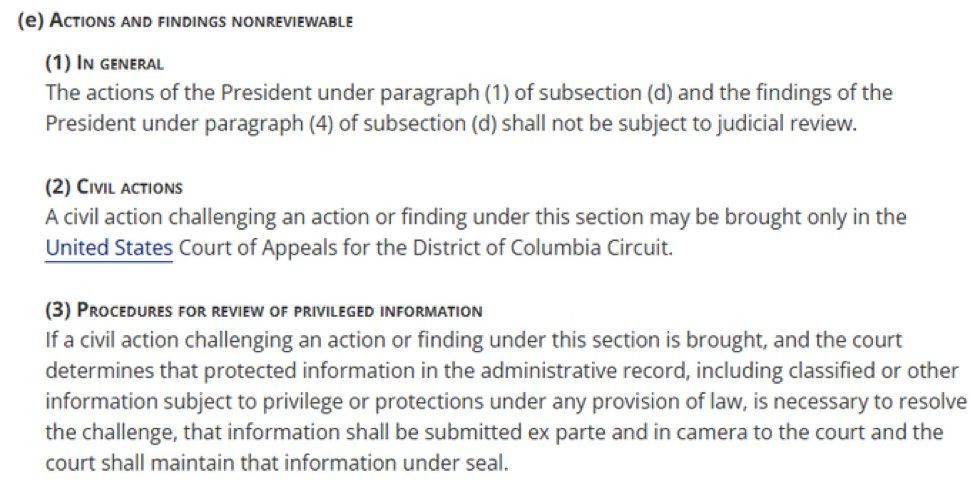
And the decision is unfortunately by law essentially immune from court challenge (see statute below). As “national security” gets stretched, would be good to see increased scrutiny from courts on these claims.
What is the counter factual on legacy investment here without controls? How much of this would have been directed to the cutting edge versus allocated to a different sector, and what would there be for a different outcome if it were cutting edge?

FBI reveals more information about the latest wave of Chinese cyber attacks that targeted U.S. telecoms and ISPs www.cybersecuritydive.com/news/china-l...
They are having a major impact overall but uneven in terms of effectiveness. Not just exemptions and loopholes—enforcement budgets are super tight so it’s hard to work around sophisticated circumvention efforts by Chinese actors
New piece and event launch!
Want to know what it means to hit China's chip ambitions by putting 140 CN firms on the "entity list" this week? What do sanctions do? Our new brief
@piie.com documents the rise of economic sanctions against China, with many surprises: a 🧵 1/n
9/what is coming under second Trump admin? Probably even more of these sanctions combined with further claims of jurisdiction to police transactions outside US borders with tools first Trump and then Biden expanded. China is also retaliating more boldly. Will be a wild ride. /fin
8/n Most US actions here are unilateral, but most sanctions are ineffective without partners. Better cost/benefit analysis w/econ component, including based on kind of work in this brief, would help convince allies it is worth the cost to work with us.
7/n Other issue is redress--what if firm listed b/c is wrongly accused of action harming US interests? It's almost impossible to challenge entity listing, but CN firms have challenged military company designations, and one case US judge found them "arbitrary and capricious"
6/n Our results show how the US under both Trump and Biden has kept the harshest sanctions on big CN targets on the table for worst case scenarios, avoiding major escalation with China and severe repercussions on US firms and allies

5/n US also used dreaded financial sanctions on CN which cut target off from all USD transactions. But not a single major CN tech firm is on the list. Instead sanctions mostly target CN firms involved in helping OTHER countries US targets (Russia, Iran, or WMD proliferation).
4/n We show that the US has put key Chinese tech firms on the entity list, due to US concerns on on CN military modernization but also human rights and surveillance. This list requires listing every subsidiary to be cut off, meaning Huawei for example is on the list 149 times!

3/n Our dataset shows first Trump admin sanctioned 4x more CN entities in 4 years than prev 16 years combined. Biden admin did even more! Chart shows the rise of a key tool, the "entity list" cutting targeted CN entities off of US exports/tech.
2/n Get the brief here piie.com/publications..., launch event is virtual tomorrow at 11a ET, please register here: piie.com/events/2024/.... Now for findings:
New piece and event launch!
Want to know what it means to hit China's chip ambitions by putting 140 CN firms on the "entity list" this week? What do sanctions do? Our new brief
@piie.com documents the rise of economic sanctions against China, with many surprises: a 🧵 1/n
If you asked what Trump's USTR, Jamieson Greer, will do to US trade policy, and specifically China, thankfully he outlined his ideas in good detail a few months ago.
It's full-on decoupling: revocation of PNTR (varying tariffs on all Chinese imports), defensive tools, and lots of industrial policy.
If Huawei creates a bunch of subsidiaries/partners to get around restrictions, listing them to cut them off too would be standard practice and not necessarily escalation. Expansion to hbm and extraterritorial fdpr more important as policy change

Brainard is right about the risks of sweeping, poorly designed trade barriers. But the argument would be more powerful had Biden chosen not to keep 300$ billion of Trump's tariffs on products from Christmas lights to baby clothes we'll never manufacture in the US.
www.ft.com/content/182e...