
For more, go read the pre-print: arxiv.org/pdf/2512.17898
27.02.2026 21:32
👍 0
🔁 0
💬 0
📌 0
For more, go read the pre-print: arxiv.org/pdf/2512.17898

Finally, engagement ≠ Trust: While humanlike AI design boosts engagement, it doesn't always boost trust. The same chatbot features that built trust in somecountries (e.g., Brazil) actually reduced it in others (e.g., Japan).

We see pronounced geo-cultural differences in preferences and perceptions of anthropomorphism in AI!

We found that users are not pondering "is this AI sentient?" when evaluating an AI´s humanlikeness! They're noticing emojis, specific phrases, and conversation flow. We believe this calls for reframing how we research AI anthropomorphism. Focus on what users actually think and do

Excited that Aida will present our paper at @spspnews.bsky.social meeting tomorrow!
We studied 3,500 people across 10 countries on preferences, perceptions, and the impact of AI anthropomorphism!
Thanks to my brilliant coauthors @blahtino.bsky.social
Aida Davani, @vinodkpg.bsky.social ky.social

"The relationship between childhood exploration and population-level innovation in cultural evolution" with @ndersen.bsky.social @sheinalew.bsky.social @felixthehauskat.bsky.social out in Proc B
royalsocietypublishing.org/rspb/article...
Super proud of this paper with @apvelilla.bsky.social and @babeheim.bsky.social, now out in Psych Review.
Non-paywalled version (preprint) here: osf.io/preprints/so...

Picture of front cover of Theme Issue entitled "Transforming cultural evolution research and its application to global futures." The image on the front cover is of a Yao honey hunter in Mozambique holding retrieved honeycomb.
Today sees the publication of the Theme Issue featuring the CES Transformation Fund grant scheme. Enjoy! royalsocietypublishing.org/rstb/issue/3...
@durhamdcerc.bsky.social @durhamanthropology.bsky.social @cultevolfunding.bsky.social @culturalevolsoc.bsky.social
Policy applications, by @schimmelpfennig.bsky.social @michael.muthukrishna.com Charles Efferson and others
Chapter: academic.oup.com/edited-volum...
Paper: www.science.org/doi/10.1126/...
Congrats to all involved in the production of the massive Oxford Handbook of cultural evolution. You can read our paper The Cultural Evolution Of Science here: cailinoconnor.com/wp-content/u...

Excited to announce the first ACE Course Design Awards for excellent cultural education teaching. Those award winning classes will be placed in an open teaching repository for anyone looking to enhance cultural evolution content in their courses.
culturalevolutionsociety.org/news-and-eve...
We just spent 6 months to add 1 figure to this paper. Some people said, "Couples aren't prioritizing men's careers. Men just have better earnings opportunities when moving."
Earnings effects of moves for couples on the left, singles on the right. Negligible gap between single men and women.
If one man marries two women, another man must go unmarried, right? No. Demography matters. If sex ratios are skewed towards women, then polygyny can exist alongside universal marriage for men (who want to marry women). If only more people understood demography 😊
Thrilled that our paper on the mechanisms underlying social learning strategies is out! First big paper from my @erc.europa.eu & @kawresearch.bsky.social funded group. More to come! I'm currently looking to recruit two post docs, get in touch if you find this line of research interesting.

In this Correspondence, Dunivin and @psmaldino.bsky.social argue for greater user control of algorithms for scientific search, and explain why this will benefit both science and platforms alike.
www.nature.com/articles/s41...

Individual social identities indicate group affiliations and are typically associated with 3 group-typical preferences, signals that indicate group membership, and the propensity to condition actions on the social signals of others, resulting in group-differentiated interaction norms. Past work modeling identity signaling and coordination has typically assumed that individuals belong to one of a discrete set of groups. Yet individuals can simultaneously belong to multiple groups, which may be nested within larger groupings. Here, we introduce the generalized Bach or Stravinsky game, a coordination game with ordered preferences, which allows us to construct a model that captures the overlapping and hierarchical nature of social identity. Our model unifies several prior results into a single framework, including results related to coordination, minority disadvantage, and cross-cultural competence. Our model also allows agents to express complex social identities through multidimensional signaling, which we use to explore a variety of complex group structures. Our consideration of intersectional identities exposes flaws in naive measures of group structure, illustrating how empirical studies may overlook some social identities if they do not consider the behaviors that those identities function to afford.
New preprint w/ Nathan Gabriel & @avbell.bsky.social: The Evolution of Identity Signals for Coordination in Diverse Societies
The model tackles multiple nested/overlapping identities and complex signaling structure. Recovers lots of old results and adds several new ones osf.io/preprints/so...

💥New postdoc position! 💥
Join us to explore how people learn from each other—and how that drives cultural evolution.
Run experiments, build computational models & collaborate across Europe w. @lucasmolleman.bsky.social
📍 Stockholm
More info: shorturl.at/CY4wk
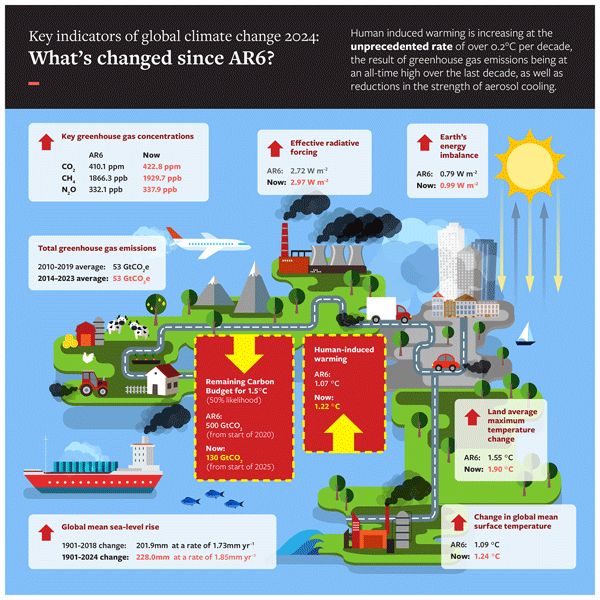
Our new paper updating key metrics in the IPCC is now out, and the news is grim:
⬆️ Human induced warming now at 1.36C
⬆️ Rate of warming now 0.27C / decade
⬆️ Sharp increase in Earth's energy imbalance
⬇️ Remaining 1.5C carbon budget only 130 GtCO2
essd.copernicus.org/...

New 2 year post-doc position on cultural adaptation in complex environmental management.
Ok, time for a short thread about this paper.
My sense over the past six months or so is that chain-of-thought prompting as used in e.g. ChatGPT o.3 improves substantially upon previous systems such as ChatGPT 4.o, at least for certain tasks.
But how revolutionary is it?
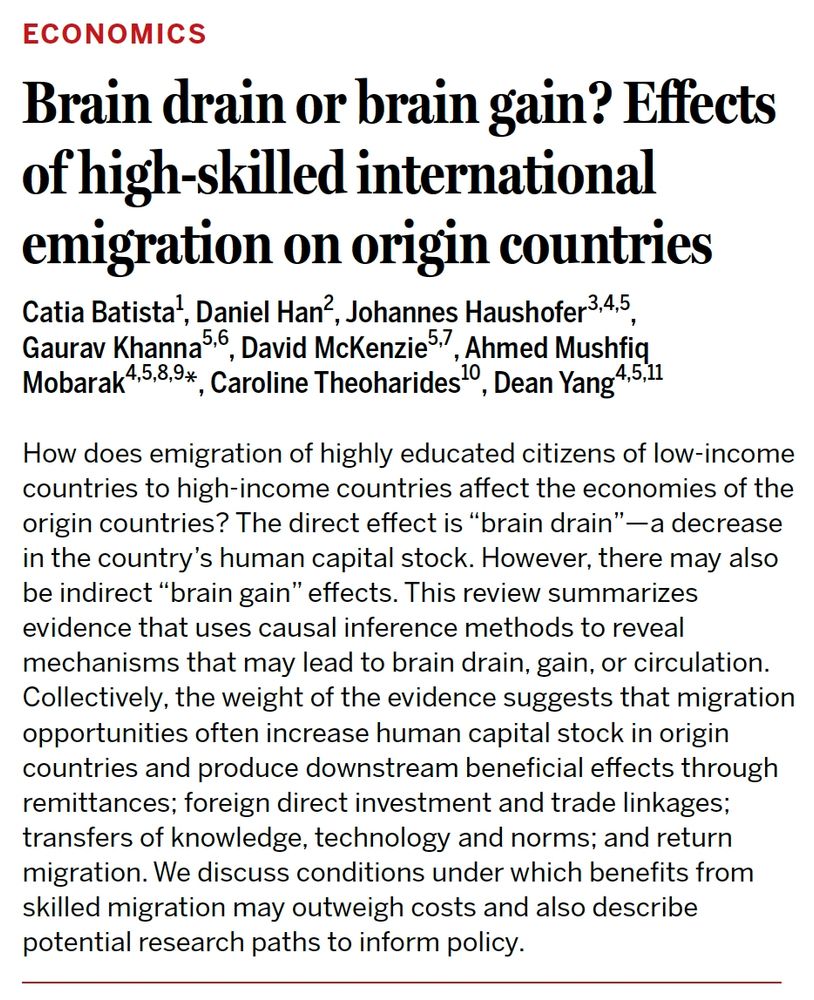
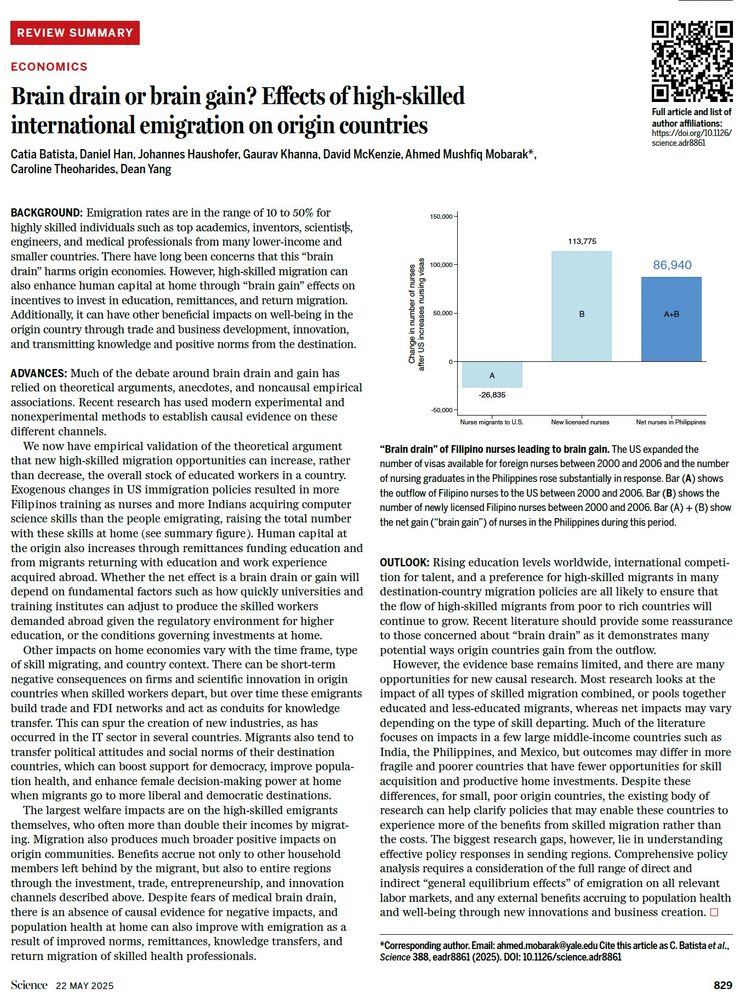
Is it "good" or "bad" when skilled people leave low-income countries? We summarized the evidence in favor of "brain gain" vs. "brain drain": www.science.org/doi/epdf/10....
Ungated PDF: johanneshaushofer.com/research
Grateful for the chance to share my thoughts on responsible use of LLMs in psychology research @spspnews.bsky.social #spsp2025. Here's a summary of my presentation for those who missed it. Thanks to @ashwinia.bsky.social for organizing this panel!
How should LLMs be used in psychology research? 🧵

The most achingly beautiful explanation of what science is, from @edyong209.bsky.social: “the idea that much of the world is hidden from us, that we don’t perceive it and don’t understand it, and that it is worth understanding and it is necessary to understand.”
www.nytimes.com/2025/02/22/m...
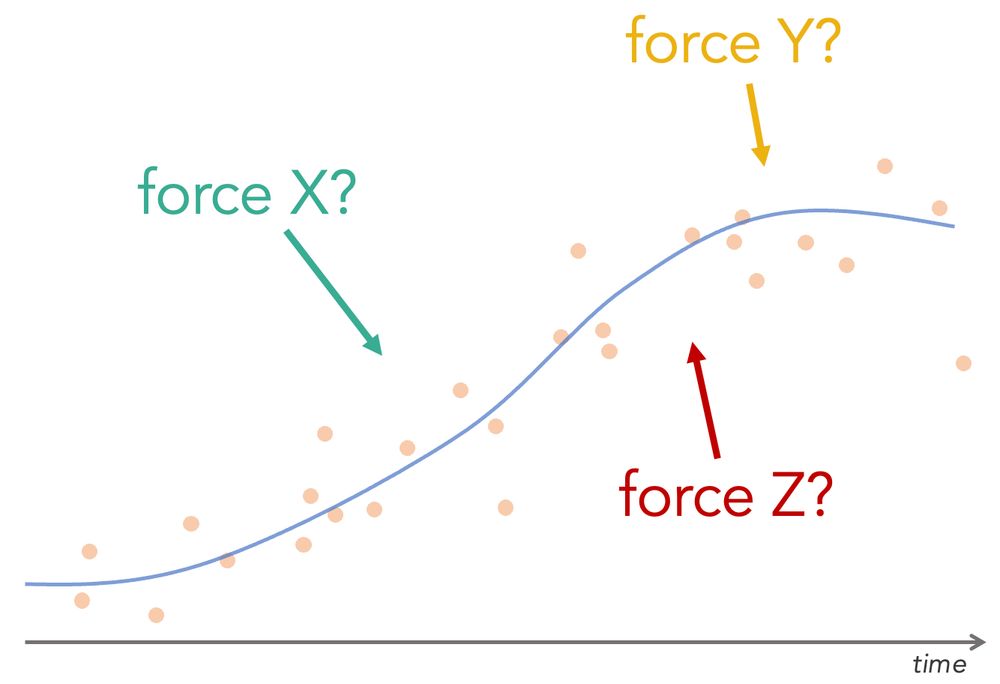
a schematic depiction of a trend line and several causal forces that give it its shape
Change over time is often depicted as a trendline. But what does shape a trendline? Which forces? Our new paper presents a method allowing to “decompose” trendlines into constituent forces. Also, we tackle an old puzzle: Does culture change “one funeral at a time”? 🧵(1/8) doi.org/10.1098/rspb...
The paper is a collaborative effort with wonderful colleagues from different corners of the globe, and we hope it sparks a conversation about how to make academic research more representative—and more actionable—for everyone.
tinyurl.com/376ueann
The lack of sample diversity in organizational research can reduce our ability to:
🔧 solve real-world problems, from tackling societal grand challenges to navigating digital transformation.
📜 build robust organizational theories.
North America and Europe account for less than 15% of the global population / SMEs constitute more than 90% of all businesses and account for over 50% of employment.
Why this matters ⁉️ If research mainly reflects, for example, US experiences or that of big corporations, it risks overlooking the realities of diverse regions, organizational sizes, and cultures.
Samples are also skewed towards certain industries and, not surprisingly, mostly conducted by researchers based in North America or European Universities (85%) on research samples collected in these regions (86%).
