

The new cult of victimhood.
www.dailykos.com/stories/2026...
04.02.2026 20:31
👍 0
🔁 0
💬 0
📌 0
They’re describing it as a “shock and awe” campaign, which is why it’s essential to show them there’s huge opposition NOW. Call / email your reps to let them know you oppose censorship bills like KOSA and the SCREEN.
Read up and get involved in the @fightforthefuture.org Week of Action.

Great answer from @timnitgebru.bsky.social about AGI youtube.com/shorts/899b7... - part of our future of AI feature www.nature.com/immersive/d4...

We spent a year investigating billionaires for @washingtonpost.com.
We found: the wealthiest 100 Americans gave $1.1 billion to influence the 2024 elections — 140x more than they did in 2000. And almost all of that giving boosted Republicans.
washingtonpost.com/politics/int...

One thing we can be sure of is that the Hamas-run health ministry's death tallies -- which IDF defenders incessantly dismiss -- are an undercount of the true death toll in Israel's gaza massacre.
From @polgreen.bsky.social (gift link)
As a kid I wondered and worried about why people could be allowed to go unfed and unhoused and insecure in the midst of unparalleled, incomparable affluence. That remains the driving question of my research. And the answer remains largely the same. Capitalism in its many guises.
I considered writing a long carefully constructed argument laying out the harms and limitations of AI, but instead I wrote about being a hater. Only humans can be haters.
Can't wait to see it!
Anyone who's tempted to cheer the state going after porn sites like XVideos should think twice. Uthmeier made a name for himself forcing the censorship of LGBTQ+ library books by calling them "patently pornographic" and "harmful to minors."
If he's coming after us, he's coming after you.

On Gaza: "A betrayal of the victims of the Holocaust." (An essay shared by Robert Reich.) open.substack.com/pub/robertre...

The mass starvation & killing of Palestinians in Gaza at the hands of the Israeli gov’t is a chillul hashem, a desecration of God.
Jewish leaders who criticized Zohran Mamdani for three words he doesn’t use should raise their voices loudly here as well.
forward.com/opinion/7575...

The people of Gaza face starvation under the joint U.S.-Israeli food distribution system run by the Gaza Humanitarian Foundation.

A convincing argument:
“I’m a Genocide Scholar. I Know It When I See It.” www.nytimes.com/2025/07/15/o...

I just donated to this charity that provides telemedicine services to Ukrainians in need. They are running out of funding.
www.pii-foundation.org
Great new article by Hallie Lieberman, giving voice to the incarcerated people being harmed by the anti-trans agenda.
How Trans Prisoners Are Dealing With The Trump Administration’s Attacks - defector.com/how-trans-pr.... #transrights

I'm attending No Kings's event, “NO KINGS in Atlanta” - sign up now to join me! www.mobilize.us/nokings/even...
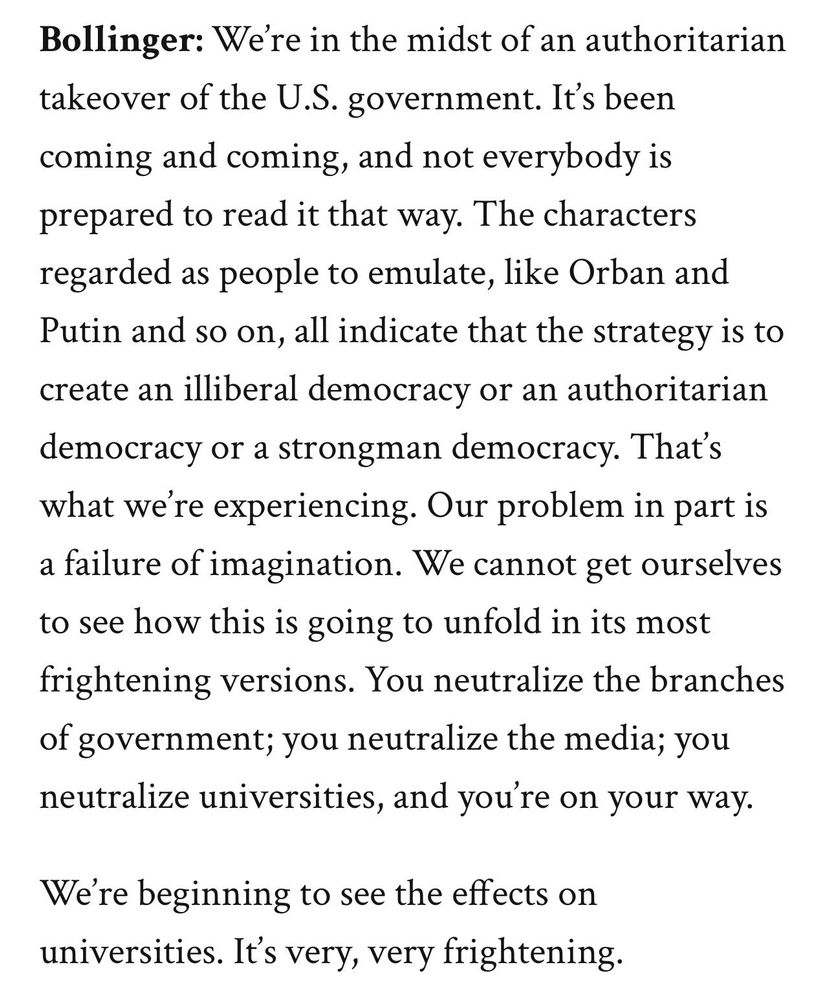
From interview of Lee Bollinger, 1st Amendment scholar who served as dean of @UMichLaw, president of @UMich, and president of Columbia University.
www.chronicle.com/article/were...

This tension between scholars and technicians has produced two sharply divergent traditions about the nature of technology and antecedent concepts. On one side, defenders of technicians view technology as a creative expression of human culture. In this view, technology is imbued with human values and strivings in all their contradictory complexity. I term this position the cultural approach to technology. The cultural approach is epitomized by the American public intellectual Lewis Mumford. In the 1930s, Mumford argued that technology (technics, in his terminology) “exists as an element in human culture and it promises well or ill as the social groups that exploit it promise well or ill.” German engineers around the turn of the twentieth century made similar claims, insisting that technology (Technik) was an essential component of culture and a product of the human spirit. Technologies thus express the spirit of an age, just like works of art. The invention of the mechanical clock in Western Europe at the end of the thirteenth century, for example, did not itself create the sense of time. Instead, the mechanical clock reflected a prior consciousness of time, rooted in monasteries and medieval towns, that motivated people to invent, improve, and embrace this new instrument. Chinese craftsmen had created far more sophisticated astronomical clocks in the eleventh century, but these devices failed to spread because they did not reflect a widespread desire for timekeeping. In contrast to the cultural approach, other scholars take what I term the instrumental approach to technology. Supporters of this approach, often humanist intellectuals, insist that technology is a mere instrument that serves ends defined by others. This vision portrays technology as narrow technical rationality, uncreative and devoid of values.
@ericschatzberg.bsky.social take on technology is spot on. The cultural and the instrumental approach. From "Technology: Critical History of a Concept" (Uni. of Chicago Press, 2018)
Something I've been trying to write about is how the right uses the existence of trans people as justification for overthrowing democracy or the state, and how similar that is to the "trans panic defense" deployed by murderers of trans women trying to earn the sympathies of juries and judges

