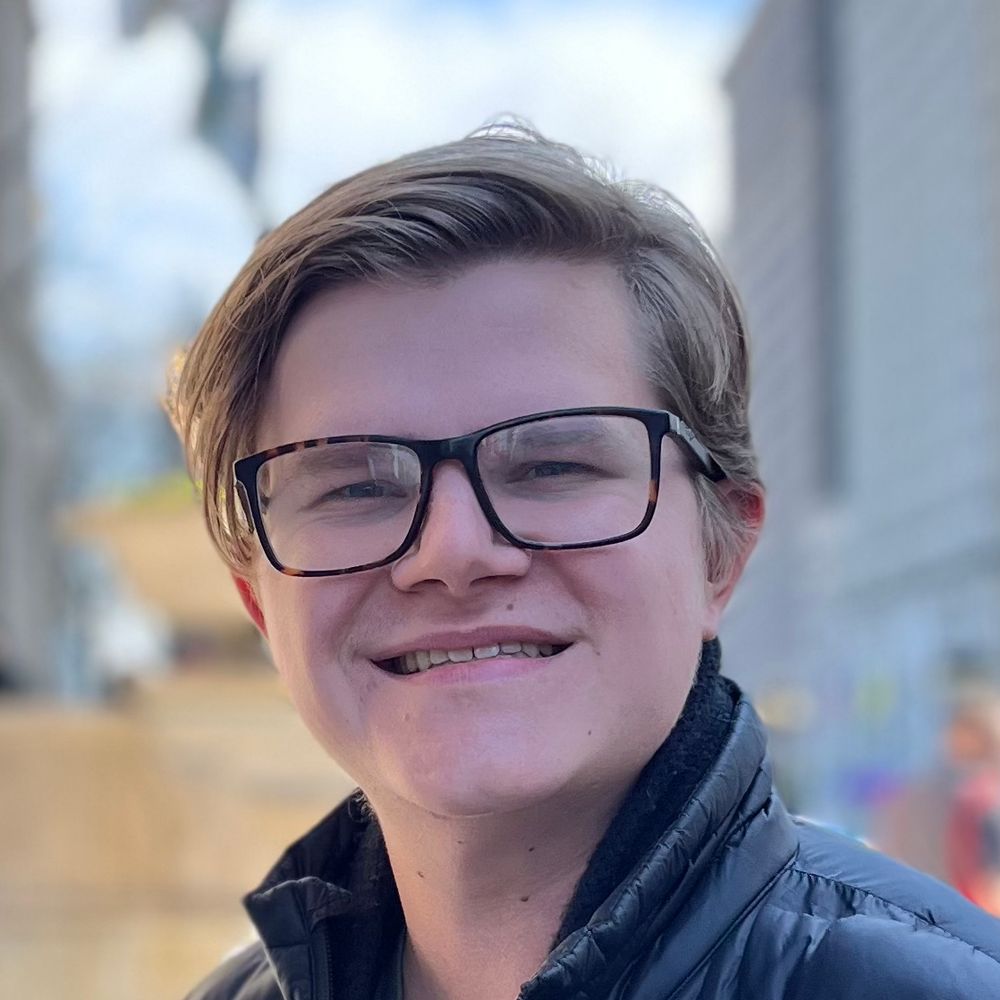
I’m thrilled to announce that I will be joining the UNITES Lab under Tianlong Chen as a postdoc in the UNC Chapel Hill CS Department starting in early 2026. My research will focus on multimodal and agentic AI for healthcare and AI for science (protein LMs and genomic LMs)!
30.10.2025 15:29
👍 0
🔁 0
💬 0
📌 0
Thanks to our awesome collaborators! Preeti Verma, Yuwen Chen, Hanxue Gu, Haoyu Dong, Yaqian Chen, Andrew Marshall, Lidia Garrucho Moras, Kaisar Kushibar, Daniel M. Lang, Gene S. Kim, Lars Grimm, John Lewin, James S. Duncan, @ja-schnabel.bsky.social, Oliver Diaz, Karim Lekadir and Maciej Mazurowski.
17.06.2025 16:08
👍 0
🔁 0
💬 0
📌 0

As part of this paper, we also present the most extensive framework for the meta-evaluation of medical image similarity metrics to date, available at github.com/mazurowski-l...!
17.06.2025 16:08
👍 0
🔁 0
💬 1
📌 0

FRD improves on other metrics (FID, RadiologyFID, KID, etc.) in many applications, including: OOD detection, image-to-image translation/image generation evaluation, correlation with expert-perceived image quality, compute stability+speed, and sensitivity to adversarial attacks + image corruptions.
17.06.2025 16:08
👍 0
🔁 0
💬 1
📌 0

FRD quantifies images via hundreds of standardized, interpretable radiomic features, rather than learned embeddings, which we find brings several advantages due to better and more robustly characterizing anatomical features (particularly those related to downstream tasks).
17.06.2025 16:08
👍 0
🔁 0
💬 1
📌 0

FID has many limitations when applied to medical images (e.g., misalignment with downstream tasks). Introducing the Fréchet Radiomic Distance (FRD): a metric designed from the ground up for better characterizing medical images, led by me and Richard Osuala! Code/paper: github.com/RichardObi/f...
17.06.2025 16:08
👍 4
🔁 0
💬 1
📌 0
Thanks for reading! Co-authors: Zafer Yildiz, Qihang Li, Yaqian Chen, Haoyu Dong, Hanxue Gu and Maciej Mazurowski
09.05.2025 14:34
👍 0
🔁 0
💬 0
📌 0

With a novel dynamic "short-long" memory, it outperforms SAM 2 and other models by >7% DSC on average, in segmenting various organs, bones, and muscles across modalities! Crucially, it exhibits better robustness to the problem of "over-propagation" of annotations through slices.
09.05.2025 14:34
👍 0
🔁 0
💬 1
📌 0

Introducing SLM-SAM 2, led by Yuwen Chen: a new video object segmentation method for medical imaging that speeds up annotation by accurately propagating labels from a single slice across the whole volume. [Code: github.com/mazurowski-l..., paper: www.arxiv.org/abs/2505.01854 ]. More info next:
09.05.2025 14:34
👍 0
🔁 0
💬 1
📌 0
Sadly, I’m unable to attend the conference next week, but I wanted to share the paper with those interested, and I am happy to answer any questions! (3/3)
05.12.2024 14:36
👍 2
🔁 0
💬 0
📌 0

I also found that the representation intrinsic dim. peaks consistently earlier in medical image models compared to natural image models, pointing to a difference in the abstractness of task-relevant features between these domains. (2/3)
05.12.2024 14:36
👍 2
🔁 0
💬 1
📌 0

Excited to share my NeurIPS SciForDL paper on how hidden repr. intrinsic dimension evolves through model depth! openreview.net/forum?id=trc...
A surprising finding: the peak intrinsic dim. is ~a constant fraction of the input data’s intrinsic dim., across diverse datasets + models! (1/3)
05.12.2024 14:36
👍 3
🔁 0
💬 1
📌 0
We are the premier conference on #uncertainty in #AI and #ML since 1985 🧓
Hello, 🦋!
Follow us to reduce uncertainty!
03.12.2024 16:08
👍 29
🔁 12
💬 0
📌 2

Picking the right explainable AI method for your computer vision task? Wondering about its evaluation reliability?
🎯 Then you might be interested in our latest #neurips2024 publication on LATEC, a (meta-)evaluation benchmark for XAI methods and metrics!
📄 arxiv.org/abs/2409.16756
🧵(1/3)
03.12.2024 13:08
👍 6
🔁 3
💬 1
📌 0