
07.03.2026 01:18
👍 1
🔁 1
💬 0
📌 0

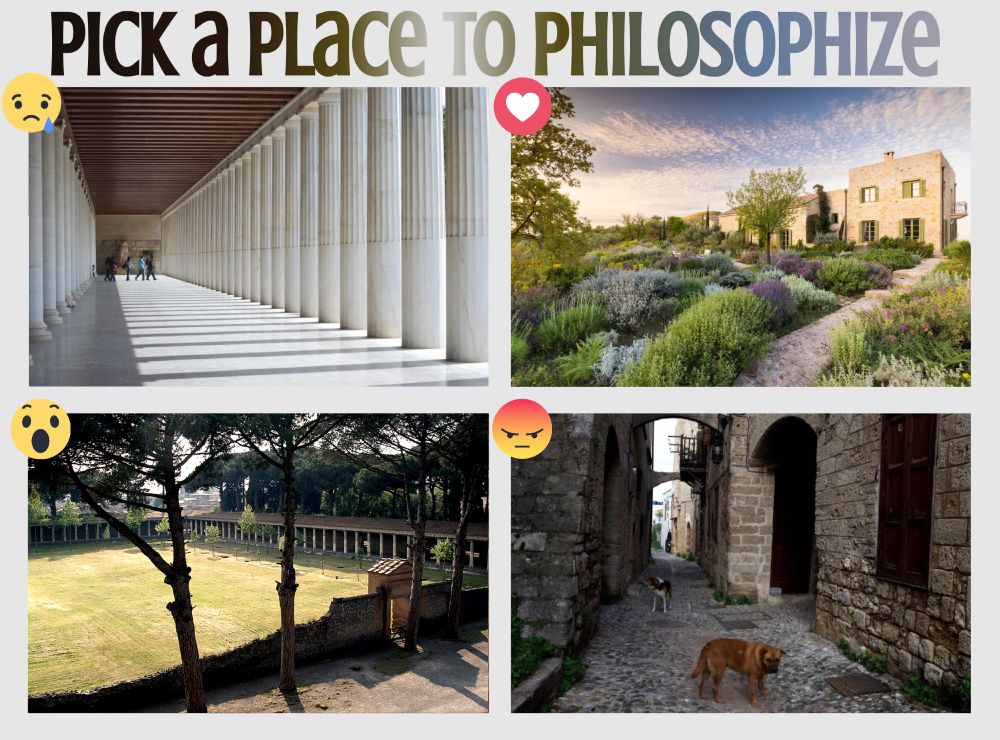
We apologise to people with screen readers: this is a flowchart aimed at answering the question "Which Greek Philosopher Are You?" First question is: "Do you prefer the indoors or outdoors?" If you choose "indoors", the next question is "Do you feel disdain for the common man?" If Yes, you're Plato. If No, you're Aristotle. If you reply "Outdoors", the follow-up is "Do you enjoy masturbating in public?" If yes, you're Diogenes. If no, the next question is, "Do you like crowds?" If yes, you're Socrates. If no, you are asked "Porch or garden?" If your reply is "Porch", you're Zeno; if it's "Garden", you're Epicurus.
Couldn't trace this back to a definitive creator, but: Epicurus all the way, bro
amaaaaaaaaaazing #art #classicsky

Love it! ❤️🐺
The Eumenides III
Ink on paper - 2024
this is not news. we have been a fully sentient posting museum since at least 2016
Working on a q&a lecture for a class today: The story of robots is always a story about slavery. The story of LLMs labeled as AI is a story about class, and which humans pay the cost, including the physical toll on their bodies/minds, and the lack of water and electricity, so data centers can exist.
this reminds me of the best joke I ever made up:
Which Greek philosopher invented studs on football boots?
Soccercleats
Lord Nelson was 5ft 6in. His statue is 17ft 4in.
That’s Horatio of 3:1.
unembarrassed enthusiasm about learning new things is genuinely the best way to live
Agreed. Sustaining your curiosity and excitement about the world is a way to fill your life with love and joy, no matter how solitary a person you may be.
I breathe the air that comes out of your nose, the north wind which comes forth from your mother. (BDF)
someone had to be
We apologise to people with screen readers: this is a flowchart aimed at answering the question "Which Greek Philosopher Are You?" First question is: "Do you prefer the indoors or outdoors?" If you choose "indoors", the next question is "Do you feel disdain for the common man?" If Yes, you're Plato. If No, you're Aristotle. If you reply "Outdoors", the follow-up is "Do you enjoy masturbating in public?" If yes, you're Diogenes. If no, the next question is, "Do you like crowds?" If yes, you're Socrates. If no, you are asked "Porch or garden?" If your reply is "Porch", you're Zeno; if it's "Garden", you're Epicurus.
Couldn't trace this back to a definitive creator, but: Epicurus all the way, bro
Booke, booke,
Reade a booke,
Reade anothir booke,
Reade a large amounte of bookes -
Bookes are freakinge awesome

NEW EPISODE! The second part of our series on the Mahabharata looks at its most famous section: the Bhagavad Gita, a dialogue between a warrior having a crisis of conscience and his best friend, who is also his brother-in-law, who is also God. podcasts.apple.com/gb/podcast/b...
New episode came out late yesterday/early today (depending on your time zone)! I dive into The Bhagavad Gita, the 700-verse section of the 100,000-verse Mahabharata that is one of the most crucial Hindu scriptures—and one of the most studied works in world literature. Don't miss it. Links below!

Black and white photo of Mohandas Karamchand Gandhi (Mahatma Gandhi, 1869–1948) taken by Margaret Bourke-White in 1946. With a spinning wheel in the foreground, Gandhi sits cross-legged on a mat, reading from a book. There's a pile of papers in his lap. He is dressed in a loin cloth, as was his habit later in his life, and wears his round glasses.
“I lost my earthly mother who gave me birth long ago,” Gandhi wrote, “but this eternal mother [the Gita] has completely filled her place by my side ever since. She has never changed, she has never failed. When I am in difficulty or distress, I seek refuge in her bosom.”

We also take a look at how the Gita influenced one of the 20th century's most important people: Mahatma Gandhi. In spite of the fact that he was a Hindu from India, Gandhi didn't actually read the Gita until he was a law student in London. It changed his life. booksofalltime.co.uk/2026/03/03/m...

In the Bhagavad Gita, Arjuna (the warrior) and Krishna (the god) discuss the nature of reality, how to act ethically when faced with an impossible dilemma, and the importance of spiritual devotion. It is one of Hinduism's most beloved and influential works. open.spotify.com/episode/4wuK...
NEW EPISODE! The second part of our series on the Mahabharata looks at its most famous section: the Bhagavad Gita, a dialogue between a warrior having a crisis of conscience and his best friend, who is also his brother-in-law, who is also God. podcasts.apple.com/gb/podcast/b...

"Mere bookish souls can never attain moksha." Um, excuse YOU, Mahatma Gandhi academic.oup.com/book/26346/c...

We hope they wrote bromances like the Mesopotamians. "The hunter-gatherers of the Paleolithic era developed a symbol system with a statistically comparable information density to the earliest proto-cuneiform tablets from ancient Mesopotamia – a full 40K years later." www.bbc.co.uk/news/article...

"The habits cultivated by serious reading, such as tolerating ambiguity, holding competing ideas in mind and deferring judgment, are precisely what is required of citizens in a democracy under pressure." #booksky www.irishtimes.com/opinion/edit...
Divine polycules, giant armies, and a truly strange ancient Indian version of in-vitro fertilisation involving ghee: The Mahabharata has all this and more. Second episode on the Bhagavad Gita coming Monday! #podcasts #booksky

You can also read the transcript at our website, booksofalltime.co.uk. Rose is improving after her long struggle with anemia, and hopes to be back to fortnightly episodes this month. Thanks for listening!

Our next episode will be in feeds on Monday, 2 March! We also realise that we forgot to promote our most recent episode on social media! Episode 44, our first episode on the Mahabharata, came out in early February. Listen on Apple here: podcasts.apple.com/gb/podcast/b... #booksky #podcasts
"The habits cultivated by serious reading, such as tolerating ambiguity, holding competing ideas in mind and deferring judgment, are precisely what is required of citizens in a democracy under pressure." #booksky www.irishtimes.com/opinion/edit...

Photo of a highlighted passage in a paperback copy of the Bhagavad Gita section of the Mahabharata, in which Krishna talks Arjuna into going to war against his cousins and other family members. Text reads, "So arise and gain glory: conquer your foes and enjoy your prosperous realm! I myself slew these long ago; be the mere instrument, ambidextrous warrior. Drona and Bhisma and Jayadratha and Karna, and the other heroic warriors too, have been killed by me; kill them! Do not be dismayed."
Heck of a day to be writing up this @booksofalltime.bsky.social episode on the Bhagavad Gita, I tell you what.
