![CATALOG AND INSTRUMENTAL DATA ABOUT THE OBJECT
Target: PGC 48082
Other names (from the catalog): M83 (from Simbad), NGC5236, ESO444-81, MCG-5-32-050, UGCA366, ESO-LV4440810, IRAS13342-2933, IRASF13341-2936, MRC1334-296
RAJ2000: 204.2508333333333
DEJ2000: -29.867777777777775
Cutout size (arcmin): 15 x 15
Spectral Band: IRAC 4 (central wavelength: 8 micrometers)
MJD_start: 54530.6813521991
MJD_stop: 54530.7234345372
Image_Name: SPITZER_I4_22574336_0000_6_E7933665_maic.fits
Origin of the sources: PAH (Polycyclic aromatic hydrocarbons) / ice of Methane
Angular resolution (arcsec): 1.98
Resampling: original image scale
BGlevel: 4.57412 (MJy/sr)
CorePeak: 416.46 (MJy/sr) - the inner core was saturated -
Histogram Cut Range: [BGlevel , CorePeak]
Signal scale: logarithmic
LogExp parameter (DS9, Log scale): 1e+04
CREDITS
Catalog: Principal Galaxy Catalogue 2003 (PGC2003) - https://cdsarc.cds.unistra.fr/viz-bin/cat/VII/237
HyperLEDA reference: http://atlas.obs-hp.fr/hyperleda/ledacat.cgi?o=pgc%2048082
Image archive and Mission: IRSA - https://irsa.ipac.caltech.edu/frontpage/ , Spitzer Space Telescope
TOPCAT (for the Table Access Protocol query and the Simple Image Access query): https://www.star.bris.ac.uk/~mbt/topcat/
SIA service: "Spitzer Heritage Archive"
DS9 (for the image analysis): https://sites.google.com/cfa.harvard.edu/saoimageds9/home
References for the spectral features in this image:
https://iopscience.iop.org/article/10.1086/376697/pdf (table 4)
https://arxiv.org/pdf/astro-ph/0405616 (figure 3)
https://iopscience.iop.org/article/10.1088/0004-6256/140/6/1868/pdf (figure 7)
https://irsa.ipac.caltech.edu/data/SPITZER/Enhanced/SEIP/docs/seip_explanatory_supplement_v3.pdf](https://cdn.bsky.app/img/feed_thumbnail/plain/did:plc:4m7qiwms7tky3k72m2363yvs/bafkreiech5nrxandreomnygndwm47k3ctnaf67xgdz2hodrxysxxzliypi@jpeg)
CATALOG AND INSTRUMENTAL DATA ABOUT THE OBJECT
Target: PGC 48082
Other names (from the catalog): M83 (from Simbad), NGC5236, ESO444-81, MCG-5-32-050, UGCA366, ESO-LV4440810, IRAS13342-2933, IRASF13341-2936, MRC1334-296
RAJ2000: 204.2508333333333
DEJ2000: -29.867777777777775
Cutout size (arcmin): 15 x 15
Spectral Band: IRAC 4 (central wavelength: 8 micrometers)
MJD_start: 54530.6813521991
MJD_stop: 54530.7234345372
Image_Name: SPITZER_I4_22574336_0000_6_E7933665_maic.fits
Origin of the sources: PAH (Polycyclic aromatic hydrocarbons) / ice of Methane
Angular resolution (arcsec): 1.98
Resampling: original image scale
BGlevel: 4.57412 (MJy/sr)
CorePeak: 416.46 (MJy/sr) - the inner core was saturated -
Histogram Cut Range: [BGlevel , CorePeak]
Signal scale: logarithmic
LogExp parameter (DS9, Log scale): 1e+04
CREDITS
Catalog: Principal Galaxy Catalogue 2003 (PGC2003) - https://cdsarc.cds.unistra.fr/viz-bin/cat/VII/237
HyperLEDA reference: http://atlas.obs-hp.fr/hyperleda/ledacat.cgi?o=pgc%2048082
Image archive and Mission: IRSA - https://irsa.ipac.caltech.edu/frontpage/ , Spitzer Space Telescope
TOPCAT (for the Table Access Protocol query and the Simple Image Access query): https://www.star.bris.ac.uk/~mbt/topcat/
SIA service: "Spitzer Heritage Archive"
DS9 (for the image analysis): https://sites.google.com/cfa.harvard.edu/saoimageds9/home
References for the spectral features in this image:
https://iopscience.iop.org/article/10.1086/376697/pdf (table 4)
https://arxiv.org/pdf/astro-ph/0405616 (figure 3)
https://iopscience.iop.org/article/10.1088/0004-6256/140/6/1868/pdf (figure 7)
https://irsa.ipac.caltech.edu/data/SPITZER/Enhanced/SEIP/docs/seip_explanatory_supplement_v3.pdf
![CATALOG AND INSTRUMENTAL DATA ABOUT THE OBJECT
Target: PGC 48082
Other names (from the catalog): M83 (from Simbad), NGC5236, ESO444-81, MCG-5-32-050, UGCA366, ESO-LV4440810, IRAS13342-2933, IRASF13341-2936, MRC1334-296
RAJ2000: 204.2508333333333
DEJ2000: -29.867777777777775
Cutout size (arcmin): 15 x 15
Spectral Band: W3 (central wavelength: 12 micrometers)
MJD_start: 55218.64118885412
MJD_stop: 55400.6630836227
Image_Name: 2034m303_ac51-w3-int-3.fits
Origin of the sources: PAH / Amorphous Silicates / Silicate Crystals / ice of carbon dioxide
Angular resolution (arcsec): 6.5
Resampling: original image scale
BGlevel: 604.221 (DN)
CorePeak: 6489.08 (DN)
Histogram Cut Range: [BGlevel , CorePeak]
Signal scale: logarithmic
LogExp parameter (DS9, Log scale): 1000
CREDITS
Catalog: Principal Galaxy Catalogue 2003 (PGC2003) - https://cdsarc.cds.unistra.fr/viz-bin/cat/VII/237
HyperLEDA reference: http://atlas.obs-hp.fr/hyperleda/ledacat.cgi?o=pgc%2048082
Image archive and Mission: IRSA - https://irsa.ipac.caltech.edu/frontpage/ , WISE - Wide-field Infrared Survey Explorer
TOPCAT (for the Table Access Protocol query and the Simple Image Access query): https://www.star.bris.ac.uk/~mbt/topcat/
SIA service: "WISE AllWISE Image Atlas"
DS9 (for the image analysis): https://sites.google.com/cfa.harvard.edu/saoimageds9/home
References for the spectral features in this image:
https://iopscience.iop.org/article/10.1086/376697/pdf (table 4)
https://arxiv.org/pdf/astro-ph/0405616 (figure 3)
https://iopscience.iop.org/article/10.1088/0004-6256/140/6/1868/pdf (figure 7)
https://irsa.ipac.caltech.edu/data/SPITZER/Enhanced/SEIP/docs/seip_explanatory_supplement_v3.pdf](https://cdn.bsky.app/img/feed_thumbnail/plain/did:plc:4m7qiwms7tky3k72m2363yvs/bafkreihl2xvpywhb2hkxktk53mko4yzsfaterk7wfihiwvx6yrvyoguxa4@jpeg)
CATALOG AND INSTRUMENTAL DATA ABOUT THE OBJECT
Target: PGC 48082
Other names (from the catalog): M83 (from Simbad), NGC5236, ESO444-81, MCG-5-32-050, UGCA366, ESO-LV4440810, IRAS13342-2933, IRASF13341-2936, MRC1334-296
RAJ2000: 204.2508333333333
DEJ2000: -29.867777777777775
Cutout size (arcmin): 15 x 15
Spectral Band: W3 (central wavelength: 12 micrometers)
MJD_start: 55218.64118885412
MJD_stop: 55400.6630836227
Image_Name: 2034m303_ac51-w3-int-3.fits
Origin of the sources: PAH / Amorphous Silicates / Silicate Crystals / ice of carbon dioxide
Angular resolution (arcsec): 6.5
Resampling: original image scale
BGlevel: 604.221 (DN)
CorePeak: 6489.08 (DN)
Histogram Cut Range: [BGlevel , CorePeak]
Signal scale: logarithmic
LogExp parameter (DS9, Log scale): 1000
CREDITS
Catalog: Principal Galaxy Catalogue 2003 (PGC2003) - https://cdsarc.cds.unistra.fr/viz-bin/cat/VII/237
HyperLEDA reference: http://atlas.obs-hp.fr/hyperleda/ledacat.cgi?o=pgc%2048082
Image archive and Mission: IRSA - https://irsa.ipac.caltech.edu/frontpage/ , WISE - Wide-field Infrared Survey Explorer
TOPCAT (for the Table Access Protocol query and the Simple Image Access query): https://www.star.bris.ac.uk/~mbt/topcat/
SIA service: "WISE AllWISE Image Atlas"
DS9 (for the image analysis): https://sites.google.com/cfa.harvard.edu/saoimageds9/home
References for the spectral features in this image:
https://iopscience.iop.org/article/10.1086/376697/pdf (table 4)
https://arxiv.org/pdf/astro-ph/0405616 (figure 3)
https://iopscience.iop.org/article/10.1088/0004-6256/140/6/1868/pdf (figure 7)
https://irsa.ipac.caltech.edu/data/SPITZER/Enhanced/SEIP/docs/seip_explanatory_supplement_v3.pdf
![CATALOG AND INSTRUMENTAL DATA ABOUT THE OBJECT
Target: PGC 48082
Other names (from the catalog): M83 (from Simbad), NGC5236, ESO444-81, MCG-5-32-050, UGCA366, ESO-LV4440810, IRAS13342-2933, IRASF13341-2936, MRC1334-296
RAJ2000: 204.2508333333333
DEJ2000: -29.867777777777775
Cutout size (arcmin): 15 x 15
Spectral Band: W4 (central wavelength: 22 micrometers)
MJD_start: 55218.64118885412
MJD_stop: 55400.6630836227
Image_Name: 2034m303_ac51-w4-int-3.fits
Origin of the sources: Iron oxides
Angular resolution (arcsec): 12
Resampling: original image scale
BGlevel: 187.664 (DN)
CorePeak: 924.207 (DN)
Histogram Cut Range: [BGlevel , CorePeak]
Signal scale: logarithmic
LogExp parameter (DS9, Log scale): 1000
CREDITS
Catalog: Principal Galaxy Catalogue 2003 (PGC2003) - https://cdsarc.cds.unistra.fr/viz-bin/cat/VII/237
HyperLEDA reference: http://atlas.obs-hp.fr/hyperleda/ledacat.cgi?o=pgc%2048082
Image archive and Mission: IRSA - https://irsa.ipac.caltech.edu/frontpage/ , WISE - Wide-field Infrared Survey Explorer
TOPCAT (for the Table Access Protocol query and the Simple Image Access query): https://www.star.bris.ac.uk/~mbt/topcat/
SIA service: "WISE AllWISE Image Atlas"
DS9 (for the image analysis): https://sites.google.com/cfa.harvard.edu/saoimageds9/home
References for the spectral features in this image:
https://iopscience.iop.org/article/10.1086/376697/pdf (table 4)
https://arxiv.org/pdf/astro-ph/0405616 (figure 3)
https://iopscience.iop.org/article/10.1088/0004-6256/140/6/1868/pdf (figure 7)
https://irsa.ipac.caltech.edu/data/SPITZER/Enhanced/SEIP/docs/seip_explanatory_supplement_v3.pdf](https://cdn.bsky.app/img/feed_thumbnail/plain/did:plc:4m7qiwms7tky3k72m2363yvs/bafkreibrpflwqcsfhof63bgjbav73ndn4ff2rnv3sqazacwnejjepwskmu@jpeg)
CATALOG AND INSTRUMENTAL DATA ABOUT THE OBJECT
Target: PGC 48082
Other names (from the catalog): M83 (from Simbad), NGC5236, ESO444-81, MCG-5-32-050, UGCA366, ESO-LV4440810, IRAS13342-2933, IRASF13341-2936, MRC1334-296
RAJ2000: 204.2508333333333
DEJ2000: -29.867777777777775
Cutout size (arcmin): 15 x 15
Spectral Band: W4 (central wavelength: 22 micrometers)
MJD_start: 55218.64118885412
MJD_stop: 55400.6630836227
Image_Name: 2034m303_ac51-w4-int-3.fits
Origin of the sources: Iron oxides
Angular resolution (arcsec): 12
Resampling: original image scale
BGlevel: 187.664 (DN)
CorePeak: 924.207 (DN)
Histogram Cut Range: [BGlevel , CorePeak]
Signal scale: logarithmic
LogExp parameter (DS9, Log scale): 1000
CREDITS
Catalog: Principal Galaxy Catalogue 2003 (PGC2003) - https://cdsarc.cds.unistra.fr/viz-bin/cat/VII/237
HyperLEDA reference: http://atlas.obs-hp.fr/hyperleda/ledacat.cgi?o=pgc%2048082
Image archive and Mission: IRSA - https://irsa.ipac.caltech.edu/frontpage/ , WISE - Wide-field Infrared Survey Explorer
TOPCAT (for the Table Access Protocol query and the Simple Image Access query): https://www.star.bris.ac.uk/~mbt/topcat/
SIA service: "WISE AllWISE Image Atlas"
DS9 (for the image analysis): https://sites.google.com/cfa.harvard.edu/saoimageds9/home
References for the spectral features in this image:
https://iopscience.iop.org/article/10.1086/376697/pdf (table 4)
https://arxiv.org/pdf/astro-ph/0405616 (figure 3)
https://iopscience.iop.org/article/10.1088/0004-6256/140/6/1868/pdf (figure 7)
https://irsa.ipac.caltech.edu/data/SPITZER/Enhanced/SEIP/docs/seip_explanatory_supplement_v3.pdf
![CATALOG AND INSTRUMENTAL DATA ABOUT THE OBJECT
Target: PGC 48082
Other names (from the catalog): M83 (from Simbad), NGC5236, ESO444-81, MCG-5-32-050, UGCA366, ESO-LV4440810, IRAS13342-2933, IRASF13341-2936, MRC1334-296
RAJ2000: 204.2508333333333
DEJ2000: -29.867777777777775
Cutout size (arcmin): 15 x 15
Spectral Band: MIPS24 (central wavelength: 24 micrometers)
MJD_start: 53784.944919595
MJD_stop: 53784.9851390859
Image_Name: SPITZER_M1_4356352_0000_7_E6320217_maic.fits
Origin of the sources: Iron oxides
Angular resolution (arcsec): 6
Resampling: original image scale
BGlevel: 35.3708 (MJy/sr)
CorePeak: 2534.69 (MJy/sr)
Histogram Cut Range: [BGlevel , CorePeak]
Signal scale: logarithmic
LogExp parameter (DS9, Log scale): 1e+04
CREDITS
Catalog: Principal Galaxy Catalogue 2003 (PGC2003) - https://cdsarc.cds.unistra.fr/viz-bin/cat/VII/237
HyperLEDA reference: http://atlas.obs-hp.fr/hyperleda/ledacat.cgi?o=pgc%2048082
Image archive and Mission: IRSA - https://irsa.ipac.caltech.edu/frontpage/ , Spitzer Space Telescope
TOPCAT (for the Table Access Protocol query and the Simple Image Access query): https://www.star.bris.ac.uk/~mbt/topcat/
SIA service: "Spitzer Heritage Archive"
DS9 (for the image analysis): https://sites.google.com/cfa.harvard.edu/saoimageds9/home
References for the spectral features in this image:
https://iopscience.iop.org/article/10.1086/376697/pdf (table 4)
https://arxiv.org/pdf/astro-ph/0405616 (figure 3)
https://iopscience.iop.org/article/10.1088/0004-6256/140/6/1868/pdf (figure 7)
https://irsa.ipac.caltech.edu/data/SPITZER/Enhanced/SEIP/docs/seip_explanatory_supplement_v3.pdf](https://cdn.bsky.app/img/feed_thumbnail/plain/did:plc:4m7qiwms7tky3k72m2363yvs/bafkreicgxmslxezsfupvw6vfmvicdyciw2un3kjhxkiqyvzsrd5ejtuv6i@jpeg)
CATALOG AND INSTRUMENTAL DATA ABOUT THE OBJECT
Target: PGC 48082
Other names (from the catalog): M83 (from Simbad), NGC5236, ESO444-81, MCG-5-32-050, UGCA366, ESO-LV4440810, IRAS13342-2933, IRASF13341-2936, MRC1334-296
RAJ2000: 204.2508333333333
DEJ2000: -29.867777777777775
Cutout size (arcmin): 15 x 15
Spectral Band: MIPS24 (central wavelength: 24 micrometers)
MJD_start: 53784.944919595
MJD_stop: 53784.9851390859
Image_Name: SPITZER_M1_4356352_0000_7_E6320217_maic.fits
Origin of the sources: Iron oxides
Angular resolution (arcsec): 6
Resampling: original image scale
BGlevel: 35.3708 (MJy/sr)
CorePeak: 2534.69 (MJy/sr)
Histogram Cut Range: [BGlevel , CorePeak]
Signal scale: logarithmic
LogExp parameter (DS9, Log scale): 1e+04
CREDITS
Catalog: Principal Galaxy Catalogue 2003 (PGC2003) - https://cdsarc.cds.unistra.fr/viz-bin/cat/VII/237
HyperLEDA reference: http://atlas.obs-hp.fr/hyperleda/ledacat.cgi?o=pgc%2048082
Image archive and Mission: IRSA - https://irsa.ipac.caltech.edu/frontpage/ , Spitzer Space Telescope
TOPCAT (for the Table Access Protocol query and the Simple Image Access query): https://www.star.bris.ac.uk/~mbt/topcat/
SIA service: "Spitzer Heritage Archive"
DS9 (for the image analysis): https://sites.google.com/cfa.harvard.edu/saoimageds9/home
References for the spectral features in this image:
https://iopscience.iop.org/article/10.1086/376697/pdf (table 4)
https://arxiv.org/pdf/astro-ph/0405616 (figure 3)
https://iopscience.iop.org/article/10.1088/0004-6256/140/6/1868/pdf (figure 7)
https://irsa.ipac.caltech.edu/data/SPITZER/Enhanced/SEIP/docs/seip_explanatory_supplement_v3.pdf
Infrared structures seen into near galaxies using an artificial color palette.
Target: PGC 48082
RAJ2000: 204.2508333333333
DEJ2000: -29.867777777777775
#astronomy
#galaxy
#pgc48082
12.02.2026 17:57
👍 5
🔁 1
💬 0
📌 0
![CATALOG AND INSTRUMENTAL DATA ABOUT THE OBJECT
Target: PGC 62836
Other names (from the catalog): NGC6744, ESO104-42, ESO-LV1040420, IRAS19050-6354
RAJ2000: 287.4383333333333
DEJ2000: -63.856111111111105
Cutout size (arcmin): 10 x 10
Spectral Band: IRAC 4 (central wavelength: 8 micrometers)
MJD_start: 54003.0718204053
MJD_stop: 54003.0960554513
Image_Name: SPITZER_I4_18285312_0000_6_E8558451_maic.fits
Origin of the sources: PAH (Polycyclic aromatic hydrocarbons) / ice of Methane
Angular resolution (arcsec): 1.98
Resampling: original image scale
BGlevel: 3.00907 (MJy/sr)
CorePeak: 20.3869 (MJy/sr)
Histogram Cut Range: [BGlevel , CorePeak]
Signal scale: logarithmic
LogExp parameter (DS9, Log scale): 200
CREDITS
Catalog: Principal Galaxy Catalogue 2003 (PGC2003) - https://cdsarc.cds.unistra.fr/viz-bin/cat/VII/237
HyperLEDA reference: http://atlas.obs-hp.fr/hyperleda/ledacat.cgi?o=pgc%2062836
Image archive and Mission: IRSA - https://irsa.ipac.caltech.edu/frontpage/ , Spitzer Space Telescope
TOPCAT (for the Table Access Protocol query and the Simple Image Access query): https://www.star.bris.ac.uk/~mbt/topcat/
SIA service: "Spitzer Heritage Archive"
DS9 (for the image analysis): https://sites.google.com/cfa.harvard.edu/saoimageds9/home
References for the spectral features in this image:
https://iopscience.iop.org/article/10.1086/376697/pdf (table 4)
https://arxiv.org/pdf/astro-ph/0405616 (figure 3)
https://iopscience.iop.org/article/10.1088/0004-6256/140/6/1868/pdf (figure 7)
https://irsa.ipac.caltech.edu/data/SPITZER/Enhanced/SEIP/docs/seip_explanatory_supplement_v3.pdf](https://cdn.bsky.app/img/feed_thumbnail/plain/did:plc:4m7qiwms7tky3k72m2363yvs/bafkreiadjslvbex5zgrwkvuoiwspi33k2fwioyqcxbw5mw5zfswtkdf36y@jpeg)
CATALOG AND INSTRUMENTAL DATA ABOUT THE OBJECT
Target: PGC 62836
Other names (from the catalog): NGC6744, ESO104-42, ESO-LV1040420, IRAS19050-6354
RAJ2000: 287.4383333333333
DEJ2000: -63.856111111111105
Cutout size (arcmin): 10 x 10
Spectral Band: IRAC 4 (central wavelength: 8 micrometers)
MJD_start: 54003.0718204053
MJD_stop: 54003.0960554513
Image_Name: SPITZER_I4_18285312_0000_6_E8558451_maic.fits
Origin of the sources: PAH (Polycyclic aromatic hydrocarbons) / ice of Methane
Angular resolution (arcsec): 1.98
Resampling: original image scale
BGlevel: 3.00907 (MJy/sr)
CorePeak: 20.3869 (MJy/sr)
Histogram Cut Range: [BGlevel , CorePeak]
Signal scale: logarithmic
LogExp parameter (DS9, Log scale): 200
CREDITS
Catalog: Principal Galaxy Catalogue 2003 (PGC2003) - https://cdsarc.cds.unistra.fr/viz-bin/cat/VII/237
HyperLEDA reference: http://atlas.obs-hp.fr/hyperleda/ledacat.cgi?o=pgc%2062836
Image archive and Mission: IRSA - https://irsa.ipac.caltech.edu/frontpage/ , Spitzer Space Telescope
TOPCAT (for the Table Access Protocol query and the Simple Image Access query): https://www.star.bris.ac.uk/~mbt/topcat/
SIA service: "Spitzer Heritage Archive"
DS9 (for the image analysis): https://sites.google.com/cfa.harvard.edu/saoimageds9/home
References for the spectral features in this image:
https://iopscience.iop.org/article/10.1086/376697/pdf (table 4)
https://arxiv.org/pdf/astro-ph/0405616 (figure 3)
https://iopscience.iop.org/article/10.1088/0004-6256/140/6/1868/pdf (figure 7)
https://irsa.ipac.caltech.edu/data/SPITZER/Enhanced/SEIP/docs/seip_explanatory_supplement_v3.pdf
![CATALOG AND INSTRUMENTAL DATA ABOUT THE OBJECT
Target: PGC 62836
Other names (from the catalog): NGC6744, ESO104-42, ESO-LV1040420, IRAS19050-6354
RAJ2000: 287.4383333333333
DEJ2000: -63.856111111111105
Cutout size (arcmin): 15 x 15
Spectral Band: W3 (central wavelength: 12 micrometers)
MJD_start: 55283.75121848378
MJD_stop: 55292.41809003474
Image_Name: 2873m637_ac51-w3-int-3.fits
Origin of the sources: PAH / Amorphous Silicates / Silicate Crystals / ice of carbon dioxide
Angular resolution (arcsec): 6.5
Resampling: original image scale
BGlevel: 362.952 (DN)
CorePeak: 427.489 (DN)
Histogram Cut Range: [BGlevel , CorePeak]
Signal scale: logarithmic
LogExp parameter (DS9, Log scale): 10
CREDITS
Catalog: Principal Galaxy Catalogue 2003 (PGC2003) - https://cdsarc.cds.unistra.fr/viz-bin/cat/VII/237
HyperLEDA reference: http://atlas.obs-hp.fr/hyperleda/ledacat.cgi?o=pgc%2062836
Image archive and Mission: IRSA - https://irsa.ipac.caltech.edu/frontpage/ , WISE - Wide-field Infrared Survey Explorer
TOPCAT (for the Table Access Protocol query and the Simple Image Access query): https://www.star.bris.ac.uk/~mbt/topcat/
SIA service: "WISE AllWISE Image Atlas"
DS9 (for the image analysis): https://sites.google.com/cfa.harvard.edu/saoimageds9/home
References for the spectral features in this image:
https://iopscience.iop.org/article/10.1086/376697/pdf (table 4)
https://arxiv.org/pdf/astro-ph/0405616 (figure 3)
https://iopscience.iop.org/article/10.1088/0004-6256/140/6/1868/pdf (figure 7)
https://irsa.ipac.caltech.edu/data/SPITZER/Enhanced/SEIP/docs/seip_explanatory_supplement_v3.pdf](https://cdn.bsky.app/img/feed_thumbnail/plain/did:plc:4m7qiwms7tky3k72m2363yvs/bafkreidnkf544hv3k4pldpodpevmzhkls6wfr6tgzx6u25k5b3zeubgkg4@jpeg)
CATALOG AND INSTRUMENTAL DATA ABOUT THE OBJECT
Target: PGC 62836
Other names (from the catalog): NGC6744, ESO104-42, ESO-LV1040420, IRAS19050-6354
RAJ2000: 287.4383333333333
DEJ2000: -63.856111111111105
Cutout size (arcmin): 15 x 15
Spectral Band: W3 (central wavelength: 12 micrometers)
MJD_start: 55283.75121848378
MJD_stop: 55292.41809003474
Image_Name: 2873m637_ac51-w3-int-3.fits
Origin of the sources: PAH / Amorphous Silicates / Silicate Crystals / ice of carbon dioxide
Angular resolution (arcsec): 6.5
Resampling: original image scale
BGlevel: 362.952 (DN)
CorePeak: 427.489 (DN)
Histogram Cut Range: [BGlevel , CorePeak]
Signal scale: logarithmic
LogExp parameter (DS9, Log scale): 10
CREDITS
Catalog: Principal Galaxy Catalogue 2003 (PGC2003) - https://cdsarc.cds.unistra.fr/viz-bin/cat/VII/237
HyperLEDA reference: http://atlas.obs-hp.fr/hyperleda/ledacat.cgi?o=pgc%2062836
Image archive and Mission: IRSA - https://irsa.ipac.caltech.edu/frontpage/ , WISE - Wide-field Infrared Survey Explorer
TOPCAT (for the Table Access Protocol query and the Simple Image Access query): https://www.star.bris.ac.uk/~mbt/topcat/
SIA service: "WISE AllWISE Image Atlas"
DS9 (for the image analysis): https://sites.google.com/cfa.harvard.edu/saoimageds9/home
References for the spectral features in this image:
https://iopscience.iop.org/article/10.1086/376697/pdf (table 4)
https://arxiv.org/pdf/astro-ph/0405616 (figure 3)
https://iopscience.iop.org/article/10.1088/0004-6256/140/6/1868/pdf (figure 7)
https://irsa.ipac.caltech.edu/data/SPITZER/Enhanced/SEIP/docs/seip_explanatory_supplement_v3.pdf
Infrared structures seen into near galaxies using an artificial color palette.
Target: PGC 62836
RAJ2000: 287.4383333333333
DEJ2000: -63.856111111111105
#astronomy
#galaxy
#pgc62836
08.02.2026 09:22
👍 7
🔁 0
💬 0
📌 0
![CATALOG AND INSTRUMENTAL DATA ABOUT THE OBJECT
Target: PGC 39600
Other names (from the catalog): M 106 (Simbad), NGC4258, UGC7353, MCG8-22-104, CGCG244-3, CGCG243-67, VV448
RAJ2000: 184.73958333333331
DEJ2000: 47.303888888888885
Cutout size (arcmin): 17 x 17
Spectral Band: IRAC 4 (central wavelength: 8 micrometers)
MJD_start: 53728.7129376042
MJD_stop: 53728.7479367708
Image_Name: SPITZER_I4_15189248_0139_5_E8612814_maic.fits
Origin of the sources: PAH (Polycyclic aromatic hydrocarbons) / ice of Methane
Angular resolution (arcsec): 1.98
Resampling: original image scale
BGlevel: 2.08138 (MJy/sr)
CorePeak: 308.69 (MJy/sr)
Histogram Cut Range: [BGlevel , CorePeak]
Signal scale: logarithmic
LogExp parameter (DS9, Log scale): 1e+05
CREDITS
Catalog: Principal Galaxy Catalogue 2003 (PGC2003) - https://cdsarc.cds.unistra.fr/viz-bin/cat/VII/237
HyperLEDA reference: http://atlas.obs-hp.fr/hyperleda/ledacat.cgi?o=pgc%2039600
Image archive and Mission: IRSA - https://irsa.ipac.caltech.edu/frontpage/ , Spitzer Space Telescope
TOPCAT (for the Table Access Protocol query and the Simple Image Access query): https://www.star.bris.ac.uk/~mbt/topcat/
SIA service: "Spitzer Heritage Archive"
DS9 (for the image analysis): https://sites.google.com/cfa.harvard.edu/saoimageds9/home
References for the spectral features in this image:
https://iopscience.iop.org/article/10.1086/376697/pdf (table 4)
https://arxiv.org/pdf/astro-ph/0405616 (figure 3)
https://iopscience.iop.org/article/10.1088/0004-6256/140/6/1868/pdf (figure 7)
https://irsa.ipac.caltech.edu/data/SPITZER/Enhanced/SEIP/docs/seip_explanatory_supplement_v3.pdf](https://cdn.bsky.app/img/feed_thumbnail/plain/did:plc:4m7qiwms7tky3k72m2363yvs/bafkreihxlhlbuobgkxn6u5za7wwdhj5g6rl7367nn7wuxbko77wexqwzdm@jpeg)
CATALOG AND INSTRUMENTAL DATA ABOUT THE OBJECT
Target: PGC 39600
Other names (from the catalog): M 106 (Simbad), NGC4258, UGC7353, MCG8-22-104, CGCG244-3, CGCG243-67, VV448
RAJ2000: 184.73958333333331
DEJ2000: 47.303888888888885
Cutout size (arcmin): 17 x 17
Spectral Band: IRAC 4 (central wavelength: 8 micrometers)
MJD_start: 53728.7129376042
MJD_stop: 53728.7479367708
Image_Name: SPITZER_I4_15189248_0139_5_E8612814_maic.fits
Origin of the sources: PAH (Polycyclic aromatic hydrocarbons) / ice of Methane
Angular resolution (arcsec): 1.98
Resampling: original image scale
BGlevel: 2.08138 (MJy/sr)
CorePeak: 308.69 (MJy/sr)
Histogram Cut Range: [BGlevel , CorePeak]
Signal scale: logarithmic
LogExp parameter (DS9, Log scale): 1e+05
CREDITS
Catalog: Principal Galaxy Catalogue 2003 (PGC2003) - https://cdsarc.cds.unistra.fr/viz-bin/cat/VII/237
HyperLEDA reference: http://atlas.obs-hp.fr/hyperleda/ledacat.cgi?o=pgc%2039600
Image archive and Mission: IRSA - https://irsa.ipac.caltech.edu/frontpage/ , Spitzer Space Telescope
TOPCAT (for the Table Access Protocol query and the Simple Image Access query): https://www.star.bris.ac.uk/~mbt/topcat/
SIA service: "Spitzer Heritage Archive"
DS9 (for the image analysis): https://sites.google.com/cfa.harvard.edu/saoimageds9/home
References for the spectral features in this image:
https://iopscience.iop.org/article/10.1086/376697/pdf (table 4)
https://arxiv.org/pdf/astro-ph/0405616 (figure 3)
https://iopscience.iop.org/article/10.1088/0004-6256/140/6/1868/pdf (figure 7)
https://irsa.ipac.caltech.edu/data/SPITZER/Enhanced/SEIP/docs/seip_explanatory_supplement_v3.pdf
![CATALOG AND INSTRUMENTAL DATA ABOUT THE OBJECT
Target: PGC 39600
Other names (from the catalog): M 106 (Simbad), NGC4258, UGC7353, MCG8-22-104, CGCG244-3, CGCG243-67, VV448
RAJ2000: 184.73958333333331
DEJ2000: 47.303888888888885
Cutout size (arcmin): 17 x 17
Spectral Band: W3 (central wavelength: 12 micrometers)
MJD_start: 55342.26580962958
MJD_stop: 55346.43331207172
Image_Name: 1854p469_ac51-w3-int-3.fits
Origin of the sources: PAH / Amorphous Silicates / Silicate Crystals / ice of carbon dioxide
Angular resolution (arcsec): 6.5
Resampling: original image scale
BGlevel: 391.503 (DN)
CorePeak: 1042.39 (DN)
Histogram Cut Range: [BGlevel , CorePeak]
Signal scale: logarithmic
LogExp parameter (DS9, Log scale): 1e+04
CREDITS
Catalog: Principal Galaxy Catalogue 2003 (PGC2003) - https://cdsarc.cds.unistra.fr/viz-bin/cat/VII/237
HyperLEDA reference: http://atlas.obs-hp.fr/hyperleda/ledacat.cgi?o=pgc%2039600
Image archive and Mission: IRSA - https://irsa.ipac.caltech.edu/frontpage/ , WISE - Wide-field Infrared Survey Explorer
TOPCAT (for the Table Access Protocol query and the Simple Image Access query): https://www.star.bris.ac.uk/~mbt/topcat/
SIA service: "WISE AllWISE Image Atlas"
DS9 (for the image analysis): https://sites.google.com/cfa.harvard.edu/saoimageds9/home
References for the spectral features in this image:
https://iopscience.iop.org/article/10.1086/376697/pdf (table 4)
https://arxiv.org/pdf/astro-ph/0405616 (figure 3)
https://iopscience.iop.org/article/10.1088/0004-6256/140/6/1868/pdf (figure 7)
https://irsa.ipac.caltech.edu/data/SPITZER/Enhanced/SEIP/docs/seip_explanatory_supplement_v3.pdf](https://cdn.bsky.app/img/feed_thumbnail/plain/did:plc:4m7qiwms7tky3k72m2363yvs/bafkreidwimv3fcr2qdnsliayeehfstp6c2l2v4wayfjaasjyyte2nsvgty@jpeg)
CATALOG AND INSTRUMENTAL DATA ABOUT THE OBJECT
Target: PGC 39600
Other names (from the catalog): M 106 (Simbad), NGC4258, UGC7353, MCG8-22-104, CGCG244-3, CGCG243-67, VV448
RAJ2000: 184.73958333333331
DEJ2000: 47.303888888888885
Cutout size (arcmin): 17 x 17
Spectral Band: W3 (central wavelength: 12 micrometers)
MJD_start: 55342.26580962958
MJD_stop: 55346.43331207172
Image_Name: 1854p469_ac51-w3-int-3.fits
Origin of the sources: PAH / Amorphous Silicates / Silicate Crystals / ice of carbon dioxide
Angular resolution (arcsec): 6.5
Resampling: original image scale
BGlevel: 391.503 (DN)
CorePeak: 1042.39 (DN)
Histogram Cut Range: [BGlevel , CorePeak]
Signal scale: logarithmic
LogExp parameter (DS9, Log scale): 1e+04
CREDITS
Catalog: Principal Galaxy Catalogue 2003 (PGC2003) - https://cdsarc.cds.unistra.fr/viz-bin/cat/VII/237
HyperLEDA reference: http://atlas.obs-hp.fr/hyperleda/ledacat.cgi?o=pgc%2039600
Image archive and Mission: IRSA - https://irsa.ipac.caltech.edu/frontpage/ , WISE - Wide-field Infrared Survey Explorer
TOPCAT (for the Table Access Protocol query and the Simple Image Access query): https://www.star.bris.ac.uk/~mbt/topcat/
SIA service: "WISE AllWISE Image Atlas"
DS9 (for the image analysis): https://sites.google.com/cfa.harvard.edu/saoimageds9/home
References for the spectral features in this image:
https://iopscience.iop.org/article/10.1086/376697/pdf (table 4)
https://arxiv.org/pdf/astro-ph/0405616 (figure 3)
https://iopscience.iop.org/article/10.1088/0004-6256/140/6/1868/pdf (figure 7)
https://irsa.ipac.caltech.edu/data/SPITZER/Enhanced/SEIP/docs/seip_explanatory_supplement_v3.pdf
![CATALOG AND INSTRUMENTAL DATA ABOUT THE OBJECT
Target: PGC 39600
Other names (from the catalog): M 106 (Simbad), NGC4258, UGC7353, MCG8-22-104, CGCG244-3, CGCG243-67, VV448
RAJ2000: 184.73958333333331
DEJ2000: 47.303888888888885
Cutout size (arcmin): 17 x 17
Spectral Band: W4 (central wavelength: 22 micrometers)
MJD_start: 55342.26580962958
MJD_stop: 55346.43331207172
Image_Name: 1854p469_ac51-w4-int-3.fits
Origin of the sources: Iron oxides
Angular resolution (arcsec): 12
Resampling: original image scale
BGlevel: 115.913 (DN)
CorePeak: 137.408 (DN)
Histogram Cut Range: [BGlevel , CorePeak]
Signal scale: logarithmic
LogExp parameter (DS9, Log scale): 1e+04
CREDITS
Catalog: Principal Galaxy Catalogue 2003 (PGC2003) - https://cdsarc.cds.unistra.fr/viz-bin/cat/VII/237
HyperLEDA reference: http://atlas.obs-hp.fr/hyperleda/ledacat.cgi?o=pgc%2039600
Image archive and Mission: IRSA - https://irsa.ipac.caltech.edu/frontpage/ , WISE - Wide-field Infrared Survey Explorer
TOPCAT (for the Table Access Protocol query and the Simple Image Access query): https://www.star.bris.ac.uk/~mbt/topcat/
SIA service: "WISE AllWISE Image Atlas"
DS9 (for the image analysis): https://sites.google.com/cfa.harvard.edu/saoimageds9/home
References for the spectral features in this image:
https://iopscience.iop.org/article/10.1086/376697/pdf (table 4)
https://arxiv.org/pdf/astro-ph/0405616 (figure 3)
https://iopscience.iop.org/article/10.1088/0004-6256/140/6/1868/pdf (figure 7)
https://irsa.ipac.caltech.edu/data/SPITZER/Enhanced/SEIP/docs/seip_explanatory_supplement_v3.pdf](https://cdn.bsky.app/img/feed_thumbnail/plain/did:plc:4m7qiwms7tky3k72m2363yvs/bafkreigvdf6jdzbswhwwnunmxs2l6hjdr7pcwuks2p6vhbjoqzyjgiih6m@jpeg)
CATALOG AND INSTRUMENTAL DATA ABOUT THE OBJECT
Target: PGC 39600
Other names (from the catalog): M 106 (Simbad), NGC4258, UGC7353, MCG8-22-104, CGCG244-3, CGCG243-67, VV448
RAJ2000: 184.73958333333331
DEJ2000: 47.303888888888885
Cutout size (arcmin): 17 x 17
Spectral Band: W4 (central wavelength: 22 micrometers)
MJD_start: 55342.26580962958
MJD_stop: 55346.43331207172
Image_Name: 1854p469_ac51-w4-int-3.fits
Origin of the sources: Iron oxides
Angular resolution (arcsec): 12
Resampling: original image scale
BGlevel: 115.913 (DN)
CorePeak: 137.408 (DN)
Histogram Cut Range: [BGlevel , CorePeak]
Signal scale: logarithmic
LogExp parameter (DS9, Log scale): 1e+04
CREDITS
Catalog: Principal Galaxy Catalogue 2003 (PGC2003) - https://cdsarc.cds.unistra.fr/viz-bin/cat/VII/237
HyperLEDA reference: http://atlas.obs-hp.fr/hyperleda/ledacat.cgi?o=pgc%2039600
Image archive and Mission: IRSA - https://irsa.ipac.caltech.edu/frontpage/ , WISE - Wide-field Infrared Survey Explorer
TOPCAT (for the Table Access Protocol query and the Simple Image Access query): https://www.star.bris.ac.uk/~mbt/topcat/
SIA service: "WISE AllWISE Image Atlas"
DS9 (for the image analysis): https://sites.google.com/cfa.harvard.edu/saoimageds9/home
References for the spectral features in this image:
https://iopscience.iop.org/article/10.1086/376697/pdf (table 4)
https://arxiv.org/pdf/astro-ph/0405616 (figure 3)
https://iopscience.iop.org/article/10.1088/0004-6256/140/6/1868/pdf (figure 7)
https://irsa.ipac.caltech.edu/data/SPITZER/Enhanced/SEIP/docs/seip_explanatory_supplement_v3.pdf
![CATALOG AND INSTRUMENTAL DATA ABOUT THE OBJECT
Target: PGC 39600
Other names (from the catalog): M 106 (Simbad), NGC4258, UGC7353, MCG8-22-104, CGCG244-3, CGCG243-67, VV448
RAJ2000: 184.73958333333331
DEJ2000: 47.303888888888885
Cutout size (arcmin): 17 x 17
Spectral Band: MIPS24 (central wavelength: 24 micrometers)
MJD_start: 54467.4826268749
MJD_stop: 54467.5344121759
Image_Name: SPITZER_M1_22654208_0000_2_E6111895_maic.fits
Origin of the sources: Iron oxides
Angular resolution (arcsec): 6
Resampling: original image scale
BGlevel: 23.4552 (MJy/sr)
CorePeak: 167.552 (MJy/sr)
Histogram Cut Range: [BGlevel , CorePeak]
Signal scale: logarithmic
LogExp parameter (DS9, Log scale): 1e+05
CREDITS
Catalog: Principal Galaxy Catalogue 2003 (PGC2003) - https://cdsarc.cds.unistra.fr/viz-bin/cat/VII/237
HyperLEDA reference: http://atlas.obs-hp.fr/hyperleda/ledacat.cgi?o=pgc%2039600
Image archive and Mission: IRSA - https://irsa.ipac.caltech.edu/frontpage/ , Spitzer Space Telescope
TOPCAT (for the Table Access Protocol query and the Simple Image Access query): https://www.star.bris.ac.uk/~mbt/topcat/
SIA service: "Spitzer Heritage Archive"
DS9 (for the image analysis): https://sites.google.com/cfa.harvard.edu/saoimageds9/home
References for the spectral features in this image:
https://iopscience.iop.org/article/10.1086/376697/pdf (table 4)
https://arxiv.org/pdf/astro-ph/0405616 (figure 3)
https://iopscience.iop.org/article/10.1088/0004-6256/140/6/1868/pdf (figure 7)
https://irsa.ipac.caltech.edu/data/SPITZER/Enhanced/SEIP/docs/seip_explanatory_supplement_v3.pdf](https://cdn.bsky.app/img/feed_thumbnail/plain/did:plc:4m7qiwms7tky3k72m2363yvs/bafkreigx6xhnzc3p2qs4kokriygnth5y7v33hnqvxrpn7jvago5nydf23m@jpeg)
CATALOG AND INSTRUMENTAL DATA ABOUT THE OBJECT
Target: PGC 39600
Other names (from the catalog): M 106 (Simbad), NGC4258, UGC7353, MCG8-22-104, CGCG244-3, CGCG243-67, VV448
RAJ2000: 184.73958333333331
DEJ2000: 47.303888888888885
Cutout size (arcmin): 17 x 17
Spectral Band: MIPS24 (central wavelength: 24 micrometers)
MJD_start: 54467.4826268749
MJD_stop: 54467.5344121759
Image_Name: SPITZER_M1_22654208_0000_2_E6111895_maic.fits
Origin of the sources: Iron oxides
Angular resolution (arcsec): 6
Resampling: original image scale
BGlevel: 23.4552 (MJy/sr)
CorePeak: 167.552 (MJy/sr)
Histogram Cut Range: [BGlevel , CorePeak]
Signal scale: logarithmic
LogExp parameter (DS9, Log scale): 1e+05
CREDITS
Catalog: Principal Galaxy Catalogue 2003 (PGC2003) - https://cdsarc.cds.unistra.fr/viz-bin/cat/VII/237
HyperLEDA reference: http://atlas.obs-hp.fr/hyperleda/ledacat.cgi?o=pgc%2039600
Image archive and Mission: IRSA - https://irsa.ipac.caltech.edu/frontpage/ , Spitzer Space Telescope
TOPCAT (for the Table Access Protocol query and the Simple Image Access query): https://www.star.bris.ac.uk/~mbt/topcat/
SIA service: "Spitzer Heritage Archive"
DS9 (for the image analysis): https://sites.google.com/cfa.harvard.edu/saoimageds9/home
References for the spectral features in this image:
https://iopscience.iop.org/article/10.1086/376697/pdf (table 4)
https://arxiv.org/pdf/astro-ph/0405616 (figure 3)
https://iopscience.iop.org/article/10.1088/0004-6256/140/6/1868/pdf (figure 7)
https://irsa.ipac.caltech.edu/data/SPITZER/Enhanced/SEIP/docs/seip_explanatory_supplement_v3.pdf
Infrared structures seen into near galaxies using an artificial color palette.
Target: PGC 39600
RAJ2000: 184.73958333333331
DEJ2000: 47.303888888888885
#astronomy
#galaxy
#pgc39600
01.02.2026 09:40
👍 6
🔁 0
💬 0
📌 0
![CATALOG AND INSTRUMENTAL DATA ABOUT THE OBJECT
Target: PGC 28630
Other names (from the catalog): M81 (Simbad), NGC3031, UGC5318, MCG12-10-010, CGCG333-7, KPG218A, IRAS09514+6918
RAJ2000: 148.89208333333332
DEJ2000: 69.06638888888888
Cutout size (arcmin): 20 x 20
Spectral Band: IRAC 4 (central wavelength: 8 micrometers)
MJD_start: 53126.2036921643
MJD_stop: 53126.2679358451
Image_Name: SPITZER_I4_5503744_0000_7_A44493917_maics.fits
Origin of the sources: PAH (Polycyclic aromatic hydrocarbons) / ice of Methane
Angular resolution (arcsec): 1.98
Resampling: original image scale
BGlevel: 2.70998 (MJy/sr)
CorePeak: 373.713 (MJy/sr)
Histogram Cut Range: [BGlevel , CorePeak]
Signal scale: logarithmic
LogExp parameter (DS9, Log scale): 1e+06
CREDITS
Catalog: Principal Galaxy Catalogue 2003 (PGC2003) - https://cdsarc.cds.unistra.fr/viz-bin/cat/VII/237
HyperLEDA reference: http://atlas.obs-hp.fr/hyperleda/ledacat.cgi?o=pgc%2028630
Image archive and Mission: IRSA - https://irsa.ipac.caltech.edu/frontpage/ , Spitzer Space Telescope
TOPCAT (for the Table Access Protocol query and the Simple Image Access query): https://www.star.bris.ac.uk/~mbt/topcat/
SIA service: "Spitzer Heritage Archive"
DS9 (for the image analysis): https://sites.google.com/cfa.harvard.edu/saoimageds9/home
References for the spectral features in this image:
https://iopscience.iop.org/article/10.1086/376697/pdf (table 4)
https://arxiv.org/pdf/astro-ph/0405616 (figure 3)
https://iopscience.iop.org/article/10.1088/0004-6256/140/6/1868/pdf (figure 7)
https://irsa.ipac.caltech.edu/data/SPITZER/Enhanced/SEIP/docs/seip_explanatory_supplement_v3.pdf](https://cdn.bsky.app/img/feed_thumbnail/plain/did:plc:4m7qiwms7tky3k72m2363yvs/bafkreigibluj76jceb35lzijsqqril5c5uckekhime3xcckzsqmqdwgxwu@jpeg)
CATALOG AND INSTRUMENTAL DATA ABOUT THE OBJECT
Target: PGC 28630
Other names (from the catalog): M81 (Simbad), NGC3031, UGC5318, MCG12-10-010, CGCG333-7, KPG218A, IRAS09514+6918
RAJ2000: 148.89208333333332
DEJ2000: 69.06638888888888
Cutout size (arcmin): 20 x 20
Spectral Band: IRAC 4 (central wavelength: 8 micrometers)
MJD_start: 53126.2036921643
MJD_stop: 53126.2679358451
Image_Name: SPITZER_I4_5503744_0000_7_A44493917_maics.fits
Origin of the sources: PAH (Polycyclic aromatic hydrocarbons) / ice of Methane
Angular resolution (arcsec): 1.98
Resampling: original image scale
BGlevel: 2.70998 (MJy/sr)
CorePeak: 373.713 (MJy/sr)
Histogram Cut Range: [BGlevel , CorePeak]
Signal scale: logarithmic
LogExp parameter (DS9, Log scale): 1e+06
CREDITS
Catalog: Principal Galaxy Catalogue 2003 (PGC2003) - https://cdsarc.cds.unistra.fr/viz-bin/cat/VII/237
HyperLEDA reference: http://atlas.obs-hp.fr/hyperleda/ledacat.cgi?o=pgc%2028630
Image archive and Mission: IRSA - https://irsa.ipac.caltech.edu/frontpage/ , Spitzer Space Telescope
TOPCAT (for the Table Access Protocol query and the Simple Image Access query): https://www.star.bris.ac.uk/~mbt/topcat/
SIA service: "Spitzer Heritage Archive"
DS9 (for the image analysis): https://sites.google.com/cfa.harvard.edu/saoimageds9/home
References for the spectral features in this image:
https://iopscience.iop.org/article/10.1086/376697/pdf (table 4)
https://arxiv.org/pdf/astro-ph/0405616 (figure 3)
https://iopscience.iop.org/article/10.1088/0004-6256/140/6/1868/pdf (figure 7)
https://irsa.ipac.caltech.edu/data/SPITZER/Enhanced/SEIP/docs/seip_explanatory_supplement_v3.pdf
![CATALOG AND INSTRUMENTAL DATA ABOUT THE OBJECT
Target: PGC 28630
Other names (from the catalog): M81 (Simbad), NGC3031, UGC5318, MCG12-10-010, CGCG333-7, KPG218A, IRAS09514+6918
RAJ2000: 148.89208333333332
DEJ2000: 69.06638888888888
Cutout size (arcmin): 15 x 24
Spectral Band: W3 (central wavelength: 12 micrometers)
MJD_start: 55297.94443162042
MJD_stop: 55308.13249603007
Image_Name: 1507p696_ac51-w3-int-3.fits
Origin of the sources: PAH / Amorphous Silicates / Silicate Crystals / ice of carbon dioxide
Angular resolution (arcsec): 6.5
Resampling: original image scale
BGlevel: 365.455 (DN)
CorePeak: 1250.02 (DN)
Histogram Cut Range: [BGlevel , CorePeak]
Signal scale: logarithmic
LogExp parameter (DS9, Log scale): 1e+04
CREDITS
Catalog: Principal Galaxy Catalogue 2003 (PGC2003) - https://cdsarc.cds.unistra.fr/viz-bin/cat/VII/237
HyperLEDA reference: http://atlas.obs-hp.fr/hyperleda/ledacat.cgi?o=pgc%2028630
Image archive and Mission: IRSA - https://irsa.ipac.caltech.edu/frontpage/ , WISE - Wide-field Infrared Survey Explorer
TOPCAT (for the Table Access Protocol query and the Simple Image Access query): https://www.star.bris.ac.uk/~mbt/topcat/
SIA service: "WISE AllWISE Image Atlas"
DS9 (for the image analysis): https://sites.google.com/cfa.harvard.edu/saoimageds9/home
References for the spectral features in this image:
https://iopscience.iop.org/article/10.1086/376697/pdf (table 4)
https://arxiv.org/pdf/astro-ph/0405616 (figure 3)
https://iopscience.iop.org/article/10.1088/0004-6256/140/6/1868/pdf (figure 7)
https://irsa.ipac.caltech.edu/data/SPITZER/Enhanced/SEIP/docs/seip_explanatory_supplement_v3.pdf](https://cdn.bsky.app/img/feed_thumbnail/plain/did:plc:4m7qiwms7tky3k72m2363yvs/bafkreif5gv5pelgh4hezazqixrnjxefbdoz3sek7sdwhgrmiujcgpkpzxq@jpeg)
CATALOG AND INSTRUMENTAL DATA ABOUT THE OBJECT
Target: PGC 28630
Other names (from the catalog): M81 (Simbad), NGC3031, UGC5318, MCG12-10-010, CGCG333-7, KPG218A, IRAS09514+6918
RAJ2000: 148.89208333333332
DEJ2000: 69.06638888888888
Cutout size (arcmin): 15 x 24
Spectral Band: W3 (central wavelength: 12 micrometers)
MJD_start: 55297.94443162042
MJD_stop: 55308.13249603007
Image_Name: 1507p696_ac51-w3-int-3.fits
Origin of the sources: PAH / Amorphous Silicates / Silicate Crystals / ice of carbon dioxide
Angular resolution (arcsec): 6.5
Resampling: original image scale
BGlevel: 365.455 (DN)
CorePeak: 1250.02 (DN)
Histogram Cut Range: [BGlevel , CorePeak]
Signal scale: logarithmic
LogExp parameter (DS9, Log scale): 1e+04
CREDITS
Catalog: Principal Galaxy Catalogue 2003 (PGC2003) - https://cdsarc.cds.unistra.fr/viz-bin/cat/VII/237
HyperLEDA reference: http://atlas.obs-hp.fr/hyperleda/ledacat.cgi?o=pgc%2028630
Image archive and Mission: IRSA - https://irsa.ipac.caltech.edu/frontpage/ , WISE - Wide-field Infrared Survey Explorer
TOPCAT (for the Table Access Protocol query and the Simple Image Access query): https://www.star.bris.ac.uk/~mbt/topcat/
SIA service: "WISE AllWISE Image Atlas"
DS9 (for the image analysis): https://sites.google.com/cfa.harvard.edu/saoimageds9/home
References for the spectral features in this image:
https://iopscience.iop.org/article/10.1086/376697/pdf (table 4)
https://arxiv.org/pdf/astro-ph/0405616 (figure 3)
https://iopscience.iop.org/article/10.1088/0004-6256/140/6/1868/pdf (figure 7)
https://irsa.ipac.caltech.edu/data/SPITZER/Enhanced/SEIP/docs/seip_explanatory_supplement_v3.pdf
![CATALOG AND INSTRUMENTAL DATA ABOUT THE OBJECT
Target: PGC 28630
Other names (from the catalog): M81 (Simbad), NGC3031, UGC5318, MCG12-10-010, CGCG333-7, KPG218A, IRAS09514+6918
RAJ2000: 148.89208333333332
DEJ2000: 69.06638888888888
Cutout size (arcmin): 15 x 24
Spectral Band: W4 (central wavelength: 22 micrometers)
MJD_start: 55297.94443162042
MJD_stop: 55308.13249603007
Image_Name: 1507p696_ac51-w4-int-3.fits
Origin of the sources: Iron oxides
Angular resolution (arcsec): 12
Resampling: original image scale
BGlevel: 104.941 (DN)
CorePeak: 134.343 (DN)
Histogram Cut Range: [BGlevel , CorePeak]
Signal scale: logarithmic
LogExp parameter (DS9, Log scale): 1e+04
CREDITS
Catalog: Principal Galaxy Catalogue 2003 (PGC2003) - https://cdsarc.cds.unistra.fr/viz-bin/cat/VII/237
HyperLEDA reference: http://atlas.obs-hp.fr/hyperleda/ledacat.cgi?o=pgc%2028630
Image archive and Mission: IRSA - https://irsa.ipac.caltech.edu/frontpage/ , WISE - Wide-field Infrared Survey Explorer
TOPCAT (for the Table Access Protocol query and the Simple Image Access query): https://www.star.bris.ac.uk/~mbt/topcat/
SIA service: "WISE AllWISE Image Atlas"
DS9 (for the image analysis): https://sites.google.com/cfa.harvard.edu/saoimageds9/home
References for the spectral features in this image:
https://iopscience.iop.org/article/10.1086/376697/pdf (table 4)
https://arxiv.org/pdf/astro-ph/0405616 (figure 3)
https://iopscience.iop.org/article/10.1088/0004-6256/140/6/1868/pdf (figure 7)
https://irsa.ipac.caltech.edu/data/SPITZER/Enhanced/SEIP/docs/seip_explanatory_supplement_v3.pdf](https://cdn.bsky.app/img/feed_thumbnail/plain/did:plc:4m7qiwms7tky3k72m2363yvs/bafkreifjp6qw6alylnnoeozkmn27esii4uxhpokfqy3fnczgjoqarzrnz4@jpeg)
CATALOG AND INSTRUMENTAL DATA ABOUT THE OBJECT
Target: PGC 28630
Other names (from the catalog): M81 (Simbad), NGC3031, UGC5318, MCG12-10-010, CGCG333-7, KPG218A, IRAS09514+6918
RAJ2000: 148.89208333333332
DEJ2000: 69.06638888888888
Cutout size (arcmin): 15 x 24
Spectral Band: W4 (central wavelength: 22 micrometers)
MJD_start: 55297.94443162042
MJD_stop: 55308.13249603007
Image_Name: 1507p696_ac51-w4-int-3.fits
Origin of the sources: Iron oxides
Angular resolution (arcsec): 12
Resampling: original image scale
BGlevel: 104.941 (DN)
CorePeak: 134.343 (DN)
Histogram Cut Range: [BGlevel , CorePeak]
Signal scale: logarithmic
LogExp parameter (DS9, Log scale): 1e+04
CREDITS
Catalog: Principal Galaxy Catalogue 2003 (PGC2003) - https://cdsarc.cds.unistra.fr/viz-bin/cat/VII/237
HyperLEDA reference: http://atlas.obs-hp.fr/hyperleda/ledacat.cgi?o=pgc%2028630
Image archive and Mission: IRSA - https://irsa.ipac.caltech.edu/frontpage/ , WISE - Wide-field Infrared Survey Explorer
TOPCAT (for the Table Access Protocol query and the Simple Image Access query): https://www.star.bris.ac.uk/~mbt/topcat/
SIA service: "WISE AllWISE Image Atlas"
DS9 (for the image analysis): https://sites.google.com/cfa.harvard.edu/saoimageds9/home
References for the spectral features in this image:
https://iopscience.iop.org/article/10.1086/376697/pdf (table 4)
https://arxiv.org/pdf/astro-ph/0405616 (figure 3)
https://iopscience.iop.org/article/10.1088/0004-6256/140/6/1868/pdf (figure 7)
https://irsa.ipac.caltech.edu/data/SPITZER/Enhanced/SEIP/docs/seip_explanatory_supplement_v3.pdf
![CATALOG AND INSTRUMENTAL DATA ABOUT THE OBJECT
Target: PGC 28630
Other names (from the catalog): M81 (Simbad), NGC3031, UGC5318, MCG12-10-010, CGCG333-7, KPG218A, IRAS09514+6918
RAJ2000: 148.89208333333332
DEJ2000: 69.06638888888888
Cutout size (arcmin): 20 x 20
Spectral Band: MIPS24 (central wavelength: 24 micrometers)
MJD_start: 53294.3913407521
MJD_stop: 53294.4635817013
Image_Name: SPITZER_M1_5554688_0000_8_E6432480_maic.fits
Origin of the sources: Iron oxides
Angular resolution (arcsec): 6
Resampling: original image scale
BGlevel: 19.625 (MJy/sr)
CorePeak: 235.839 (MJy/sr)
Histogram Cut Range: [BGlevel , CorePeak]
Signal scale: logarithmic
LogExp parameter (DS9, Log scale): 1e+06
CREDITS
Catalog: Principal Galaxy Catalogue 2003 (PGC2003) - https://cdsarc.cds.unistra.fr/viz-bin/cat/VII/237
HyperLEDA reference: http://atlas.obs-hp.fr/hyperleda/ledacat.cgi?o=pgc%2028630
Image archive and Mission: IRSA - https://irsa.ipac.caltech.edu/frontpage/ , Spitzer Space Telescope
TOPCAT (for the Table Access Protocol query and the Simple Image Access query): https://www.star.bris.ac.uk/~mbt/topcat/
SIA service: "Spitzer Heritage Archive"
DS9 (for the image analysis): https://sites.google.com/cfa.harvard.edu/saoimageds9/home
References for the spectral features in this image:
https://iopscience.iop.org/article/10.1086/376697/pdf (table 4)
https://arxiv.org/pdf/astro-ph/0405616 (figure 3)
https://iopscience.iop.org/article/10.1088/0004-6256/140/6/1868/pdf (figure 7)
https://irsa.ipac.caltech.edu/data/SPITZER/Enhanced/SEIP/docs/seip_explanatory_supplement_v3.pdf](https://cdn.bsky.app/img/feed_thumbnail/plain/did:plc:4m7qiwms7tky3k72m2363yvs/bafkreigbjihetmz67h4wwvabwwxabqvculi6z5lmnpx7obxz3tjdev7s4q@jpeg)
CATALOG AND INSTRUMENTAL DATA ABOUT THE OBJECT
Target: PGC 28630
Other names (from the catalog): M81 (Simbad), NGC3031, UGC5318, MCG12-10-010, CGCG333-7, KPG218A, IRAS09514+6918
RAJ2000: 148.89208333333332
DEJ2000: 69.06638888888888
Cutout size (arcmin): 20 x 20
Spectral Band: MIPS24 (central wavelength: 24 micrometers)
MJD_start: 53294.3913407521
MJD_stop: 53294.4635817013
Image_Name: SPITZER_M1_5554688_0000_8_E6432480_maic.fits
Origin of the sources: Iron oxides
Angular resolution (arcsec): 6
Resampling: original image scale
BGlevel: 19.625 (MJy/sr)
CorePeak: 235.839 (MJy/sr)
Histogram Cut Range: [BGlevel , CorePeak]
Signal scale: logarithmic
LogExp parameter (DS9, Log scale): 1e+06
CREDITS
Catalog: Principal Galaxy Catalogue 2003 (PGC2003) - https://cdsarc.cds.unistra.fr/viz-bin/cat/VII/237
HyperLEDA reference: http://atlas.obs-hp.fr/hyperleda/ledacat.cgi?o=pgc%2028630
Image archive and Mission: IRSA - https://irsa.ipac.caltech.edu/frontpage/ , Spitzer Space Telescope
TOPCAT (for the Table Access Protocol query and the Simple Image Access query): https://www.star.bris.ac.uk/~mbt/topcat/
SIA service: "Spitzer Heritage Archive"
DS9 (for the image analysis): https://sites.google.com/cfa.harvard.edu/saoimageds9/home
References for the spectral features in this image:
https://iopscience.iop.org/article/10.1086/376697/pdf (table 4)
https://arxiv.org/pdf/astro-ph/0405616 (figure 3)
https://iopscience.iop.org/article/10.1088/0004-6256/140/6/1868/pdf (figure 7)
https://irsa.ipac.caltech.edu/data/SPITZER/Enhanced/SEIP/docs/seip_explanatory_supplement_v3.pdf
Infrared structures seen into near galaxies using an artificial color palette.
Target: PGC 28630
RAJ2000: 148.89208333333332
DEJ2000: 69.06638888888888
#astronomy
#galaxy
#pgc28630
25.01.2026 13:46
👍 13
🔁 1
💬 0
📌 0
![CATALOG AND INSTRUMENTAL DATA ABOUT THE OBJECT
Target: PGC 13826
Other names (from the catalog): IC342, UGC2847, MCG11-05-003, CGCG305-2, IRAS03419+6756
RAJ2000: 56.704583333333325
DEJ2000: 68.09666666666666
Cutout size (arcmin): 25 x 25
Spectral Band: IRAC 4 (central wavelength: 8 micrometers)
MJD_start: 53672.5553323147
MJD_stop: 53672.582437708
Image_Name: SPITZER_I4_14914304_0000_5_E8673215_maic.fits
Origin of the sources: PAH (Polycyclic aromatic hydrocarbons) / ice of Methane
Angular resolution (arcsec): 1.98
Resampling: original image scale
BGlevel: 1.49387 (MJy/sr)
CorePeak: 961.676 (MJy/sr)
Histogram Cut Range: [BGlevel , CorePeak]
Signal scale: logarithmic
LogExp parameter (DS9, Log scale): 1e+06
CREDITS
Catalog: Principal Galaxy Catalogue 2003 (PGC2003) - https://cdsarc.cds.unistra.fr/viz-bin/cat/VII/237
HyperLEDA reference: http://atlas.obs-hp.fr/hyperleda/ledacat.cgi?o=pgc%2013826
Image archive and Mission: IRSA - https://irsa.ipac.caltech.edu/frontpage/ , Spitzer Space Telescope
TOPCAT (for the Table Access Protocol query and the Simple Image Access query): https://www.star.bris.ac.uk/~mbt/topcat/
SIA service: "Spitzer Heritage Archive"
DS9 (for the image analysis): https://sites.google.com/cfa.harvard.edu/saoimageds9/home
References for the spectral features in this image:
https://iopscience.iop.org/article/10.1086/376697/pdf (table 4)
https://arxiv.org/pdf/astro-ph/0405616 (figure 3)
https://iopscience.iop.org/article/10.1088/0004-6256/140/6/1868/pdf (figure 7)
https://irsa.ipac.caltech.edu/data/SPITZER/Enhanced/SEIP/docs/seip_explanatory_supplement_v3.pdf](https://cdn.bsky.app/img/feed_thumbnail/plain/did:plc:4m7qiwms7tky3k72m2363yvs/bafkreihldh3kj4dmgu7kfdgwrjpqzpg4btyeqyfpvfxhvcoa5zuo7qfzwe@jpeg)
CATALOG AND INSTRUMENTAL DATA ABOUT THE OBJECT
Target: PGC 13826
Other names (from the catalog): IC342, UGC2847, MCG11-05-003, CGCG305-2, IRAS03419+6756
RAJ2000: 56.704583333333325
DEJ2000: 68.09666666666666
Cutout size (arcmin): 25 x 25
Spectral Band: IRAC 4 (central wavelength: 8 micrometers)
MJD_start: 53672.5553323147
MJD_stop: 53672.582437708
Image_Name: SPITZER_I4_14914304_0000_5_E8673215_maic.fits
Origin of the sources: PAH (Polycyclic aromatic hydrocarbons) / ice of Methane
Angular resolution (arcsec): 1.98
Resampling: original image scale
BGlevel: 1.49387 (MJy/sr)
CorePeak: 961.676 (MJy/sr)
Histogram Cut Range: [BGlevel , CorePeak]
Signal scale: logarithmic
LogExp parameter (DS9, Log scale): 1e+06
CREDITS
Catalog: Principal Galaxy Catalogue 2003 (PGC2003) - https://cdsarc.cds.unistra.fr/viz-bin/cat/VII/237
HyperLEDA reference: http://atlas.obs-hp.fr/hyperleda/ledacat.cgi?o=pgc%2013826
Image archive and Mission: IRSA - https://irsa.ipac.caltech.edu/frontpage/ , Spitzer Space Telescope
TOPCAT (for the Table Access Protocol query and the Simple Image Access query): https://www.star.bris.ac.uk/~mbt/topcat/
SIA service: "Spitzer Heritage Archive"
DS9 (for the image analysis): https://sites.google.com/cfa.harvard.edu/saoimageds9/home
References for the spectral features in this image:
https://iopscience.iop.org/article/10.1086/376697/pdf (table 4)
https://arxiv.org/pdf/astro-ph/0405616 (figure 3)
https://iopscience.iop.org/article/10.1088/0004-6256/140/6/1868/pdf (figure 7)
https://irsa.ipac.caltech.edu/data/SPITZER/Enhanced/SEIP/docs/seip_explanatory_supplement_v3.pdf
![CATALOG AND INSTRUMENTAL DATA ABOUT THE OBJECT
Target: PGC 13826
Other names (from the catalog): IC342, UGC2847, MCG11-05-003, CGCG305-2, IRAS03419+6756
RAJ2000: 56.704583333333325
DEJ2000: 68.09666666666666
Cutout size (arcmin): 20 x 20
Spectral Band: MIPS24 (central wavelength: 24 micrometers)
MJD_start: 53061.5993641205
MJD_stop: 53061.6344803125
Image_Name: SPITZER_M1_9182208_0000_9_E6475872_maic.fits
Origin of the sources: Iron oxides
Angular resolution (arcsec): 6
Resampling: original image scale
BGlevel: 26.035 (MJy/sr)
CorePeak: 2470.37 (MJy/sr)
Histogram Cut Range: [BGlevel , CorePeak]
Signal scale: logarithmic
LogExp parameter (DS9, Log scale): 1e+06
CREDITS
Catalog: Principal Galaxy Catalogue 2003 (PGC2003) - https://cdsarc.cds.unistra.fr/viz-bin/cat/VII/237
HyperLEDA reference: http://atlas.obs-hp.fr/hyperleda/ledacat.cgi?o=pgc%2013826
Image archive and Mission: IRSA - https://irsa.ipac.caltech.edu/frontpage/ , Spitzer Space Telescope
TOPCAT (for the Table Access Protocol query and the Simple Image Access query): https://www.star.bris.ac.uk/~mbt/topcat/
SIA service: "Spitzer Heritage Archive"
DS9 (for the image analysis): https://sites.google.com/cfa.harvard.edu/saoimageds9/home
References for the spectral features in this image:
https://iopscience.iop.org/article/10.1086/376697/pdf (table 4)
https://arxiv.org/pdf/astro-ph/0405616 (figure 3)
https://iopscience.iop.org/article/10.1088/0004-6256/140/6/1868/pdf (figure 7)
https://irsa.ipac.caltech.edu/data/SPITZER/Enhanced/SEIP/docs/seip_explanatory_supplement_v3.pdf](https://cdn.bsky.app/img/feed_thumbnail/plain/did:plc:4m7qiwms7tky3k72m2363yvs/bafkreienszlbmdzrahl3owdtdnoaksjfqwoa6hlymypxlrcheuc5q6l52u@jpeg)
CATALOG AND INSTRUMENTAL DATA ABOUT THE OBJECT
Target: PGC 13826
Other names (from the catalog): IC342, UGC2847, MCG11-05-003, CGCG305-2, IRAS03419+6756
RAJ2000: 56.704583333333325
DEJ2000: 68.09666666666666
Cutout size (arcmin): 20 x 20
Spectral Band: MIPS24 (central wavelength: 24 micrometers)
MJD_start: 53061.5993641205
MJD_stop: 53061.6344803125
Image_Name: SPITZER_M1_9182208_0000_9_E6475872_maic.fits
Origin of the sources: Iron oxides
Angular resolution (arcsec): 6
Resampling: original image scale
BGlevel: 26.035 (MJy/sr)
CorePeak: 2470.37 (MJy/sr)
Histogram Cut Range: [BGlevel , CorePeak]
Signal scale: logarithmic
LogExp parameter (DS9, Log scale): 1e+06
CREDITS
Catalog: Principal Galaxy Catalogue 2003 (PGC2003) - https://cdsarc.cds.unistra.fr/viz-bin/cat/VII/237
HyperLEDA reference: http://atlas.obs-hp.fr/hyperleda/ledacat.cgi?o=pgc%2013826
Image archive and Mission: IRSA - https://irsa.ipac.caltech.edu/frontpage/ , Spitzer Space Telescope
TOPCAT (for the Table Access Protocol query and the Simple Image Access query): https://www.star.bris.ac.uk/~mbt/topcat/
SIA service: "Spitzer Heritage Archive"
DS9 (for the image analysis): https://sites.google.com/cfa.harvard.edu/saoimageds9/home
References for the spectral features in this image:
https://iopscience.iop.org/article/10.1086/376697/pdf (table 4)
https://arxiv.org/pdf/astro-ph/0405616 (figure 3)
https://iopscience.iop.org/article/10.1088/0004-6256/140/6/1868/pdf (figure 7)
https://irsa.ipac.caltech.edu/data/SPITZER/Enhanced/SEIP/docs/seip_explanatory_supplement_v3.pdf
![CATALOG AND INSTRUMENTAL DATA ABOUT THE OBJECT
Target: PGC 13826
Other names (from the catalog): IC342, UGC2847, MCG11-05-003, CGCG305-2, IRAS03419+6756
RAJ2000: 56.704583333333325
DEJ2000: 68.09666666666666
Cutout size (arcmin): 20 x 20
Spectral Band: W3 (central wavelength: 12 micrometers)
MJD_start: 55249.248521261616
MJD_stop: 55255.66673084488
Image_Name: 0553p681_ac51-w3-int-3.fits
Origin of the sources: PAH / Amorphous Silicates / Silicate Crystals / ice of carbon dioxide
Angular resolution (arcsec): 6.5
Resampling: original image scale
BGlevel: 415.224 (DN)
CorePeak: 5960.81 (DN)
Histogram Cut Range: [BGlevel , CorePeak]
Signal scale: logarithmic
LogExp parameter (DS9, Log scale): 1e+04
CREDITS
Catalog: Principal Galaxy Catalogue 2003 (PGC2003) - https://cdsarc.cds.unistra.fr/viz-bin/cat/VII/237
HyperLEDA reference: http://atlas.obs-hp.fr/hyperleda/ledacat.cgi?o=pgc%2013826
Image archive and Mission: IRSA - https://irsa.ipac.caltech.edu/frontpage/ , WISE - Wide-field Infrared Survey Explorer
TOPCAT (for the Table Access Protocol query and the Simple Image Access query): https://www.star.bris.ac.uk/~mbt/topcat/
SIA service: "WISE AllWISE Image Atlas"
DS9 (for the image analysis): https://sites.google.com/cfa.harvard.edu/saoimageds9/home
References for the spectral features in this image:
https://iopscience.iop.org/article/10.1086/376697/pdf (table 4)
https://arxiv.org/pdf/astro-ph/0405616 (figure 3)
https://iopscience.iop.org/article/10.1088/0004-6256/140/6/1868/pdf (figure 7)
https://irsa.ipac.caltech.edu/data/SPITZER/Enhanced/SEIP/docs/seip_explanatory_supplement_v3.pdf](https://cdn.bsky.app/img/feed_thumbnail/plain/did:plc:4m7qiwms7tky3k72m2363yvs/bafkreigfz2e6ezg7hkcwzrr7zrbvron2z3q4tkl7yjlfy3ktg2cn44zm6u@jpeg)
CATALOG AND INSTRUMENTAL DATA ABOUT THE OBJECT
Target: PGC 13826
Other names (from the catalog): IC342, UGC2847, MCG11-05-003, CGCG305-2, IRAS03419+6756
RAJ2000: 56.704583333333325
DEJ2000: 68.09666666666666
Cutout size (arcmin): 20 x 20
Spectral Band: W3 (central wavelength: 12 micrometers)
MJD_start: 55249.248521261616
MJD_stop: 55255.66673084488
Image_Name: 0553p681_ac51-w3-int-3.fits
Origin of the sources: PAH / Amorphous Silicates / Silicate Crystals / ice of carbon dioxide
Angular resolution (arcsec): 6.5
Resampling: original image scale
BGlevel: 415.224 (DN)
CorePeak: 5960.81 (DN)
Histogram Cut Range: [BGlevel , CorePeak]
Signal scale: logarithmic
LogExp parameter (DS9, Log scale): 1e+04
CREDITS
Catalog: Principal Galaxy Catalogue 2003 (PGC2003) - https://cdsarc.cds.unistra.fr/viz-bin/cat/VII/237
HyperLEDA reference: http://atlas.obs-hp.fr/hyperleda/ledacat.cgi?o=pgc%2013826
Image archive and Mission: IRSA - https://irsa.ipac.caltech.edu/frontpage/ , WISE - Wide-field Infrared Survey Explorer
TOPCAT (for the Table Access Protocol query and the Simple Image Access query): https://www.star.bris.ac.uk/~mbt/topcat/
SIA service: "WISE AllWISE Image Atlas"
DS9 (for the image analysis): https://sites.google.com/cfa.harvard.edu/saoimageds9/home
References for the spectral features in this image:
https://iopscience.iop.org/article/10.1086/376697/pdf (table 4)
https://arxiv.org/pdf/astro-ph/0405616 (figure 3)
https://iopscience.iop.org/article/10.1088/0004-6256/140/6/1868/pdf (figure 7)
https://irsa.ipac.caltech.edu/data/SPITZER/Enhanced/SEIP/docs/seip_explanatory_supplement_v3.pdf
![CATALOG AND INSTRUMENTAL DATA ABOUT THE OBJECT
Target: PGC 13826
Other names (from the catalog): IC342, UGC2847, MCG11-05-003, CGCG305-2, IRAS03419+6756
RAJ2000: 56.704583333333325
DEJ2000: 68.09666666666666
Cutout size (arcmin): 20 x 20
Spectral Band: W4 (central wavelength: 22 micrometers)
MJD_start: 55249.248521261616
MJD_stop: 55255.66673084488
Image_Name: 0553p681_ac51-w4-int-3.fits
Origin of the sources: Iron oxides
Angular resolution (arcsec): 12
Resampling: original image scale
BGlevel: 115.41 (DN)
CorePeak: 814.299 (DN)
Histogram Cut Range: [BGlevel , CorePeak]
Signal scale: logarithmic
LogExp parameter (DS9, Log scale): 1e+04
CREDITS
Catalog: Principal Galaxy Catalogue 2003 (PGC2003) - https://cdsarc.cds.unistra.fr/viz-bin/cat/VII/237
HyperLEDA reference: http://atlas.obs-hp.fr/hyperleda/ledacat.cgi?o=pgc%2013826
Image archive and Mission: IRSA - https://irsa.ipac.caltech.edu/frontpage/ , WISE - Wide-field Infrared Survey Explorer
TOPCAT (for the Table Access Protocol query and the Simple Image Access query): https://www.star.bris.ac.uk/~mbt/topcat/
SIA service: "WISE AllWISE Image Atlas"
DS9 (for the image analysis): https://sites.google.com/cfa.harvard.edu/saoimageds9/home
References for the spectral features in this image:
https://iopscience.iop.org/article/10.1086/376697/pdf (table 4)
https://arxiv.org/pdf/astro-ph/0405616 (figure 3)
https://iopscience.iop.org/article/10.1088/0004-6256/140/6/1868/pdf (figure 7)
https://irsa.ipac.caltech.edu/data/SPITZER/Enhanced/SEIP/docs/seip_explanatory_supplement_v3.pdf](https://cdn.bsky.app/img/feed_thumbnail/plain/did:plc:4m7qiwms7tky3k72m2363yvs/bafkreigcxvsdxtjoselqg5ri43a5zom7w6sq6k4r74ze442yzuseld32se@jpeg)
CATALOG AND INSTRUMENTAL DATA ABOUT THE OBJECT
Target: PGC 13826
Other names (from the catalog): IC342, UGC2847, MCG11-05-003, CGCG305-2, IRAS03419+6756
RAJ2000: 56.704583333333325
DEJ2000: 68.09666666666666
Cutout size (arcmin): 20 x 20
Spectral Band: W4 (central wavelength: 22 micrometers)
MJD_start: 55249.248521261616
MJD_stop: 55255.66673084488
Image_Name: 0553p681_ac51-w4-int-3.fits
Origin of the sources: Iron oxides
Angular resolution (arcsec): 12
Resampling: original image scale
BGlevel: 115.41 (DN)
CorePeak: 814.299 (DN)
Histogram Cut Range: [BGlevel , CorePeak]
Signal scale: logarithmic
LogExp parameter (DS9, Log scale): 1e+04
CREDITS
Catalog: Principal Galaxy Catalogue 2003 (PGC2003) - https://cdsarc.cds.unistra.fr/viz-bin/cat/VII/237
HyperLEDA reference: http://atlas.obs-hp.fr/hyperleda/ledacat.cgi?o=pgc%2013826
Image archive and Mission: IRSA - https://irsa.ipac.caltech.edu/frontpage/ , WISE - Wide-field Infrared Survey Explorer
TOPCAT (for the Table Access Protocol query and the Simple Image Access query): https://www.star.bris.ac.uk/~mbt/topcat/
SIA service: "WISE AllWISE Image Atlas"
DS9 (for the image analysis): https://sites.google.com/cfa.harvard.edu/saoimageds9/home
References for the spectral features in this image:
https://iopscience.iop.org/article/10.1086/376697/pdf (table 4)
https://arxiv.org/pdf/astro-ph/0405616 (figure 3)
https://iopscience.iop.org/article/10.1088/0004-6256/140/6/1868/pdf (figure 7)
https://irsa.ipac.caltech.edu/data/SPITZER/Enhanced/SEIP/docs/seip_explanatory_supplement_v3.pdf
Infrared structures seen into near galaxies
Target: PGC 13826
RAJ2000: 56.704583333333325
DEJ2000: 68.09666666666666
#astronomy
#galaxy
#pgc13826
19.01.2026 11:02
👍 10
🔁 2
💬 0
📌 0
Zooniverse 2025 highlights
YouTube video by The Zooniverse
Happy 2026 from the Zooniverse team!
youtu.be/is55A1M25LU
31.12.2025 13:49
👍 8
🔁 3
💬 0
📌 0
Radware Bot Manager Captcha
To ensure we keep this website safe, please can you confirm you are a human by ticking the box below.
The second paper of the "Eclipsing Binary Patrol" project, hosted on Zooniverse, is now on The Astronomical Journal.
The contribute of many people (and mine), in the support of the science and the researchers.
iopscience.iop.org/article/10.3...
#stellarastro #variablestars
11.12.2025 14:14
👍 6
🔁 0
💬 0
📌 0

52 Eclipsing Quadruple Star Candidates Discovered in TESS Full Frame Images
We present the discovery of 52 eclipsing quadruple star candidates detected in TESS Full Frame Image eleanor data by machine learning and citizen scientists. The uniformly-vetted and -validated target...
The second pre-print from the Eclipsing Binary Patrol project on Zooniverse is available on arXiv!
@ebpatrol.bsky.social
Here is my contribution as a citizen scientist: we found 52 eclipsing quadruple star candidates.
arxiv.org/abs/2510.274...
#stellarastro
#variablestars
#eclipsingbinarystars
03.11.2025 09:50
👍 10
🔁 1
💬 0
📌 0
Radware Bot Manager Captcha
To ensure we keep this website safe, please can you confirm you are a human by ticking the box below.
The first paper of the "Eclipsing Binary Patrol" project, hosted on Zooniverse, is now on the Astrophysical Journal Supplement Series.
The contribute of many people (and mine), in the support of the science and the researchers.
iopscience.iop.org/article/10.3...
#stellarastro #variablestars
01.08.2025 21:41
👍 5
🔁 1
💬 0
📌 0
Also, a new great instrument to study variable stars!
25.07.2025 08:11
👍 1
🔁 0
💬 0
📌 0

This is an artist’s impression showing what the exoplanet WASP-39 b could look like, based on current understanding of the planet.
WASP-39 b is a hot, puffy gas giant planet, orbiting just 7 274 285 km from its host star.
Top three mysteries our Plato mission will investigate:
🌎 Does Earth have a twin?
🌅 What's the sky like on exoplanets?
🐣 What do the insides of stars look like?
Discover more 👉 www.esa.int/Science_Expl... 🔭
23.07.2025 07:00
👍 55
🔁 11
💬 0
📌 0

This is an artist's impression of ESA’s mission Plato, PLAnetary Transits and Oscillations of stars, which will discover potentially habitable planets around stars similar to our Sun. The spacecraft is seen in space, studying a star system with four planets. The central star is also visible.
Does an Earth look-alike exist?
Our Plato mission will take us one step closer to answering that question. It will focus its search on bright Sun-like stars to detect and define possible Earth look-alikes in the Universe 👉 www.esa.int/Science_Expl... 🔭
22.07.2025 07:48
👍 129
🔁 21
💬 7
📌 0

*** Variable Stars from the Gaia DR3 Epoch Photometry by the G-band fluxes ***
This is an amateur approach to the analysis of the light from a variable star
The diagram shown here is the "phase plot" of the flux (in logarithmic scale, namely "magnitudes") from a star which brightness changes over time
The X-axis represents the "phases of the oscillation": from the phase 0 to the phase 1 we explore the oscillation period in adimensional units
Gaia DR3 409684702600599424
Position (epoch 2016.0): 24.07735600488 , 56.47612360587
RUWE (astrometric single-star parameter, 1=single): 0.968
Frequency (doubled for the Fourier Analysis): 3.025336 /d
Standard Error of the Frequency: 0.000033999689 /d
Period: 0.661083595342 d
Semi-amplitude of the fundamental Fourier term: 0.191206586408 mag (G-band)
Standard Error of the Semi-amplitude: 0.011810557294 mag (G-mag)
Amplitude of the oscillation: 0.583695 mag (G-band)
Morphological Class (my estimation): b1P (eclipsing binary star of Beta-Lyrae type, with positive O'Connell Effect - different maxima with the absolute maximum close to the orbital phase 0.25 if the absolute minimum was to the phases -1, 0, +1)
Variability Class (from Gaia DR3 - Variability): ECL
Credits:
TOPCAT --> https://www.star.bris.ac.uk/~mbt/topcat/
VStar --> https://www.aavso.org/vstar
TAP service --> https://gaia.aip.de/datalink/links
Data table: gaiadr3.epoch_photometry
Filter on the table: n_transits > 109
Gaia DR3 Part 1 - Main Table - I/355 (on VizieR)
Gaia DR3 Variability - I/358 (on VizieR)
Gaia DR3: This work has made use of data from the European Space Agency (ESA) mission Gaia (https://www.cosmos.esa.int/gaia), processed by the Gaia Data Processing and Analysis Consortium (DPAC, https://www.cosmos.esa.int/web/gaia/dpac/consortium). Funding for the DPAC has been provided by national institutions, in particular the institutions participating in the Gaia Multilateral Agreement.

The Power Spectrum, from the Discrete Fourier Transform Analysis, about the frequencies of the periodic signal from this variable star.
The spectral frequency resolution was: 0.0005 /d
Compare these frequency peaks with the ones of the Spectral Window (other diagram).

The Power Spectrum, from the Discrete Fourier Transform Analysis, about the frequencies of the explored spectral window: these frequencies are "alias", not real.
The spectral frequency resolution was: 0.0005 /d
Variable Stars from the Gaia DR3 Epoch Photometry by the G-band fluxes.
This is an amateur approach to the analysis of the light from a variable star.
Gaia DR3 409684702600599424
Coordinates (2016.0): 24.07735600488 , 56.47612360587
#variablestars #gaia #stellarastro
#gaiadr3_409684702600599424
13.07.2025 16:34
👍 6
🔁 0
💬 0
📌 0

Representation of stellar motion for the next 400 thousand years, based on Gaia observations. An oval-shaped image showing our Milky Way galaxy has numerous white streaks across it.
A cosmic cartographer, Gaia's main mission was to map out a billion stars.
But Gaia also became a treasure trove for finding exoplanets through a technique called astrometry, which involved something Gaia was exquisite at: measuring the exact positions of stars 👉 www.esa.int/Science_Expl... 🔭
09.07.2025 07:26
👍 160
🔁 37
💬 3
📌 2
This month, the SETI Institute made headlines across science and culture, highlighting new frontiers in our understanding of life on Earth, in space, and what it means to search for life. 🧪 🔭 👩🔬 🐋
Read the full stories: www.seti.org/news/seti-in...
08.07.2025 19:02
👍 26
🔁 3
💬 0
📌 2
I'm at the position (4,16). Thank you!
29.06.2025 21:08
👍 0
🔁 0
💬 0
📌 0
I'm at the position (4,16). Thank you!
29.06.2025 21:08
👍 1
🔁 0
💬 0
📌 0

A photo of the slide with the December 2026 release date
Finding out about Gaia at #EAS2025Cork! ☄️
Just announced: Gaia DR4 will be released in December 2026!
26.06.2025 14:11
👍 96
🔁 37
💬 1
📌 1
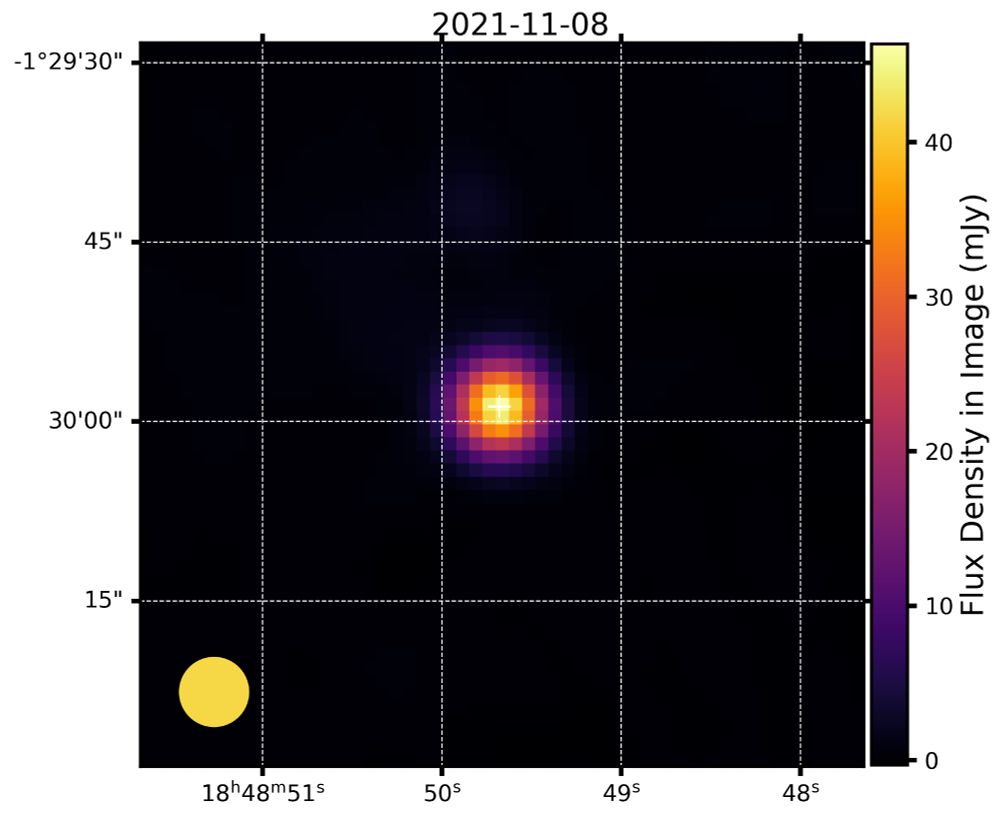
Bursts from Space: MeerKAT
https://www.zooniverse.org/projects/alex-andersson/bursts-from-space-meerkat
Subject Number: 70786879
Talk on the subject:
https://www.zooniverse.org/projects/alex-andersson/bursts-from-space-meerkat/talk/subjects/70786879
The flux density from this astronomical object was expressed in milliJansky unit, by a color map (not real colors).
The orange blob at the left bottom is the PSF ("point spread function"), showing the shape of an ideal pointwise source as recorded by the radiotelescope taking in count the spatial resolution of the instrument, and the sky position of the object.
Reference with my contribute as a citizen scientist:
https://doi.org/10.1093/mnras/stad1298
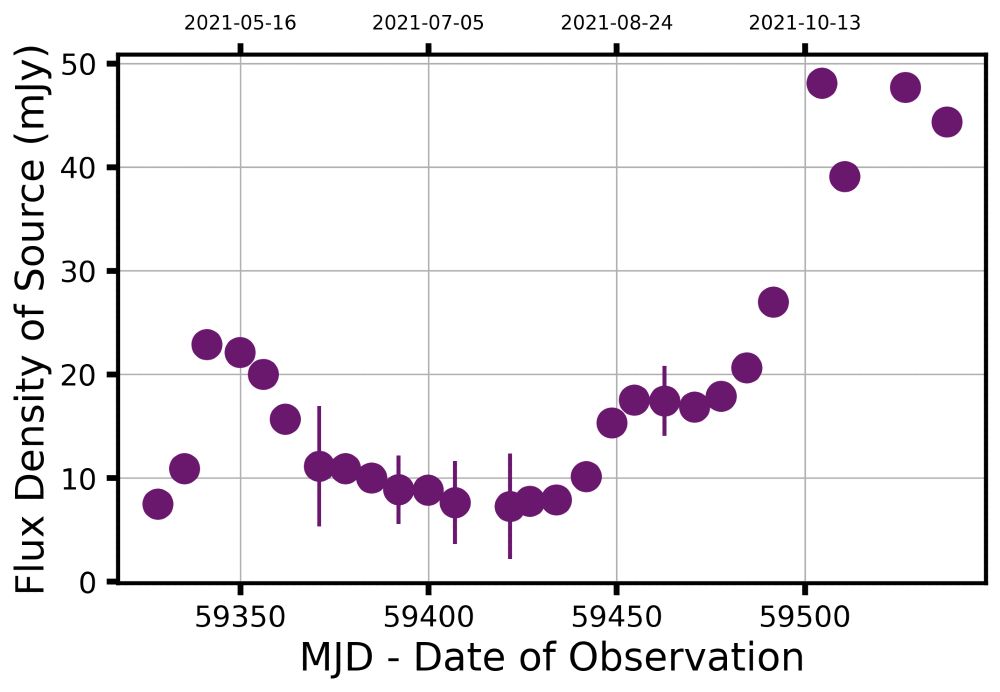
Almost all of the error bars are smaller than the diameter of the dots, still showing a significative dynamic range in the flux density over the time.
The variability amplitude is about 40 mJy, excluding the outliers.
The median flux is about 15.7 mJy.
The subject has a good activity in the explored time window, for the available time resolution, with a first distinctive growing phase between the epochs 59300 MJD - 59350 MJD; a falling phase between the epochs 59350 MJD - 59425 MJD; a second prominent growing phase between the epochs 59425 MJD - 59525 MJD.
"MJD" stands for "Modified Julian Day": this is a time unit used by astronomers to refer to an event "zero", without having to calculate the days from the ordinary calendary. This is a uniform time reference.
Slow variable pointwise radio source from my collections on Zooniverse
Coordinates:
282.206987053898 , -1.49966214209343
Data Credits: Project "Bursts from Space: MeerKAT"
Click radio image and "light curve" for more
#astronomy
#radioastronomy
#timedomainastronomy
#citizenscience
#zooniverse
03.04.2025 20:22
👍 3
🔁 0
💬 0
📌 0
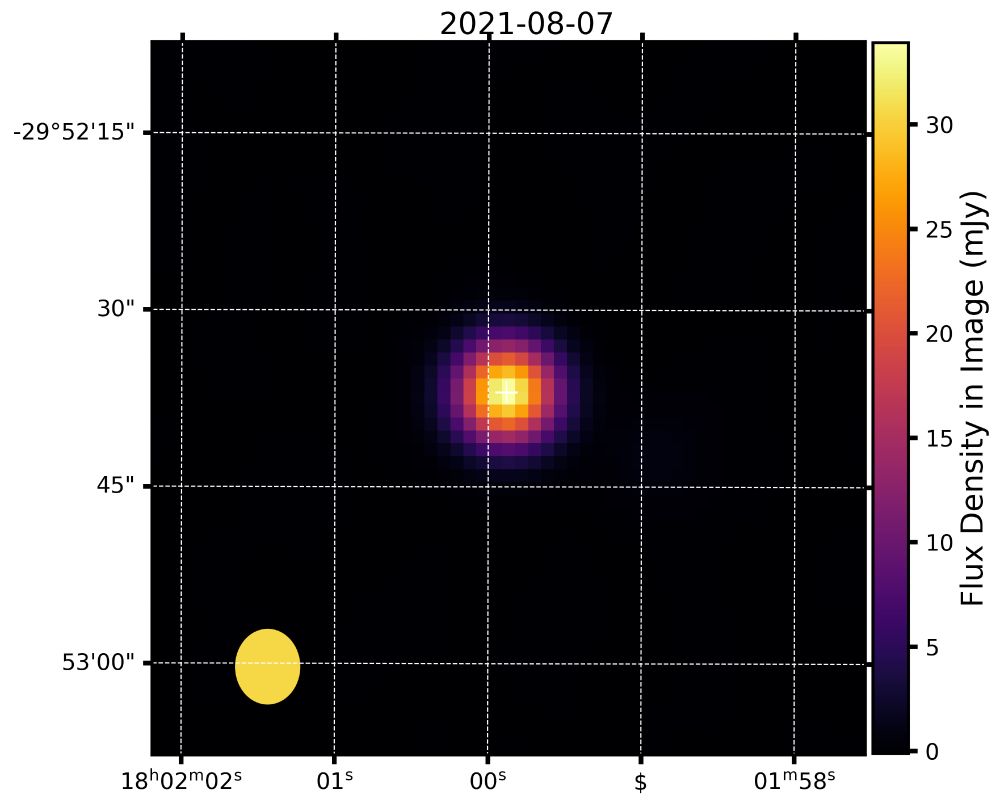
Bursts from Space: MeerKAT
https://www.zooniverse.org/projects/alex-andersson/bursts-from-space-meerkat
Subject Number: 70790078
Talk on the subject:
https://www.zooniverse.org/projects/alex-andersson/bursts-from-space-meerkat/talk/subjects/70790078
The flux density from this astronomical object was expressed in milliJansky unit, by a color map (not real colors).
The orange blob at the left bottom is the PSF ("point spread function"), showing the shape of an ideal pointwise source as recorded by the radiotelescope taking in count the spatial resolution of the instrument, and the sky position of the object.
Reference with my contribute as a citizen scientist:
https://doi.org/10.1093/mnras/stad1298
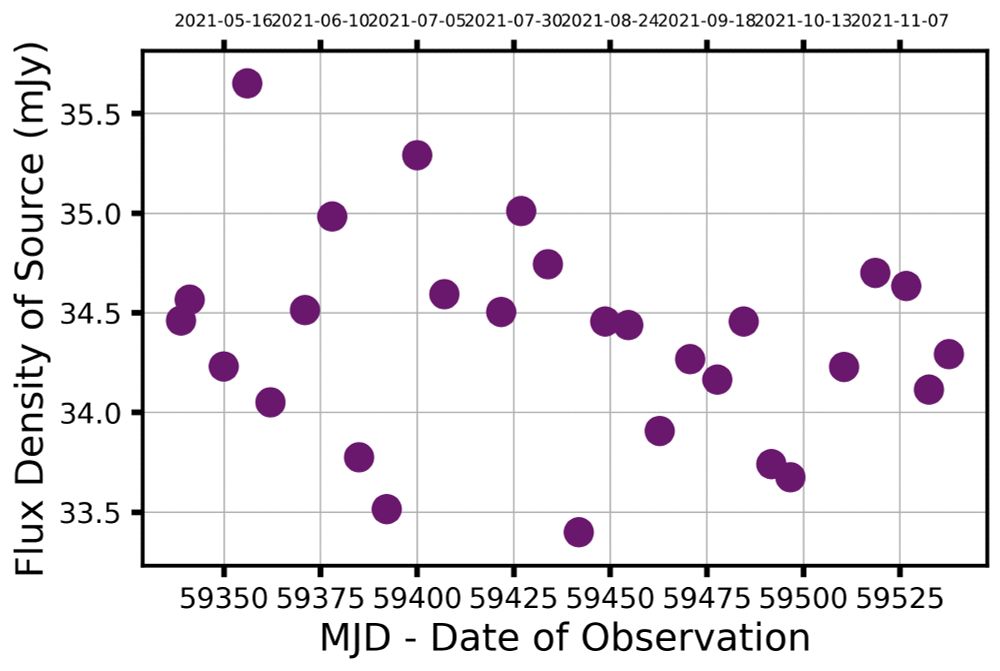
The error bars are smaller than the diameter of the dots, showing a significative dynamic range in the flux density over the time.
The variability amplitude is about 1.75 mJy, excluding the outliers.
The median flux is about 34.45 mJy.
The subject has a good activity in the explored time window, for the available time resolution.
"MJD" stands for "Modified Julian Day": this is a time unit used by astronomers to refer to an event "zero", without having to calculate the days from the ordinary calendary. This is a uniform time reference.
Fast variable pointwise radio source from my collections on Zooniverse
Coordinates:
270.49949659664 , -29.876944065209997
Data Credits: Project "Bursts from Space: MeerKAT"
Click radio image and "light curve" for more
#astronomy
#radioastronomy
#timedomainastronomy
#citizenscience
#zooniverse
29.03.2025 21:49
👍 11
🔁 1
💬 0
📌 0

GZ Euclid
This app was built in Streamlit! Check it out and visit https://streamlit.io for more awesome community apps. 🎈
Loving the Euclid @ec-euclid.bsky.social galaxy explorer tool by Mike Walmsley. Thanks to the @galaxyzoo.org volunteers for all this work! euclid.streamlit.app 🔭🧪
24.03.2025 14:22
👍 21
🔁 7
💬 0
📌 1
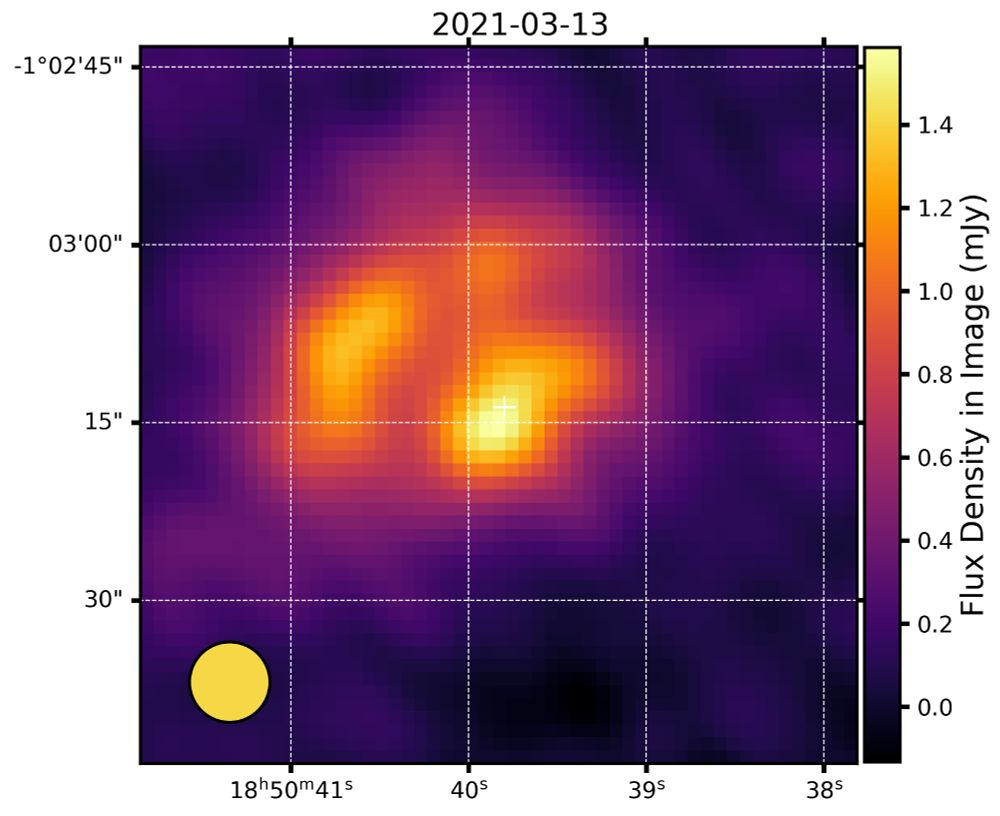
Bursts from Space: MeerKAT
https://www.zooniverse.org/projects/alex-andersson/bursts-from-space-meerkat
Subject Number: 70786719
Talk on the subject:
https://www.zooniverse.org/projects/alex-andersson/bursts-from-space-meerkat/talk/subjects/70786719
The flux density from this astronomical object was expressed in milliJansky unit, by a color map (not real colors).
The orange blob at the left bottom is the PSF ("point spread function"), showing the shape of an ideal pointwise source as recorded by the radiotelescope taking in count the spatial resolution of the instrument, and the sky position of the object.
Reference with my contribute as a citizen scientist:
https://doi.org/10.1093/mnras/stad1298
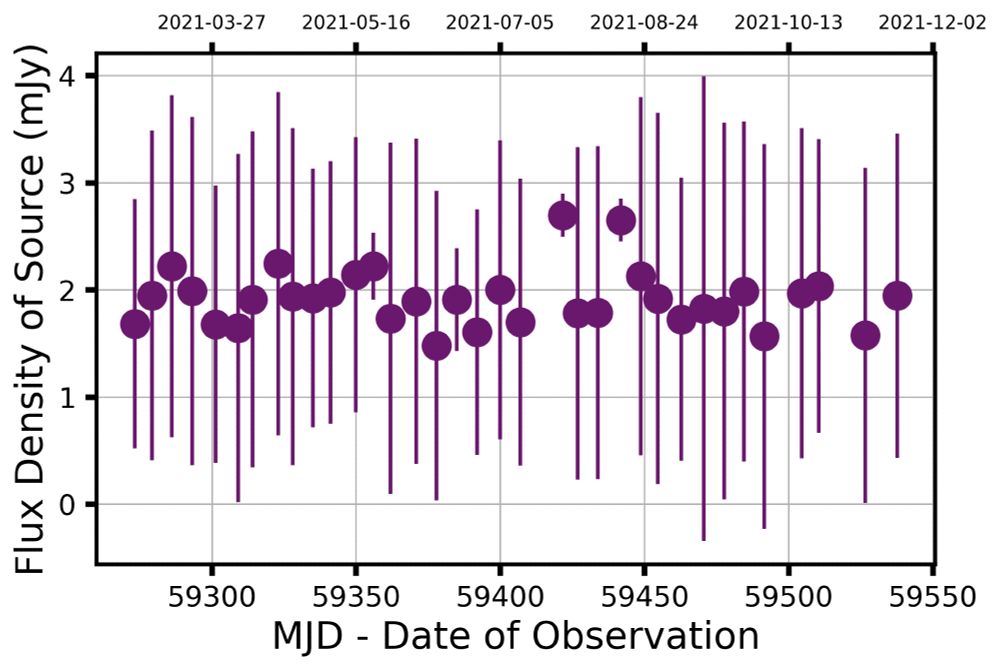
The extension of the error bars, and the distribution of the dots in the light curve excluding the outliers, show a stable flux around 1.92 mJy.
"MJD" stands for "Modified Julian Day": this is a time unit used by astronomers to refer to an event "zero", without having to calculate the days from the ordinary calendary. This is a uniform time reference.
Extended stable radio source from my collections on Zooniverse
Coordinates:
282.665813752953 , -1.0538110718629101
Data Credits: Project "Bursts from Space: MeerKAT"
Click the image and "light curve" for more
#astronomy
#radioastronomy
#timedomainastronomy
#citizenscience
#zooniverse
22.03.2025 22:12
👍 11
🔁 2
💬 0
📌 0
Comet C/2024 G3 (ATLAS) spotted in full glory by #SolarOrbiter.
The #comet was observed with the SoloHI instrument from the U.S. Naval Research Laboratory.
The encounter happened on 14-25 January, while Solar Orbiter was heading toward #Venus and the comet coincidentally swung by the #Sun.
🔭 🧪
21.03.2025 14:00
👍 232
🔁 79
💬 8
📌 7

The Open University
The @openuniversity.bsky.social has a nice news article on the @ec-euclid.bsky.social @eucliduk.bsky.social data release today, including some breakthrough work on lens discovery done by my grad student Ruby Pearce-Casey 🧪🔭 www.open.ac.uk/blogs/news/s...
19.03.2025 12:08
👍 20
🔁 5
💬 0
📌 1

Bursts from Space: MeerKAT
https://www.zooniverse.org/projects/alex-andersson/bursts-from-space-meerkat
Subject Number: 70786950
Talk on the subject:
https://www.zooniverse.org/projects/alex-andersson/bursts-from-space-meerkat/talk/subjects/70786950
The flux density from this astronomical object was expressed in milliJansky unit, by a color map (not real colors).
The orange blob at the left bottom is the PSF ("point spread function"), showing the shape of an ideal pointwise source as recorded by the radiotelescope taking in count the spatial resolution of the instrument, and the sky position of the object.
Reference with my contribute as a citizen scientist:
https://doi.org/10.1093/mnras/stad1298

Almost all of the error bars are smaller than the diameter of the dots, showing a significative dynamic range in the flux density over the time.
The variability amplitude is about 7 mJy, excluding the outliers.
The median flux is about 37.88 mJy.
The subject has a good activity in the explored time window, for the available time resolution.
"MJD" stands for "Modified Julian Day": this is a time unit used by astronomers to refer to an event "zero", without having to calculate the days from the ordinary calendary. This is a uniform time reference.
Extended variable radio source from my collections on Zooniverse
Coordinates:
282.253366334433 , -1.9079543352235002
Data Credits: Project "Bursts from Space: MeerKAT"
Click the radio image and the "light curve" for more
#astronomy
#radioastronomy
#timedomainastronomy
#citizenscience
#zooniverse
17.03.2025 08:38
👍 7
🔁 0
💬 0
📌 0

Image enhanced by a colormap, to show the gradients with low intensity: the little-scale structures of the galactic disk
Reference for the Hubble catalog: MAST - Barbara A. Mikulski Archive for Space Telescopes | Advanced Search
https://mast.stsci.edu/portal/Mashup/Clients/Mast/Portal.html
Calibration level: 3 - scientific products
Instrument_name: ACS/WFC
Proposal_id: 13750
Proposal_type: GO
Spectral band: optical
Filter: F606W
Coordinates of the Hubble field (center): 0.08883333333333 , 31.0225
Processed FITS file: hst_skycell-p1930x11y15_acs_wfc_f606w_all_drc.fits
Angular scale: 1 pixel = 0.039987419 arcsec
Signal scale: logarithmic
Signal units: e-/s
Signal range (histogram cut): 0.0676956 e-/s , 0.387074 e-/s
Colormap: "sls inverted"
Coordinates of the object: 0.10458656 , 31.014292
Processing tool: DS9 - https://sites.google.com/cfa.harvard.edu/saoimageds9
Astronomical Data Center (search and download): ESASky web portal - https://sky.esa.int/esasky/

Image enhanced by a colormap, to show the gradients with mean intensity: the large-scale structures of the galactic disk
Reference for the Hubble catalog: MAST - Barbara A. Mikulski Archive for Space Telescopes | Advanced Search
https://mast.stsci.edu/portal/Mashup/Clients/Mast/Portal.html
Calibration level: 3 - scientific products
Instrument_name: ACS/WFC
Proposal_id: 13750
Proposal_type: GO
Spectral band: optical
Filter: F606W
Coordinates of the Hubble field (center): 0.08883333333333 , 31.0225
Processed FITS file: hst_skycell-p1930x11y15_acs_wfc_f606w_all_drc.fits
Angular scale: 1 pixel = 0.039987419 arcsec
Signal scale: logarithmic
Signal units: e-/s
Signal range (histogram cut): 0.0676956 e-/s , 0.387074 e-/s
Colormap: "b inverted"
Coordinates of the object: 0.10458656 , 31.014292
Processing tool: DS9 - https://sites.google.com/cfa.harvard.edu/saoimageds9
Astronomical Data Center (search and download): ESASky web portal - https://sky.esa.int/esasky/

Image enhanced by a colormap, to show the gradients with high intensity: the structure of the galactic core
Reference for the Hubble catalog: MAST - Barbara A. Mikulski Archive for Space Telescopes | Advanced Search
https://mast.stsci.edu/portal/Mashup/Clients/Mast/Portal.html
Calibration level: 3 - scientific products
Instrument_name: ACS/WFC
Proposal_id: 13750
Proposal_type: GO
Spectral band: optical
Filter: F606W
Coordinates of the Hubble field (center): 0.08883333333333 , 31.0225
Processed FITS file: hst_skycell-p1930x11y15_acs_wfc_f606w_all_drc.fits
Angular scale: 1 pixel = 0.039987419 arcsec
Signal scale: linear
Signal units: e-/s
Signal range (histogram cut): 0.0676956 e-/s , 0.387074 e-/s
Colormap: "sls inverted"
Coordinates of the object: 0.10458656 , 31.014292
Processing tool: DS9 - https://sites.google.com/cfa.harvard.edu/saoimageds9
Astronomical Data Center (search and download): ESASky web portal - https://sky.esa.int/esasky/
Gradient analysis of galaxies in the Hubble fields
Coordinates:
0.10458656 , 31.014292
Data Credits: Hubble Space Telescope
Click the images for more
#astronomy
#hubblespacetelescope
#imageprocessing
16.03.2025 21:14
👍 9
🔁 2
💬 0
📌 0

Image enhanced by a colormap, to show the gradients with low intensity: the little-scale structures of the galactic disk
Reference for the Hubble catalog: MAST - Barbara A. Mikulski Archive for Space Telescopes | Advanced Search
https://mast.stsci.edu/portal/Mashup/Clients/Mast/Portal.html
Calibration level: 3 - scientific products
Instrument_name: ACS/WFC
Proposal_id: 13750
Proposal_type: GO
Spectral band: optical
Filter: F606W
Coordinates of the Hubble field (center): 0.08883333333333 , 31.0225
Processed FITS file: hst_skycell-p1930x11y15_acs_wfc_f606w_all_drc.fits
Angular scale: 1 pixel = 0.039987419 arcsec
Signal scale: logarithmic
Signal units: e-/s
Signal range (histogram cut): 0.0678952 e-/s , 1.16467 e-/s
Colormap: "sls inverted"
Coordinates of the object: 0.038007605 , 31.016747
Processing tool: DS9 - https://sites.google.com/cfa.harvard.edu/saoimageds9
Astronomical Data Center (search and download): ESASky web portal - https://sky.esa.int/esasky/

Image enhanced by a colormap, to show the gradients with mean intensity: the large-scale structures of the galactic disk
Reference for the Hubble catalog: MAST - Barbara A. Mikulski Archive for Space Telescopes | Advanced Search
https://mast.stsci.edu/portal/Mashup/Clients/Mast/Portal.html
Calibration level: 3 - scientific products
Instrument_name: ACS/WFC
Proposal_id: 13750
Proposal_type: GO
Spectral band: optical
Filter: F606W
Coordinates of the Hubble field (center): 0.08883333333333 , 31.0225
Processed FITS file: hst_skycell-p1930x11y15_acs_wfc_f606w_all_drc.fits
Angular scale: 1 pixel = 0.039987419 arcsec
Signal scale: logarithmic
Signal units: e-/s
Signal range (histogram cut): 0.0678952 e-/s , 1.16467 e-/s
Colormap: "b inverted"
Coordinates of the object: 0.038007605 , 31.016747
Processing tool: DS9 - https://sites.google.com/cfa.harvard.edu/saoimageds9
Astronomical Data Center (search and download): ESASky web portal - https://sky.esa.int/esasky/

Image enhanced by a colormap, to show the gradients with high intensity: the structure of the galactic core
Reference for the Hubble catalog: MAST - Barbara A. Mikulski Archive for Space Telescopes | Advanced Search
https://mast.stsci.edu/portal/Mashup/Clients/Mast/Portal.html
Calibration level: 3 - scientific products
Instrument_name: ACS/WFC
Proposal_id: 13750
Proposal_type: GO
Spectral band: optical
Filter: F606W
Coordinates of the Hubble field (center): 0.08883333333333 , 31.0225
Processed FITS file: hst_skycell-p1930x11y15_acs_wfc_f606w_all_drc.fits
Angular scale: 1 pixel = 0.039987419 arcsec
Signal scale: linear
Signal units: e-/s
Signal range (histogram cut): 0.0678952 e-/s , 1.16467 e-/s
Colormap: "sls inverted"
Coordinates of the object: 0.038007605 , 31.016747
Processing tool: DS9 - https://sites.google.com/cfa.harvard.edu/saoimageds9
Astronomical Data Center (search and download): ESASky web portal - https://sky.esa.int/esasky/
Gradient analysis of galaxies in the Hubble fields
Coordinates:
0.038007605 , 31.016747
Data Credits: Hubble Space Telescope
Click the images for more
#astronomy
#hubblespacetelescope
#imageprocessing
11.03.2025 23:00
👍 8
🔁 1
💬 0
📌 0