Please join us at #CHI2026 to think about community + connection! Bring your own crafts + we will have some provided.
23.02.2026 17:31
👍 1
🔁 0
💬 0
📌 0
Please join us at #CHI2026 to think about community + connection! Bring your own crafts + we will have some provided.

And there's a sibling piece led by @drnikko.bsky.social about trans specific data epistemologies journals.sagepub.com/doi/full/10....
![Research Agenda for Trans
Data
Implications for Data
Advocacy Research
Implications for CSCW
Research
Trans data materially
improves trans lives.
Embrace political
orientations of data [68] as
articulated in previous data
activism and advocacy
research [20, 26]
Research in service to a
community rather than
researching communities
Trans data crosses
boundaries.
Consider expansive
definitions of data [27] when
describing data advocacy
practices
Embrace embodied
knowledge and help build
non-conventional data
outputs
Trans data requires constant
power analysis.
Support activists with
already established power
analysis in considering how
data might be useful to them
Consider whether
participants might have
capacity to use tools built for
them
Table 4. Summary of research and design implications from trans data for data advocacy research and CSCW
research.](https://cdn.bsky.app/img/feed_thumbnail/plain/did:plc:f4lyb765sp4d25a5jb4igr65/bafkreiftojysbapns5vfb72mtpssdyipis4oe7u377mbgy454f5xpiz6wa@jpeg)
Research Agenda for Trans Data Implications for Data Advocacy Research Implications for CSCW Research Trans data materially improves trans lives. Embrace political orientations of data [68] as articulated in previous data activism and advocacy research [20, 26] Research in service to a community rather than researching communities Trans data crosses boundaries. Consider expansive definitions of data [27] when describing data advocacy practices Embrace embodied knowledge and help build non-conventional data outputs Trans data requires constant power analysis. Support activists with already established power analysis in considering how data might be useful to them Consider whether participants might have capacity to use tools built for them Table 4. Summary of research and design implications from trans data for data advocacy research and CSCW research.
We highlight how trans data can be used to build new data collection, analysis, and communication systems that serve trans liberation and help reorient researchers to the deep political commitments of data for and about trans people. And also there are implications for data advocacy + CSCW research!
We create a design/research agenda called trans data that prioritizes trans ppl (drawing on prev research abt trans tech + trans competent interaction design). We propose:
1) Trans data materially improves trans lives.
2)Trans data crosses boundaries.
3) Trans data requires constant power analysis.
They record data in structured formats like databases but also informally through building things like "the trans brain trust on making name changes." They also refuse data (to protect trans ppl) + use data to reframe common narratives.
We got to think about how US trans activists use data in interesting + nuanced ways that affirm expansive definitions of data like stories, letters, and more. They research for data through traditional methods like in-person data gathering but also through embodied work as activists.

New work that I got to present at #CSCW2025 (that got an honorable mention + DEI recognition) with @drnikko.bsky.social @kanarinka.bsky.social "Trans Data: A Research and Design Agenda from Trans Activists' Transformative Data Science" dl.acm.org/doi/10.1145/...
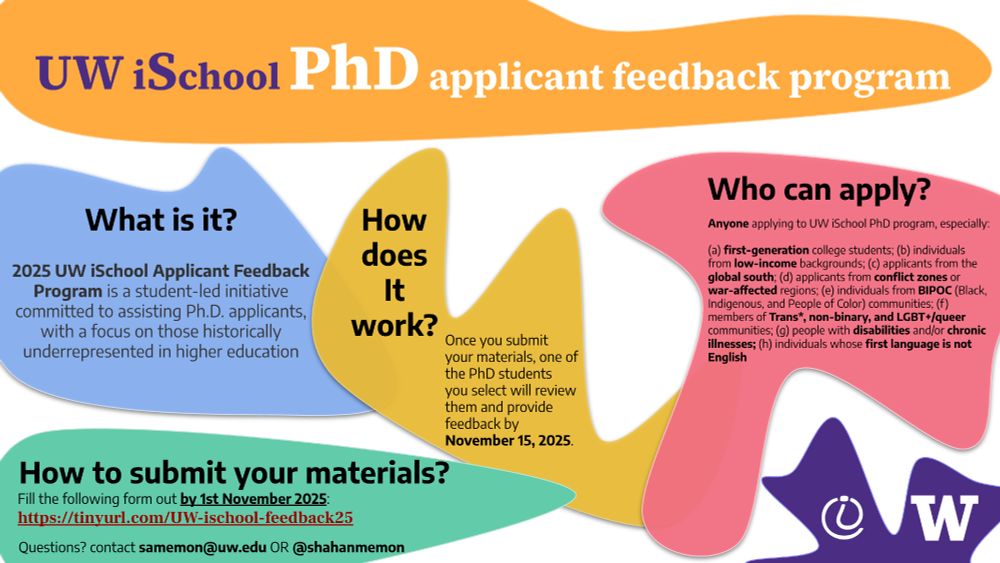
Applying for a #PhD @ischool.uw.edu? Read 👇
Our student-run application feedback program will be open from October 20th through 1st November 2025.
Everyone applying, especially those from historically underrepresented groups or who have faced barriers in higher ed are highly encouraged to apply.

Excited to be a Madrona Fellow this year with @ecotrust.bsky.social thinking about food + culture + land + climate in the Pacific Northwest with sooooo many other inspiring people in the region ecotrust.org/madrona-fell...

UW News spoke with Amelia Lee Doğan @ameliadogan.bsky.social & Lindah Kotut @kotut.bsky.social of the Information School about what can AI developers learn from climate activists.
Read the Q&A:
www.washington.edu/news/2025/08...
Read the research article: dl.acm.org/doi/full/10....

Did a Q and A with @kotut.bsky.social for UW News about what developers for AI for sustainability can gain from engaging with climate and environmental advocates www.washington.edu/news/2025/08...
We propose a "down to earth" approach to AI for sustainability that 1) engages intended beneficiaries and advocates
2) address the urgency of the climate crisis
3) evaluates societal and environmetal impacts
Some of it stems from systematic barriers developers face, a lack of systematic approaches to climate change that address root causes, and not a lot of useful AI tools for climate and environmental advocates. There's also a lot of skepticism for the sustainability impacts of the actual AI itself.
We look at how developers of AI for sustainability + environmental and climate advocates perceive + use AI. We found that everyone cares about the planet + people which is why they do this work, but there's a lot of barriers preventing effective AI for sustainability.

New work at #DIS25 with Hongjin Lin and @kotut.bsky.social (who will be presenting)! "Down to Earth": Design Considerations for AI for Sustainability from the Environmental and Climate Movement dl.acm.org/doi/10.1145/...

I'm co-organizing a workshop for #C&C2025. Join us to explore intersections of design, decolonial feminisms, and activist knowledge.
June 23 – Online
Submit your story, artwork, or creative format by May 23.
All welcome, no prior experience required. sites.google.com/view/intdesign-as-a-form-of-care

happy to have gotten to talk to The Daily about AI + climate + all over the contradictions within www.dailyuw.com/special_sect...