Difficult to resist the urge to tweet 'told you so' every I see a headline like this. And so I've decided not to resist that urge at all!
www.cambridge.org/core/journal...
02.02.2026 19:15
👍 18
🔁 4
💬 1
📌 2
Others can likely answer this more proficiently than I can, but Marathousa 1 is a very cold glacial, MIS 12, so likely not with high sea levels, and therefore not cut off. Hope that helps a bit! Cool paper, thanks for sharing.
28.01.2026 15:02
👍 1
🔁 0
💬 0
📌 0

EPE 2026 Award Nominations
Nominations for the University of Michigan's Evolution & Human Adaptation Program award: Evolution in the Public Eye
Nomination deadline: January 31, 2026
Award Description:
This award honors outsta...
Help recognize people who have gone above and beyond in communicating and countering misinformation about human evolutionary science by nominating them for the 2026 Evolution in the Public Eye award! Self-nominations allowed too. Deadline extended until February 7th! forms.gle/VXJgczHA1irD...
27.01.2026 21:26
👍 4
🔁 6
💬 0
📌 1
I love how accurate the reconstruction is: she is carving a small alder trunk, in the right direction on the basis of the toolmarks we documented on the tool, with the landscape, palaeolake and fauna in the background all rooted in the evidence from Marathousa 1. Thank you Katerina & Gleiver!👏
28.01.2026 08:40
👍 33
🔁 5
💬 0
📌 0

The artwork that illustrated our PNAS paper on the oldest wooden tools was made by Gleiver Prieto, who has also worked with me on illustrations for previous projects, including the paleoenvironmental reconstruction of Marathousa 1.
Gleiver's art really brings Pleistocene Megalopolis to life ✨ 🤩
27.01.2026 17:19
👍 73
🔁 13
💬 4
📌 2
I waited in for a full WEEK for a refurbished laptop from @backmarketofficial.bsky.social to be delivered by DHL. I don't know whether the driver has stolen the item or is just incompetent, but Backmarket won't help either. Good news: I can request a chargeback from the bank so I can get my £ back!
27.01.2026 18:29
👍 1
🔁 0
💬 0
📌 0

Eine künstlerische Darstellung eines Menschen in prähistorischer Fellkleidung, der einen Ast bearbeitet. Im Hintergrund sind Landschaftselemente wie ein See, Berge und grasende Tiere zu sehen. Text im Bild: "Frühester Nachweis von Menschenhand genutzter Holzwerkzeuge". Oben ist das Wort "Forschung" zu lesen.
Die bisher frühesten bekannten Holzwerkzeuge, die Menschen nutzten, stammen aus Griechenland. Ein Forschungsteam der Universitäten Tübingen und Reading sowie der Senckenberg Gesellschaft für Naturforschung hat rund 430.000 Jahre alte Belege entdeckt: 👉 uni-tuebingen.de/universitaet/… #Archäologie
27.01.2026 09:22
👍 27
🔁 10
💬 1
📌 0
Thank you @andrewcurry.com for covering the research and to colleagues for contributing their thoughts!
Artistic reconstruction by G. Prieto of a Palaeolithic woman producing a digging stick at the Marathousa site from a small alder tree trunk with a small stone tool (copyright K. Harvati).
27.01.2026 13:22
👍 12
🔁 2
💬 0
📌 0
I've really enjoyed working with the @harvatilab.bsky.social and to make a contribution to their amazing site, research team, and findings!
27.01.2026 11:03
👍 7
🔁 0
💬 1
📌 0
Thanks to advances in methods over the last decade to identify early wood tools, including developing expertise as well as methods such as microCT scans and microscopy, we can now more clearly differentiate natural background wood from these simple modified tools.
27.01.2026 11:01
👍 9
🔁 0
💬 1
📌 0

Digging stick with close-up images of tool marks
Marathousa 1 joins just a handful of early sites in Zambia, China, the UK and Germany to have clear evidence that humans were making and using wooden tools. Hominins were making use of plants for 'simple' tools, and potentially using them also to search for plant resources.
27.01.2026 11:01
👍 13
🔁 0
💬 1
📌 1
Among an assemblage of 144 sampled wood remains from an elephant butchery area, which also included stone tools, we have discovered two wooden tools. A larger tool, likely a digging stick, made of alder, and a much smaller tool made of willow.
27.01.2026 11:01
👍 9
🔁 0
💬 1
📌 0

Evidence for the earliest hominin use of wooden handheld tools found at Marathousa 1 (Greece) | PNAS
The Middle Pleistocene (MP; ca. 774 to 129 ka) marks a critical period of human evolution,
characterized by increasing behavioral complexity and th...
Such a pleasure to share our latest article on the wooden tools from Marathousa 1 (Megalopolis), the oldest known in the world at 430 ka.
Congratulations to the team!
Evidence for the earliest hominin use of wooden handheld tools found at Marathousa 1 (Greece) | PNAS www.pnas.org/doi/10.1073/...
26.01.2026 21:14
👍 28
🔁 9
💬 2
📌 0
PNAS
Proceedings of the National Academy of Sciences (PNAS), a peer reviewed journal of the National Academy of Sciences (NAS) - an authoritative source of high-impact, original research that broadly spans...
Usually, stones and bones get all the attention, but wood was part of the toolkit too, and the evidence is growing! 🪵
A new paper by @annemiekemilks.bsky.social et al. reports the earliest handheld wooden tools (~430 ka) from Marathousa 1 (Greece)! @harvatilab.bsky.social 🦣🧪🏺
26.01.2026 21:28
👍 13
🔁 3
💬 0
📌 0
It's temporary, but I know I'll learn and grow a lot from teaching, and feel lucky to be able to pass it on for a short while.
11.01.2026 17:18
👍 2
🔁 0
💬 0
📌 0
This year I have the privilege of lecturing in lithics, experimental archaeology, human evolution, early prehistory, and the European Lower Palaeolithic at U. of Reading. It's a lot...but also, very exciting to be in a position to share my knowledge and experience with students!
11.01.2026 10:27
👍 24
🔁 0
💬 2
📌 0
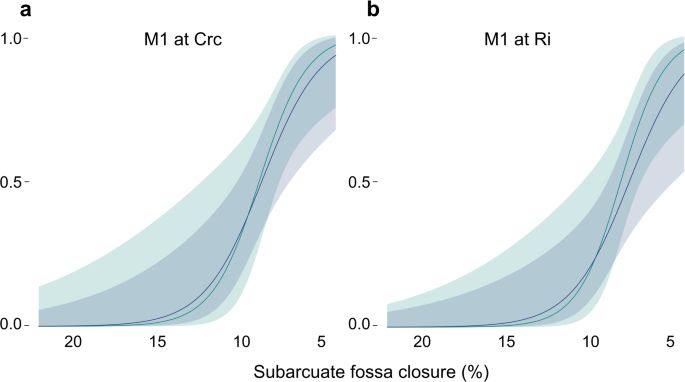
Complex and diverse patterns of neurocranial development in Australopithecus, Paranthropus and Homo - Scientific Reports
Scientific Reports - Complex and diverse patterns of neurocranial development in Australopithecus, Paranthropus and Homo
Al contrario que el desarrollo prolongado en el neurocráneo de H. sapiens y H. erectus, en Au. afarensis y P. robustus los patrones de desarrollo son variables:
Complex and diverse patterns of neurocranial development in Australopithecus, Paranthropus and Homo
28.12.2025 12:30
👍 1
🔁 2
💬 0
📌 0
Thanks again for your invaluable contributions to this study!
28.12.2025 11:42
👍 1
🔁 0
💬 0
📌 0
Many journals are outsourcing the proofing process, with horrendous and wasteful outcomes. Just don't approve until it's right I guess. Sorry you had that experience.
28.12.2025 11:40
👍 0
🔁 0
💬 0
📌 0
I have to correct the proofs for publication, a normal part of the publishing process. It was the timing that's totally bonkers. They could make settings to have a few days where they don't 'bother' people, maybe even take a break themselves!
28.12.2025 09:50
👍 1
🔁 0
💬 0
📌 0
Educate me: are there not established genetic links for many psychological disorders?
28.12.2025 09:44
👍 0
🔁 0
💬 0
📌 0
Academia doesn't have a healthy work culture, and neither does America. So imagine my (total lack of) surprise when I got proofs for an article ON Christmas day from a big American journal, followed by email reminders to do them w/in 48 hours. Nope nope nope. I am on vacation. Enjoy your breaks!
28.12.2025 09:42
👍 9
🔁 0
💬 2
📌 0
Amazing - congratulations! I've always been a fan of the 'multifunctionality' argument for many early tools, it's great to see some formalised evidence-based results of that. 👏
04.12.2025 09:41
👍 0
🔁 0
💬 0
📌 0
I am very happy to see this published! Congratulations 🥳 to Okopi Ade, it was a pleasure to have you in our lab at @tracer-leiza.bsky.social @paleomonrepos.bsky.social @leizarchaeology.bsky.social We all learned a lot
02.12.2025 13:37
👍 28
🔁 10
💬 1
📌 0

Last weekend I got out on my board for a wonderful session (just me and a few others out on the meanders). Today might be the last warm day before the temperature drops by quite a large margin so maybe I can fit one more in for 2025!
15.11.2025 10:23
👍 1
🔁 0
💬 0
📌 0
As do you. I recently had a non-archaeology academic colleague get wrapped into an email thread with archaeologists, and they messaged me to comment on how awful archs are to each other. 😬
12.11.2025 16:50
👍 3
🔁 0
💬 0
📌 0
That doesn't of course mean there's no scope for being critical, especially when a correction is in order, but one can be decent and fair in critiques.
12.11.2025 14:01
👍 1
🔁 0
💬 0
📌 0
Our wider research culture in archaeology is a shame, I hang on dearly to those collaborators that are decent, supportive (especially of early career researchers), share ideas, work well with others, and understand what 'constructive' feedback means. Every day I try to be that person for others.
12.11.2025 13:59
👍 8
🔁 0
💬 2
📌 0