Expect inspiring talks and lively discussions on response diversity, stability, and ecological insurance mechanisms.
If you’re attending #BES2025, join us for an engaging conversation about biodiversity and stability!
04.12.2025 07:53
👍 0
🔁 0
💬 0
📌 0
📅 Date: Wednesday, 17 December 2025
🕒 Time: 15:00 – 17:00
📍 Location: Edinburgh
This session will bring together many members of the Response Diversity Network to explore how response diversity shapes ecosystem resilience across scales.
04.12.2025 07:53
👍 1
🔁 0
💬 1
📌 0
Excited to announce our thematic session at @britishecologicalsociety.org annual meeting!
@ckunze.bsky.social and I will be co-chairing the thematic session entitled “Insurance in ecosystems: exploring the role of response diversity across scales”.
04.12.2025 07:53
👍 4
🔁 3
💬 1
📌 0
This work reframes how we think about the diversity–stability relationship and highlights the power of response diversity as a stabilizing force.
With: Til Hämmig, @owpet.bsky.social & @pennekampster.bsky.social
02.10.2025 15:30
👍 0
🔁 0
💬 0
📌 0
Structural equation models showed that asynchrony and population stability—both shaped by imbalance—explained most of the variation in community stability.
This suggests that in our system species’ fundamental responses (measured in monocultures) determine stability, not interactions.
02.10.2025 15:30
👍 0
🔁 0
💬 2
📌 0
Key finding:
A new metric—imbalance—captures how unevenly species respond to the environment.
→ Lower imbalance = higher community stability
→ Richness alone had no effect!
02.10.2025 15:30
👍 0
🔁 0
💬 1
📌 0
We show that it’s not richness, but how differently species respond to the environment.
🔬 Using protist microcosms, we manipulated:
🌡️ Temperature fluctuations
🧪 Nutrient levels
🌱 Species richness
📈 Distribution of species’ thermal performance curves
02.10.2025 15:30
👍 0
🔁 0
💬 1
📌 0
AI tips and tricks | TheTrophicLink
At our recent group retreat we shared AI tips and tricks:
Don’t forget all the cool stuff in Google NotebookLM, including making podcasts to listen to on the train, in the gym, or while doing the lau...
AI in research, tips and tricks from the retreat of my and Frank Pennekamp's research groups. Nothing too revolutionary, but we found it useful to share. Happy to hear any of your tips and tricks!
@pennekampster.bsky.social @fancescopolazzo.bsky.social
thetrophiclink.org/posts/2025-0...
08.07.2025 12:34
👍 3
🔁 1
💬 0
📌 1

PhD student in Ecology (up to 4 years)
The position is funded by the Swiss National Science Foundation project “A mechanistic theory of functional responses: zooming into movement behaviour to understand and predict predator prey interacti...
Are you interested in predator-prey interactions and movement ecology?
I am looking for a PhD student to work on the project "A mechanistic theory of functional responses: zooming into movement behaviour to understand and predict predator-prey interactions"
euraxess.ec.europa.eu/jobs/342402.
14.05.2025 12:27
👍 14
🔁 16
💬 2
📌 4
Wiley - swissuniversities
swissuniversities and Wiley are in a no-deal situation. Suggestions include to consider alternatives to Wiley, and to reconsider review activities for Wiley. Very sad---some great ecology and evolution journals are with Wiley. www.swissuniversities.ch/en/topics/op...
15.04.2025 13:28
👍 1
🔁 1
💬 0
📌 0

Details of the Response Diversity Network seminar, given by JF Arnoldi, including a Zoom link and Abstract:
Ecosystem functions describe processes like biomass production, respiration, or nutrient cycling, that can be key to the livelihood of humans and other life forms. These functions are collectively performed by the many species that constitute an ecosystem; trees in a forest, plants in a grassland, or bacterial strains in a microbiome. Here, I will use linear algebra to show that generically, there is a sense in which a rare species can have as much importance as an abundant one. The reason why this claim is not obvious comes from the fact that in functional ecology, under the mass-ratio hypothesis, species contributions should be well predicted by their effect traits and abundance. I will illustrate using soil-microbiome data that this hypothesis has merit, even for complex functions related to nutrient cycling. Yet the mass-ratio hypothesis has an awkward corollary: functions are typically performed by just a few dominant species, so that most of an ecosystem's diversity appears redundant, or even useless. To understand why rare species can be important, one has to take a perturbative approach, looking at the sensitivity of a function to say, added mortality (a pathogen) on a given species. Doing so reveals a completely different picture than the one the mass-ratio hypothesis depicts. Via direct and indirect interactions between them, species can have large impacts on a given function, even if those species are rare or if they do not possess traits that relate to the function.
Happy to announce that JF Arnoldi (Theoretical and Experimental Ecology Station, CNRS, France) will present the next #ResponseDiversityNetwork Seminar, Wednesday 26th Feb 15.00 CET.
"Linear functional ecology:� Rethinking species contributions to ecosystem functions"
Zoom link via rb.gy/3pf8dh
24.02.2025 13:15
👍 9
🔁 4
💬 0
📌 2
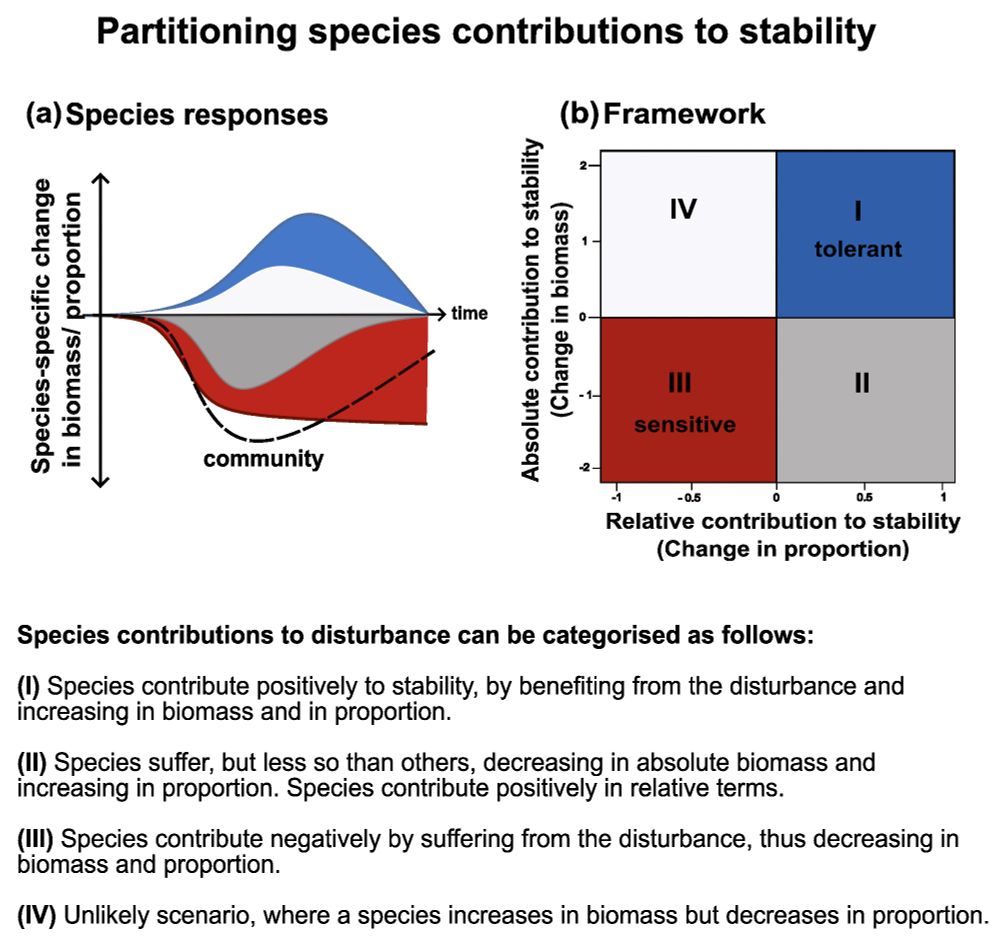
Read our new paper in EcologicalMonographs esajournals.onlinelibrary.wiley.com/doi/10.1002/...
We introduce a framework on how to partition species contributions to ecological stability in disturbed communities based on species absolute change in biomass and relative change in proportion.
25.11.2024 10:50
👍 89
🔁 36
💬 1
📌 3
Very exciting and fun collaboration with @pennekampster.bsky.social, @gsimpson.bsky.social, Romana Limberger, Sam Ross, and Owen Petchey
21.11.2024 15:53
👍 3
🔁 1
💬 0
📌 0
We then used simulated species responses to investigate what determines response diversity in a multifarious environmental change context.
21.11.2024 15:53
👍 2
🔁 1
💬 1
📌 0
We propose a new way of calculating response diversity that is unrelated to the environmental change a community experiences, and that describes the insurance capacity of a community to all possible environmental changes.
21.11.2024 15:53
👍 3
🔁 1
💬 1
📌 0


