
AI and human behaviour | BIT
AUGMENT, ADOPT, ALIGN, ADAPT – Why behavioural science matters in an AI world
The final part of BIT’s new AI & Human Behaviour framework, Adapt, looks at how our interactions with AI shape society—and how organisations and policymakers can guide its impact responsibly. Download your copy: www.bi.team/publications...
01.10.2025 09:47
👍 0
🔁 0
💬 0
📌 0

AI is not just a technological shift; it is a societal one.
AI adoption is accelerating - but mostly happening reactively, outside organisational planning or governance. That creates risks, because the way we adapt to AI today will lock in the habits of tomorrow.
01.10.2025 09:47
👍 0
🔁 0
💬 1
📌 0

Old policy methods struggle with today’s complex challenges.
Learn how flexible, iterative ‘test and learn’ approaches help governments reduce risk, adapt fast, and deliver impactful public services with @bitglobal.bsky.social's new course.
🔗 Book your place now: https://bit.ly/463YRQg
26.09.2025 08:01
👍 2
🔁 1
💬 0
📌 0
AI and human behaviour | BIT
AUGMENT, ADOPT, ALIGN, ADAPT – Why behavioural science matters in an AI world
Do we really understand how AI and humans interact?
The third part of BIT’s AI & human behaviour framework highlights the need to align AI with our values, intentions, and well-being, and shares new insights on how generative AI can shape human biases:
www.bi.team/publications...
23.09.2025 15:04
👍 0
🔁 0
💬 0
📌 0

Image reads: Align - understanding how AI and humans interact
The rise of conversational AI has created a giant real-world experiment in human-machine relationships.
For the first time, we are not just using AI as a tool; we are interacting with it, confiding in it, and being influenced by it in ways we are only beginning to understand.
23.09.2025 15:04
👍 0
🔁 0
💬 1
📌 0
AI and human behaviour | BIT
AUGMENT, ADOPT, ALIGN, ADAPT – Why behavioural science matters in an AI world
The second part of our AI and human behaviour series explains how insights from human cognition can unlock new ways of designing AI.
Read Augment:
www.bi.team/insights/pub...
16.09.2025 12:34
👍 0
🔁 0
💬 0
📌 0

Most generative AI models are skilled fast thinkers – but they also inherit some of the same biases as human intuition.
For AI to advance, developers need to design systems that reliably choose when to think fast or think slow - adapting their approach to the task at hand.
16.09.2025 12:34
👍 0
🔁 0
💬 1
📌 0
Thank you to everyone who joined us in person and online for #PolicyLive!
More than 400 guests joined us in Westminster to explore how to do policy differently and solve the UK's most pressing challenges.
🎥 Watch back a selection of our sessions now: https://www.policylive.org/nesta/332/82846
12.09.2025 07:00
👍 4
🔁 1
💬 0
📌 1

Why do people choose to use or resist AI?
The first chapter in our new four-part framework - AI & human behaviour - looks at what drives or holds back AI adoption, and how leaders can encourage deep integration of AI that complements and enhances human work.
bit.ly/46hqWm8
09.09.2025 10:05
👍 1
🔁 2
💬 0
📌 0
Policy Live is back for 2025: and registration is now open 🎉
Join us on 11 Sept in central London for our full-day programme: with over 60 speakers exploring how to do policy differently - including Wes Streeting, Nicola Sturgeon and more.
Tickets are limited, apply now: bit.ly/4m0j4fx
04.08.2025 11:00
👍 3
🔁 1
💬 0
📌 2
📱 Why does 'just 5 mins' on social media turn into an hour?
Our behavioural audit for @ofcom.bsky.social found major platforms use design to maximise engagement—often at the cost of user well-being.
Here’s how better design could support healthier, more intentional online habits 👇 bit.ly/4kKu3rL
22.07.2025 14:14
👍 1
🔁 1
💬 0
📌 2

Why behavioural insights matter for policing today | BIT
Policing today demands more than enforcement. It requires proactive prevention, early intervention and building trust with communities. Yet many policing challenges hinge on human behaviour: victims e...
Policing today is about more than enforcement – it’s about prevention, early action and building trust.
We worked with officers and staff at @cheshirepolice.bsky.social to explore how behavioural insights can improve everyday decision-making and service delivery.
Read more: bit.ly/44rc2Zu
03.07.2025 13:38
👍 1
🔁 0
💬 0
📌 0

Why society changes: behavioural science explains social norms | BIT
Recorded at the Behavioural Exchange conference #BX2025 in Abu Dhabi, Michael Hallsworth, BIT’s Chief Behavioural Scientist, dives deep into the science behind these shifts - asking the question ‘What...
🎧 New BIT podcast: How do social norms shift and what role can behavioural science play?
Recorded live at #BX2025 in Abu Dhabi, our Chief Behavioural Scientist @mhallsworth.bsky.social speaks with global experts on what drives change in societies, systems & institutions.
⬇️ Tune in: bit.ly/4ltzbkU
02.07.2025 14:03
👍 1
🔁 0
💬 0
📌 0
Senior Research Advisor (quantitative) | BIT
We are recruiting for a Senior Research Advisor (SRA) with strong quantitative skills in our EPIC team.
🚨 We're hiring! We're looking for a Senior Research Advisor to join our Economic Policy team in the UK.
We’re looking for someone with strong quantitative skills and a passion for using evidence to help people make better decisions.
👇 Find out more and apply by 14 July: bit.ly/4k2pRmU
26.06.2025 13:24
👍 0
🔁 0
💬 0
📌 0
How do friendships affect social mobility. I wrote in @financialtimes.com about research from BIT colleagues replicating Raj Chetty's US work analysing facebook data. Perhaps the department with communities in its name can run trials on cross-class interaction, and reducing 'friending bias'.
27.05.2025 07:51
👍 4
🔁 2
💬 1
📌 0
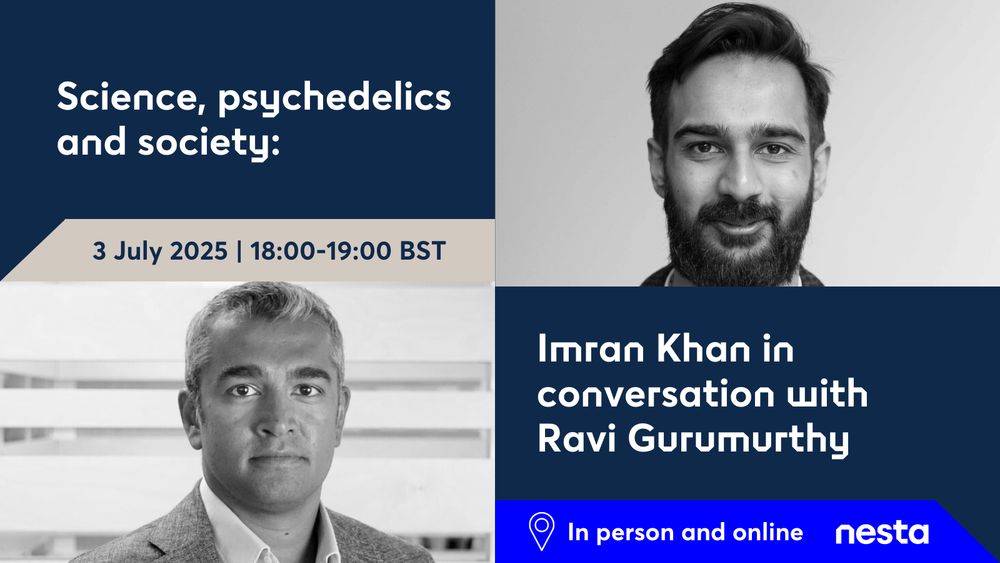
📣 New event: Science, psychedelics, and society
Join Nesta’s @raviguru.bsky.social and @ikhan.bsky.social, former Exec Director of the UC Berkeley Center for the Science of Psychedelics, as they unpack the science, politics & future of psychedelics.
Register now: bit.ly/43BgwNP
22.05.2025 05:00
👍 3
🔁 2
💬 0
📌 0

New paper: Fixing the Holes in Economics
Ahead of BIT’s inaugural President’s Lecture, David Halpern explores how behavioural and institutional insights are challenging economic models - and how this could reshape policymaking.
Read the full paper: bit.ly/430ireS
15.05.2025 09:15
👍 0
🔁 0
💬 0
📌 0

Why Simplicity Can Be Strength in a Complex World - by Michael Hallsworth - Behavioral Scientist
As intuitive as it seems, a complicated approach to behavioral design may not be the best response to complexity.
As intuitive as it seems, creating a complicated approach may not be the best response to complexity.
@mhallsworth.bsky.social writes about the value of simplicity in applied behavioural science - in a world wrestling with personalisation, generative AI and complex adaptive systems 👇 bit.ly/4j2joIn
12.05.2025 08:20
👍 4
🔁 1
💬 0
📌 0

How can behavioural insights boost malaria vaccine uptake? | BIT
Behavioural science has extraordinary potential to supercharge malaria vaccine rollouts currently underway across Sub-Saharan Africa. Almost 20 countries across the African continent are embarking on...
Malaria vaccines could save millions of lives across Sub-Saharan Africa – but rollout success depends on more than supply. Uptake is key.
At BIT, we’ve used behavioural science to boost vaccine uptake worldwide. For #WorldImmunizationWeek, we explore how it can help here too: bit.ly/4lQaoII
29.04.2025 08:01
👍 0
🔁 0
💬 0
📌 0
Public services face mounting pressures and public finances are constrained. Test and learn is critical for the government to cost-effectively deliver on its missions. helping to navigate the uncertainties of addressing complex problems and accelerate the delivery of impactful solutions.
22.04.2025 08:13
👍 0
🔁 0
💬 0
📌 0
The UK government already has many of the building blocks required to work in a test and learn way - including the joint Cabinet Office-Treasury Evaluation Task Force, a £100m reform fund and essential skills. But embedding it at scale will require changes to how government works.
22.04.2025 08:13
👍 0
🔁 0
💬 1
📌 0
In conventional government policymaking and delivery, most of the big choices are made at the beginning of a programme. A test and learn approach would see policies, programmes and services adapt and evolve based on early and ongoing data and evidence.
22.04.2025 08:13
👍 0
🔁 0
💬 1
📌 0

Test and learn: a playbook for mission-driven government | BIT
The UK government has pledged to deliver bold new missions – ambitious, long-term commitments to tackle critical societal challenges. These promises will resonate strongly with many public servants wh...
The UK govt needs to adopt a different way of working to achieve its bold new missions.
Policies need to be reviewed and improved via a test and learn approach.
BIT + @nestauk.bsky.social new playbook explains this approach and how it can deliver impactful solutions 👇 www.bi.team/publications...
22.04.2025 08:13
👍 1
🔁 1
💬 1
📌 1


